





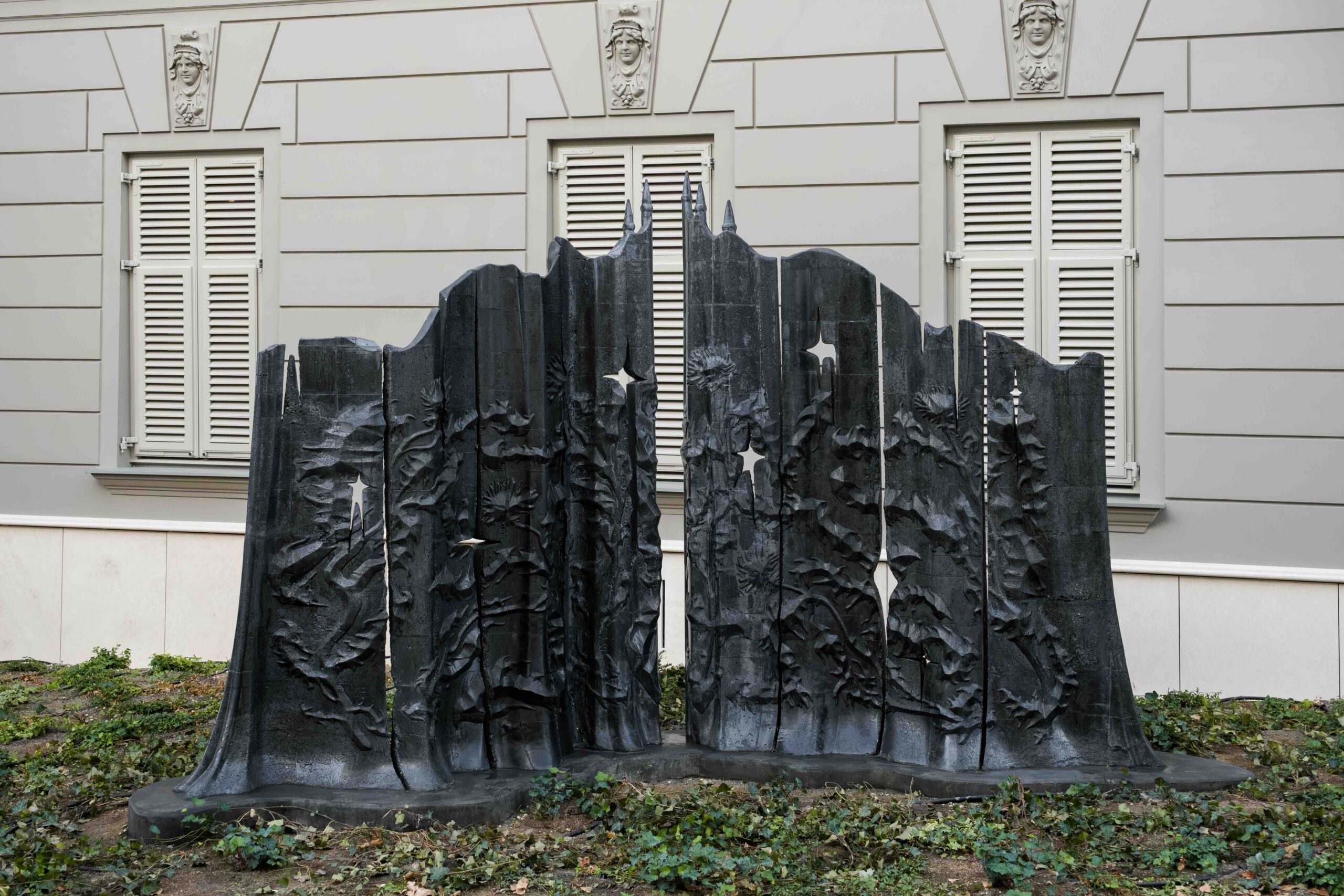
A monumental, jagged black concrete form resembling a gate confronts visitors outside Plan B Foundation in Cluj-Napoca, Romania. Its shape follows the sequential movements of flags in the wind. Fixed in time, this sculpture is disrupted and punctured by stars and ornate dandelions. Traditionally associated with hope and reminders of the fleeting nature of time, the motifs here destabilise the promise of progress that comes with a flying flag or an opening gateway.

Winds of Progress (2026) provides material form to the ambivalence, awkwardness and despair of past promises that either never materialised or now lie in ruins. The work is a reinterpretation by the Romanian artist and set-designer Adrian Ganea of an object named “the Gate of Progress” pictured in the Mihai Oroveanu photographic collection. Ganea has been investigating the archive for three years, producing works that examine narratives of life and work in Romania during the rapidly changing twentieth century. The title toys with the word “wind”, suggesting both a promise of progress and the emptiness of rhetoric that often surrounds it.
His works explore the narratives of social and ecological rupture brought about by technological and political change.
Ganea’s practice combines material experimentation across analogue and digital media with speculative approaches to history, technology and the natural world. His works explore the narratives of social and ecological rupture brought about by technological and political change. These concerns connect his practice to the broader discussions within the Romanian art scene, where, since 1989, artists have grappled with the legacy of the communist era and the realities of post-communist capitalist society, addressing questions of nostalgia, freedom of expression, as well as promises and limitations of progress.

The Puppets’ Dance
Inside the Plan B Foundation, Ganea presented the series Brave Dance, Figure Studies (2026) — a group of works demonstrating his technical background in set design and fabrication. The life-sized marionettes appear in different positions, their bodies assembled from recycled wood, textiles, acrylic, steel, sand and electronics.

Traditionally associated with performance, anthropomorphism and automation, marionettes also raise questions about concepts of control and obedience. In 1801, the theorist Heinrich von Kleist suggested that they could be more perfect performers than human actors due to their lack of hubris and emotion. Ganea’s programmed figures revisit these ideas, questioning the promise of perfection that abstraction and mechanisation offer. Their limbs are pushed to their limits. Each automotive body’s range of movement is determined by its construction — the specific tools, materials, forms and mechanical forces used in its production. Their movements echo exercises, collective demonstration and protest dance. As they move, their shadows fall across the floor under overhead lighting, reminiscent of the dramatic effects of the Baroque.

The Baroque references go further with the shape of the figures’ heads that recall the forms of the Sun and the North Star — symbols of cosmic order, unwavering loyalty and stability. Artists of the period often sought to convey intangible ideas, including faith, through movement and dramatic effects. These references offer a different perspective on the relationship between the man, the mechanical and the intangible from the one associated with Kleist’s scientific theorisations of the marionettes. The figures’ abstracted, baluster-like limbs also recall the Dada artist Sophie Taeuber-Arp’s experiments with marionettes from the 1910s. In the early 20th century, artists associated with Dadaism and Bauhaus explored abstraction and puppetry as ways of moving beyond the conventional representations of the human body, responding to the horrors of war and the growing presence of machines.
Movement is understood as a form of expression, but one that is constrained by the processes that produce the body itself.
These historical parallels offer a way to consider Ganea’s sculptures in relation to historical attempts to express the intangible and the beyond-human in the face of new social and technological developments. Movement is understood as a form of expression, but one that is constrained by the processes that produce the body itself. Confronted with his automated marionettes, viewers are left to question what they consider brave, entertaining or difficult — and how far such human judgments can go in an increasingly automated world.
Artificial Hope and Natural Despair
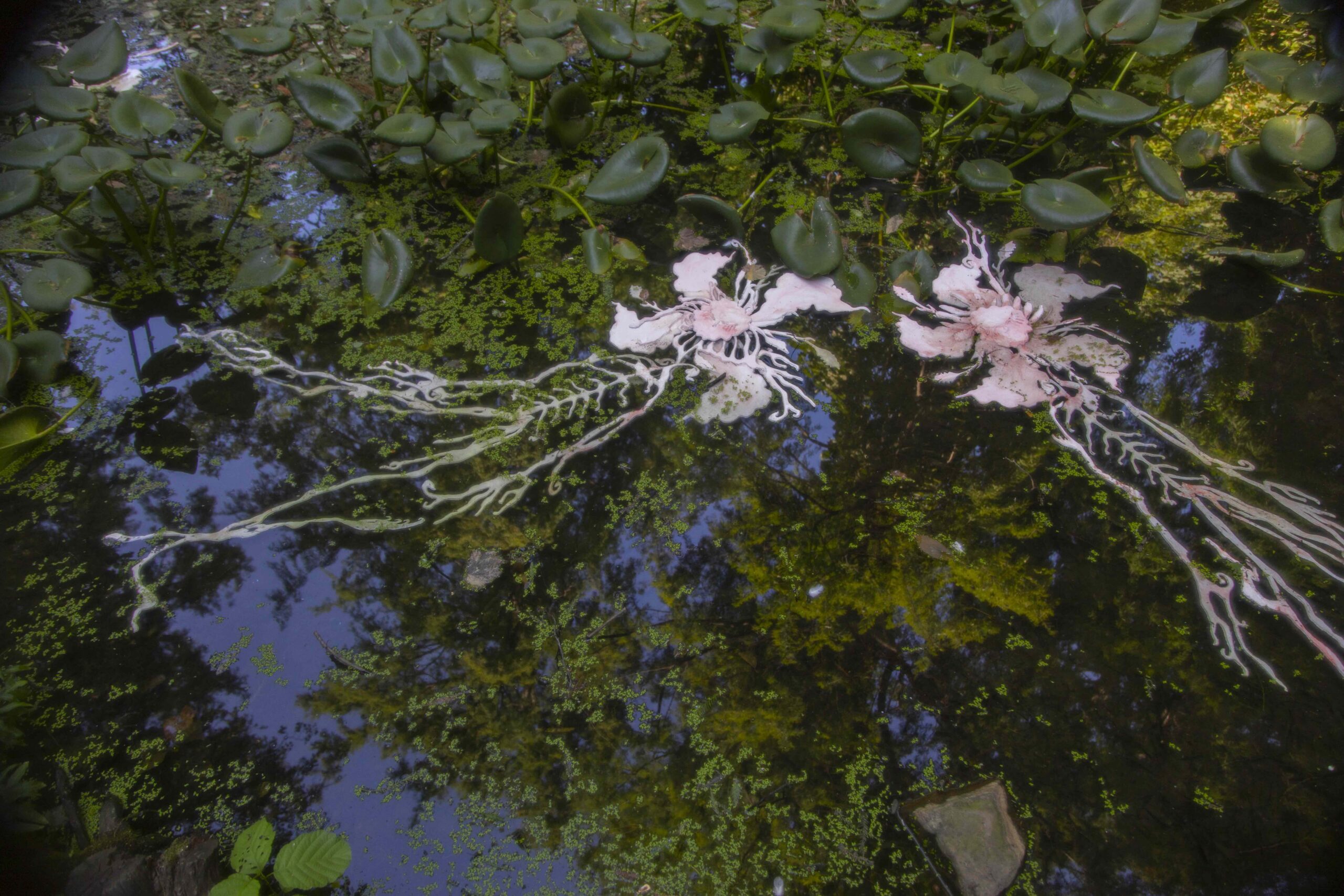
In the earlier Death Masks series (2022), Ganea investigates ecological disaster, fictions of natural history and modern-day virtual simulations of nature. Presented in the exhibition Ghost Trade, the series was part of a wider reflection on how digital technologies reproduce the natural world even as its living counterparts face destruction.

The pinkish masks gaze out in mourning, their small eyeholes fixed on the viewer. They are inspired by the ancient tradition of death masks, made from impressions of the deceased’s face. Arranged on a wall in a checkerboard pattern, they evoke binary code and pixelated video animations.
To create the series, Ganea digitally manipulated scans of tree grafts, treating the resulting data as a sculptural material before 3D-printing the forms and casting them in acrylic resin. The process brings together digital modelling and traditional casting techniques, blurring the distinction between natural forms and their technological reproductions — a characteristic feature of Ganea’s practice.

Anthropomorphic in nature, the masks confront the viewer with their mourning of the natural world. They challenge our convictions of which forms of life are privileged, undermining the separation between natural and artificial, animal and plant, feeling and logic. These masks exemplify Ganea’s practice, which continually questions presumed ideals and values, moves between historical pasts and the present, and invites viewers to confront their associations with materiality, as well as the meanings and methods of artistic production in the contemporary world.
They challenge our convictions of which forms of life are privileged, undermining the separation between natural and artificial, animal and plant, feeling and logic.

BIO
Adrian Ganea (b.1989) was born in Târgu Mureș and now lives and works in Cluj-Napoca, Romania. He studied Set Design at Universitatea de Arte Tg-Mureș, completing a BA in 2011 and later an MA at Universität der Künste Berlin in 2016. His work has been exhibited across Romania in group and solo exhibitions. He also created set designs for theatres in Romania, Hungary and Germany.


