Alina Kopytsia (b. 1983) is a Zurich-based Ukrainian artist whose practice of storytelling unfolds across a range of media, including textiles, silicone and ceramics. She is best known for her textile collages. Their visual language is rich in cultural references — both popular and historical — which the artist redefines in a way that foregrounds the entrenched conventions of gender, sexuality or parenthood, whilst remaining non-dogmatic in their humour and irony.

Though initially trained in academic drawing, she found that the tactile qualities of textiles align better with the themes she explores. Fabric handicraft, embroidery or sewing have long been considered primarily female pursuits, gradually securing their place in galleries and auction houses thanks to the likes of Magdalena Abakanowicz or Billie Zangewa. Kopytsia, whose artistic narrative meanders between female agency and reframing power dynamics, extends that lineage.

Fabric handicraft, embroidery or sewing have long been considered primarily female pursuits, gradually securing their place in galleries and auction houses thanks to the likes of Magdalena Abakanowicz or Billie Zangewa. Kopytsia, whose artistic narrative meanders between female agency and reframing power dynamics, extends that lineage.
Motherly Creatures
As the story goes, Melusine, cursed by her mother to shapeshift every Saturday into half-woman, half-serpent or dragon, needed to marry a man who would leave her be for one day every week. Despite the children and wealth she had brought him, Raymondin broke the oath and doomed his wife to a solitary life in her less-human form, only to return home to lament the deaths in the family.

In Kopytsia’s Mammals’ Milk series, which she began in 2025 after becoming a mother herself, Melusine takes different forms. In Fountain (2025), she is depicted from the front, holding her breasts from which milk spurts in steady streams, her double fish tail swirling symmetrically behind her against the pale chartreuse background. Echoing Italian fountains such as the Detail of the Lactating Mermaid on a Dolphin (1563), the piece positions the breastfeeding woman as the most direct embodiment of Mother Nature, a symbol of fertility and abundance. Milk, flowing in a fountain-like loop, quenches the thirst of all those in need, generous and nourishing.

In another three-quarter view of the figure, Melusine with the milk pump (2025), massive hindlimbs of a dragon emerge below the female torso, wings and a thick tail behind them. In this reimagined medieval miniature, the creature can be observed using a breast pump — a modern symbol of the balancing act between motherly duties and everyday life. Melusine becomes an archetype of a mother who has managed to secure a measure of independence within the demands of caregiving, in a way extending that care to herself. She contains the multitudes of femalehood: being a mother and a wife, though wronged by her spouse, is interwoven with a mythical, unique form full of creative capacity. This fabled interpretation echoes Leonora Carrington’s stories and paintings, such as The Giantess (1947), in which giving birth and nurturing become sources of fantastical power.
She contains the multitudes of femalehood: being a mother and a wife, though wronged by her spouse, is interwoven with a mythical, unique form full of creative capacity.
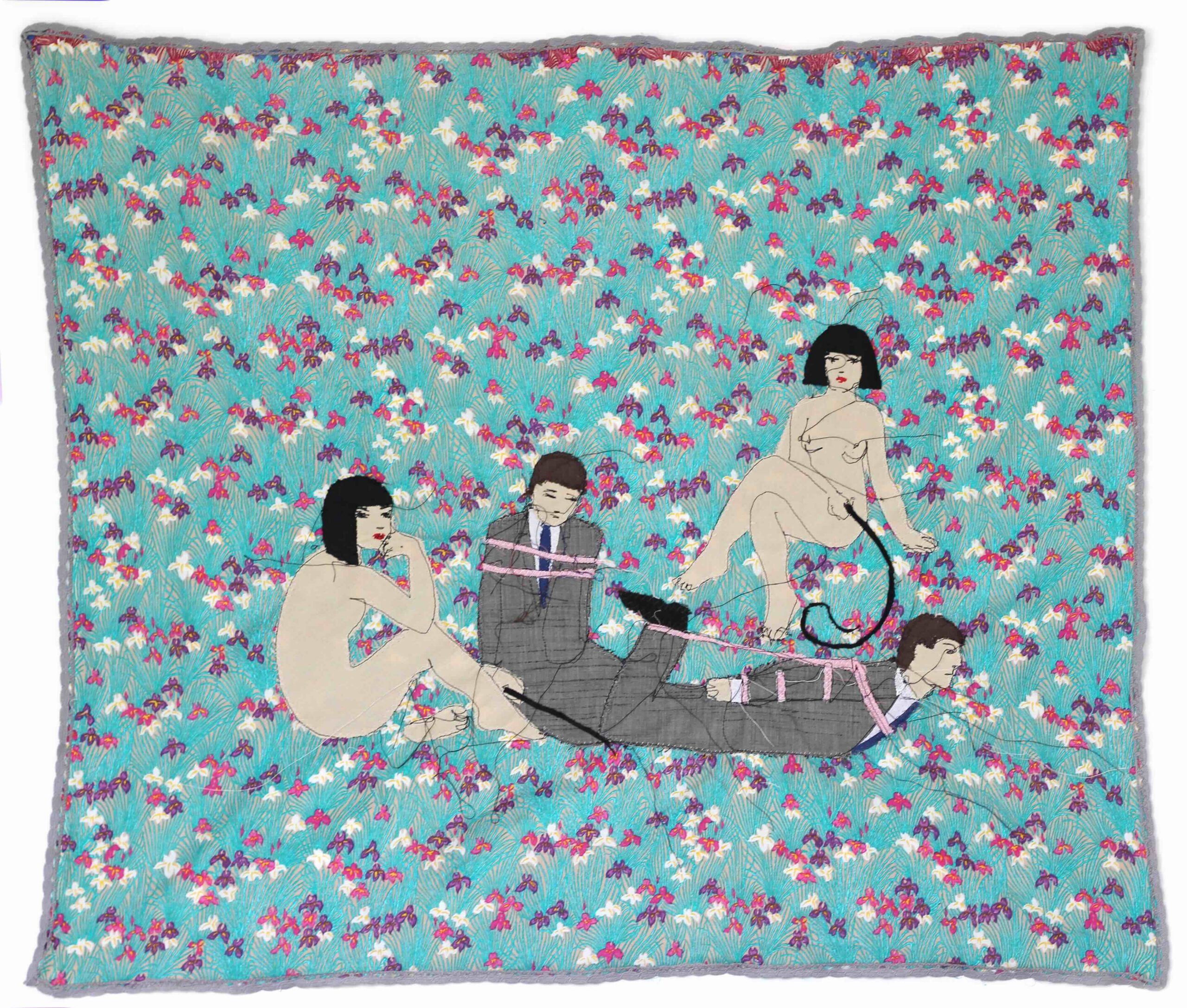
The second set of images in the series is that of a Cat-Woman I, II and III (2025). It explores the riddles of caregiving — imagined here as a sexy lady in latex nursing her small kittens, a mother and a lover combined. All three pieces retain a playful aesthetic, the Cat-Woman interacting with her babies on a floral background. Her tight, pitch-black costume stands in sharp contrast to the pastel fabric, adding to the contradictory feelings evoked by the image. The artist imbues this figure, conventionally associated with dominance and seduction, with a tender, protective side, inviting viewers to reconsider their preconceptions of motherhood.

The choice to cast fictional creatures as mothers and refer to the broad group of mammals in the series’ title allowed Kopytsia to explore the topic beyond the conventional, ‘womanly’ lens. Like the she-wolf which nursed Romulus and Remus, or Louise Bourgeois’s spider Maman (1999) protecting its eggs, Kopytsia’s Melusine and Cat-Woman proudly exhibit the interspecies reach and magnitude of motherhood.

Nothing about a Family is Nuclear
Motivated to interrogate accepted social norms, Kopytsia turns to parenthood and family, understood as a network of mutual support. In Portraits of Friends’ Families (2025), she presents ten textile collages featuring vibrant character depictions on one side, and short accounts of their lives on the reverse. The images are joyful and simple, regardless of how unorthodox the family constellations are. Loose threads hang from embroidered eyes, cuffs and embraces — a familiar feature of Kopytsia’s practice, but one that here evokes a sense of continual unfolding, the dynamics fluid rather than set in fabric.

The straightforward manner in which the stories are told makes the institutional blind spots apparent, if not absurd. The artist points to the rigid Swiss laws governing co- and multi-parenting in non-traditional family structures — limitations experienced firsthand by people in her immediate circle. Although rooted in particular lived experiences, the works speak to the multiplicity of familial frameworks, much like the many, often contradictory facets of what it means to be a mother.

By archiving personal histories through embroidery, the series indirectly recalls many folk traditions, such as the Ukrainian rushnyk — an intricately woven towel, indispensable in the rites of passage like christenings, weddings and funerals. These fabrics, cherished by mothers and wives, exemplify how personal and engaging textile art can be. Kopytsia draws from this sentiment in her work, elevating the collage into a medium of communication and liberation that extends beyond comfort and decoration.
Patching the Canon
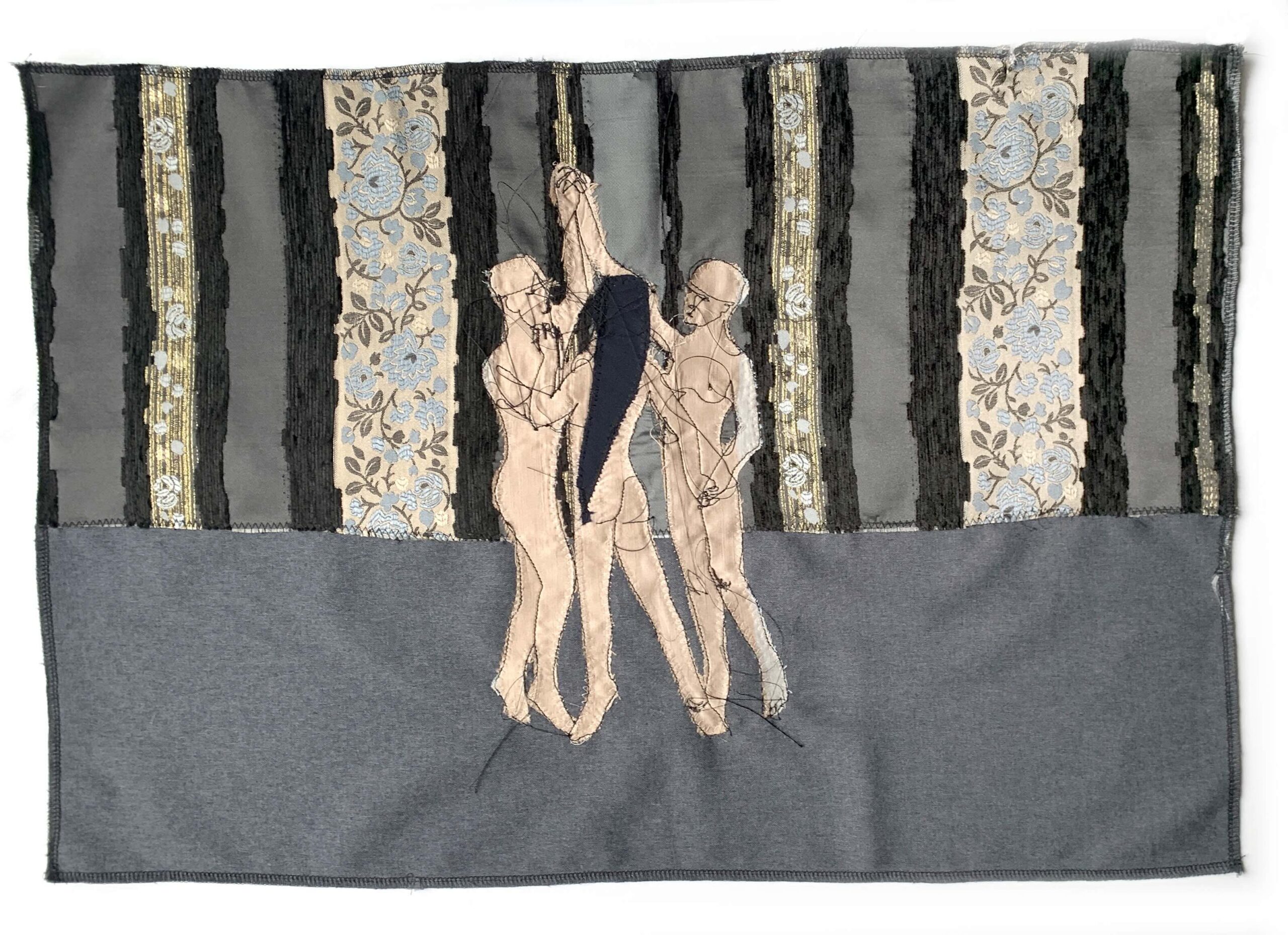
A recurring feature of Kopytsia’s practice is the reworking of canonical images into textile collages. Nods to masters of painting and pop culture gurus can be found throughout her oeuvre, nowhere more densely than in Prime Power (2022). It offers a glimpse behind the office windows of a Zurich skyscraper — an absurd, kinky and amusing fantasy. Matisse’s dancers celebrate the closing of a deal, Hirst’s shark intimidates its co-workers, and Mapplethorne’s polyester-clad gentleman flashes the viewer, his face concealed behind a softbox, in Paul Sepuya’s style. Some figures assume the positions of power in a recognisably theatrical, masculine manner, while many others embrace strength through voluntary submission, suspended from the ceiling, their arms restrained.

Intertextuality, at the heart of collage as a medium, inevitably unsettles familiar conventions. The original and supposedly ideal form of a piece, embedded in the viewer’s memory, acquires new meaning and quality when displaced, forcing one to reassess what once seemed fixed. In Kopytsia’s hands, this process stands a chance to extend beyond the aesthetic experience and influence the workings of the social fabric, which, like textiles, is neither seamless nor immutable.
Intertextuality, at the heart of collage as a medium, inevitably unsettles familiar conventions. The original and supposedly ideal form of a piece, embedded in the viewer’s memory, acquires new meaning and quality when displaced, forcing one to reassess what once seemed fixed.
BIO
Alina Kopytsia was born in Poliske, Ukraine, where she later earned a Master of Fine Arts from the Kyiv Polytechnic Institute. Since relocating to Zurich in 2017, she has completed both a BFA and an MFA at the Zurich University of the Arts (ZHdK). Her work has been shown across Europe, including at Ruettimann Contemporary in Zurich, Galerie Ladøns in Hamburg, and Francesco Pantaleone Arte Contemporanea in Palermo.