




Ana Navas (b. 1984, Quito, Ecuador) is a Rotterdam-based multidisciplinary artist whose work unfolds as a rigorous inquiry into the genealogy of objects, images, and forms. Her practice is inspired by a recurrent metaphor: the “non-stop domino effect”, as she calls it, where visual ideas and material histories continuously trigger and transform one another. As such, for Navas, art is not a fixed point of origin but a conversation with the other, one that intentionally echoes far beyond the traditional boundaries of the art world.
Raised in Caracas, Venezuela, and educated in Germany, Navas’s art navigates the porous borders between art, design, and everyday culture, questioning orthodoxies of authorship, originality, and artistic creation. As a result, she often describes her work as a form of genealogical tracing, one that is not merely documenting the ancestry of an object or image, but actively unravelling and recombining its lineage across time, culture, and medium. Her inquiry extends beyond the object itself to include its circulating forms, its cultural afterlives, and the contexts in which it might reappear. “I often think of my practice as tracing an object’s genealogical tree: What do its ‘ancestors’ look like, what influences has it undergone, and in what new contexts could it reappear?”, she asks.

“For me, art is a conversation with the other”. Rather than seeking a revolutionary point of creation, Navas positions making as translation and transformation, where mimicry and appropriation become productive strategies. She embraces techniques such as hand-painting industrial textiles to mimic printed patterns, developing sculptures from manufacturing glitches in the counterfeit industry, and even dressing up as iconic sculptural figures — each an experiment in how images and objects circulate, mutate, and accrue new meanings. “This dialogue is not limited to an art-informed audience but generates an echo in broader fields”, she stresses.
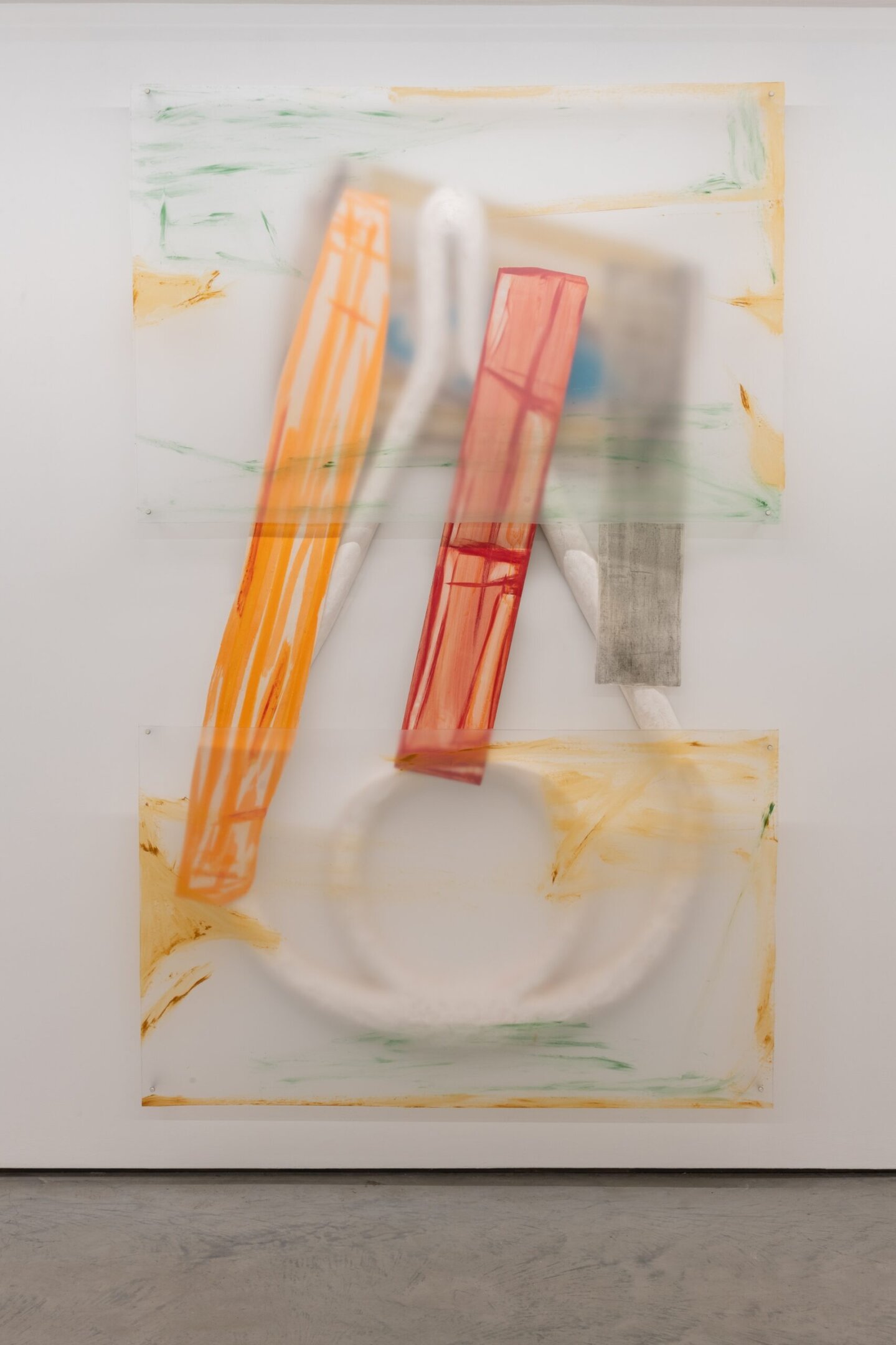
Her practice consistently foregrounds the tension between original and copy, high and popular culture, and design and fine art, proposing that forms we think we know well carry layered histories that slip through any single interpretive frame.
Breaking contexts
Navas frequently works in series that function as modules – discrete works that can be reused, recombined, or reconfigured in new constellations. “I am interested in how art is perceived and transformed beyond its own context, and where it intersects with entirely different disciplines”, she says. And like that, she views the exhibition not as a fixed outcome but as an essay-like moment in an ongoing research process, wherein conceptual relations among works unfold dynamically through installation.
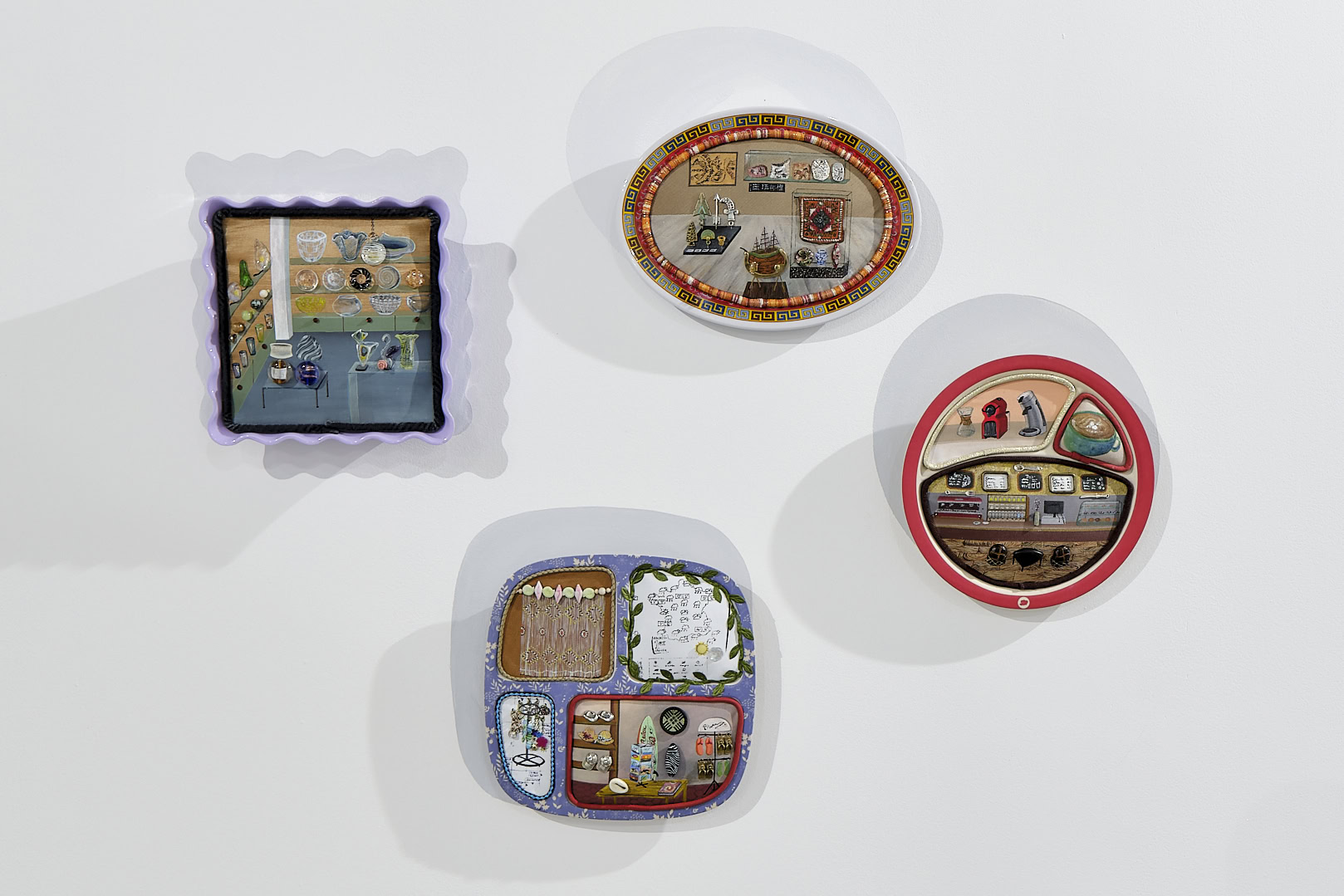
In her 2021 solo show Aura significa soplo at Pequod Co., Mexico City, she examined the circulation and transformation of twentieth-century avant-garde aesthetics through acts of material dissection and visual translation – flattening, disassembling, and reassembling forms into miniature scenes that revealed how meanings are carried and mutated across contexts. While in the group exhibition Reproductive Matters (2024), works like Mozo con smoking and Una fuente iluminada por luces de colores juxtaposed hand-painted imitations of industrial textile patterns with their manufactured counterparts, probing how styles circulate through multiple shifts of reproduction and imitation.
Whilst the artist’s collaborative spirit is evident in presentations such as mano a mano (2024), a two-artist dialogue with Toon Verhoef at Amsterdam’s tegenboschvanvreden and Galerie Onrust. By reacting to each other’s visual vocabularies and archive sketches, the two artists created a shared terrain where awkwardness, familiarity, and artistic unpredictability become sources of creative friction and synthesis.
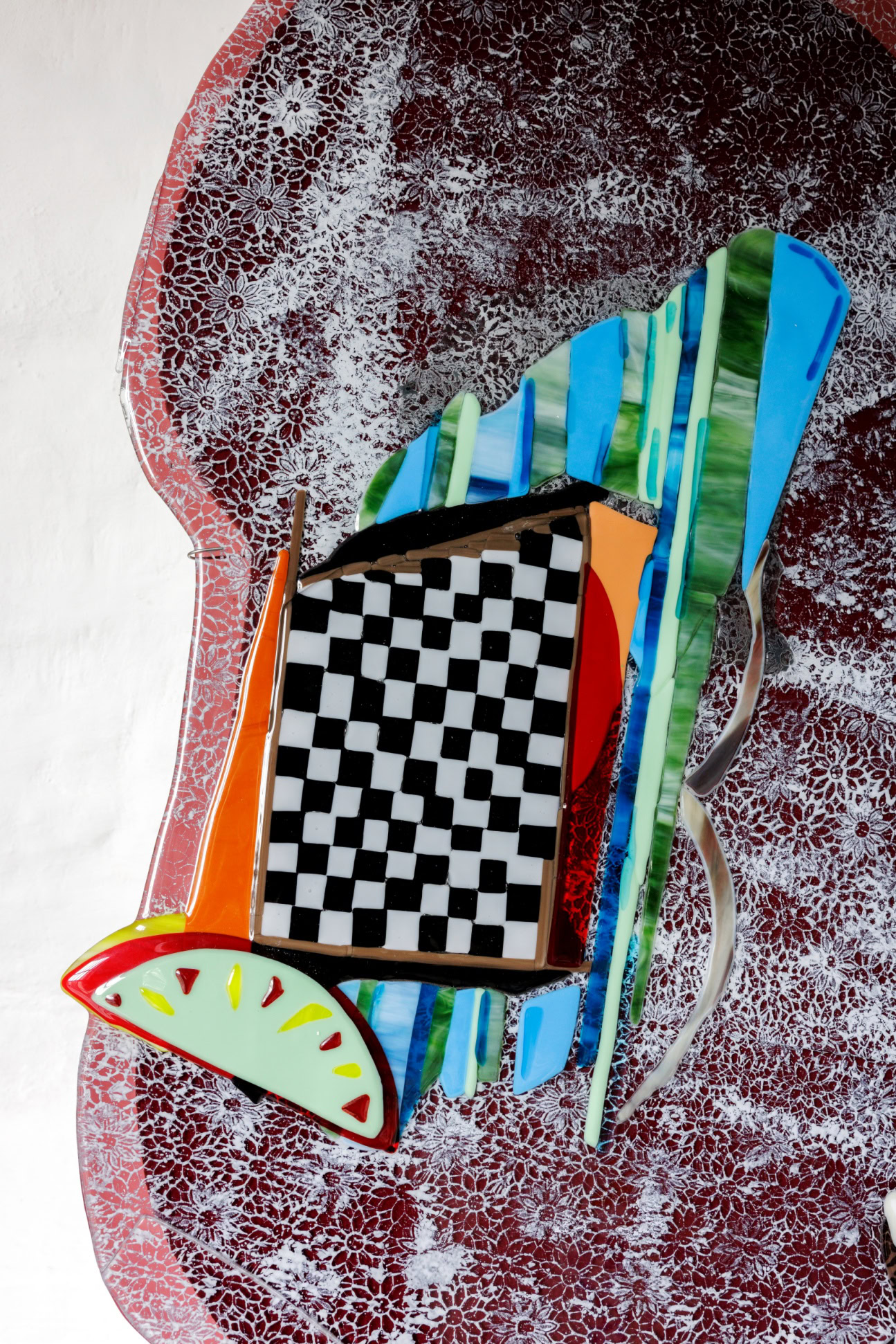
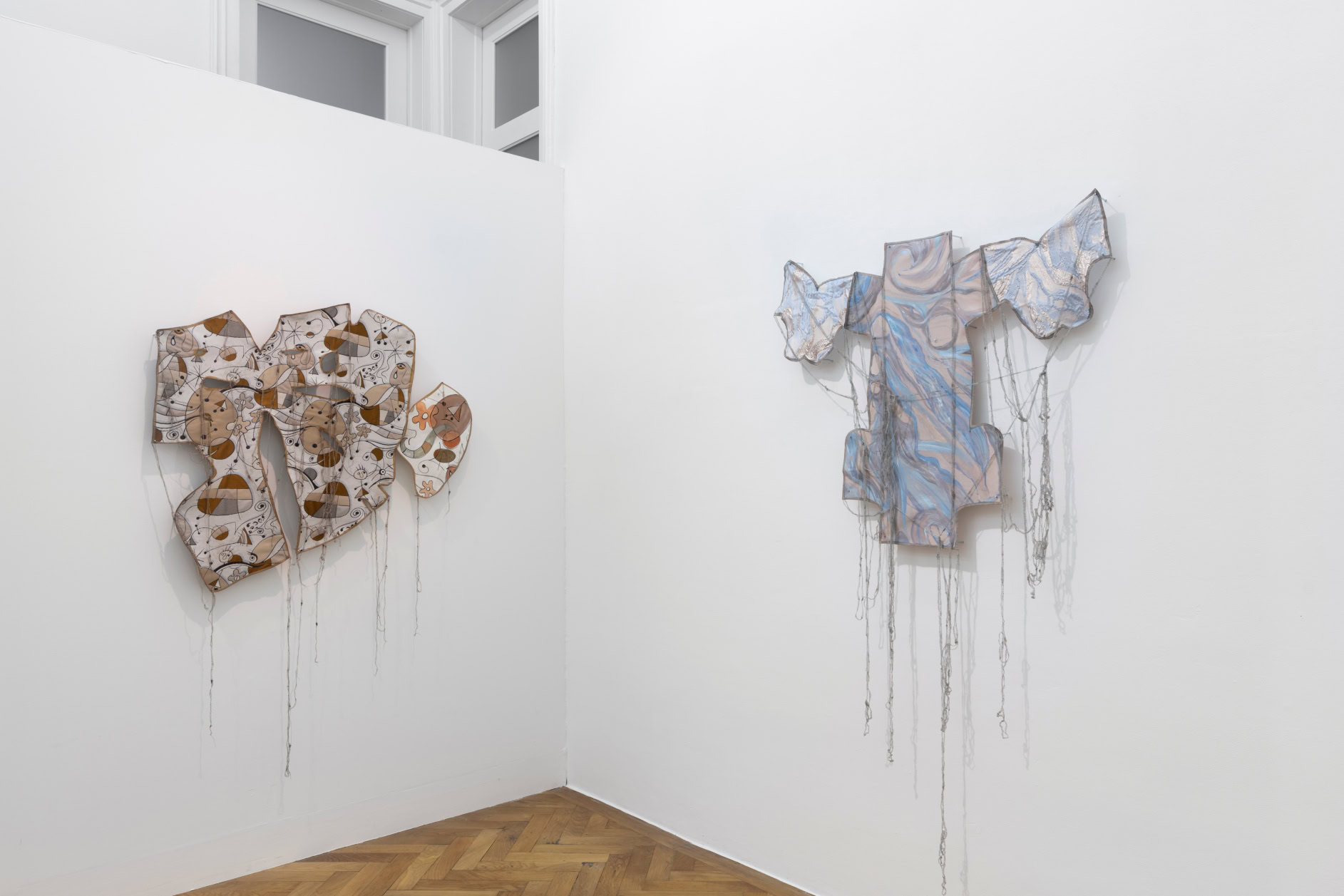
Further, Navas’s contribution to the 2025 Liverpool Biennial marked a significant articulation of her ongoing engagement with historical transmission, institutional frameworks, and the migration of images across time. Installed in the Lady Chapel of Liverpool Cathedral, her presentation consisted of a group of fused glass works that entered into a subtle but pointed dialogue with the architecture, iconography, and historical weight of the site.
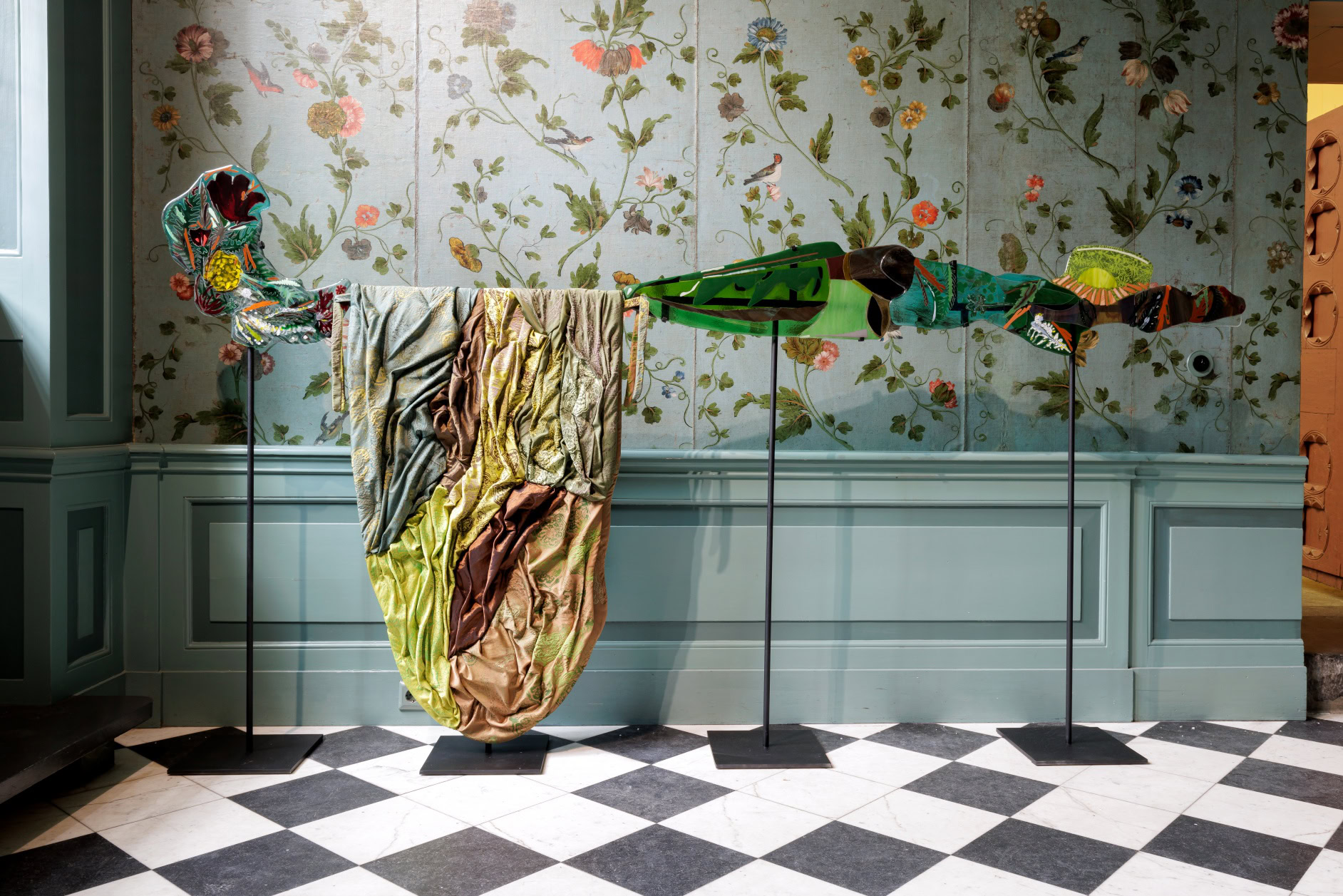
Rather than producing works that directly reference religious imagery, Navas approached the cathedral as a repository of accumulated visual codes. The glass collages draw on the chromatic registers, folds, and ornamental details found in historical portraiture — particularly clothing, drapery, and accessories — elements that often carry social, political, and symbolic meaning while remaining peripheral to the subject depicted. In isolating and reworking these motifs, Navas shifts attention away from individual identity and toward the circulation of visual language itself.
Touch of glass
In Liverpool, the use of glass was central, both materially and conceptually. Echoing traditions of stained glass without replicating their narrative or devotional functions, the works hover between ornament and abstraction, transparency and opacity. Their surfaces bear traces of heat, pressure, and chance – outcomes of the fusing process that resist total authorial control. This material unpredictability mirrors the artist’s broader interest in how images are shaped not only by intention but by systems, repetitions, and transformations over time.

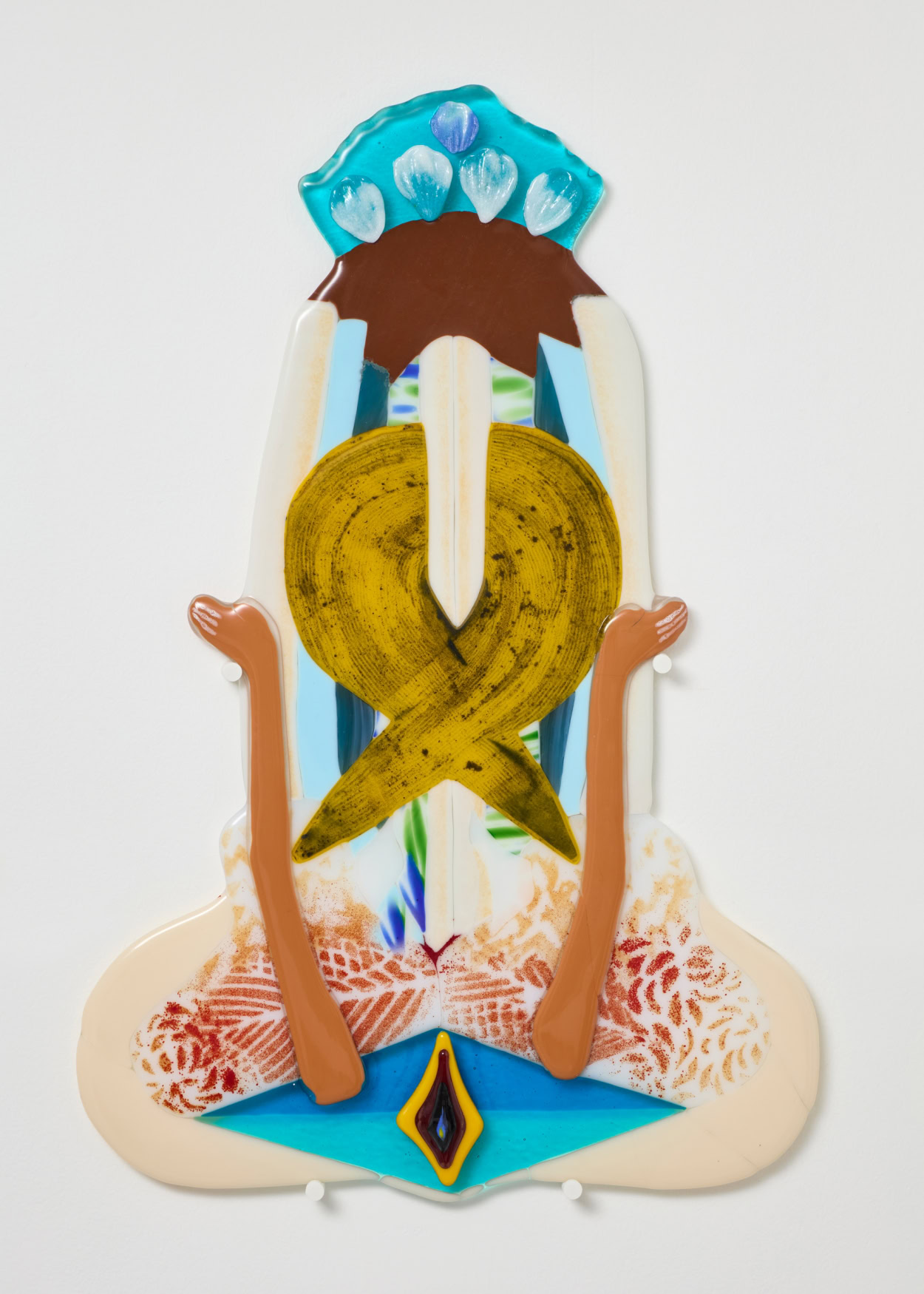
It follows the new material direction in Navas’ oeuvre, as in recent years, she has developed a significant body of work in fused glass (all of the artist’s glassworks are produced at MAKE Eindhoven), first prominently in her 2024 solo presentation A Veil as a Glaze at Oude Kerk, Amsterdam, and then in Amuleto at Crisis Galería, Lima, in 2025. These works use glass both as support and as sculptural material, employing a technically demanding glass-fusing process that involves passing assembled pieces through a high-temperature kiln more than once. What emerges are forms that seem to hover between painting, mosaic, stained glass, and textile pattern, bearing evidence of both artistic intention and the material forces of fire.
In A Veil as a Glaze, the glass works have affinities with stained glass traditions – their translucent, layered surfaces echo the ambience of the historic church while refracting motifs drawn from wallpaper patterns, floral ornament, and portraiture. At the Oude Kerk, Navas worked with the site’s painted wallpaper in the Mirror Room, a decorative motif that itself is an imaginary botanical hybrid, to explore how forms circulate in collective memory and how backgrounds can become protagonists in visual culture.

Similarly, Amuleto unfolds the logic of abstraction and everyday visual culture through glass: here, references to modernist abstraction, theosophy, and spirituality merge with the material unpredictability of the kiln, creating objects that critics have described as glass organisms that invite viewers to forge their own associative pathways between form and meaning.
Industrial textiles
A consistent thread in Navas’s practice involves, however, industrial textiles paired with hand-painted copies of their patterns, a strategy that reveals the subtle pressures between machine production and manual gesture, design and art, original and copy. This method – which puts the human hand into dialogue with mechanised pattern – recurs across different series and exhibitions, including the group show Reproductive Matters at Künstler:innenhaus Bremen, where works such as Mozo con smoking (2022) and Una fuente iluminada por luces de colores (2022) negotiated modernist language through fashion fabric and abstraction.
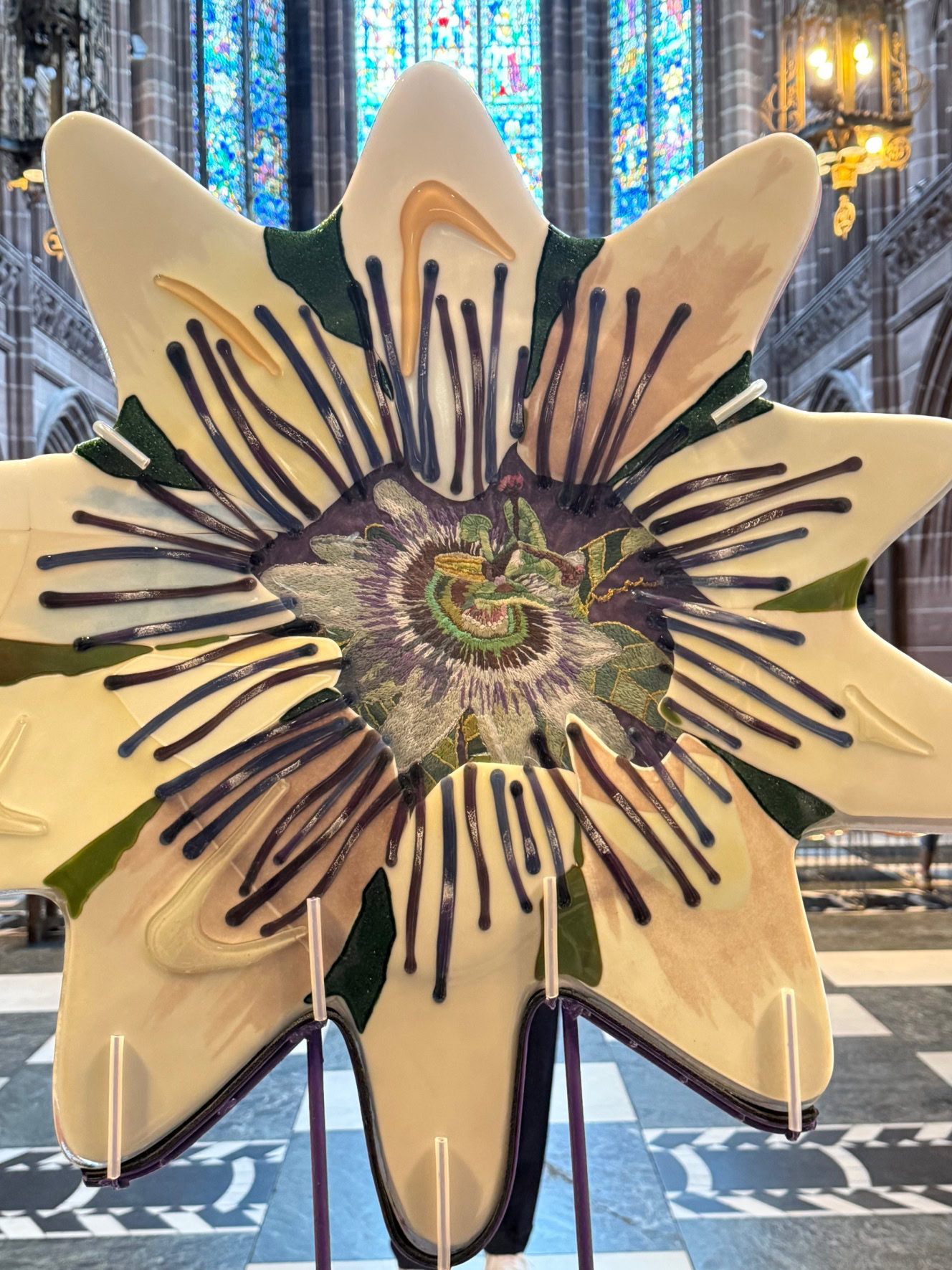
In pieces like Group using triangle & Lines under a tangerine light (2022), she combined silkscreen printed translucent textiles with metal stands to create spatial compositions that shift between sculpture and suspended pattern field – underscoring how patterns migrate between mediums and meanings.
This textile-pattern technique also shapes her ongoing Dress-Ups series, where everyday objects, such as a plastic bottle, are reembodied through a second skin of industrial cloth and hand-painted patterns. In works like Paisaje (con picos y flores) (2022), the object is both familiar and destabilised, inviting recirculation as art rather than mere utilitarian form.

Chains of reference
Through her sustained exploration of transformation, imitation, and the genealogical life of objects, Ana Navas’s practice unsettles entrenched narratives of originality and authorship. Rather than treating artworks as autonomous or self-contained entities, she approaches them as points within extended chains of reference, influence, and material circulation.
“I am interested in how art is perceived and transformed beyond its own context, and where it intersects with entirely different disciplines”, she says. By tracing how forms migrate across materials, cultures, and systems of value, Navas reveals the interwoven histories of form, function, and meaning that shape both art and everyday visual experience. Her practice situates art within a broader field of social, industrial, and cultural exchange, where value is neither fixed nor singular but continually renegotiated.
“Approaches such as copying painting-like industrial textiles by hand, developing sculptures based on manufacturing mistakes within the counterfeit industry, paying attention to imitation materials, dressing up as well-known sculptures, or looking after the hidden artisanal knowledges behind iconic artworks are outcomes of my exploration of reproducibility, accessibility, commodification, impersonation, appreciation, and appropriation”, she adds. In doing so, Navas opens space for a more fluid understanding of authorship, originality, and meaning – one grounded not in rupture or invention, but in circulation, adaptation, and ongoing dialogue.
Ana Navas has been recognised with awards such as the illy SustainArt Prize (ARCOmadrid, 2022), the NN Art Award (Art Rotterdam, 2020) and the Kalinowski Prize (Stiftung Kunstfonds, 2018). Her work has been exhibited widely across Europe and Latin America, including at the Stedelijk Museum Amsterdam, Künstler:innenhaus Bremen, Oude Kerk Amsterdam, and Liverpool Biennial, and is included in major institutional and private collections.
She is represented by tegenboschvanvreden (Amsterdam), Sperling (Munich), CRISIS (Lima), Pequod Co. (Mexico City), and ABRA (Caracas).