



Andrea Zabric (b. 1994) developed her practice through painting, writing and exhibition-making. Central to her is an exploration of how images emerge through the act of painting itself, an approach that places making, perception and material encounter before fixed composition. This has led her towards historical techniques such as fresco and encaustic — not as acts of revival but as living processes whose physical constraints generate new possibilities for contemporary painting.

Painting often begins with the expectation of control: an image imagined, a composition planned, a surface gradually resolved into a finished work. But Andrea Zabric’s practice unsettles this premise. Her paintings begin with conditions that resist certainty, allowing material, environment and time to shape the work as much as artistic intention. Presented in the group exhibition Before Your Eyes Open in Munich, alongside Laura Hinrichsmeyer and Luisa Kasalicky, her recent works demonstrate how painting can remain open to interruption without relinquishing precision.

The curatorial framework for the Munich exhibition, developed by Magdalena Wiśniowska, began from the proposition that painters never approach a blank surface. Every painting carries inherited histories, visual memories and cultural structures before the first mark is made. Zabric accepts these inheritances while resisting the impulse to resolve them into singular images. Instead, her paintings accumulate traces, revisions and material events that remain visible within the finished work, producing surfaces that feel simultaneously ancient and immediate.
Her paintings begin with conditions that resist certainty, allowing material, environment and time to shape the work as much as artistic intention.

Resisting Fixed Forms
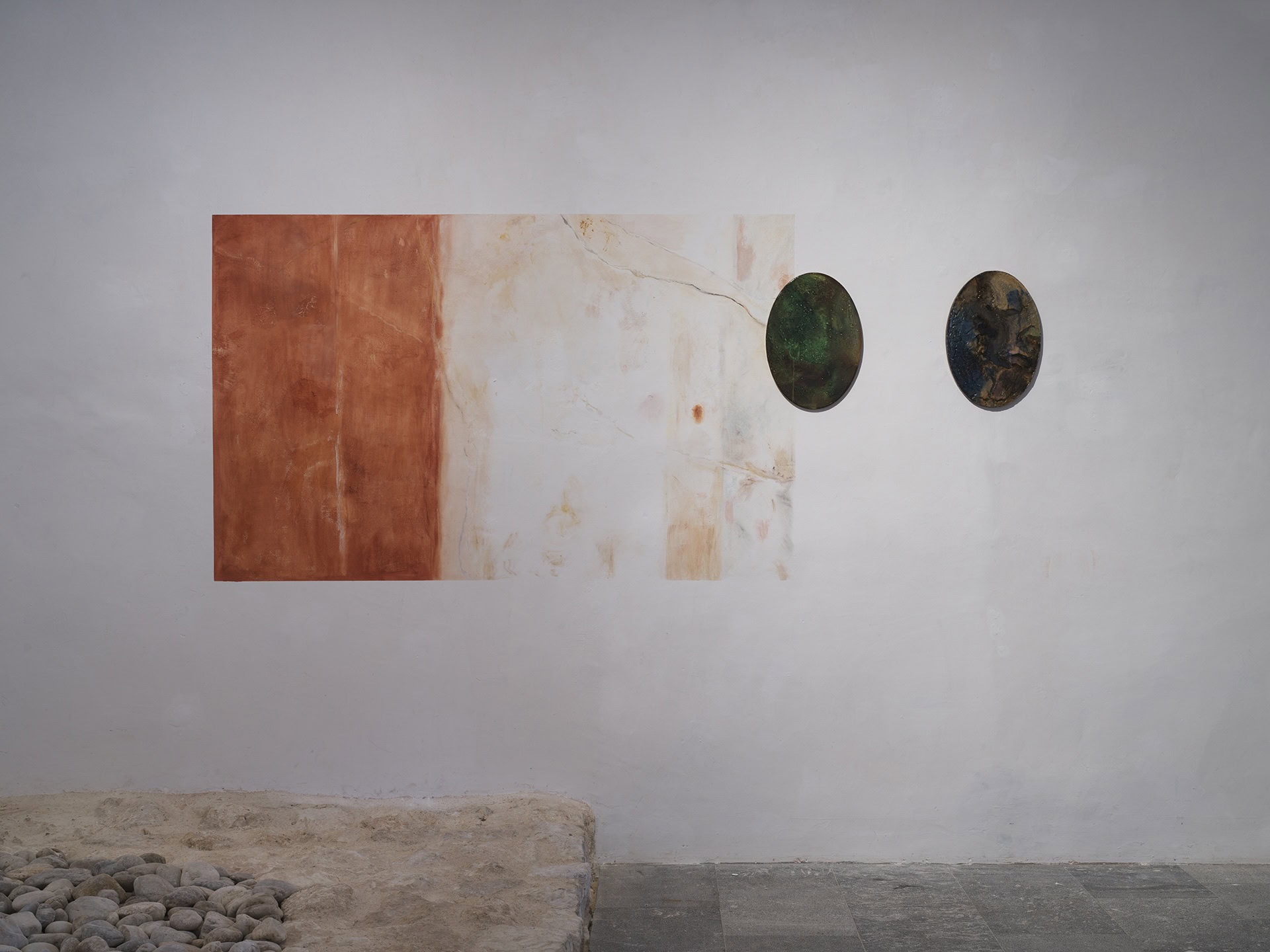
Zabric’s paintings command attention through their material presence. In the 2025 exhibition DAY’S WORK at Painting Diary in Vienna, the oval works unfold as layered surfaces where fresco, encaustic and pigments shift between matte and gloss, opacity and translucency. Powdery whites merge with pale greens and muted blues, interrupted by earthy ochres, umbers and rust-coloured passages that evoke weathered stone, oxidised metal and mineral deposits. Colour does not function descriptively; it accumulates, settles and stains, giving the impression that it has emerged from within the support rather than been applied to it.

This geological quality is heightened by the artist’s use of fresco and mineral pigments. Lime plaster absorbs colour unevenly, producing subtle chromatic variations that cannot be entirely predicted. Layers disappear beneath subsequent applications while others remain suspended close to the surface, allowing the paintings to retain a sense of depth without relying on conventional illusionism.

This openness extends to the imagery itself. Across DAY’S WORK, forms hover at the threshold of recognition without resolving into fixed representations. In Untitled (from the Karst Series No. VI) (2025), fields of ochre, pale pink and mineral white gradually suggest an exposed rock face, an aerial landscape or the contours of a body before dissolving back into the surface. The painting resists singular interpretation, allowing perception to shift over time. Images emerge through chromatic relationships and material accumulation, remaining deliberately provisional.

The recurring oval format reinforces the material presence of Zabric’s paintings. Detached from the conventions of portrait or landscape orientation, these forms recall mirrors, devotional panels and archaeological fragments while remaining resolutely contemporary. Their curved edges encourage the eye to move across the surface, emphasising the painting as a physical object rather than a window onto another space. Within these contained compositions, marks emerge and recede, fragments gather and dissolve, and colour circulates instead of settling into fixed arrangements.

This sense of openness extends beyond each individual work. Installed in dialogue with one another, the paintings form a sequence rather than a series of isolated images. Variations in scale, colour and surface establish visual correspondences across the gallery, encouraging viewers to move between works and to understand each painting as part of a broader material and temporal conversation.
The recurring oval format reinforces the material presence of Zabric’s paintings. Detached from the conventions of portrait or landscape orientation, these forms recall mirrors, devotional panels and archaeological fragments while remaining resolutely contemporary.
The Fragment as Form
Across the Karst series, the 2025 Untitled (from the Karst Series No. VI) in particular challenges the assumption that a fragment is simply part of something larger. Although its weathered surface and mineral palette evoke an archaeological remnant, the work never suggests incompleteness. Instead, Zabric treats the fragment as an autonomous pictorial form, deriving meaning as much from what it withholds as from what it reveals. The painting resists narrative resolution, inviting viewers to consider incompleteness as a productive condition rather than evidence of absence.

This enquiry continues in Untitled (Pompeii Propp III) (2024), where references to Roman wall painting become more explicit. Decorative mouldings, muted pigments and an irregular plaster edge recall an excavated fresco, yet the work resists the logic of restoration. Its fractured outline is not presented as damage awaiting repair, but as a compositional device that foregrounds painting’s material history. Detached from its original architectural context, the fragment is no longer understood as a remnant of the past but as a contemporary painting that continues to generate new meanings.

Across both works, history is approached as something active and changing. Archaeology and fresco are not treated as subjects to be represented but as ways of thinking through painting itself. The surfaces retain visible joins, seams and subtle discontinuities, allowing time to remain legible within the work. Instead of concealing these transitions, Zabric incorporates them into the composition, revealing history not as a singular narrative but as an accumulation of material decisions, interruptions and continuities.
Surfaces in Formation
Time remains central to Zabric’s practice, not only through historical reference but through the conditions under which each painting is made. As the artist has explained in conversation with André Hemer, many of her recent works are produced outdoors in the Karst region of Slovenia, where plaster, pigments and shellac are exposed to changing weather conditions as they dry. Dust settles across wet surfaces, flowers and leaves leave impressions, and insects occasionally become suspended in layers of shellac. These traces are neither corrected nor concealed. They remain within the work as evidence of its formation.

The resulting paintings expand conventional ideas of authorship. Zabric establishes the framework for each composition, yet its final form is shaped through an exchange between artistic intention and the behaviour of materials. Pigments absorb unevenly into plaster, surfaces crack or compress as they cure, and each stage of the process introduces conditions that cannot be entirely anticipated. Chance is not treated as a disruption but as an integral part of the painting’s structure.

Zabric’s use of fresco also unsettles long-held assumptions about permanence and technical mastery. Historical techniques are not revisited to affirm tradition, but to explore their capacity to generate new forms of painting in the present. Through plaster and different binders, the medium remains open to weather, time and material transformation, allowing each work to retain the circumstances of its own making.

This approach positions Zabric within a broader conversation surrounding contemporary painting. In an increasingly image-driven culture, her works insist on the significance of material presence and sustained looking. They demonstrate that painting continues to evolve through its engagement with history, environmental conditions and the unpredictable behaviour of materials.
Zabric establishes the framework for each composition, yet its final form is shaped through an exchange between artistic intention and the behaviour of materials.
BIO
Andrea Zabric works between the Karst region of Slovenia and Vienna. She studied Painting and Graphics at the Academy of Fine Arts Munich, graduating in 2018, and Art History and Philosophy at Ludwig Maximilian University of Munich. She completed her Master’s degree in Critical Studies at the Academy of Fine Arts Vienna in 2022. Her work has been exhibited at GiG Munich, Neuer Kunstverein Wien, Salzburger Kunstverein, Lacatena Fine Arts in Naples, and Galerija Kranjčar in Zagreb, among others. Her practice has been supported by the DAAD and the Erwin and Gisela von Steiner Foundation. She teaches at the Art Academy in Linz.