Bogumił Książek (b.1974) is a Kraków-based painter whose work unfolds at the intersection of technical precision and material activation. In each successive series of works, historical narratives and disciplinary systems serve not as subjects to be illustrated, but as catalysts. They function as ignition points and starting positions for deeper, more complex explorations of form, structure, and optical perception. The historical thread becomes a pretext for painterly inquiry rather than an end in itself.

Working primarily in painting, Książek builds works that appear disciplined at first glance. Clean lines, calibrated compositions, and precisely constructed elements suggest control. Yet this control is not static. The image is activated through light, material tension, and spatial extension. Surfaces respond to illumination; structural components generate rhythm; the object expands beyond the limits of the pictorial field. His work unfolds in the dynamic interplay between construction and activation – between the painting’s material framework and the optical forces that animate it.
While his recent exhibitions, Loty (2023), Tremolo (2024), and Wydech (2026), are thematically distinct, they share a methodological coherence. Each series presents a specific structural problem, and external references act as triggers for formal and perceptual inquiry rather than narrative or illustrative content.

Light and Structure
In Loty (“Flights”), presented at UFO Art Gallery, Książek turned toward the “radical postulate of lightness”. In the exhibition, for which he received the Witold Wojtkiewicz Prize and drew in part on the figure of Jan Wnęk, the historical reference does not operate as reconstruction. The story of Wnęk and the mythology of flight become triggers – conceptual points of departure that allow the artist to investigate fragility, aspiration, and structural tension. For the artist, influenced by the methods used in the construction of flying devices, this “consists of the maximal and multifunctional use of every element that makes up the painting-object.”
As such, he draws on the often unnoticeable components of the painting – the stretcher and the wedges. “In this way, everything that constitutes the physical, seemingly overlooked structure of the painting becomes emancipated,” Książek explains. He also stresses the role of the wall, which in his work assumes a particular and significant role as “a reflector that bounces light back through the semi-transparent satin/nylon, illuminating the entire structure from behind.”

Here, the frame’s wooden construction then seems to emerge outward. As these elements partially obscure the painted surface, cast shadows, establish rhythms, and expand beyond the edge of the image, they function as spatial, object-based components rather than decorative additions – active installation components. By interacting with shadows and reflections, these wooden elements disrupt the way light interacts with the painting, transforming it from a passive factor into an active force that guides the viewer’s perception of the work. “Light ‘drives’ my paintings in the same way that air inflates the wing of a hang glider,” the artist adds. The object-space aspect has been weakened in favour of a metaphor of tension.
One especially notable feature of this effect is the tension created by the interaction between the painted folds and the actual creases that form on the nylon surface. Książek describes it as fundamental. “In my own approach, the dynamics of the image arise not from psychological ‘instability,’ but from the optical and luminous energy generated by semi-transparent materials, reflections, and shadows.”

So don’t be wrong, Flights have nothing to do with aviation. Książek’s approach operates in terms of control and fracture, while describing the works themselves as aerodynamic-light systems. Although he introduces specific workshop references: “bird’s-eye afterimages,” “the tradition of aeropainting,” “the airbrush as a kind of action painting,” his model of dynamics is different – physical, not existential.
As such, he describes his actions as “on the one hand formalist, on the other essentially mystical. The ‘mysticism’ arises from the experience of light and air, not from fear or fracture.”
Vibration and Repetition
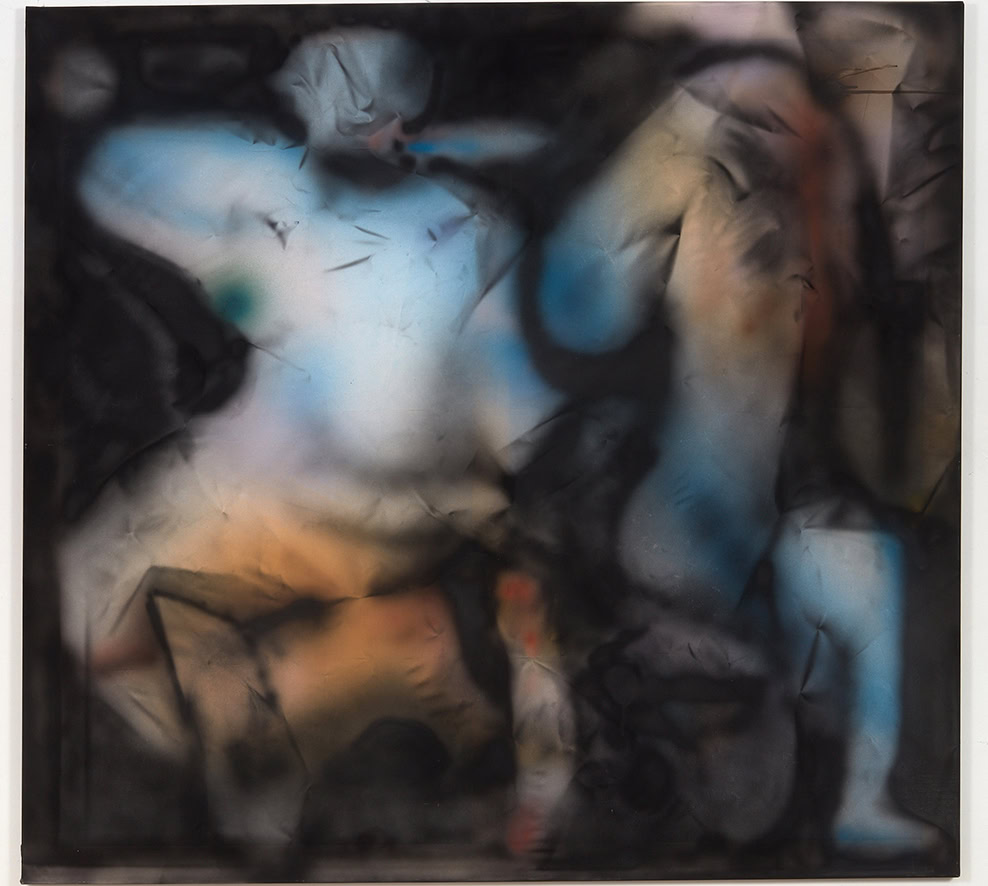
If Loty examined ascent, Tremolo, presented at Pryzmat, shifted toward vibration. Borrowing its title from the musical term denoting rapid repetition, the exhibition again begins with an external reference, this time musical structure, but transforms it into a painterly principle.
Repetition here does not create harmony but friction. Forms echo with slight variations. Lines stutter. Surfaces appear to quiver. The works suggest systems under pressure, structures that continue to function but are no longer entirely secure.
In his accompanying text for Restart Mag, Arkadiusz Półtorak situates Książek’s practice within a lineage of modernist ambition while emphasising its undercurrent of violence and doubt. The artist’s images expose “modernism as a field of tension rather than certainty.” The musical reference, like the motives in Flights before it, operates less as a theme than as a mechanism through which instability can be formalised.

Książek’s figuration becomes more ambiguous during this period. Bodies appear partially abstracted, embedded within architectural or mechanical frameworks. They exist in negotiation with their surroundings, caught between agency and containment. The tremor is quiet and internal, detectable through rhythm rather than gesture.
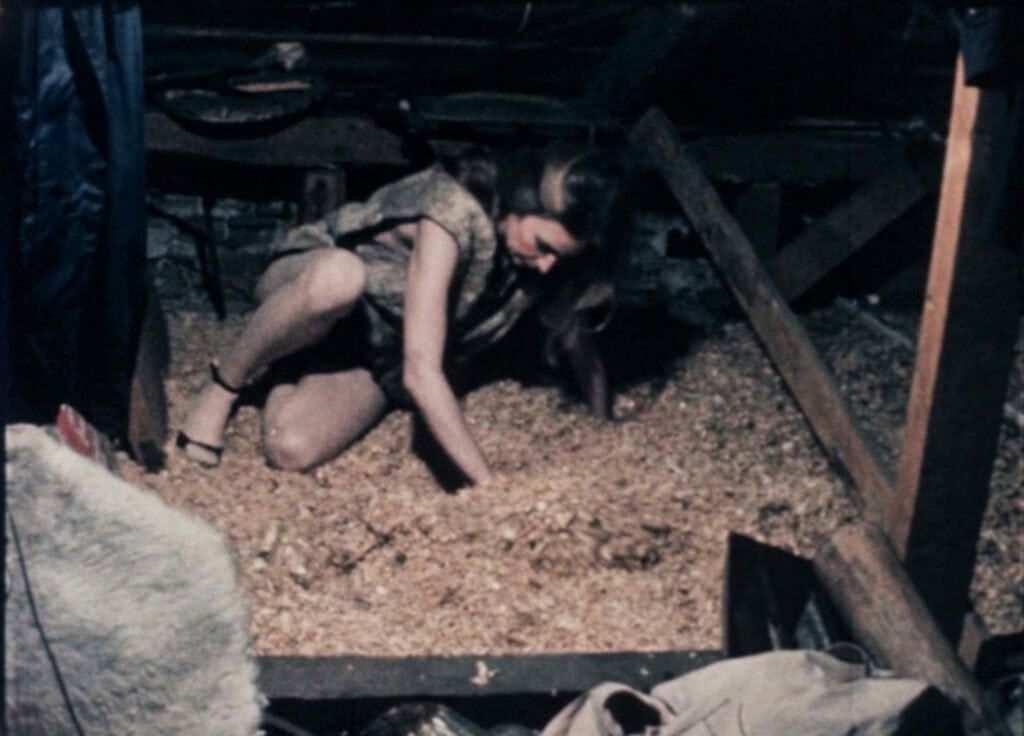
This working process was also documented in the film Jedno słowo, directed by Michał Sosna and presented in the context of the exhibition at UFO Art Gallery. The documentary shows the creative process of artists participating in the Unknown exhibition, offering insight into the development of the works and the conditions of their production.

Between Pressure and Release
The current exhibition Wydech (“Exhale”) at BWA Ostrowiec Świętokrzyski (on view till March 14) continues this trajectory. Once again, an external concept – breath – becomes the structural and metaphorical axis of the works.
In his curatorial text, Robert Domżalski describes the paintings as operating between contraction and expansion, positioning breath as both necessity and vulnerability. Breath becomes an invisible force shaping tension within the image. The compositions appear more open. Negative space gains importance. Forms pause rather than collide.

Yet even here, the motif does not become illustrative. Exhalation is not depicted literally; it is translated into rhythm, spacing, and structural release. What remains central is not the theme itself, but the formal investigation it enables.
Across these exhibitions, Książek consistently returns to systems designed to stabilise experience – engineering, music, architecture, history – only to reveal their limits. In each case, the historical or disciplinary reference functions as a starting mechanism: a pretext that activates the painterly process and opens a field of formal and psychological tension.

He does not dramatise collapse. Instead, he lingers in subtle shifts: the tremor in a line, the imbalance in a structure, the moment just before or just after impact. His paintings are never loud. Their intensity comes from restraint. Control is present, but it is never absolute. The image always carries the possibility of fracture.
What remains constant in his work is this oscillation: lift and gravity, repetition and rupture, inhalation and exhalation. The references may change, but their function does not. They are points of ignition – and the painting begins where the narrative ends.