


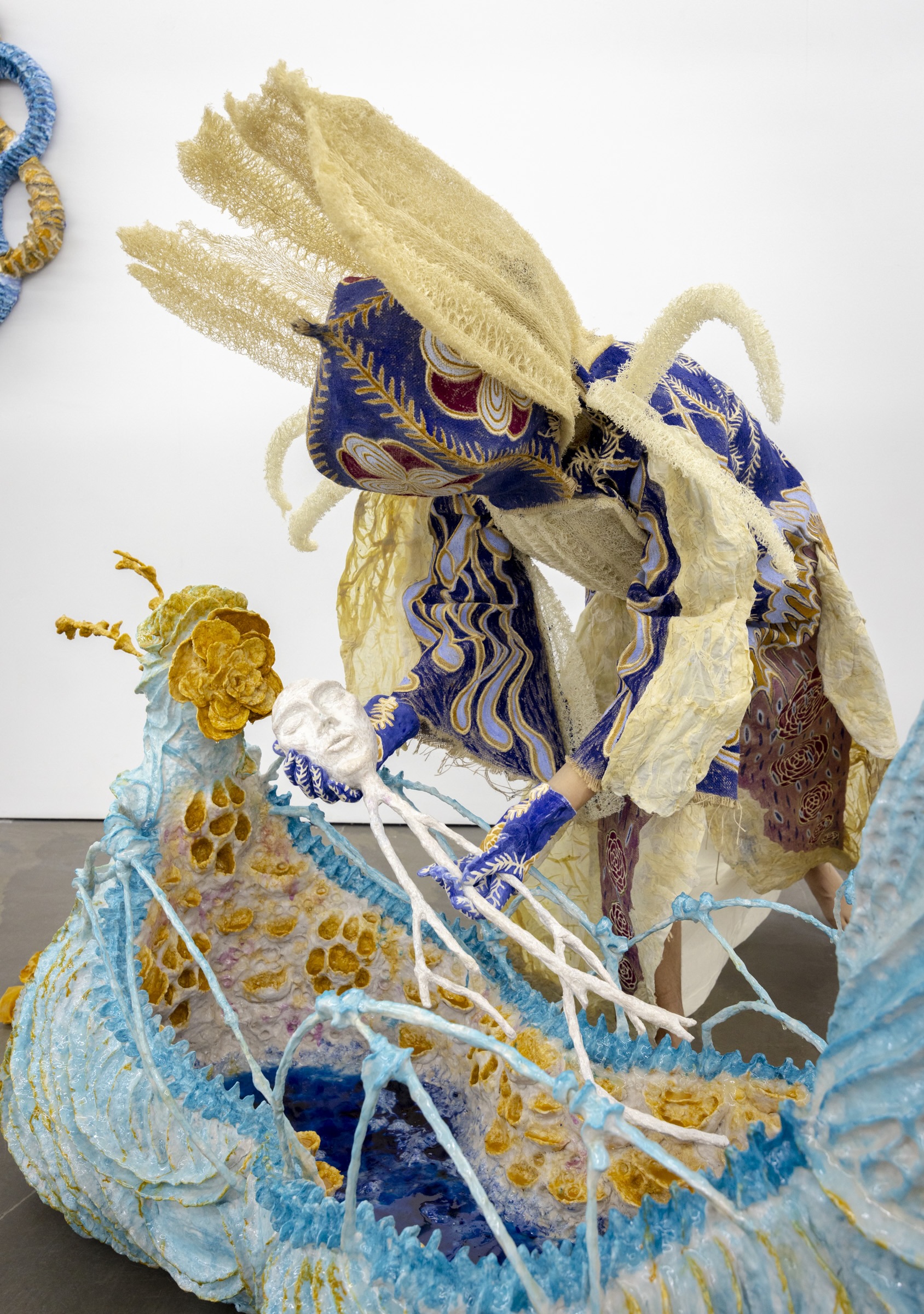
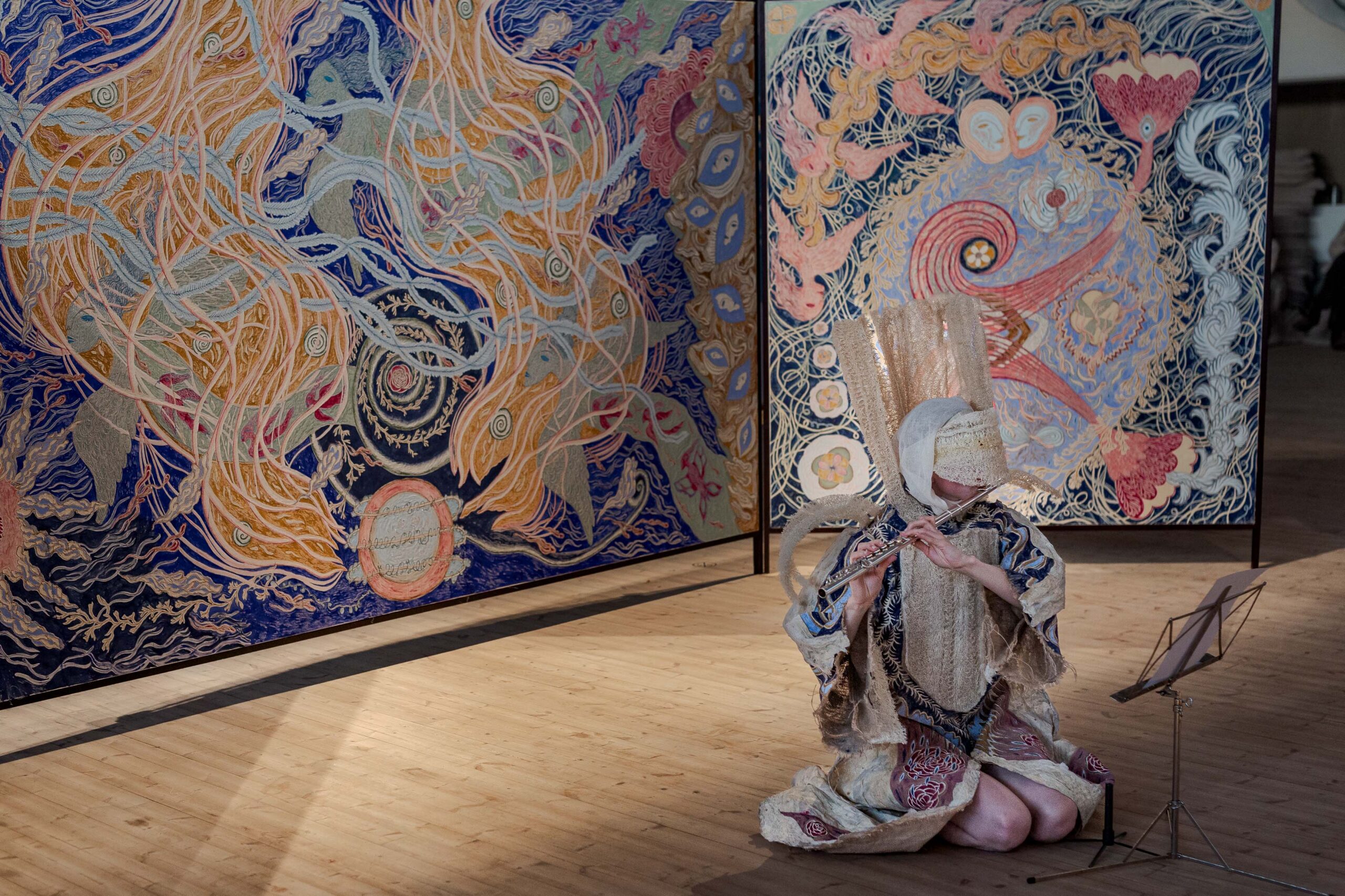
The scent of seagrass fills the air. Soft vocalisations thrum in the background as three voices weave together. Buzzing, humming, harmonising, they dance amongst the sculptures. Their featureless faces escape recognition, hidden by colourful cloth. Indigo, vermilion and ochre catch the eye. The performers move with purpose, each carrying a small shape. A creature? A seed? A symbol? They transport it between various parts of the installation, giving and taking, bringing life as well as death.
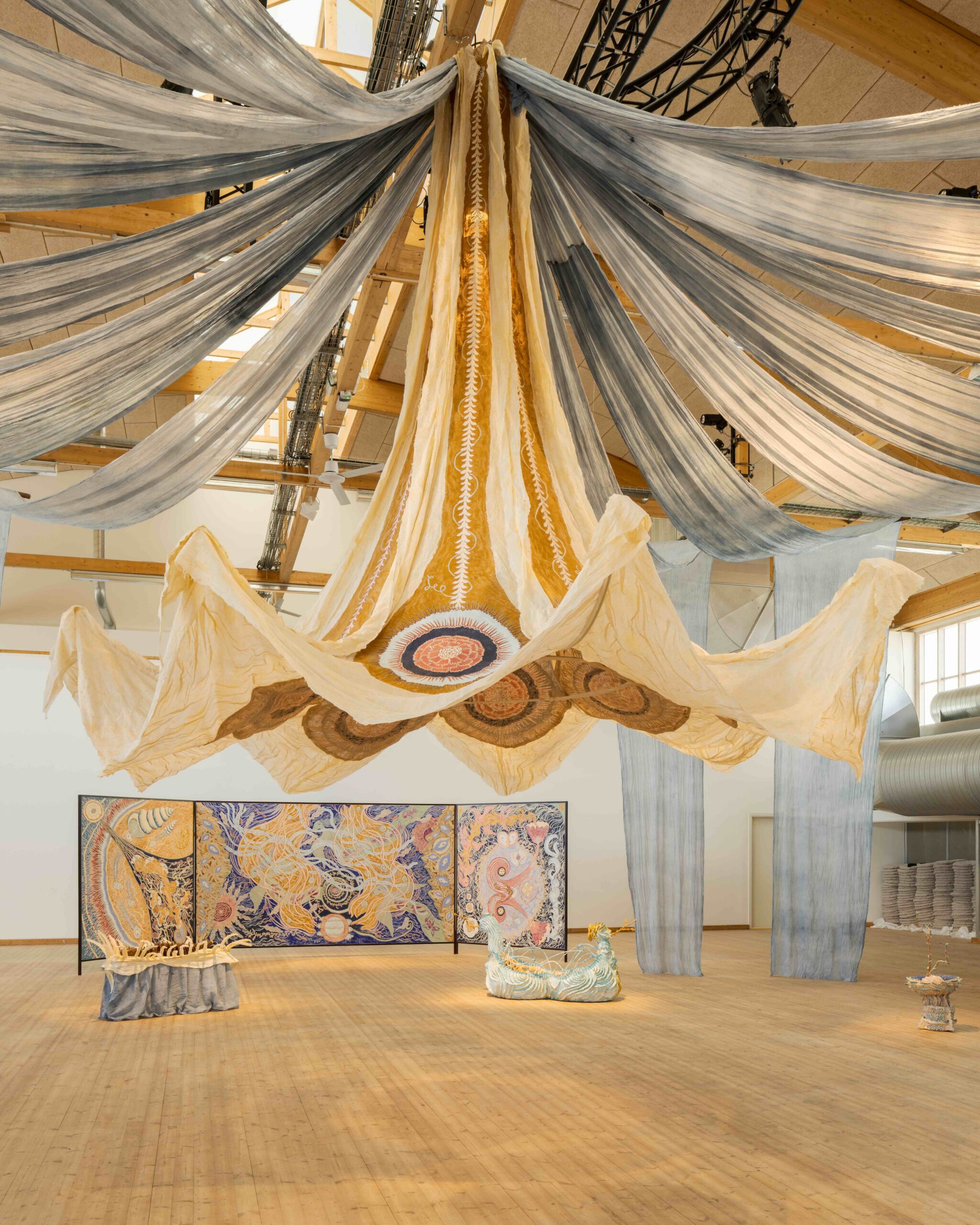
Cecilia Fiona’s Infinite Pollination (2026), presented at Bergen Kunsthall, is an ethereal meditation on the underlying threads that connect all existence. Using organic materials, she creates evocative imagery that feels both natural and otherworldly. The performers are wearing costumes hand-sewn and painted by the artist, with sandy-coloured tendrils and frills that accentuate every flowing movement. When not inhabited by humans, the garments hang from the ceiling in front of the wall of seagrass: still, embodying the cyclical nature of life and death.
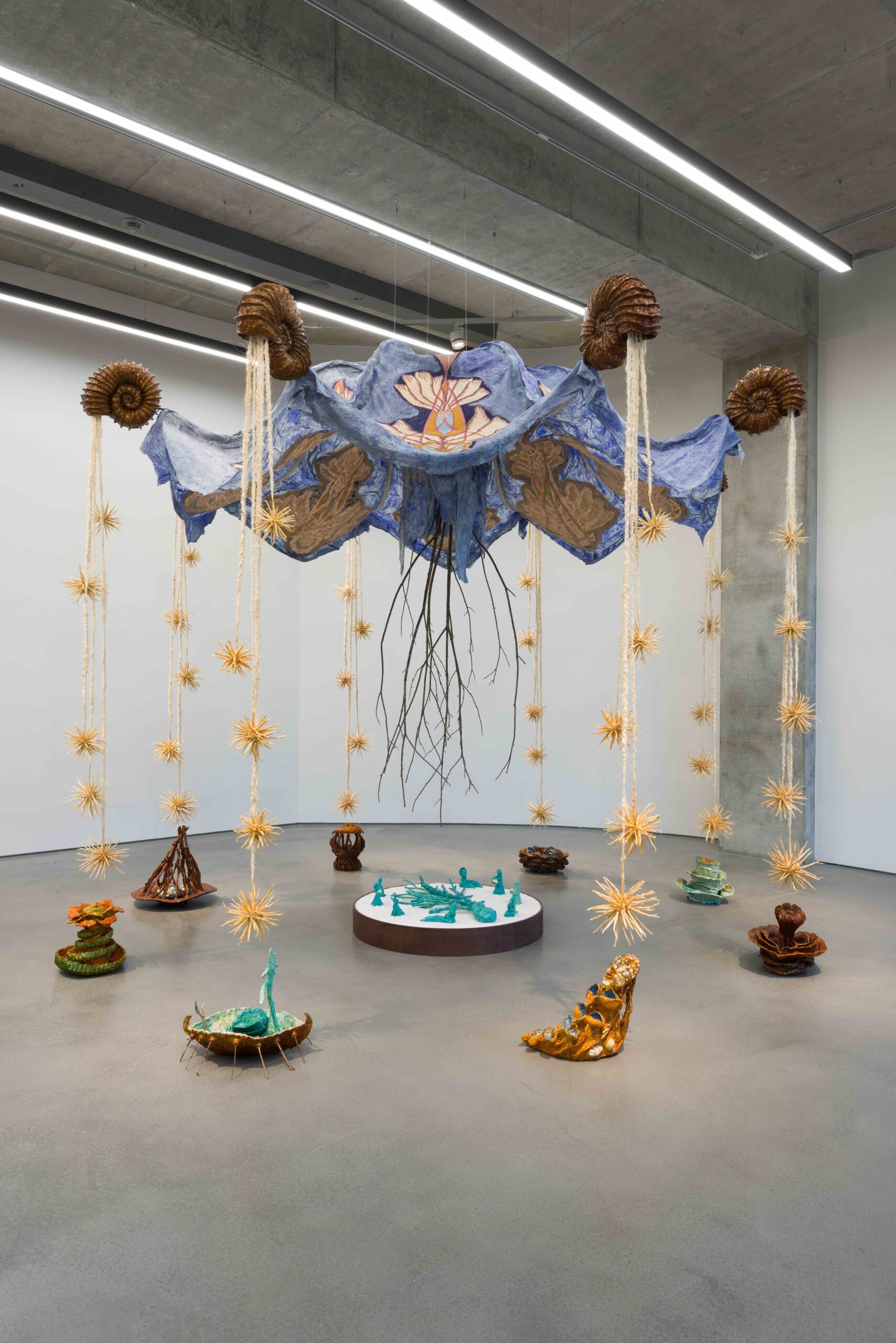
While creating them, the artist read about natural pollinators like bees and other insects, but also about the Norns — beings from Norse Mythology who wove the fate of humanity. They sat around the Tree of Life, Yggdrasil, their hands steady and true. If they cut a string, one would die. The tree itself appears in another of Fiona’s pieces: Spirals Gathering, Time Breathing (2026), part of her first institutional solo exhibition in the UK, at Towner, in Eastbourne. A dead tree hangs down from the ceiling, enveloped by the cerulean embrace of the Immortal Jellyfish. It is a tiny creature, found in the oceans of our planet, capable of reversing its own life cycle. Here, it takes on a cosmic scale, as mythos and strange physical reality collide.
Hybridising Tradition
This intermingling of worlds, whether earthly, cosmic or divine, echoes throughout Fiona’s art. She works across sculpture, painting, installation and performance, joining disciplines and modes of expression with a strongly defined aesthetic. Her materials are mostly organic, her methods traditional. Jute, seashells, grass and wool all provide earthy, characteristic textures and smells, enriching the multi-sensory experience. The colours bring to mind underwater reefs and sun-bleached flowers, with flashes of bright minerals in between. The curved, plant-like shapes of her sculptures mimic organic beings, traces of roots and coral in their silhouettes.
She works across sculpture, painting, installation and performance, joining disciplines and modes of expression with a strongly defined aesthetic.
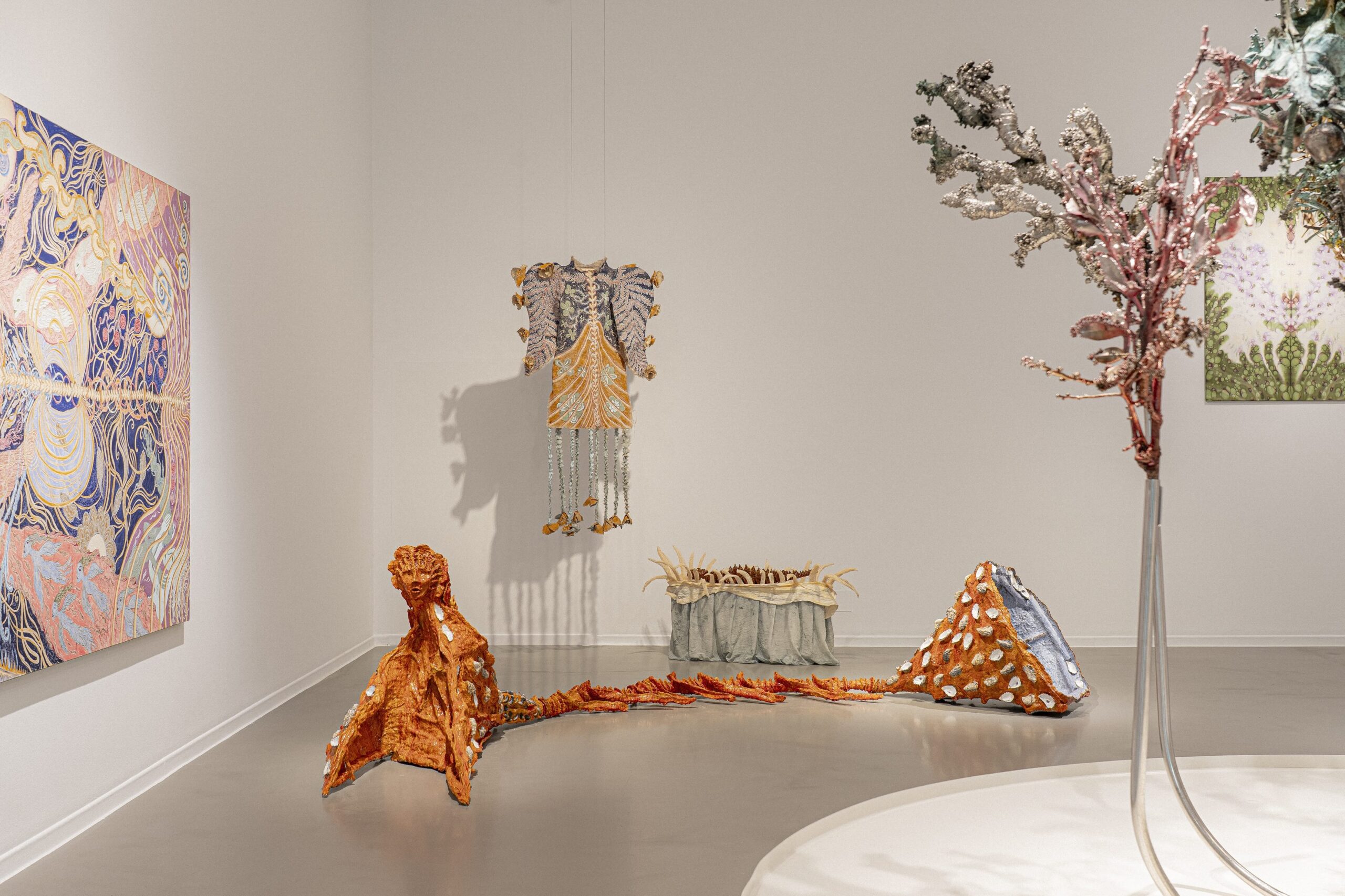
One sits crouched in a sphinx-like pose, its long tail sprawled on the gallery floor. It is called Multiple Beginnings (2025). Paper pulp, branches and shellac form the orange body of a hybridised being. Oyster shells cling to the outside, symbolising growth and symbiosis. The piece was largely inspired by Ursula K. Le Guin’s “carrier bag” theory, where a shared existence can be both benevolent and parasitic. The body is home to others, an open shelter, a galaxy viewed from a different perspective. The same patterns found in the warm caverns of our bodies weave through the cosmos — primordial paradigms at different scales.
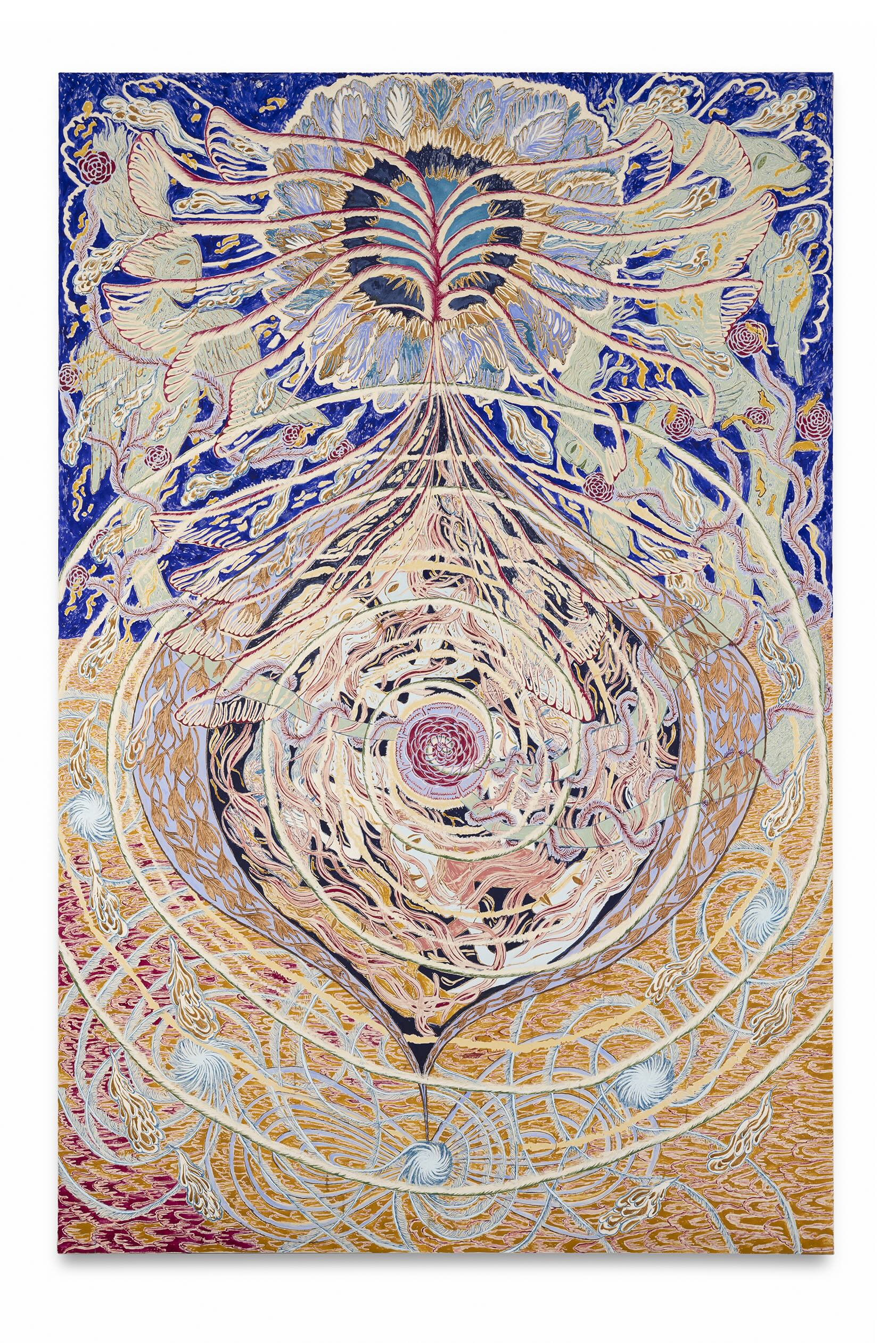
Birth and Black Holes (2026) examines the spiral in this manner. It draws connections between electrical charges running along the surface of a fertilised egg, and the forming of a black hole. Destruction and creation, beginnings and endings, the microscopic and the incomprehensibly large — all linked by a pattern on a nautilus shell. The boundaries between body and landscape seem to dissipate in the dreamlike imagery of Fiona’s art. Her paintings in particular have a unique look to them, due largely to the unconventional technique she uses. Instead of regular paint, the artist mixes pigments directly with rabbit glue, achieving a translucent, airy quality.
Touching a Dream
Though just as surreal, her textile and sculptural work grounds the art, evoking a tactile experience. Well-defined textures seem rough, warm and durable, their feel against the skin almost palpable. Sound is another component that envelops the viewer, whether during a live performance, as in the aforementioned Infinite Pollination, or as part of an installation, as in, for instance, Questions from a Seed (2026).
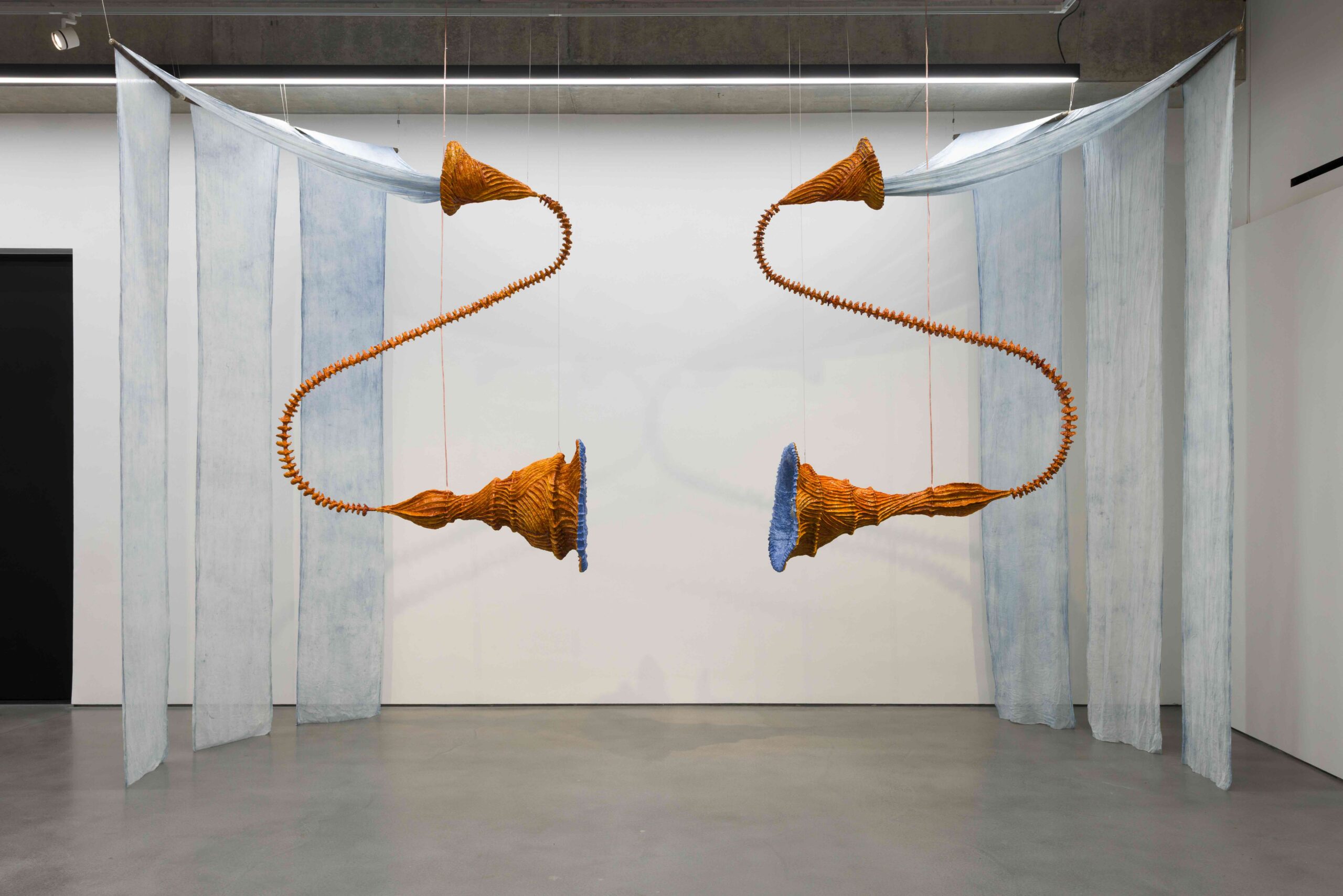
Fiona collaborated on the piece with singer and composer Lucie Cure to translate one of her paintings into a vocal composition, giving it new life. Two curved trumpet-esque shapes hang from the ceiling, facing each other. Inside, something hides — the forms resemble seeds, atoms, maybe souls. They obscure speakers, which emit an endless dialogue, exchanged wordlessly between the shapes. The installation was inspired by the phenomenon known as quantum entanglement, where time and space cease to matter as particles remain linked, regardless of what separates them.
Cecilia Fiona seems to create a new mythos with each piece, paying as close attention to the biological architecture of a cell as she does to the overarching themes of life, death and rebirth, which reverberate through galaxies real and imagined.
Again, science and myth combine as the often-invisible layers of our reality serve as inspiration for musings on our place in the cosmos. Cecilia Fiona seems to create a new mythos with each piece, paying as close attention to the biological architecture of a cell as she does to the overarching themes of life, death and rebirth, which reverberate through galaxies real and imagined. Her art leaves one wondering, and often struck with a newfound appreciation for the extraordinary existence we happen to be a part of.
BIO
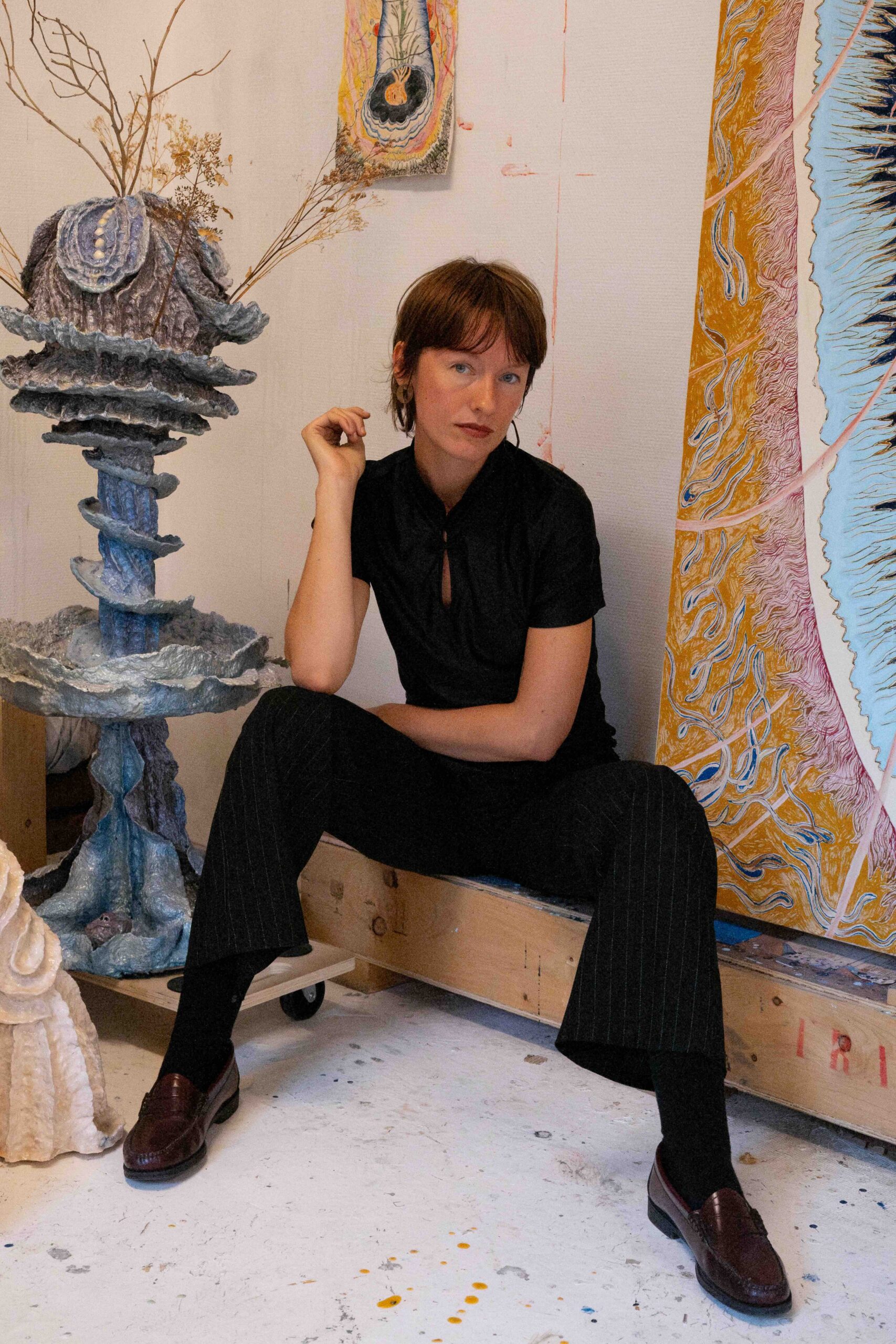
Cecilia Fiona (b.1997) is an interdisciplinary artist based in Copenhagen, Denmark. Her art combines sculpture, painting, performance and installation. She has exhibited internationally at Copenhagen Contemporary, DK (2025), Towner, UK (2026), La Casa Encendida, ES (2026), Bergen Kunsthall, NO (2026), SIXI Museum, CN (2024), among others. Fiona is represented by Niru Ratnam Gallery (London) and Andersen’s Contemporary (Copenhagen).