Showcasing a variety of approaches, themes, and techniques, PreFka Photography Review at the Wozownia Art Gallery in Toruń leads its audiences through both historical discoveries, classic methods of working with images, and contemporary narratives. Among this celebration of a medium that constantly redefines the boundaries between art, documentary, and experience, there’s an exploration of Franciszek Fuchs’s work – first ever on such a scale.
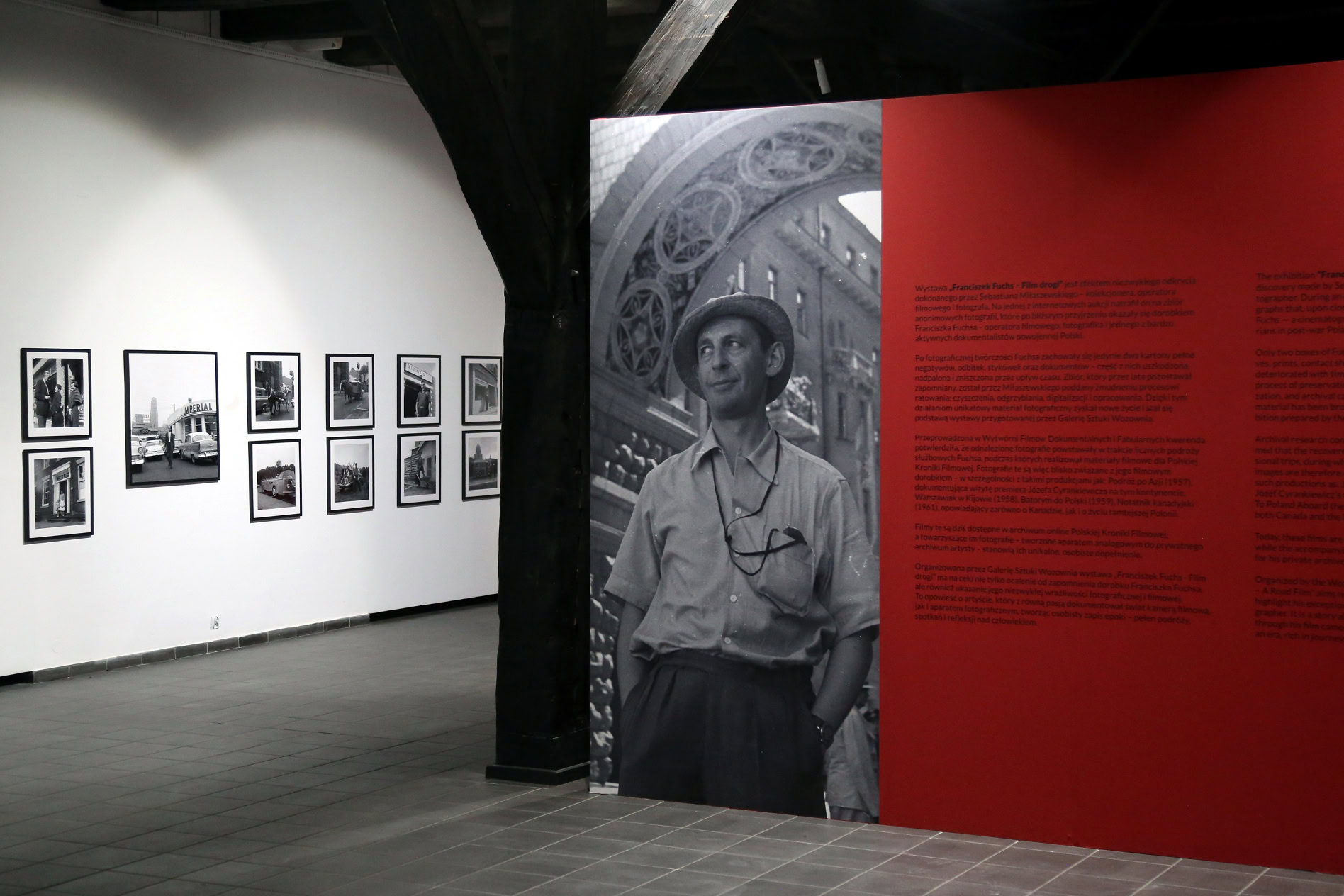
Thanks to a discovery made by Sebastian Miłaszewski at an online auction, a unique collection of photographs showcasing Fuchs’s extensive artistic output has been recovered, shedding new light on his career as a documentarist. As such, Road Movie exhibition (one of four in the PreFka’s programme) recalls the work of a forgotten cinematographer and photographer, whose work has now taken on new meaning – a unique dialogue between film and photography in a story about memory, travel, and images as bearing witness.
Franciszek Fuchs (1914-1996) worked with the Polish Film Chronicle and the Warsaw Documentary Film Studio. During his career, he worked on projects from various corners of the world; known for such productions as Podróż po Azji (Journey Through Asia, 1957), which documented Prime Minister Józef Cyrankiewicz’s visit to the continent, and Notatnik Kanadyjski (Canadian Notebook, 1961), telling the story of the country and its Polish community. While also being the director and screenwriter of two feature films: Przygoda na Mariensztacie (Adventure in Marienstadt) from 1954 and Zemsta (Revenge) from 1956, he also created music videos for the Polish music stars of the time, such as Czerwone Gitary.
For this year’s edition of PreFka and the accompanying exhibition, Road Movie. Franciszek Fuchs, we are talking to Jacek Świderski, director of the Wozownia Art Gallery and co-curator of the exhibition along with Dominika Krawańska, about the remarkable discovery of the artist’s forgotten photographs, the process of recovering them, and the meaning they carry about Fuchs’s cinematic and photographic visual language.

Paulina Mamot: What led you to exhibit Franciszek Fuchs’s work at this year’s PreFka?
Jacek Świderski: I am friends with Sebastian Miłaszewski, the current owner of Fuchs’s negatives. We studied together in Prague – he studied cinematography, and I did photography. He was the one who put forward the idea for the exhibition. Sebastian and I meet every now and then, we call each other, and two or three years ago, he let me know that he had Fuchs’s work ready. We waited for an opportunity to display it and finally included Fuchs in the gallery’s budget for this year. Although it took some time after the initial notice, we finally managed to prepare the exhibition.
We went into it blind. I decided that it was a discovery that should be exhibited and made public, that someone should take up this subject. There was a sense of mission behind it. After making this decision, we began reviewing the material. At first, Sebastian sent us his initial selection of about a hundred photographs, and only later the full collection of scanned negatives. Not until then could we assess the scale and quality of the material.

PM: Tell us more about the story of finding Fuchs’s photographs. What condition were the materials found in, and what were the challenges involved in their restoration and digitalisation?
JŚ: Sebastian found them on an online marketplace about 10 years ago. As a cinematographer himself, he knew Fuchs’s name. He also knew there was no legacy of his photographs left. That is why he became even more interested in the subject.
The box of negatives was found in a basement. It was damp and in poor condition. No one had taken care of it, and the negatives had been poorly stored. Sebastian initially cleaned the negatives, removing dirt from them by hand. Only then did he start scanning them. He bought a special scanner for this purpose. He did so and then retouched the negatives, fixing any defects. It took him about two or three years, mainly during the pandemic. At that time, we all had plenty of time to scan negatives and, incidentally, I also went through a part of my own archive then. It was a good time for photographers, I think.
“Fuchs was visibly fascinated by capturing fleeting and sudden moments, such as people running across a meadow to escape the rain. Typical momentary reportage.”
— Jacek Świderski
PM: As you mentioned, Franciszek Fuchs is primarily known as a cinematographer. What is the difference between his approach to photography and film? What can we see in his photographs that his co-created films do not show?
JŚ: The difference is tremendous. At the Polish Film Chronicle, he worked within the constraints of top-down guidelines. He primarily documented the visits to Asia of then-Prime Minister Józef Cyrankiewicz. There was no room for original expression. The chronicles were like a newsreel: short, fragmented pieces, always narrated by the same voiceover. However, such unification is not found in the photographs. Instead, they show who Fuchs was as an artist; they convey a sense of freedom and document his various passions, portraying the subjects that interested him the most.
One of the main themes is the automotive world – cars in motion or standing in car parks or scrap yards. His work also includes many photos of children – a rewarding subject for photography, which was also the case in the 1950s. Furthermore, Fuchs was visibly fascinated by capturing fleeting and sudden moments, such as people running across a meadow to escape the rain. Typical momentary reportage.
There was also a bit of fascination with technology in all of it. But above all, Fuchs’s photographs show us that, between his commissioned duties, he had time for himself and pursued his own passions, which differed completely from the Polish Film Chronicle commissions.


PM: But his travels were also international, which was rare at the time. Could it be that it was the sheer novelty of his surroundings that inspired such enthusiasm?
JŚ: Maybe. Interestingly, despite the deep communism of this period, he also managed to travel to Canada. Sebastian did some research on him, also at the Institute of National Remembrance [IPN – editor’s note], but found no documents related to Fuchs. He was an ordinary citizen who was not registered as a Party member, yet managed to obtain a passport. Maybe due to the fact that his sister lived in Canada.
PM: Does this mean that the archive contains family photographs?
JŚ: Yes. The exhibition features two photographs of Fuchs’s family, his sister, and his nephew, who is still alive today.
PM: What about self-portraits?
JŚ: We have a whole series of self-portraits, which are twofold: on the one hand, Fuchs the cinematographer at work with his camera, and on the other, he’s a joker in his free time. The photographs are funny and show his personality and sense of humour.

PM: What is the greatest value of Fuchs’s photographs? What did you specifically want to draw the audience’s attention to, and how did you carry out the process of selecting the material?
JŚ: First and foremost, we present a collection that has never been publicly released before. Eventually, we chose 106 photographs out of around 2000 negatives. Our selection differs slightly from the initial one suggested by Sebastian Miłaszewski, who chose more photographs of children and family. I was mainly interested in the themes of travel and movement. This is also reflected in the title of the exhibition – Road Movie. We wanted to refer to this film genre, whose main theme is travel, in particular by car, but also to the fact that Fuchs was a cinematographer. That is why we decided to highlight themes related to the automotive industry and movement. Fuchs travelled by car in both Canada and Asia and was clearly fascinated by these vehicles.
Moreover, we see Fuchs as a precursor of Polish street photography in the 1950s. At that time, there were not many photographers and reporters here; it was primarily a group centred around magazines, which we presented last year at our Photojournalists exhibition. Hence, it was also vital for us to display these photographs capturing the moments Fuchs actively sought out and hunted for. We wanted to highlight his journalistic flair. There is this one photograph showing a boy walking on a wet road, which reminds me of a famous shot by Cartier-Bresson – a boy carrying bottles of wine. Or a photo showing two workers or boys looking at a model in a shop window.
A shop window was such a typical motif for Western photography at that time. These associations led me to the very theme of street reportage, which became an essential element of this year’s exhibition. Also, it is worth mentioning that, thanks to our collaboration with the Film Museum in Łódź, our exhibition features not only Fuchs’s photographs, but also historic cameras and the Arriflex camera used in his work as a cinematographer, as can be seen in his self-portraits.

PM: Are there any further plans regarding Fuchs’s archive, such as an exhibition catalogue, archiving the materials, or releasing them in digital form?
JŚ: An exhibition catalogue should be published while the exhibition is still running. We also want to take the exhibition to other venues so that more people can learn about Fuchs.
One interesting aspect that we have not covered in this exhibition is his family background. His father owned the Fuchs chocolate factory, and to this day, the chocolate boxes with the company logo can be found at auctions. The history of the factory itself is quite complicated, as it was nationalised after the war. This could potentially be material for another exhibition. However, it is Sebastian Miłaszewski, the owner of the collection, who will make decisions regarding the archive.
PM: Is there a particular photograph by Fuchs that is especially memorable to you? What makes it special?
JŚ: There are a few. Actually, one of my favourites was not included in Sebastian’s initial selection. It matches the atmosphere of the frames of the aforementioned Cartier-Bresson, but also of stills from Fellini’s films. A combination of photography and cinema. The frame is somewhat lopsided and square. On the left, two women enter the frame and remain slightly out of focus. Further on, there is a road with a car, and at the end of the road, a pole. In the background, there is some kind of a shack. And this is precisely one of the fleeting moments captured by Fuchs. It reminds me of Fellini because it combines action with a large dose of nostalgia. For Sebastian, a cinematographer, the frame was imperfect. For me, a photographer, it is a manifestation of looking deep inside – deep into the scene, because it is multidimensional, but also deep inside oneself. You can see a lot of sentiment in this shot. For me, it could be a poster for a Fellini or Antonioni film.
This photograph opens the exhibition’s series of Fuchs’s momentary photographs, a kind of quick shots. It closes with another of my favourite photos, taken from a worm’s-eye view. It depicts a road and a crosswalk. Fuchs himself or one of his friends is jumping across this road. For this time, it is a truly innovative shot. It showcases Fuchs’s personality and creativity very well. He was able to lie down on the ground and take a completely unusual photo from a perspective that is usually not accessible to a cinematographer.
“It is a manifestation of looking deep inside – deep into the scene, because it is multidimensional, but also deep inside oneself.”
— Jacek Świderski

PM: But there’s also more to see at this year’s edition of PreFka, besides this excellent exhibition of Franciszek Fuchs’s photographs, isn’t it?
JŚ: We also present three other exhibitions. The first one, Contacts. Time of Nature. Time of the Tree was created in cooperation with BWA in Jelenia Góra. It is dedicated to photographs created by contact printing of large-format, light-sensitive negatives on photographic paper, without enlargement or cropping. A contact print transfers the richest and most complete photographic image from the film. The exhibition includes works by both late masters of the so-called Jelenia Góra School of Photography and photographs by younger artists who share a passion for this traditional technique.
There are also two exhibitions by younger generation artists. Natalia Miedziak-Skonieczna’s Body Images is a record of the search for unity between the body, nature and the world. Mujeres Medicina by Marta Kowalska is a photographic project, an interpretation of the archetype of a woman connected with her own intuition and nature. It is also a story of self-improvement and self-healing.
In addition, the second edition of the Self-Portrait competition was announced. We are interested in a creative approach to the subject, not selfies taken with a phone. As in the saying “the shoemaker’s son always goes barefoot”, photographers usually have little to no photos of themselves. That is why we want to promote photography, but with a concept.

II PreFka. Photography Review
November 14 – December 28, 2025
Galeria Sztuki Wozownia, Toruń
The announcement of the Self-Portrait competition results and the award ceremony will take place on December 19.