Emmanuel Aggrey Tieku (b. 1994) is a Ghanaian artist who transforms the material residue of global consumption into temporary architectures of memory, visibility, and collective responsibility through large-scale installations assembled from discarded garments. Constructed primarily with garments collected from Ghana’s second-hand clothing economy, as well as landfills and beaches, his works move fluidly between sculpture, architecture, and public intervention. His lifetime project is unfolding under the name How to heal a broken world.
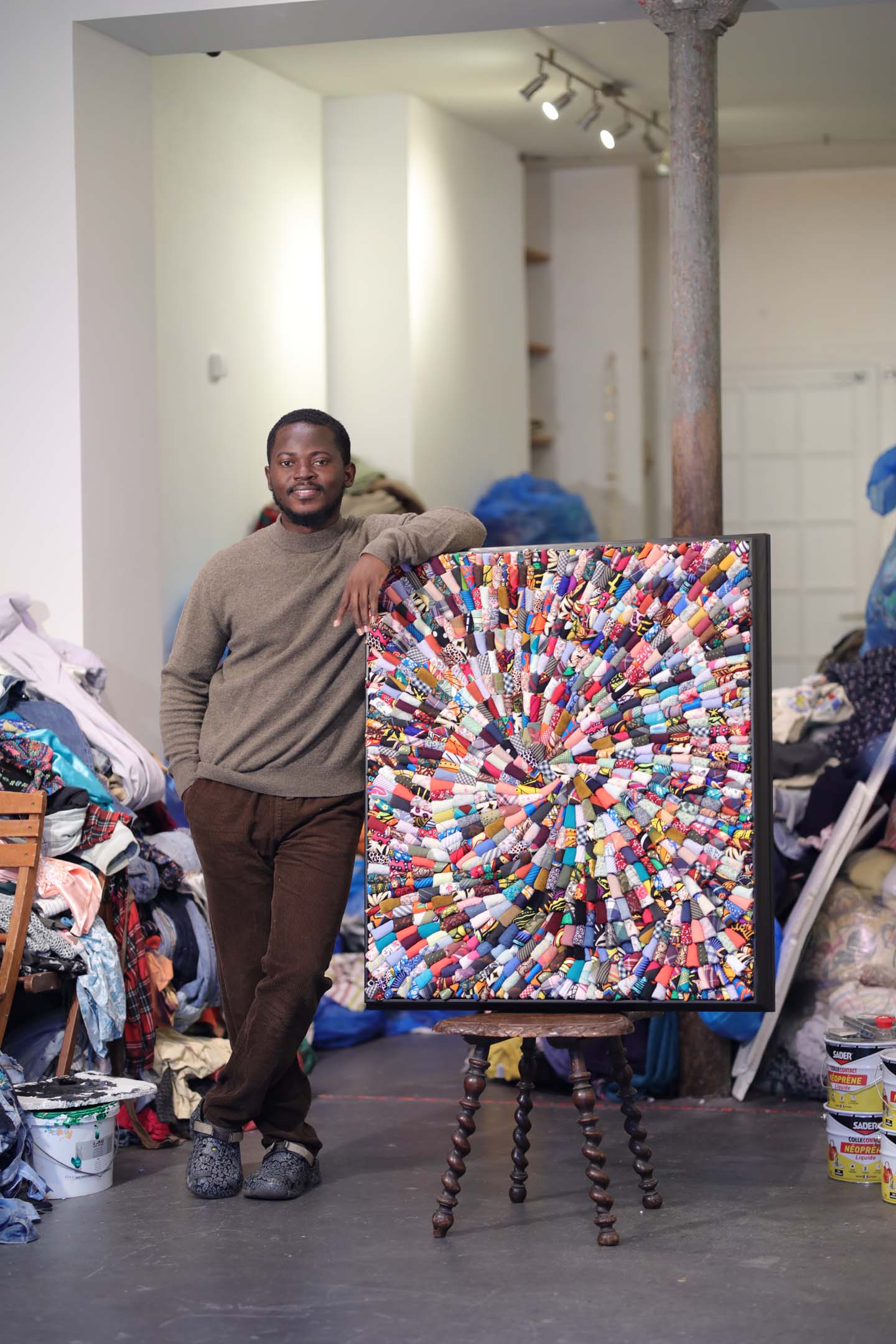
Tieku’s works emerge from specific material realities, yet they resist documentary description. Instead, they ask how objects continue to accumulate meaning as they circulate through multiple lives, geographies, and systems of value. This concern with circulation extends beyond the movement of goods. It is equally present in the movement of memory, responsibility, and attention. Across beaches, cemeteries, urban sites, and gallery spaces, Tieku repeatedly returns to a central question: what becomes visible when the material remains of global consumption are no longer hidden from view?
Across beaches, cemeteries, urban sites, and gallery spaces, Tieku repeatedly returns to a central question: what becomes visible when the material remains of global consumption are no longer hidden from view?


Beyond the Object
Over the past decade, a growing number of artists have turned to found textiles as a means of examining labour, migration, consumption, and environmental extraction. Yet Emmanuel Aggrey Tieku occupies a distinctive position within this field. In his installations, clothing operates as infrastructure, carrying traces of economic exchange, social relations, and historical movement long after it leaves the body.

Installation is not simply the medium through which he presents his work; it is the conceptual framework that underpins it. Individual garments rarely appear as isolated elements. They are gathered into expansive formations that alter the experience of space itself. Suspended overhead, draped across landscapes, wrapped around existing structures, or compressed into monumental masses, the materials lose their original function while retaining traces of their former lives.
Suspended overhead, draped across landscapes, wrapped around existing structures, or compressed into monumental masses, the materials lose their original function while retaining traces of their former lives.
What emerges is a practice rooted in accumulation. Tieku does not erase the identity of his materials through transformation. Frayed seams, faded colours, worn surfaces, and irregular textures remain visible, producing installations that appear simultaneously constructed and inherited. The works carry the visual evidence of previous use, allowing history to remain present within the structure rather than hidden beneath it.
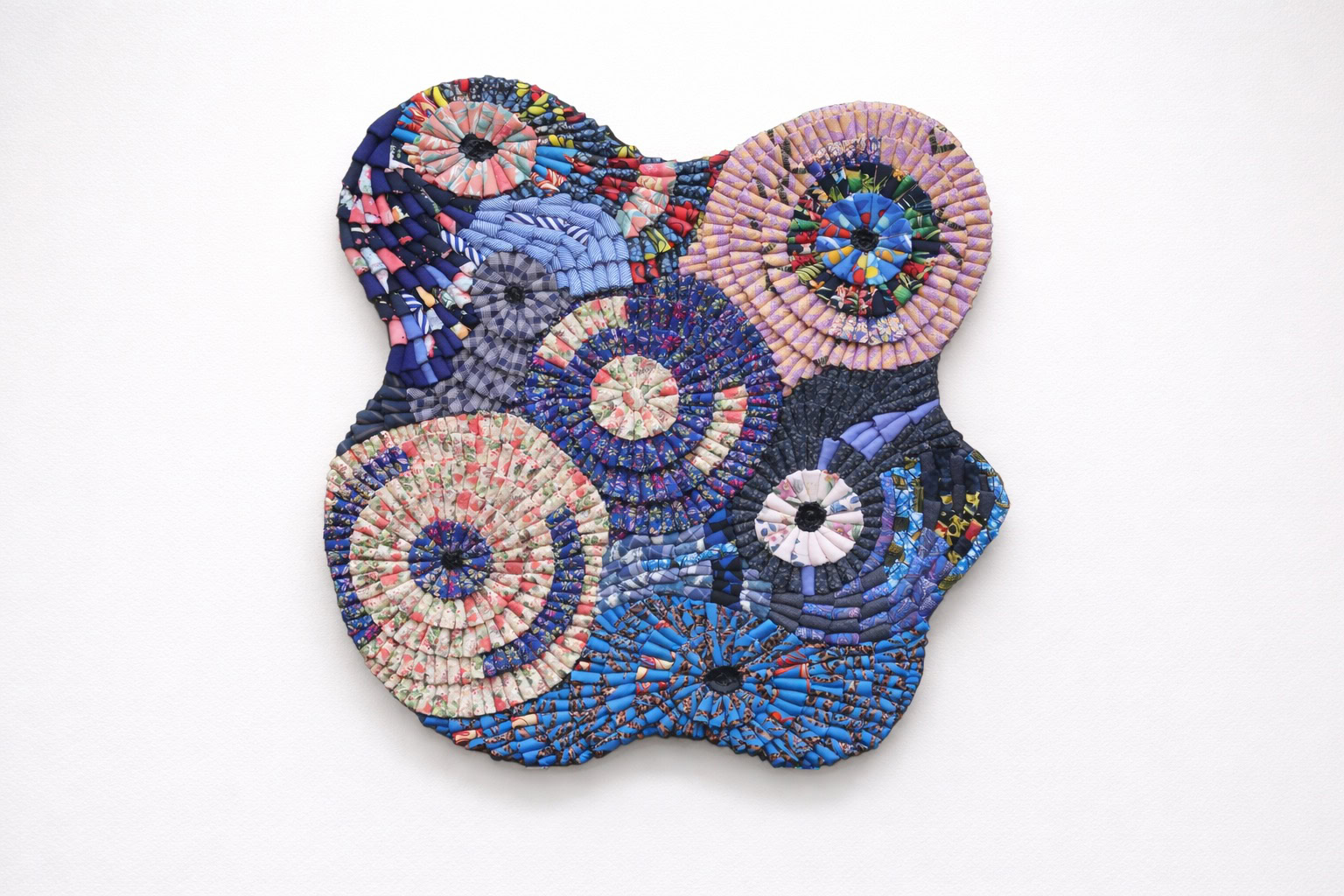
This attention to material history owes something to the artist’s background in civil engineering. Construction, support, tension, and load-bearing relationships recur throughout the installations. Yet the works never fully settle into architecture. They remain provisional, often appearing as though they could be assembled elsewhere, rearranged, or dismantled entirely. Their instability is deliberate. It mirrors the unstable conditions of the systems from which their materials emerge.
Rewriting Public Space
Among Tieku’s most compelling projects is BALEBOARDS (2026), a series that appropriates the visual language of advertising to confront the afterlife of consumer goods. Constructed from compressed bales of discarded clothing, the works occupy the formal territory of the billboard, a structure traditionally associated with desire, aspiration, and economic persuasion.

Tieku’s intervention lies in reversing this logic. Instead of displaying commodities before they are purchased, BALEBOARDS presents their remains after consumption. The installation transforms a structure designed to generate visibility into one that exposes what systems of consumption routinely conceal.
Importantly, the work avoids moral spectacle. The bales are not arranged as evidence of catastrophe, nor are they aestheticised into abstract compositions detached from their origins. Their physical presence does the work. Elevated into public view, they become impossible to ignore, occupying the same visual register as the advertisements that once encouraged the purchase of the garments now compressed within them.

The project demonstrates a recurring feature of Tieku’s practice: his ability to work through existing structures of circulation. Advertising frameworks, trade networks, and public infrastructures become material for intervention, exposing the assumptions and hierarchies embedded within them.
Temporary Monuments
Questions of visibility are also present in Cemetery of Belongings (2025), a large-scale installation staged within the historic Osu Cemetery in Accra. Here, garments are suspended, draped, and arranged throughout the site, producing an encounter between discarded materials and a landscape already shaped by colonial histories.
The work’s strength lies in its restraint. Tieku does not use clothing to represent absent bodies, nor does he impose a singular narrative onto the site. Instead, the installation creates a dialogue between different forms of abandonment. Colonial histories, environmental degradation, and global patterns of disposal remain distinct yet interconnected, occupying the same physical space without collapsing into one another.

The cemetery becomes less a backdrop than an active participant in the work. Existing monuments, pathways, and grave markers are drawn into the installation’s visual field, producing a temporary counter-monument that questions how histories are preserved, forgotten, or displaced.
Throughout the project, permanence remains conspicuously absent. The garments sag, weather, and absorb the conditions of the site. Their gradual transformation forms part of the work itself, making time visible as a material process.
The Politics of Scale
One of the defining characteristics of Tieku’s installations is the distance they create between the intimacy of clothing and the magnitude of the systems in which clothing circulates.

A single garment suggests an individual wearer. Thousands of garments gathered together suggest something else entirely. Through repetition and accumulation, the artist transforms personal objects into collective structures. The shift is subtle but significant. Viewers are no longer invited to consider who wore a particular shirt or dress. Instead, they are confronted with the larger networks through which such objects move.
A single garment suggests an individual wearer. Thousands of garments gathered together suggest something else entirely. Through repetition and accumulation, the artist transforms personal objects into collective structures.
This tension between the individual and the collective allows Tieku to avoid many of the familiar tropes associated with environmentally engaged art. The installations do not rely on shock, guilt, or spectacle. Their impact derives from scale, proximity, and material persistence. What appears at first as an ordinary piece of clothing gradually reveals itself as part of a much larger system.

What ultimately distinguishes Tieku’s practice is its insistence that materials are never passive. Every garment arrives carrying histories of production, movement, ownership, and disposal. By bringing these histories together within the space of installation, the artist constructs works that operate simultaneously as sculptures, archives, and public interventions.
The result is a body of work that asks not only where things come from, but where they go, who carries them, and what remains after their value has supposedly been exhausted.

BIO
Emmanuel Aggrey Tieku was born in Cape Coast, Ghana, and currently resides and works in Accra. He holds a bachelor’s degree in Engineering and a master’s degree in Environmental Engineering. His works were shown across Ghana, in different locations in Germany, in Paris, and at Art Basel in Miami. He plans to show his How to heal a broken world project globally. In 2025, Tieku received the Ellipse Prize.