Helena Tahir (b. 1992) is a Ljubljana-based visual artist whose practice unfolds across a multitude of media, anchored in the material and emotional traces of personal and collective histories. Working across printmaking, drawing, painting, installation, and archival exploration, to probe displacement, identity, memory, and fragmented genealogies, she frequently brings the intimate weight of family narratives into dialogue with broader historical ruptures.

The artist’s work negotiates the tension between absence and presence, between what is documented and what has been suppressed or lost to time. Her primary focus is on remnants – archival photographs, personal letters, fragments of official documents – treated as charged material that carries layered meanings across generations. Through drawing, printmaking, and installation, she reconfigures these remnants into forms that resist straightforward narrative coherence but reveal patterns of memory, ruination, and transformation.
Her working methods often mirror her conceptual focus: repetitive gestures, layering, overlap, misalignment, and trace – techniques that resonate with the mechanics of memory itself, where repetition alters what came before, and loss becomes embedded in process. These in-between states – between print and drawing, image and object, document and gesture – are where intimate and political histories intersect in her practice.
Fragmentation, memory, and remnants
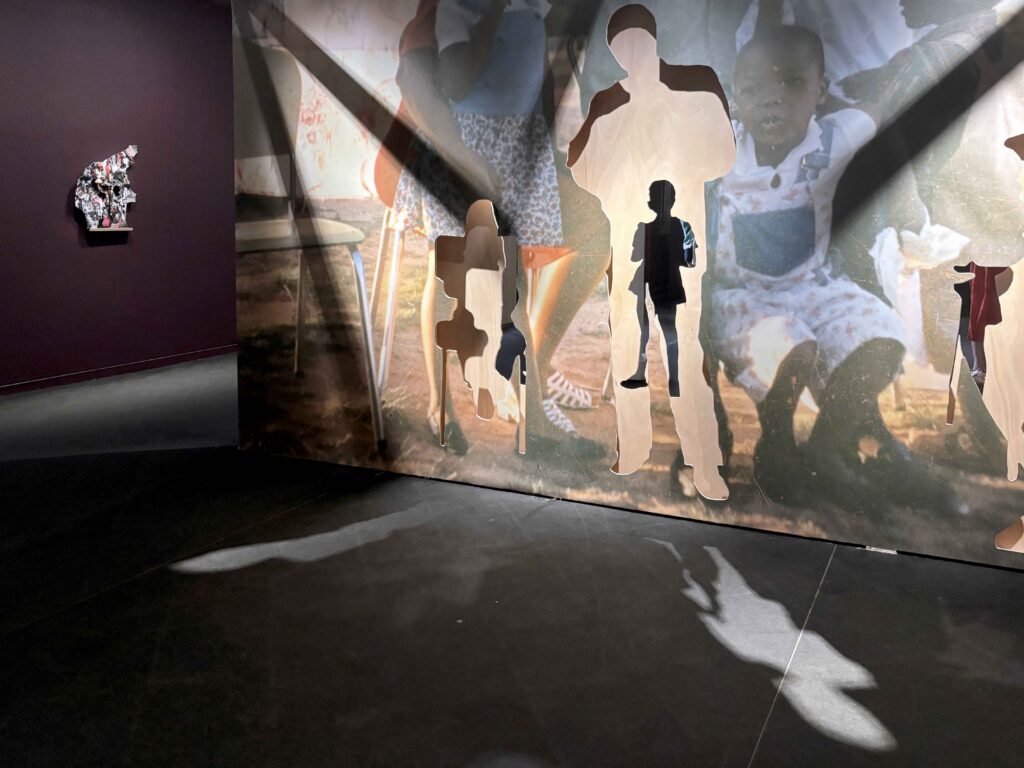
A pivotal body of work in Helena Tahir’s recent practice is The Last Sector, an ongoing project that unfolds across printmaking, drawing, installation, video, and the book format. Initiated through long-term archival investigation and personal inquiry, the project examines the fragmented legacy of her father’s political migration from Iraq in the 1970s.


The title refers to a peripheral neighbourhood in Sadr City, Baghdad, a place that functions less as a fixed geographical reference than as a conceptual threshold – a zone at the edge of memory where historical continuity breaks down. For Tahir, this “last sector” becomes a metaphor for what remains inaccessible or partially transmitted: stories interrupted by exile, documents without context, photographs stripped of annotation, and narratives that surface only in fragments.
As such, Tahir works with archival remnants, like family photographs, official records, maps, and oral traces – not as stable evidence, but as charged material. These elements are subjected to processes of repetition, pressure, transfer, and layering, reflecting the mechanics of memory itself. Meaning does not emerge through linear storytelling, but through accumulation, misalignment, and the tension between presence and absence. What is missing is allowed to speak as forcefully as what remains.

Formally, The Last Sector is marked by a pronounced interest in in-between states. Tahir’s works frequently hover between print and drawing, image and object, document and gesture, resisting clear categorisation, with material decisions echoing the project’s conceptual core of histories that are simultaneously preserved and obscured.
The project was first presented in a solo exhibition at RAVNIKAR Gallery Space, Ljubljana (2024), alongside the publication of Tahir’s artist’s book The Last Sector: Tracing My Father’s Past, co-published with PrivatePrint. The book extends the project’s logic into a tactile, sequential form, allowing images, documents, and blank spaces to operate together as a visual archive that refuses closure.


In The Last Sector II (2025), the artist deepened and expanded the project following the completion of her two-year residency at Švicarija. This second chapter shifts the focus from recovery toward reconfiguration, placing greater emphasis on material transformation and spatial experience. New works explore how inherited histories settle into bodies, objects, and surfaces over time, and how repetition becomes a form of embodied transmission.
Rather than offering reconciliation, The Last Sector remains deliberately open – a living archive in which memory is continually renegotiated. In this sense, Tahir’s work aligns personal history with broader political questions, revealing how intimate genealogies are shaped by forces of migration, ideology, and historical violence, and how art can become a site where these forces are neither fixed nor forgotten, but actively re-entered.

Extending the practice
While The Last Sector has been central in Tahir’s recent artistic trajectory, her work extends across series and practices that reveal a consistently deep engagement with similar themes, often pushing the boundaries of classic graphic media.
For instance, In a Whirl (2018), a linocut series, showcases Tahir’s engagement with linocut – a medium traditionally associated with printmaking’s expressive potential. These black-and-white works combine fictional and historical imagery, playing with the tension between invented and lived narratives in a manner that prefigures her later archival investigations, while reflecting the artist’s interest in how history, memory, and visual form intersect, a theme, as we know, she continues to explore throughout her practice.

Another series of hers, Words Fail Me (2022), the large-format drawings present lush, narrative intensity and meticulous craft, demonstrating her ability to handle figurative detail, bold compositional structures, and symbolic interplay in coloured pencil and mixed media. Here, figures and objects emerge from dense pictorial fields, demanding slow, rigorous viewing. These works are populated by people and motifs that function as vehicles of memory, emotion, and metaphor, with colour and light playing significant roles in constructing both symbolic depth and visual tension. Tahir’s experimentation with how narrative unfolds within a single frame was already evident here, a technique that would evolve into her larger interdisciplinary projects.
Hybrid forms and material experiments
Alongside her narrative projects, Tahir has experimented with hybrid forms — combining drawing, transfer, frottage, and mixed media. Works such as Ea (2024), Distant Prospects (2024), and Tiles (2024) (all variants within the broader context of The Last Sector) utilise techniques like carbon transfer drawing on paper, found objects, and mixed media sculptures to convey layered histories and affective material. This formal hybridity leads us through questions of how image and object, document and gesture blur in contemporary practice.

Many of these pieces bring archival photographs, fragments of personal family material, and collected objects into the studio as physical traces, making them part of a visual language where absence and presence co-exist.
However, while Tahir’s written and graphic works are at the centre of her practice, she has also explored installation and video contexts. For example, Distant Prospects III (2024), a video installation, shown as part of The Last Sector exhibition, adding temporal and narrative depth to the static drawings and prints. As such, these multimedia works further amplify her interest in displacement and memory as perceptual experiences, inviting the viewer to encounter layered histories not only through the stillness of prints and drawings but also through time-based narrative and spatial resonance.
Towards a fragmented visual language
Helena Tahir’s works – whether prints, drawings, or installations – often present narrative complexities that require slow, attentive viewing and interpretation. While materiality becomes meaning. From linocuts and carbon transfer to gilded faux-leather screenprints, material choices in her work carry conceptual weight, often mirroring her thematic engagement with memory and recovery. Whether in the fractured visual planes of her linocuts or the layered installations of The Last Sector, her practice consistently works with fragmentary logic, where meaning emerges through juxtaposition and interrelation.
Like that, her artistic practice is a thoughtful, methodical negotiation with layers of history – personal, familial, and cultural – rendered through meticulous print, drawing, and archival techniques. Her works do not simply record memory but activate absence as presence, coaxing viewers into the silent spaces between documented fact and emotional truth. In doing so, Tahir situates her intimate narratives within broader conversations about identity, migration, and the politics of remembering in contemporary art.

Helena Tahir’s artistic formation is rooted in rigorous academic and international study: she completed a BFA in Printmaking with honours and an MFA in Painting at the Academy of Fine Arts and Design (ALUO) in Ljubljana, with study exchanges at the Faculty of Fine Arts in Porto and the Hochschule für Grafik und Buchkunst in Leipzig. Her transdisciplinary approach emerges from this layered education in graphic processes, painterly methods, and cross-cultural visual languages.
In addition to her studio practice, she has received prestigious acknowledgements in her field, including the Young Artist Award at the International Exhibition of Prints and Artists’ Books in Rijeka (2022) and other accolades that recognise the depth and rigour of her graphic practice. Her works are held in public collections such as the Museum and Galleries of Ljubljana, Božidar Jakac Art Museum, the International Centre of Graphic Arts (MGLC), and the Modern Art Museum SLU in Niš, among others. She is represented by RAVNIKAR.