






Maison Markul in Paris is thrilled to announce the opening of Joanna Hawrot’s exhibition Visible Futures, with works by Angelika Markul and Zuza Krajewska, curated by Paweł Pachciarek. This is a continuation of Joanna Hawrot’s exhibition Wearable Art – Unseen Threads, first presented at Daimaru Shinsaibashi in Osaka as part of the EXPO 2025 cultural programme. Having contributed to the exhibition in Osaka, Maison Markul invited Joanna Hawrot to present her textile creations, along with a performance by Ramona Nagabczyńska during Art Basel Paris 2025.
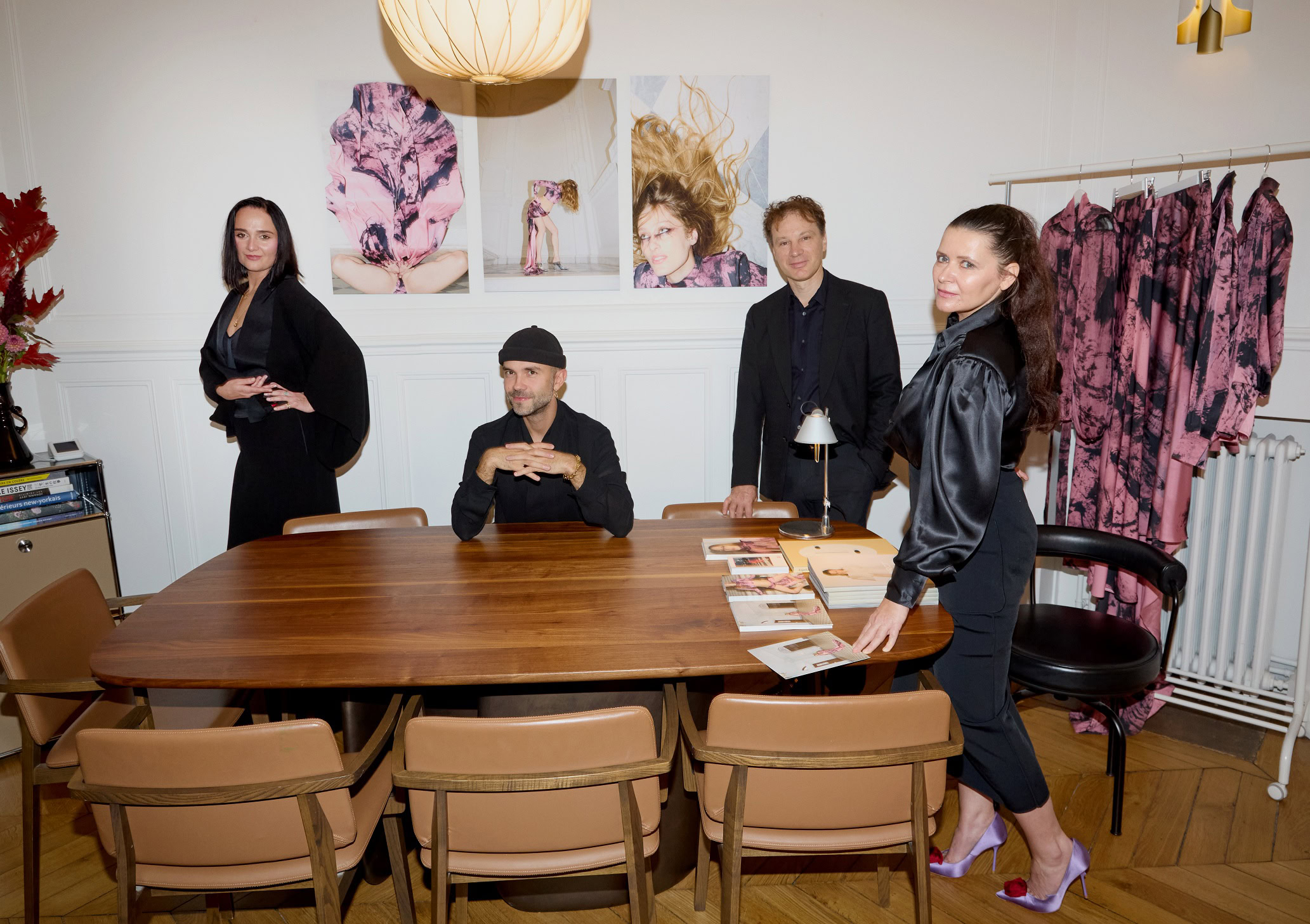
For Joanna Hawrot, fabric is language, where each pattern, cut, and movement functions as a code, while fashion becomes a space for storytelling. Inspired by the Polish School of Artistic Textiles and the Japanese philosophy of jūnihitoe, Unseen Threads embraces layered narratives and highlights voices excluded from mainstream fashion, like the elderly, transgender individuals, and outsiders. Hawrot’s garments, alongside Angelika Markul’s new series of wax sculptures and Zuza Krajewska’s photography, weave together Polish textile traditions, Japanese aesthetics, and contemporary narratives of visibility and self-expression in the new Visible Futures exhibition.
With the support of Adam Mickiewicz Institute and Institut Polonais Paris, Angelika Markul and Arnaud Lutellier invite visitors to their 19th-century hôtel particulier to experience a dialogue between art, fashion, and identity.

Alicja Stąpór: Angelika, could you tell us about the initiative of Maison Markul? What made you decide to open your private home to host exhibitions, and what has been the programme focus so far?
Angelika Markul: The initial idea of this kind of space, physically and somewhat metaphorically, has been growing in my mind for some time now. After years of filming around the world and collecting extensive footage, I’ve always wanted to find a way to archive and share those experiences. Having traveled to some of the world’s most remote places like Chernobyl in Ukraine, El Calafate in Patagonia, Yucatán Peninsula in Mexico, Sweetwater in Texas, Broome in Kimberley Coast in Australia, Fukushima, and the Yonaguni underwater ruins in Japan, or the Atacama Desert in Chile, I felt that I should start archiving my journeys and creating a physical space where I could share those stories and invite other artists, researchers, poets, to develop a conversation. Since all of my journeys were collaborative projects and happened thanks to the support of other driven individuals, it feels natural to now offer a platform for multidisciplinary dialogue.
This vision has grown into Maison Markul, a fonds de dotation project functioning as a foundation under French law. Inspired by places like the Fondation Giacometti in Paris, where Giacometti’s work is shown in a dialogue with that of other artists, last year I decided to establish Maison Markul with my husband, Arnauld Lutelier, and my long-time collaborator and now artistic director, Paola Soave. Sharing our commitment to art and design, my husband and I opened our home in the 7th arrondissement of Paris to host events built around our art collection and the initiatives we want to support. Our first exhibition, organised with LETO Gallery in Warsaw, paired my sculptures with works by François Ristori, whose estate Paola Soave is closely connected to. This was followed by a design exhibition in collaboration with COLAAB Gallery, presenting works by Nicolas Momein, Morgane Tschiember, Nicolas Delprat, Xiao Fan Ru, alongside my bronze table created specially in collaboration with COLAAB.
I believe that inviting art into private spaces creates a certain kind of intimacy, a bond between works that is challenging to establish in an institutionalised space. This intimacy provides a very personal and safe space for dialogue and discussion, and the upcoming exhibition with Joanna Hawrot, Visible Futures, is an example of such exchange. A dialogue between art and fashion, where we can freely speak of matters that are close to our hearts.
“I believe that inviting art into private spaces creates a certain kind of intimacy, a bond between works that is challenging to establish in an institutionalised space.”
— Angelika Markul
A.S.: Now, Visible Futures in Maison Markul is a continuation of the Wearable Art – Unseen Threads exhibition, first presented in Osaka during EXPO 2025 in Daimaru Shinsaibashi. Joanna, tell us about the experience of showing your work in these circumstances and how it influenced the narrative of Visible Futures.
Joanna Hawrot: Following the success of the Osaka exhibition, we are delighted to expand its scope to Europe with the invitation of Maison Markul and the support of The Adam Mickiewicz Institute. Wearable Art – Unseen Threads was a project bringing together fashion, art, and new media, inspired by the Polish heritage of artists such as Wojciech Sadley and Magdalena Abakanowicz. Having been invited by the Adam Mickiewicz Institute to work on this project, I collaborated with Paweł Pachciarek, and together we created the concept for this exhibition during the EXPO 2025 in Osaka.
It consisted of 30 kimonos that I designed especially for this project, and the photography of Zuzanna Krajewska, who helped me to sharpen the visual language and portray my characters. My main inspiration was the Japanese tradition of jūnihitoe from the Heian period, a court twelve‑layer female garment. I was particularly inspired by the complex layeredness, which back then was a symbol of the transformation of the seasons and colours. I wanted to embrace this theme of transformation and reflect on it from a perspective of the ever-changing nature of feminine experience. I decided to create twelve stories around twelve women, six from Poland, and six from Japan.
Having presented this vision in the Daimaru Shinsaibashi, a place that has a long-running history of creating court kimonos, it all became organically connected with the roots of my practice. Unseen threads was therefore about the invisible connection between transcultural similarities, amplifying voices marginalised in mainstream fashion, the elderly, transgender communities, and outsiders. This evolved into a thought I discussed with Paweł Pachciarek, to shift the narrative from the unseen to the visible, and that way to observe the visible changes in our lives, bodies, and embrace them within the visual language of the exhibition.
Now we are travelling with those ideas to Paris at the invitation of Angelika Markul and Maison Markul to present the second stage of the Osaka exhibition. Unseen Threads was conceived as a project dedicated specifically to Japan, while Paris will host a new chapter focusing on the visibility of the future.

A.S.: Angelika, it is not the first time that you have collaborated with Joanna. The two of you already created a collection of garments together, and now you presented your sculptures during her exhibition, Wearable Art – Unseen Threads, in Osaka. Could you tell us more about your collaboration and this series in particular?
A.M.: My earlier collaboration with Joanna was quite a bold project. I think we both have this urgency within to speak of things that concern us, and to do so freely. We worked on a design for kimonos with my drawings imprinted on the textiles. Those were erotic, very feminine themes and drawings. We wanted to create a piece of clothing that felt liberating to own and wear. For Joanna’s exhibition in Osaka, I proposed to present my latest sculptures that are in dialogue with my recent movie Haunted House, exploring the Medieval Castle of Fougeret, known to be the most haunted place in France.
Alongside the film, I created a series of wax sculptures inspired by the fauna of the film, which extend the narratives of the screening into the physical space. Those sculptures symbolise the mysterious, the unseen, the private, the intimate, the haunted of a self and of the spaces we inhabit. The animal and heart sculptures that we will present during Visible Futures are symbols of metaphysical elements of our lives, of something hidden yet equally present in every one of us.
A.S.: And beyond your work with Maison Markul, you are actively exhibiting internationally. Could you share some insights into your most recent projects?
A.M.: Yes, I am mostly engaged in my studio time and organising international exhibitions. At this moment, I am mostly focused on production for a show I will have in the Mac Val Museum in Paris. Back in May, I had an exhibition at Albarrán Bourdais in Madrid, which was my third time having a chance for a solo show there, this time presenting Haunted House, alongside my wax sculptures, paintings, and an audio composed specially for the exhibition by Wojciech Puś. Then this summer, I presented my film 1335 Meters (2022), which focuses on the recent discovery and drilling of a crater, an attempt to explain the mystery behind the dinosaurs’ extinction, during the Pulse of Life exhibition at the Daegu Photo Biennale.
The 10th Daegu Photo Biennale examined the diversity, fragility, and resilience of life, showing works that question our understanding of nature and humanity’s place within the cosmos, so it was a great fit contextually. In June, I contributed to the Unseen Threads exhibition in Osaka, which led to Visible Futures with Joanna Hawrot, Zuza Krajewska, and Paweł Pachciarek, now being introduced to European audiences during Art Basel Paris at Maison Markul. During this year’s Art Basel Paris, apart from organising Visible Futures at Maison Markul, I am participating in French Collection, an exhibition organised by The French Center of Design, presenting 100 works by artists and designers at Hotel Dassault in Paris, happening from October 20 to 25. My sculptures are also shown during a Showroom exhibition at my Gallery Albarrán Bourdais for the occasion of the Art Basel week.

A.S.: For this project, Joanna, you collaborated with other Polish creatives – not only Angelika, but also Zuza Krajewska and Paweł Pachciarek. All have contributed to the sharp visual and conceptual execution of this project, creating a very specific universe where fashion and art blend to create a dialogue of liberation and identity beyond divisions. What made you decide to work with them, and how do you reflect on this collaboration?
J.H.: My practice has always been very much based on finding a certain togetherness of ideas and execution with other creatives. Equally, in the case of this project, to create the elaborate visual and contextual language, I collaborated with Zuza, Angelika, and Paweł; each of them brought an essential perspective, and helped to sharpen my vision.
Since 2016, I have been working with photographer Zuza Krajewska on projects that directly explore themes of femininity, the body, and marginalised individuals. Elements that resonate with us personally and professionally, inspiring us to explore different facets of femininity. Our practice invites protagonists who rarely have access to the world of fashion, opening a dialogue between fashion and art. Performative, paratheatrical, and movement-based elements play an essential role in our work.
With Angelika, we have also been in conversation for years now. Having created collections of kimonos together, we have been supporting each other’s work and enriching the themes that interest us both. For me, her heart sculptures presented during Unseen Threads and Visible Futures are like bridges for emotions that cannot be expressed through textiles or images. They resonate on an emotional level that reaches beyond any other medium. Something very carnal, intimate about the way Angelika works with wax, makes me incredibly intrigued by her works, and therefore, in the case of these two exhibitions, I just knew her work had to be part of the narrative.
The exhibition is curated by Paweł Pachciarek, an Osaka-based curator, who initiated the project and selected the location in Daimaru Shinsaibashi. His curatorial vision unites new media, art, and fashion; he has a profound understanding of Japanese art and culture. The way he was able to orient my practice within the Japanese context was truly flattering. He created a sharp concept that embraced my work and his own curatorial research. The continuation of the Osaka project in Paris thus speaks of the understanding and appreciation we all share for this collaborative encounter.
“My practice has always been very much based on finding a certain togetherness of ideas and execution with other creatives.”
— Joanna Hawrot
A.S.: Both Unseen Threads and Visible Futures speak of femininity, of a somewhat collective experience of womanhood. In what ways does this project weave together visibility and questions about the future? What does the future mean to you?
J.H.: The story continues, expanding the concept of the twelve layers and deepening it through the voices of more women, telling our shared story across different perspectives and social stages. In the context of the Parisian exhibition, we understand pregnancy as a core reflection of the future. This chapter will focus on underage mothers and the transformation from girlhood into womanhood. Here, transformation becomes not only the theme but also the lens through which we imagine the future of a woman. Femininity becomes a symbol of a portal to what lies ahead, embodying this threshold between present and future.
I want to initiate a dialogue on the ever-changing experience of being a woman, to speak of transformation as an inseparable aspect of womanhood. Becoming a daughter, becoming a woman, becoming a mother. We focus on the emotions and experiences that accompany women through the stages of transformation in their lives, and through each medium presented, I seek to express this theme in a subtle yet specific way. In the context of the Paris exhibition, we understand pregnancy as a core reflection upon the future. During Visible Futures at Maison Markul, we invite the viewer to consider how the future can become tangible. By situating the exhibition within a private setting of Maison Markul, rather than a neutral white cube, the curatorial choice brings forward themes of intimacy, hospitality, and the politics of display.


