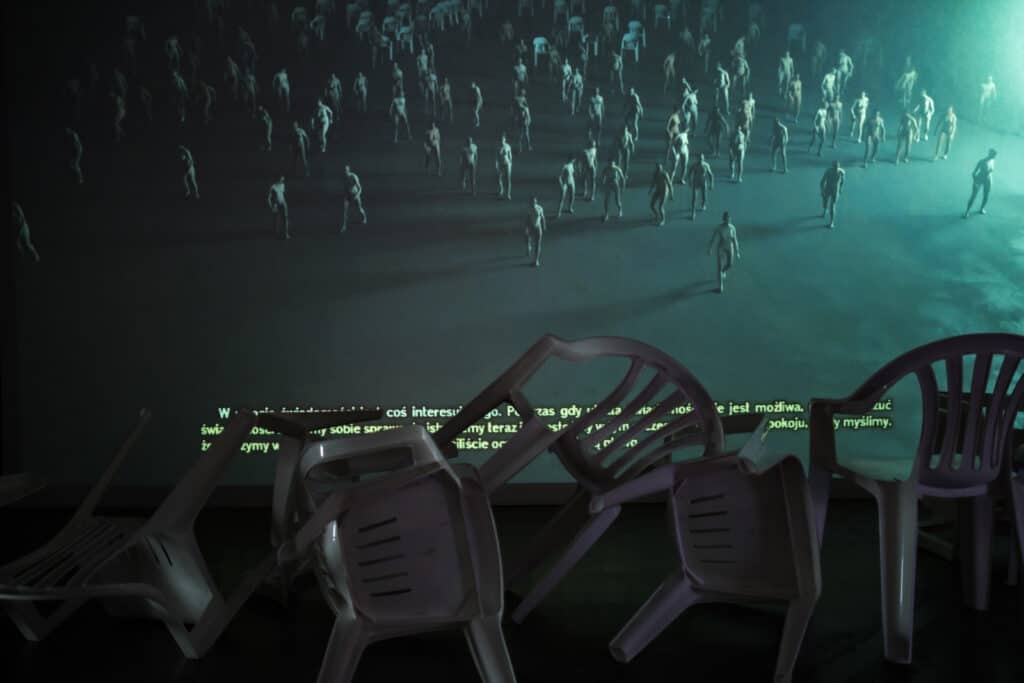
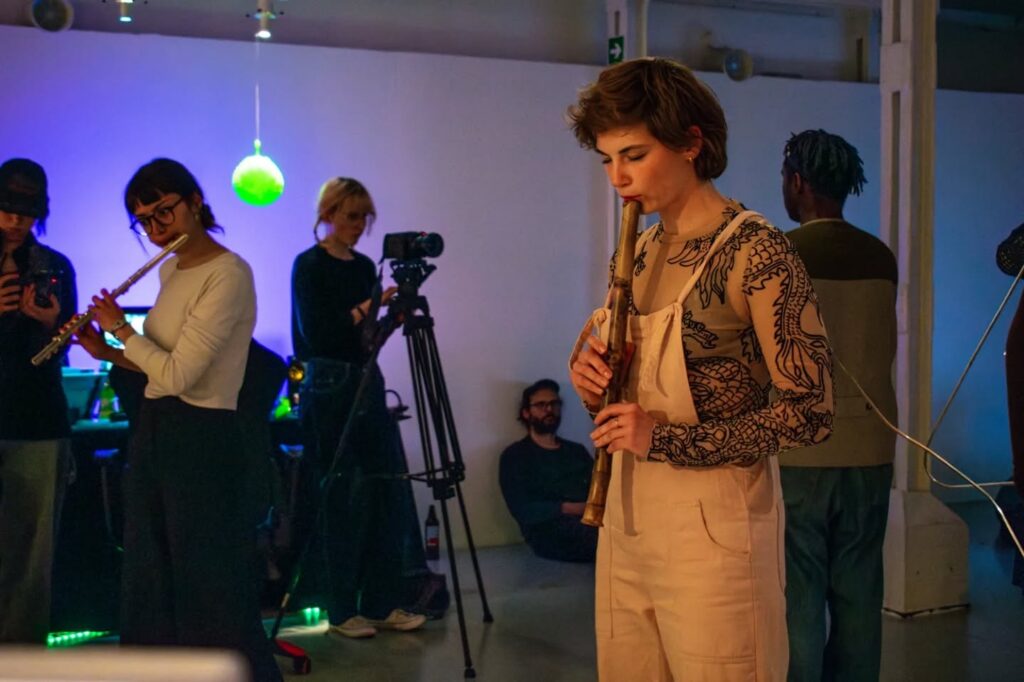
Karina Synytsia (b. 1999) is a Kyiv-based artist working through painting, collage, and site-specific intervention, who constructs visual worlds shaped by displacement and the ongoing realities of war in Ukraine. Her paintings and installations occupy a space between memory, architecture, and psychological fragmentation. Across her practice, she remains deeply attentive to the emotional and symbolic charge carried by material environments — domestic interiors dissolve into dreamscapes, industrial structures become monuments to historical rupture, and landscapes appear suspended in a state of uneasy stillness.

Born in Siverskodonetsk in the Luhansk region, a city currently under Russian occupation, Synytsia’s practice is rooted in what she describes as “landscapes, architecture, and the political and social traces that remain within these spaces.” Rather than approaching war through direct representation, she works through indirect imagery, vernacular objects, and emotionally charged environments that speak to instability, absence, and survival. Walking itself becomes a recurring method within her research-based practice: a way of tracing how cities, ruins, and natural spaces accumulate historical residue.
Rather than approaching war through direct representation, she works through indirect imagery, vernacular objects, and emotionally charged environments that speak to instability, absence, and survival.
Onirism and the Post-Soviet Image
Her paintings frequently draw upon the visual language of post-Soviet urbanism. Concrete facades, industrial ruins, communal spaces, and infrastructural remnants recur throughout her compositions, though never as straightforward representations of place. In Nowhere (2022), architectural form becomes a psychological metaphor. A towering concrete barrier cuts through an otherwise open landscape, dwarfing the small figures positioned before it. The painting evokes the monumental severity of Soviet modernism, yet its atmosphere remains deeply unstable. Space flattens, scale shifts unnaturally, and the wall begins to function less as an object than as a condition, an embodiment of estrangement, paralysis, and uncertainty.

This dreamlike instability connects Synytsia’s work to traditions of Symbolism and Surrealism, though her approach is markedly restrained. Rather than adopting surrealism’s theatrical absurdity, she builds quieter forms of disorientation through composition and spatial collapse. Her paintings resemble collaged recollections: fragments of industrial zones, apartment blocks, stairwells, and empty fields assembled into psychologically charged environments where memory drifts between personal experience and collective history.
Synytsia has described architecture as “a silent witness to political events,” and this idea becomes central to understanding her practice. Buildings in her work are never passive backgrounds; they absorb violence, displacement, and emotional memory.
Synytsia has described architecture as “a silent witness to political events,” and this idea becomes central to understanding her practice. Buildings in her work are never passive backgrounds; they absorb violence, displacement, and emotional memory. Through painting, she examines “how landscapes remember and how nature continues to exist within systems of destruction and subsequent restoration.”

In Fantasy (2023), this tension materialises through an ambiguous, dreamlike environment where a vacant architectural structure hovers within a darkened landscape. Two stark vertical forms frame the composition like monuments or remnants, while a lone figure drags a fragment of text across the foreground, introducing a sense of narrative rupture and psychological displacement. The painting’s blurred edges and unstable atmosphere resist fixed interpretation, allowing the scene to oscillate between memory, ruin, and hallucination. Organic and architectural forms coexist uneasily, suggesting that persistence and decay remain inseparable within landscapes shaped by war and historical trauma.
Her compositions also resist perspectival logic. Walls tilt, interiors unfold unnaturally, and landscapes feel staged rather than inhabited. This collaged spatiality reinforces the sensation that these are emotional reconstructions shaped by trauma and recollection rather than direct depictions of reality.

Painting Through Wartime
Following Russia’s full-scale invasion of Ukraine in 2022, Synytsia’s work became increasingly charged with atmospheres of precarity and dissonance. The Ultra-Naivety series introduced a visual language where devastation and absurdity coexist. In works such as Scorched Earth (2022) and Wall of Disbelief (2022), flattened graphic symbols and almost childlike motifs interrupt scenes of destruction and abandonment.

The resulting tension is deeply unsettling. Burned fields, playground structures, and emptied domestic spaces become sites where humour and catastrophe collapse into one another. These paintings capture the emotional instability of prolonged crisis, the coexistence of numbness, irony, grief, and survival that often defines wartime experience.


This tension continues in Welcome to Paradise, Synytsia’s solo exhibition of works produced between 2022 and 2025, presented in the Artsvit Gallery, Dnipro. Throughout the exhibition, she draws on the decorative photo wallpapers that proliferated in post-Soviet domestic interiors during the 1990s and early 2000s. Idealised images of tropical islands and artificial coastlines are overpainted with scenes of destruction and ecological collapse. The collision between decorative fantasy and violence transforms nostalgia into something uncanny, reflecting on occupied homes and altered landscapes under conditions of war.
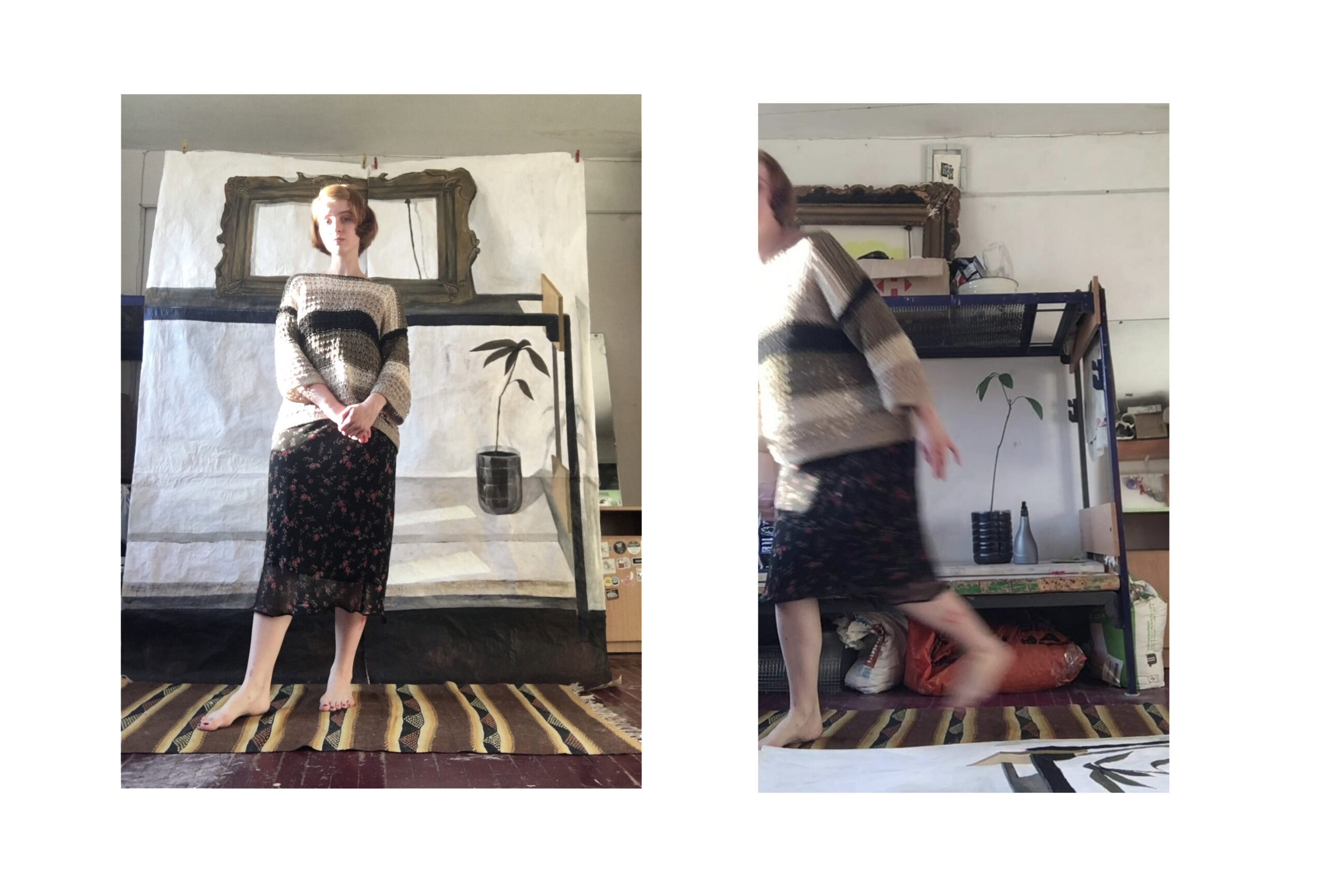
Material fragility also becomes politically significant in works such as Fast, Easy Memory Transfer (2022), where Synytsia reproduced a life-sized image of her dormitory room onto kraft paper rather than canvas. The light weight of paper transforms the painting into something portable and provisional, reflecting the instability of home under displacement. Memory here becomes fragile, transportable, and perpetually unfinished.
Monumental Fragility
Her recent wall painting Дикий Виноград (Wild Grapevine), commissioned by Lothringer 13 Halle as part of the project Antifascism: Now in collaboration with the Goethe-Institut, marks a significant expansion of these topics into monumental and site-specific practice.

Painted in 2026 across the staircase of the gallery’s former industrial building, the sprawling vine motif transforms the architecture into a living memorial shaped by displacement, labour histories, and ongoing violence. Drawing upon imagery connected to her childhood home in Siverskodonetsk, the vine operates simultaneously as a symbol of rootedness and loss. The original grapevine once climbed through several floors of her family home before drying out following the invasion and her family’s displacement. Reconstructed through archival photographs gathered across Odesa, Zaporizhzhia, and Kyiv, the vine becomes both a memorial and a continuation.

Synytsia describes the work as emerging from reflections on “rootedness, fragility, and survival under conditions of violence.” Organic forms spread across the rigid industrial architecture of the staircase, interrupting its severity with gestures of persistence and mourning. The mural also repositions wall painting against the legacy of Soviet monumentalism. Rather than functioning as an ideological spectacle, the work transforms mural painting into what the artist calls “a living structure of memory,” foregrounding vulnerability instead of heroic permanence.

This engagement with architecture as a carrier of layered histories also appears in I Hope the Sky Doesn’t Fall on the Sea (2024), created during a residency in Uzhhorod. Painted throughout the perimeter of a modernist hotel room in the Intourist-Zakarpattia building, the mural unfolds as a fragmented apocalyptic landscape populated by fossils, skeletal remains, dismembered limbs, teeth, shells, and submerged organic forms scattered across barren terrain.

Referencing biblical imagery, natural history museum dioramas, and the visual language of church frescoes, the work constructs a claustrophobic cycle of decay and renewal. The room itself becomes immersive, surrounding the viewer with imagery that feels both archaeological and prophetic, as though the walls were preserving traces of a civilisation already in collapse. Rather than presenting catastrophe as a singular event, Synytsia evokes it as a slow geological and historical process, where ecological destruction, extinction, and human violence become inseparable from the landscapes that contain them.
In her hands, painting becomes both an archive and an act of resistance, a fragile structure through which memory, displacement, and survival continue to unfold.
Overall, across her works, Synytsia continues to develop a visual language shaped by fragmentation, instability, and persistence. Her works resist spectacle, instead constructing quiet yet deeply unsettling environments in which architecture absorbs the emotional residue of historical violence. In her hands, painting becomes both an archive and an act of resistance, a fragile structure through which memory, displacement, and survival continue to unfold.

BIO
Karina Synytsia was born in Siverskodonetsk, Luhansk region, Ukraine, and currently lives and works in Kyiv. She graduated from the Department of Fine Arts of the Kharkiv Art College, majoring in painting. In recent years, Synytsia has participated in residencies and exhibitions across Ukraine and Europe, including projects in Germany, Poland, Italy, and Romania. Her inclusion in exhibitions such as The Woman Question. 1550–2025 at the Museum of Modern Art in Warsaw, Secondary Archive: Women Artists in War at Galeria Labirynt, and Antifascist Cultures of the Present at Lothringer 13 Halle reflects the growing international recognition of her work within conversations surrounding contemporary Ukrainian art, feminist practice, memorialisation, and postwar reconstruction.