






Liliana Zeic, formerly Piskorska (b. 1988), is a Warsaw-based visual artist with a PhD in Fine Arts. She roots her work in historical research, analysing social issues through the lens of queer ecologies and feminism. Her work interlaces different tangibilities, techniques, and temporalities. Creating “everything but painting” – on the intersection of video, photography, performance, and text, Zeic bridges the past with the present and personal with public. She returns to traditional woodworking methods like intarsia to explore connections between her intersecting identities, private life, herstories, and the environment. Her craft embraces the “other” among people and flora, and does so with a truly radical empathy.

In her most recent exhibition, First Year They Sleep, Second Year They Creep, Third Year They Leap (2025), vegetal motifs mingle with naked human bodies in a promise of an alternative deepwater society. She imagines a space where all kinds of outcasts can flourish – from relic species to societal rejects. This welcome of the “abnormal” goes beyond the thematic plane – it permeates the materiality of her handiwork-inspired pieces. The artist’s turn to craft demands time and precision in the age of short-form content and same-day delivery. The “wood collage” technique of intarsia possesses a subversive quality, as does every warped ring of its burr wood “canvas”.

Traditionally used in floor and furniture decor, burr is a tree growth caused by the swelling of an infected or otherwise damaged trunk. The resultant patterns, beloved for their decorative value, are in fact nothing but a scar – a testament to the tree’s struggles. Zeic’s use of poplar burr intarsia in queer-ecological frameworks taps into traumatic memory, at once transforming past pain into bright visions of the future. In her splintered utopia, “weed species” like poplar can be refigured as worthy of aesthetic use. What unfolds is a questioning of the “norm”/”anomaly” boundary across ecosystems and societies.

Crafting Alternative Worlds
A similarly inquisitive impulse permeated the 2023 exhibition Let’s Slip a Moist Flax Seed into a Soil at lokal_30 in Warsaw, in which Zeic once again turned to intarsia, tracing bidirectional relationships between nature and queer environments. At the core of the artist’s practice – to echo the title of her PhD thesis – is a “desire for contact” in and outside the social space. The use of handicraft methods, which Zeic has been increasingly drawn to starting from 2020, allows her not only to break the human/nature dichotomy – but also, as her other works prove, to draw together marginal experiences from distant timescapes.

Woodwork arises as a means of connecting with those who came before her – from carpenter parents to early-20th-century craftswomen like Natalia Bobrówna, Cecylia Chalus, and Antonina Dunin. Zeic pays tribute to the latter three – and many other forgotten female practitioners of decorative arts – in My Hands are Full (2024) exhibit at Lisowski Gallery in Warsaw. There, the artist doubles as a queer archivist, uncovering homosocial (or, indeed, sapphic) connections between the women. “I’m not a historian”, asserts Zeic in the Queerstorie podcast. “I can play around more, I can create an experience that is more transformative. I’d like to add to the story. This is the freedom that contemporary art gives me”. For the artist, creative practice then emerges as an opportunity to fill in gaps and silences in history. She, for instance, creates an intarsia portrait of Bobrówna – of whom no photos or paintings remain – or references Chalus and Dunin’s alleged life-long relationship. Zeic crafts against the grain of cis-heteronormative historical narratives, unveiling forgotten queer feminist contexts in Polish (art)history. Initiated in 2020, her Sourcebook series is an ever-expanding archive of the country’s non-normative past.

Beyond Binaries
The artist’s queer-archivist sensibility traverses various artistic techniques. Her performance, A Pine with Six Hands (2020), commemorates Alma Dina de Paradeda, one of the first transgender women described in the European press, who committed suicide in Breslau (now Wrocław) in 1906. Zeic collaborates with drag performer Twoja Stara (Your Mum) to present a fairytale narrative of de Paradeda’s life – one that refuses deadnames or “masculine” gendered language. Performed originally in Wrocław, A Pine constitutes yet another example of Zeic’s interest in relationships between people and their surroundings.
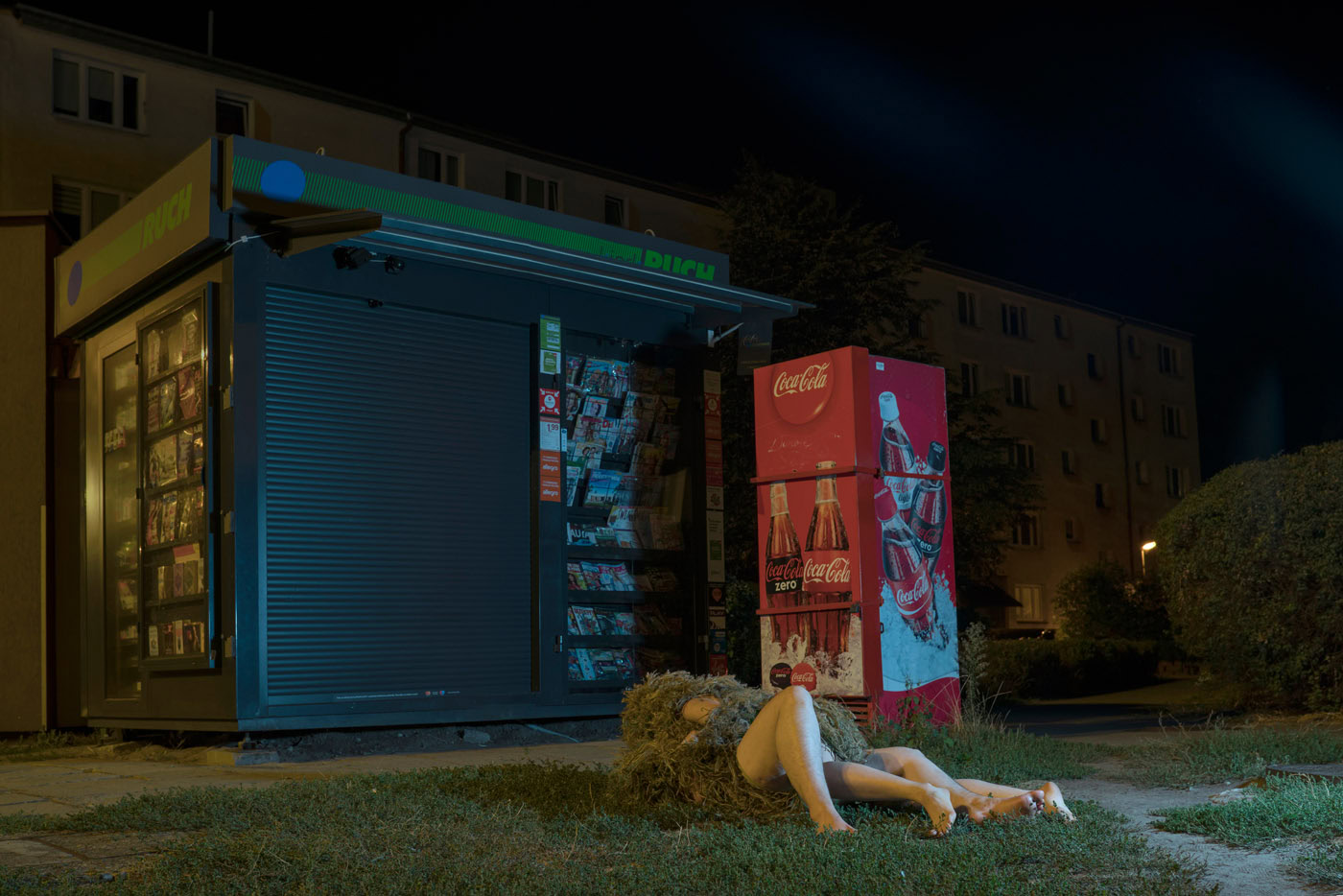
Like My Hands are Full, A Pine illuminates submerged queer-feminist histories. The piece, however, achieves this effect through very different means, reminding us that Zeic creates across social and artistic divisions. From craft to performance, fairytale, and historical narrative, her oeuvre questions the tenets of contemporary society.
Zeic unsettles the human/nature dichotomy of the Anthropocene; meanwhile, capitalist and cis-heteronormative ideas of linear time and progress crumble in her mingling of past and present with visions of the future; what remains is a radical empathy for the “other” within and outside of one’s own experience.

Zeic works at the Faculty of Art Mediation at the Academy of Fine Arts in Wrocław. Her work has appeared in over 140 individual and group exhibitions in Poland and abroad; among others, in Zachęta National Gallery of Art, Wrocław Contemporary Museum and Municipal Gallery Arsenał. She is the finalist of the 2017 Forecast Forum in Berlin’s Haus der Kulturen der Welt and an Audience Award recipient during Views 2019 in Zachęta. She is represented by lokal_30.


