



Organic sculptures, as if sent from another world. Their irregular structures evoke geological formations, strange creatures or contemporary totems. In Matyáš Chochola’s work, seemingly distant elements meet in unexpected configurations. Rusted barrels, fragments of popular culture, references to ancient rituals and monumental hybrid sculptures form phantasmic landscapes. Moving between sculpture, installation and performance, the Czech artist explores different dimensions of contemporary life.
Chochola’s works combine 3D-printed concrete with different materials, visual languages and ideas of nature, creating forms that seem to belong simultaneously to the present and an imagined future.
This approach comes into focus in Virtues and Vices of Our Time, presented at Frieze Sculpture 2026 and curated by Fatoş Üstek in London’s Regent’s Park. Three monumental sculptures — METEOR, BRUTALIST and MACE II — occupy the English Gardens as if they had arrived from another world. Are they natural formations or artificial constructions? Resonating with the exhibition’s theme of vibrant hybrid ecology, Chochola’s works combine 3D-printed concrete with different materials, visual languages and ideas of nature, creating forms that seem to belong simultaneously to the present and an imagined future.

Old Virtues, New Vices
The series draws on the Baroque cycle Virtues and Vices by Czech sculptor Matthias Bernard Braun, created between 1718 and 1720 for the Kuks hospital complex. His twenty-four allegorical figures personified Christian moral qualities and shortcomings through recognisable forms and attributes.
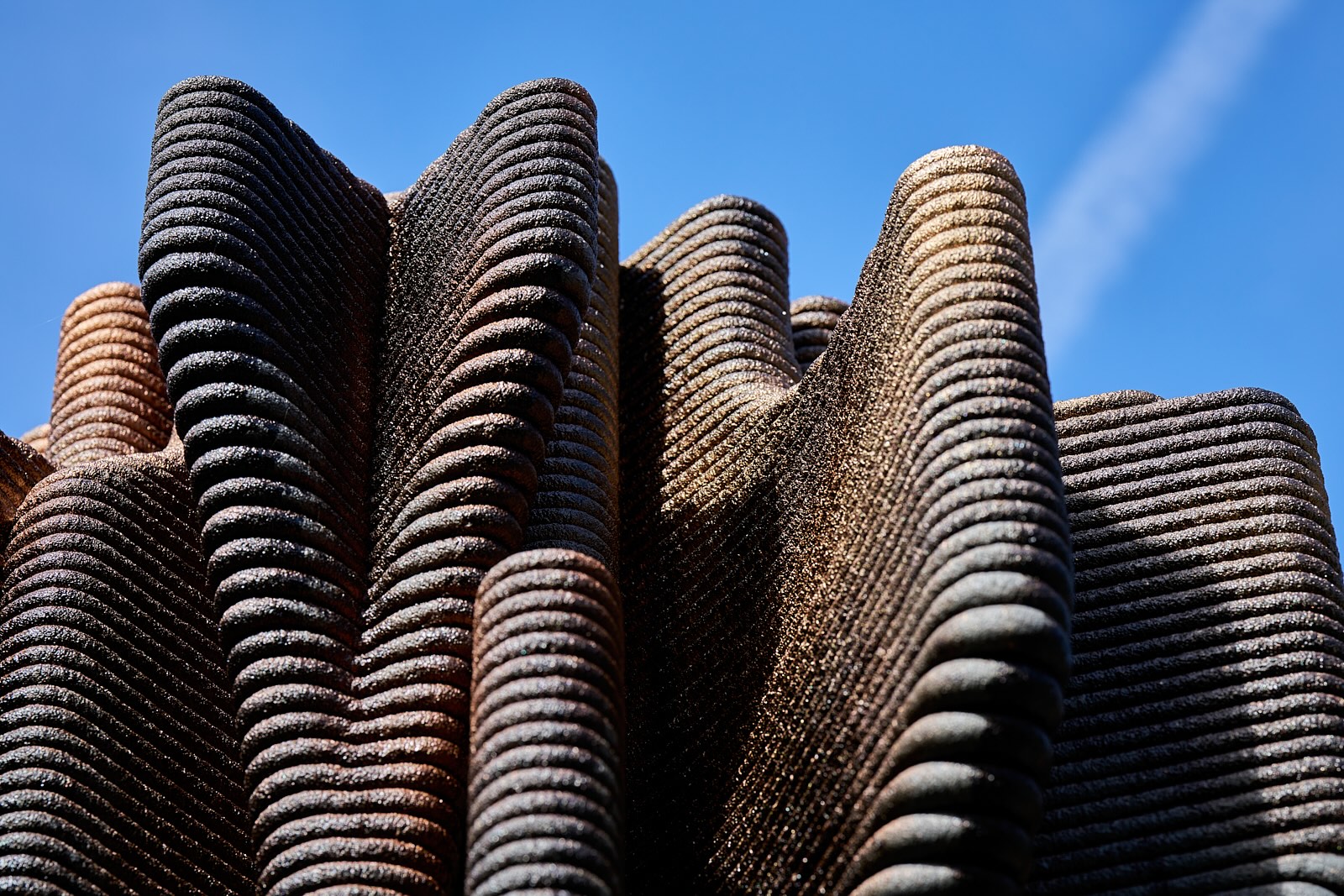
Instead of translating the figures one by one, Chochola developed twelve hybrid forms, combining the essence of the original allegories. Their visual language moves across Antiquity, Cubism, Brutalism, science fiction, mythology and contemporary popular culture. Their roots appear to anchor them in the ground, while their upper structures reach in different directions, like totems carrying fragments of multiple cultures and belief systems. This clash of forms and references allows the artist to represent a different understanding of morality — one that is not unified by a higher authority and remains open to interpretation. A more humane portrayal that takes into account that our actions are rarely black-and-white.

Material experimentation — central to Chochola’s practice — accentuates the ambiguity of the forms even further. For Virtues and Vices of Our Time, the artist explored 3D concrete printing: the sculptures, three to four metres tall and around one tonne each, were robotically produced and then manually processed. He pushed the technology beyond conventional parameters. Different component orientations, non-planar printing paths and large overhangs supported by lightweight clay aggregate disrupted regular structures. Programmed irregularities introduced controlled glitches. The concrete was then ground, carved and polished by hand, while glass, bronze, brass and pigments were added. The resulting forms sit between machine and human gesture, digital and physical, industrial and traditional.

A similar curiosity drives Experimento (2022), an exhibition conceived specifically for raw underground spaces. Moving along a trajectory from glass to bronze and neon, Chochola combined traditional craftsmanship with a contemporary, uncompromising aesthetic. Light, shadows and sound transformed the basement into an immersive environment resembling a shamanic cave, where materials seemed to acquire new meanings through their surroundings. The exhibition extended beyond sculpture to include Chochola Gang, the artist’s original clothing and T-shirt collection, presented at the opening. Here, experimentation becomes a way of moving beyond established artistic boundaries, allowing sculpture, fashion and spatial experience to converge.

A Clash of Different Realities
A different dimension of Chochola’s practice emerges in The Alchemist, presented at London’s Gossamer Fog in 2021. The installation resembles a travelling druid-alchemist’s workshop, between laboratory and ritual space, exploring ancient knowledge, spiritual practices and natural materials. Glass sculptures, formulas written in a language invented by the artist and objects associated with natural forces create an atmosphere of discovery. Tree of Life, combining gold-plated steel, hand-blown glass and copper, and Alchemist’s Stone, made from molten glass, use materials with symbolic associations, making transformation both physical and spiritual.

The artist’s interest in combining different realities is also evident in his earlier works, such as Magic, Exotic, Erotic (2016), presented as a multimedia installation at the Jindřich Chalupecký Award finalists’ exhibition in Prague’s Veletržní Palace. Chochola stages a world of controlled chaos where industrial decay and underground culture come together in an immersive, sensory environment.

Construction rubble and discarded materials, the smell of dust, and loud rap music performed and developed by the artist for the show transform the gallery into something resembling a building site or an underground ritual space. Sculpture, painting, video and performance intertwine with references to 1990s pop culture, creating a Gesamtkunstwerk (a total work of art) that blurs the boundaries between high and low culture, artistic production and subcultural expression. The installation’s disorder follows its own internal logic, bringing seemingly disparate elements into a strange harmony. With the artist’s presence receding, the viewer becomes an active participant, free to navigate the space and develop their own associations.

Throughout his work, Chochola allows the different realities he brings together to coexist rather than trying to resolve their internal contradictions. Moving between the sacred and the profane, the organic and the artificial, the ancient and the contemporary, he’s like an explorer navigating unfamiliar territory, guiding the viewer towards new ways of understanding the world that go beyond the established order.
Chochola stages a world of controlled chaos where industrial decay and underground culture come together in an immersive, sensory environment.

BIO
Matyáš Chochola (b. 1986) is a Czech artist working across sculpture, performance and site-specific projects. He studied at the Academy of Fine Arts in Prague and Universität der Künste in Berlin. Chochola was awarded the Václav Chad Award in 2012 and the Jindřich Chalupecký Award in 2016. His work has been exhibited across Europe, including the Czech Republic, Poland, Italy, Switzerland and Denmark; he also participated in Manifesta Biennale 11 in 2016 in Zurich.