The practice of Mia Akrap (b. 1995) unfolds through an ongoing investigation of memory, inheritance, and transformation. Working across painting, ceramics, sculpture, and installation, the Zagreb-based artist constructs visual languages that emerge from autobiography while engaging broader questions of gendered experience and intergenerational transmission, creating spaces where individual memory intersects with collective histories.

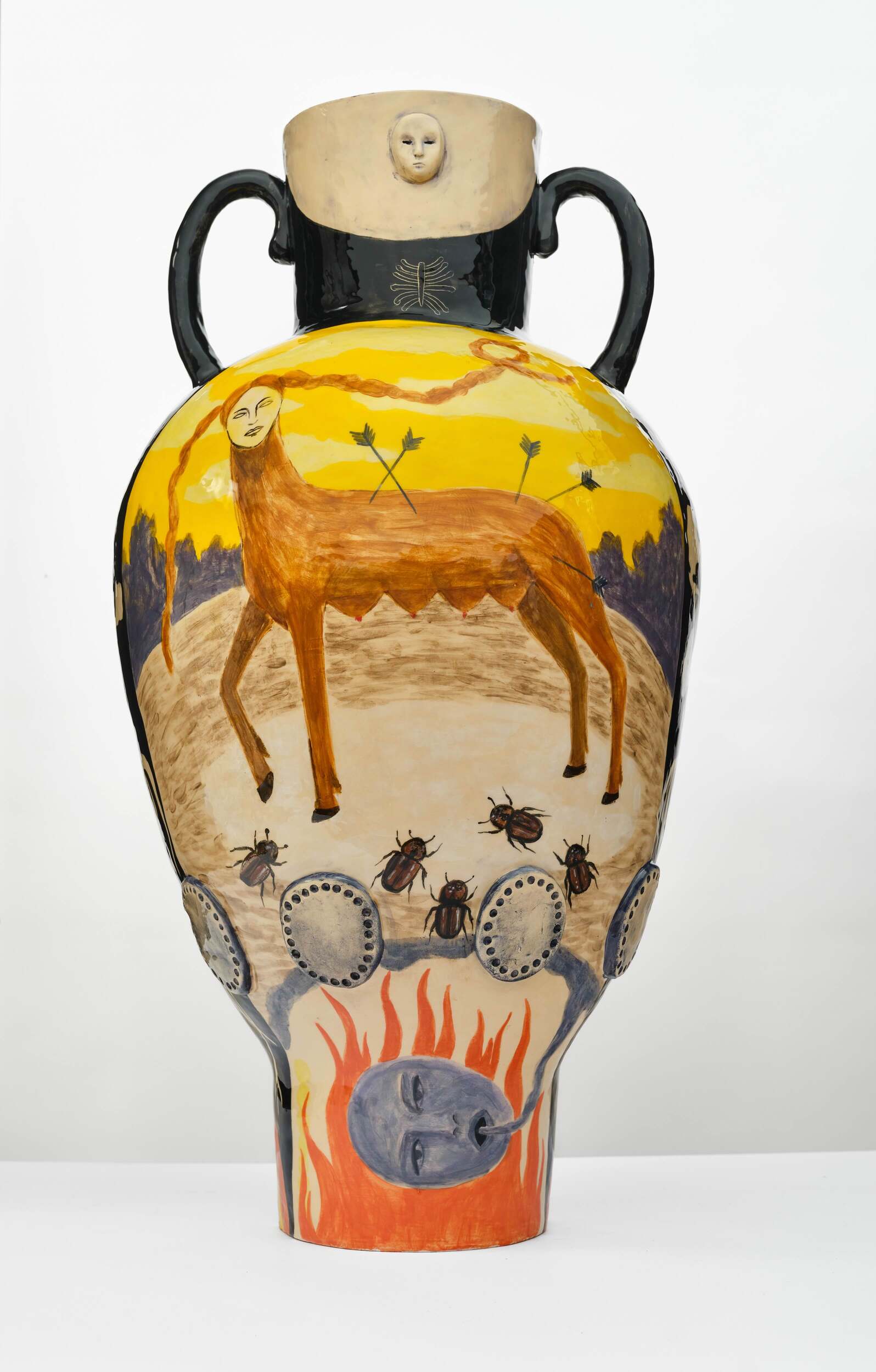
Although painting remains central to her practice, ceramics have become an increasingly significant site of inquiry. Clay offers Akrap a medium through which memory can be materially embedded, layered, and transformed. Recurring motifs, water, hair, cords, female figures, animals, and fragmented bodies form an iconographic system that appears across media, establishing connections between lived experience and symbolic representation. In her practice, memory functions as a dynamic process of transmission and transformation, carrying emotional, behavioural, and cultural traces across generations.
Although painting remains central to her practice, ceramics have become an increasingly significant site of inquiry. Clay offers Akrap a medium through which memory can be materially embedded, layered, and transformed.


Constructing Subjectivity
Painting occupies a central position within Akrap’s practice, functioning as the conceptual anchor from which her sculptural and ceramic works often emerge. Memory Studies (2023–2024) unfolds as a series shaped by the artist’s engagement with personal recollections alongside conversations with women from diverse social and cultural contexts. Through these exchanges, Akrap explored how experiences are internalised, interpreted, and carried across different stages of life, constructing a body of work that moves between individual narratives and shared forms of experience.

One of the paintings from the series, It started around my eyes (2023), presents three female figures within a fragmented landscape, connected through gesture and spatial proximity while remaining psychologically distinct. A reclining figure occupies the foreground, immersed in a luminous yellow field, while two standing figures emerge behind her. The veiled woman holding a bouquet evokes ritual and the social expectations attached to femininity, while the violet-toned figure’s raised arm introduces a sense of agency and resistance. Akrap reinforces these tensions through colour, contrasting the cool blue landscape with saturated violet and yellow tones to create an atmosphere suspended between intimacy and estrangement. The composition examines how identity is shaped through overlapping experiences, social roles, and forms of self-representation without resolving them into a singular narrative.

Viewed alongside her later ceramic works, Memory Studies reveals the emergence of an iconographic language that continues throughout Akrap’s practice. The emphasis on female subjectivity, transformation, and relational experience establishes concerns that later take material form in vessels, sculptural assemblages, and fountains. The shift in medium expands the scale of these investigations, while maintaining a sustained engagement with the structures through which experience is shaped and understood.
Interwoven: Networks of Connection
The ceramic work Interwoven (2026) exemplifies Akrap’s sustained interest in relational structures. The piece centres on the braid, a recurring motif within her practice that functions simultaneously as a physical form and a symbolic device. Hair appears throughout her work as a carrier of memory, identity, and lineage. In Interwoven, three naked women are braiding their hair together. They appear to be of different ages yet very similar to each other, suggesting that they may all be self-portraits of the artist at various stages of growing up or a portrayal of closely related women.

The braid possesses a particular significance within feminist histories and visual culture. It evokes care, intimacy, and inherited practices while also signalling the ways identity is shaped through collective experience. Akrap mobilises this symbolism through clay, translating the pliability of hair into a material characterised by permanence and fragility. The transformation of one material language into another reinforces the tension between continuity and rupture that underpins her practice.

The imagery on the reverse of Interwoven broadens this investigation through a constellation of recurring symbols. A multi-tiered fountain occupies the centre of the composition, establishing a vertical structure that connects ideas of continuity, nourishment, and generational passage. Surrounding elements, including landscape fragments, architectural forms, and a prominently positioned moth, extend the work’s exploration of transformation and becoming. Together, these motifs articulate a visual language in which inherited experiences move across time, accumulating new meanings while remaining connected to earlier histories. The fountain is particularly significant within Akrap’s practice, anticipating its later emergence as a central sculptural form through which questions of motherhood, memory, and transmission are examined.

The vessel form provides an important conceptual framework. Historically associated with containment, preservation, and domestic labour, the ceramic vessel acquires a psychological dimension in Akrap’s work. It becomes a metaphorical body that accumulates traces of experience. In Interwoven, the act of joining braids by the women suggests that memory remains embedded within networks of relationships and exceeds any singular point of origin. The work visualises inheritance as a process of entanglement, where personal histories are inseparable from broader familial and social structures.
Historically associated with containment, preservation, and domestic labour, the ceramic vessel acquires a psychological dimension in Akrap’s work. It becomes a metaphorical body that accumulates traces of experience.
Spring of Phantoms: Inherited Memory and Transformation
Water occupies a central position within Akrap’s recent ceramic practice, finding one of its most compelling expressions in Spring of Phantoms (2026). Conceived as a sculptural assemblage, the work extends her ongoing engagement with motherhood, kinship, and the formation of subjectivity. The circulation of water activates the composition, introducing a temporal dimension that draws attention to processes of continuity, change, and interdependence.

Structured through a vertical sequence of female heads, the work visualises lineage as a layered and evolving condition. Each figure appears connected to the next, creating a chain of relations that unfolds across generations. The title’s “phantoms” suggest inherited emotional residues and unresolved experiences that persist within family histories, shaping relationships long after their point of origin has faded from view. The female figure emerges as a site where inherited roles, expectations, and forms of knowledge are negotiated. Through its stacked configuration and continuous flow, Spring of Phantoms articulates genealogy as an active process — one shaped by repetition, adaptation, and transformation.

The ceramic material itself is critical to the work’s affective register. Its tactile surfaces and hand-built forms preserve evidence of touch and labour. These material traces establish a direct relationship between making and remembering. Through this synthesis of sculpture, vessel, and fountain, Spring of Phantoms proposes inheritance as a living process, shaped through acts of negotiation, resistance, and renewal.


Stronger Than Bone
Opening at TROTOAR, Zagreb, on 10 June 2026, Stronger Than Bone, curated by Gabriella Rebello Kolandra, marks a significant moment in Mia Akrap’s artistic development. Bringing together a new body of ceramic sculptures, vessels, and fountains, the exhibition expands the concerns that have shaped her practice in recent years while introducing increasingly ambitious sculptural forms. Working through autobiography and lived experience, Akrap examines how identity is shaped through relationships, family structures, and inherited ways of seeing and inhabiting the world.

Viewed alongside earlier ceramic works such as Interwoven and Spring of Phantoms, Stronger Than Bone reveals an artist extending the possibilities of her chosen medium with increasing confidence and precision. The exhibition brings together many of the themes that have occupied Akrap’s practice, lineage, embodiment, care, and self-formation, while demonstrating a growing investment in sculpture as a space for critical and personal inquiry. In doing so, it positions ceramics as an active site of reflection, where individual experience is shaped by wider social histories and where inherited structures can be examined, challenged, and reimagined.
Viewed alongside earlier ceramic works such as Interwoven and Spring of Phantoms, Stronger Than Bone reveals an artist extending the possibilities of her chosen medium with increasing confidence and precision.

BIO
Mia Akrap was born in Požega, Croatia, and resides and works in Zagreb. She graduated from the Academy of Fine Arts in Zagreb in 2020 and is currently undertaking her postgraduate studies there. Her works are exhibited extensively across Croatia, and she was awarded the Canvas Gallery Prize at the 7th Biennale of Painting (2023), the Collector to Artist Award at the 36th Youth Salon (2022), and the People’s Choice Award at the 16th Erste Fragments competition (2020). Her works are part of the collection of the National Museum of Modern Art in Zagreb, as well as private collections.