






Nhu Xuan Hua (b. 1989) is a French artist and photographer of Vietnamese heritage whose work moves between fashion photography and a more introspective artistic practice. Although known for her collaborations with the fashion world, her artistic practice has expanded alongside it. Fashion remains a particularly special place for her, where she continues to develop meaningful storytelling through a different lens. Today, her focus is on a body of work that is less concerned with visibility as display and more with the fragile ways memory is formed, carried, and undone.

Nhu Xuan Hua’s practice moves between photography, installation, and book-making, circling questions of memory, inheritance, and the fragile architectures of intimacy. Working with staged images, archival gestures, and carefully calibrated colour, she constructs scenes that feel both theatrical and deeply private, spaces where personal history becomes a material to be handled, folded, and reassembled. Rather than treating the photograph as a document, she uses it as a site of projection: a place where family narratives, cultural displacement, and emotional residues are rehearsed again and again until they begin to loosen and shift.
At the centre of her practice is the family archive. Not as a source of stable truth, but as a space of uncertainty, distance, and emotional residue. The photographs she works with come from her family’s life in Vietnam and their early years in Europe. They are images she did not live, yet they continue to shape her sense of self. Growing up in Paris as the daughter of parents who fled Vietnam after the war, Hua experienced a persistent distance from her Vietnamese heritage. Questions about the past were often met with the quiet insistence that it should remain the past. This sense of withholding was not only emotional but also linguistic. Across generations, there was no fully shared language in the household. This absence of a common language becomes, in Hua’s work, both a biographical reality and a broader metaphor for the failures of transmission that mark diasporic experience.
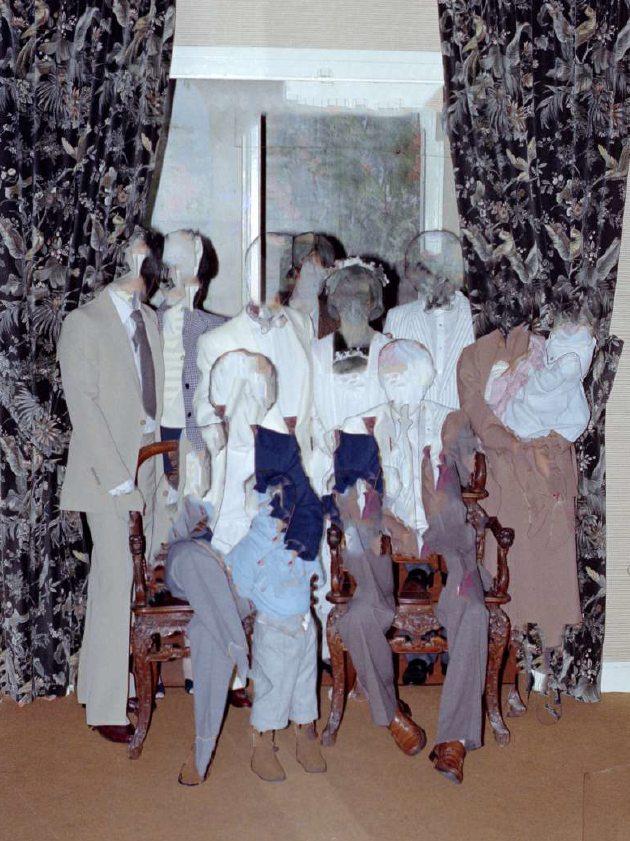
It is from this position that Hua began Tropism, Consequences of a Displaced Memory, her long-term project, by reworking her family archive, and it was published as an artist book by Area Books in 2022 before being exhibited at Galerie Anne-Laure Buffard (Paris) in 2023. Hua describes the beginning of this investigation as a deeply personal and belated encounter with her own history: “In 2016, having very little knowledge of Vietnamese history, I undertook a personal investigation to connect my family’s history to the history of my country of origin in order to understand this inexplicable need I felt to correspond with the past”, the artist explains. Her work is not an act of recovery in any straightforward sense, but a negotiation with absence, distance, and the limits of what can be known.
Working with what does not fully belong
Rather than treating the archive as a stable source of truth, Hua approaches it as a volatile emotional terrain. “Working from archival photographs of my family, I explored the process of Tropisms through my visual experience, in the presence of these photographs whose memories and experiences did not belong to me”, she adds. “Nevertheless, certain images provoked a strong and inexplicable emotional reaction, which I attempted to convey through these digital manipulations, dematerialising the memory to retain only a shape, sometimes abstract, of a sensation floating within the image.” Here, the archive becomes less of a container of facts, but more of a trigger, a surface onto which emotion, imagination, and speculation are projected.

In her hands, the photograph becomes something unstable. Bodies blur, faces lose their contours, and figures seem to merge into their surroundings. “With Tropism, I decided to distort these memories in a very instinctive way. I spend time looking at hundreds of photos of my family, one of which catches my attention, and I work on it without asking myself why.” The gesture is not analytical but intuitive, driven by affect rather than explanation. Rather than trying to close these gaps, Hua makes them visible. The distortions she introduces do not destroy the image. They reveal its vulnerability. They suggest that memory is not something that can be retrieved intact but shifts, fades, and rearranges itself over time.
Between fashion and intimacy
While Tropism, Consequences of a Displaced Memory remains a central project, focusing solely on this series risks flattening the wider scope of Hua’s practice. Her earlier and parallel works already signal many of the concerns that later become more explicitly articulated through family archives. In projects such as Hug of a Swan (2022), first presented at Huis Marseille in Amsterdam and later at Fotografie Forum Frankfurt, the artist constructs carefully staged, psychologically charged images that hover between fashion photography, performance, and visual fiction. Here, the body becomes a sculptural and symbolic presence, often caught in gestures that suggest protection, tension, or withdrawal. These images are less about documenting identity than about staging its fragility.
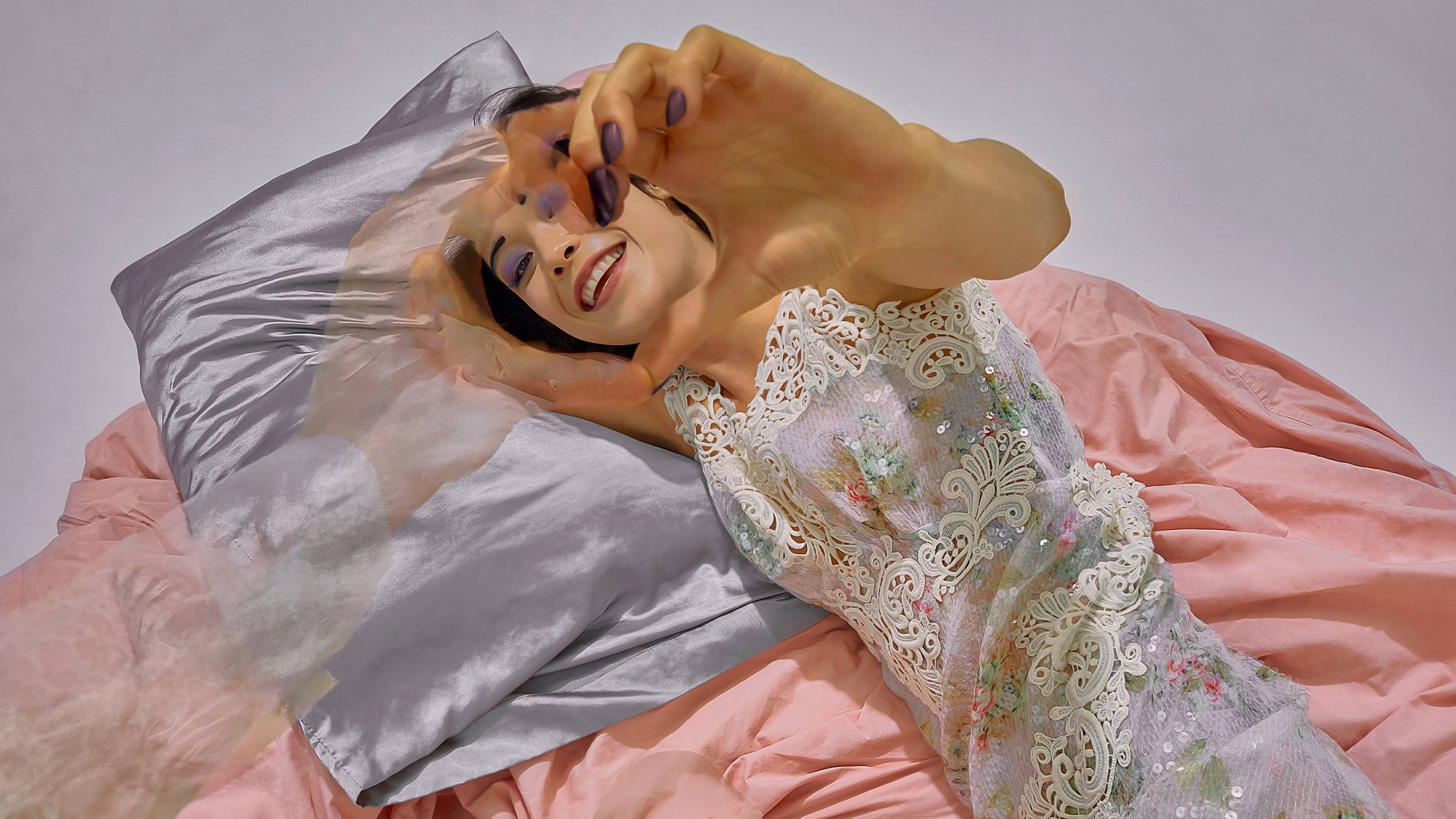
Similarly, in collaborative works such as Heaven and Hell (2024), developed with performer Vimala Pons and presented at Rencontres de la Photographie in Arles, Hua expands her visual language into a more overtly performative and theatrical register. The work explores duality, excess, and transformation, drawing on both art-historical and popular visual codes. Although stylistically distinct from Tropism, these projects share a preoccupation with unstable identities and the construction of meaning through images that resist easy narrative closure.
A similar tension runs through Bridge Falling Down, Soon Rising Up (2024), shown at Galerie Anne-Laure Buffard in Paris, where architectural motifs, supports, and frames become metaphors for connection and collapse. Here, rebuilding is not presented as a clean or heroic act, but as a cyclical and vulnerable process, where repair always carries traces of what has already failed. Although formally different from Tropism, the work continues Hua’s interest in instability, in structures that promise coherence but remain emotionally precarious.

This sensitivity to staging, surface, and the body is inseparable from Hua’s background in fashion photography. Her collaborations with houses such as Dior, Maison Margiela, Kenzo, and Gucci, and her work for publications including Vogue, Time Magazine, and Dazed Beauty, have shaped a visual language marked by precision, choreography, and a strong awareness of how images circulate. Yet in her autonomous practice, these tools are redirected. The image is no longer there to persuade or to perfect. It is there to hold ambiguity, to remain unresolved, and to stay close to feeling rather than explanation. The polish of fashion imagery is not abandoned, but retooled to speak about memory, erasure, and displacement.
This concern with fragmentation becomes especially poignant when placed in the context of her family history. Born in Paris to parents who fled Vietnam after the war, Hua has spoken about growing up with a palpable distance from her heritage, where questions about the past were often met with silence or dismissal. This intergenerational gap is not only cultural but also linguistic: her father, who is oral deaf, communicates in spoken Vietnamese and a self-taught form of French Sign Language, learned after arriving in France. The absence of a shared, stable language within the household becomes, in Hua’s work, both a biographical fact and a metaphor for the broader failures of transmission that mark diasporic experience.

Silence as a form of inheritance
In Spring 2026, visual arts charity Autograph will present Hua’s first UK solo exhibition, spanning both gallery spaces at its Shoreditch building and featuring newly commissioned work. The exhibition asks what is communicated or withheld across generations, a question that runs through her practice as a whole. Reworking archival images from her family’s past, Hua builds dreamlike compositions that shift between clarity and distortion, echoing the ways memory in the diaspora can blur, splinter, and slip from view.
Seen in this light, her work is not only personal but also political. It resists the expectation that history should be coherent or that identity should be fully visible. Instead, it insists on the importance of opacity, of partial knowledge, and of silence as something that shapes lives rather than simply obscures them.

Ultimately, Hua’s images do not offer answers about the past. They offer a way of staying with its uncertainty. Memory, in her work, is not a stable archive waiting to be opened. It is a movement, a sensation, a fragile and shifting field. The photograph becomes a place where this instability is not resolved, but carefully held.
Nhu Xuan Hua works between Paris and London. Originally trained in fashion photography, she has collaborated with Dior, Maison Margiela, Kenzo, and Gucci, and contributed to publications including Vogue, Time Magazine, and Dazed Beauty. Her work is held in collections including Huis Marseille, Museum for Photography, Amsterdam; the Centre National d’Art Plastique (CNAP), France; and the JPMorgan Chase Art Collection. Tropism, Consequences of a Displaced Memory was also published in the form of a book by Area Books in 2022.


