
At first glance, Constantin Brâncuși is a name synonymous with sculpture: a key leader of modern abstraction, a visionary who shaped light through stone, metal, and wood. Yet Brâncuși. Sculpting with Light, on view at Kraków’s International Cultural Centre (ICC), asks us to see him anew. Not just as a sculptor of matter, but as a sculptor of perception itself.

This exhibition, a collaboration between the ICC and the Romanian Cultural Institute, reveals a facet of Brâncuși’s practice often left in the shadows – his fascination with photography as both documentation and creation. It’s a rare and intimate glimpse into how one of the twentieth century’s most revered artists saw as well as how he played with light itself to participate in the act of making.
Curated by Doïna Lemny and Karolina Wójcik, the showcase forms part of the 2024-2025 Romania–Poland Cultural Season, a timely partnership between two nations whose intertwined histories of resilience and reinvention continue to echo through their cultural landscapes. The exhibition gathers rare original photographs from three private collections, those of the David Grob Gallery, Bruce Silverstein, and Christian Reyntjens, alongside contemporary responses by artists based in Poland. The exhibition manages to bridge many aspects, including Brâncuși’s Parisian atelier and the Carpathian roots that shaped his worldview, into a thoughtful constellation of memory, objects, and collaboration.

Sculpting Light, Sculpting Thought
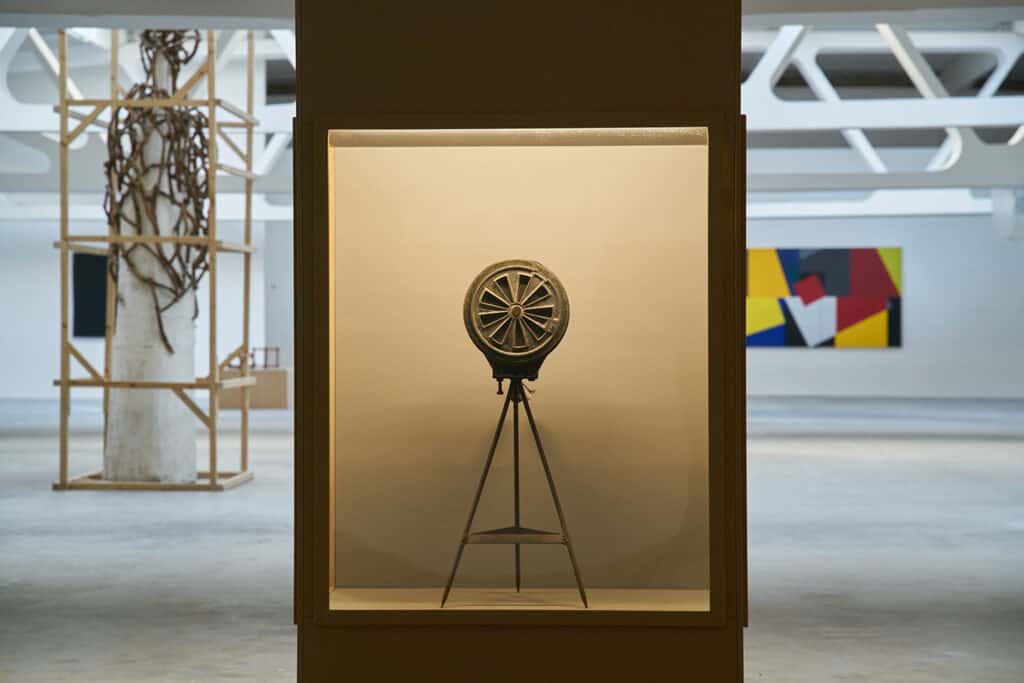
The exhibition begins and ends in an immersive forest-like installation, a gesture toward the Carpathians where Brâncuși was born, grounding his philosophy of form in nature. In this softly lit space filled with columned-tree trunks, photography becomes less a record of sculpture than an extension of it. For Brâncuși, the play of light and shadow was not merely atmospheric; it was constitutive. The work did not exist fully until light completed it.
Early in his career, Brâncuși often relied on others to photograph his sculptures. But once given a camera, a gift from the American photographer Man Ray, he began to take control of the lens himself. In doing so, he extended his studio practice into an exciting new realm, one that was far ahead of its time, as photography was not considered an official form of fine art at the time. Each photograph became both a document and a transformation, revealing how he perceived the material world through his own sensibilities.
“The exhibition’s title, Sculpting with Light, captures this complexity and duality. Brâncuși did not treat photography as secondary or supplementary.”
The exhibition’s title, Sculpting with Light, captures this complexity and duality. Brâncuși did not treat photography as secondary or supplementary. He experimented obsessively with chemical processes, manipulating negatives, layering exposures, and reprinting variations of the same image to explore how matter and light might merge into spiritual form. Some prints, like his series of Bird in Space, seem to hover between sculpture and apparition, light distilled into flight and movement.
His alchemical approach also surfaces in a selection of gelatin silver prints, where the artist pushed technical boundaries, emphasising not precision but transformation. Brâncuși’s process, the curators note, was often one of “controlled accident,” in which the chemical, natural, and conceptual converged.

Between Object and Shadow
One of the exhibition’s most compelling insights lies in how Brâncuși used photography to test his ideas about form and space. In his hands, the studio itself became a stage, such as a self-portrait through materials, rather than through his (solely) physical likeness. Rather than photographing himself, he positioned his sculptures, tools, and blocks of raw material as proxies of his identity. Again, an artistic act that was ahead of the times he was working in.

The resulting images dissolve distinctions between artist and object, between making and being. Columns, shadows, and reflections enter into a quiet dialogue, each echoing the other. A sequence of photographs featuring Fish (1926) and Endless Column (1918) highlights this interplay of vertical and horizontal, solidity and motion. As viewers, we begin to see not only the sculptures but also the thinking behind them, of Brâncuși’s conviction that art is arguably never fixed, only in flux, and specific to its environmental surroundings.
This sense of continuity carries through to his monumental outdoor commissions, particularly the large-scale ensemble at Târgu Jiu, with The Table of Silence (1938), The Gate of the Kiss (1938), and Endless Column. Though created as memorials for fallen heroes of World War I, these works have evolved over time into living public spaces. Once solemn monuments, they have now since borne witness to hosting wedding photographs, tourist selfies, and local gatherings. Acts that simultaneously feel both irreverent, yet in their own way sustain Brâncuși’s vision of art as holding evolving meaning based on the space it inhabits. As the exhibition suggests, meaning in his work is never static; it shifts with those who choose to engage with it, with all the complexity and messy memory-construction it demands.
“Acts that simultaneously feel both irreverent, yet in their own way sustain Brâncuși’s vision of art as holding evolving meaning based on the space it inhabits.”
Dialogues Across Time
What makes the ICC’s presentation especially powerful is its dialogue between Brâncuși and a new generation of artists. Works by Bogusław Bachorczyk, Maciek Bernaś, Bartek Buczek, Michał Sroka, Justyna Stasiowska, and Bogdan Achimescu respond to his legacy through contemporary lenses across sound, video, sculpture, and installation.

Michał Sroka’s chiaroscuro-lit sculptures echo Brâncuși’s fascination with shadow and reduction, while Achimescu’s intricate drawings and mappings reinterpret the studio, borders, and monumental work as a psychological landscape. A sound installation by Justyna Stasiowska incorporates recorded tones inspired by the violin and phonograph Brâncuși himself invented, reanimating his musical sensibility within the gallery.
Altogether, these interventions don’t merely pay homage, but also reveal how Brâncuși’s language of embracing simplicity and essence continues to shape artistic thought today. His philosophy of form as spirit, material as meaning, remains a living influence.

The Studio as Cosmos
Perhaps the most striking section is an exhibited part of Bartek Buczek’s workshop. A wall-mounted installation of tools, including chisels, lenses, and moulds, evokes the rhythm of making, blurring boundaries between artefact and artwork. Echoing Brâncuși, the studio was a total work of art, an environment of transformation where objects, music, and materials coexisted in continual dialogue.
Even his photographs of the studio carry this spirit of totality. They are not mere records of finished pieces but glimpses into an ongoing process, creating a space where ideas were tested, broken apart, and reborn. His works, The Newborn (1920) and Princess X (1916), for instance, appear repeatedly in varying light and position, as if he were sculpting them over and over again through the manipulation of light and darkness.

The exhibition provides an abundance of Brâncuși’s work to explore, as well as the work of a number of contemporary artists. For those curious to learn more, the curators expand upon the work showcased in the exhibition photobook. With even more examples of Brâncuși’s photographic experimentation, we see that in one particularly poignant photograph, Brâncuși overlays a negative of a self-portrait with another image, creating a spectral double in his Portrait Nancy Cunard (1932). It’s as though he jumped through space and time into a contemporary 21st-century trajectory where making art often dissolves the self into matter and memory. In these experiments, it seems he anticipated later artistic inquiries into process, performativity, and the expanded field of photography.
The Light That Remains
As curators Doïna Lemny with Karolina Wójcik note, Brâncuși. Sculpting with Light is not an easy exhibition, and nor should it be. Its subject resists categorisation, its medium slips between documentation and creation. Yet precisely in this liminal space lies its power and its resonance today. The show invites viewers to slow down, to see how Brâncuși’s engagement with light was not only aesthetic but philosophical – a meditation on presence, impermanence, and the act of seeing itself.
“In an age saturated with images, Brâncuși’s photographs feel startlingly fresh. They remind us that vision is an act of making, and that art begins where light meets attention.”
In an age saturated with images, Brâncuși’s photographs feel startlingly fresh. They remind us that vision is an act of making, and that art begins where light meets attention. His sculptures taught us to see the world anew; his photographs reveal how he saw beyond simply the mastery of a material or skill, but through reverence for its natural qualities and the memories they hold.
Ultimately, this exhibition is less a retrospective than a poignant conversation across time: between artist and medium, past and present, material and spirit. It asks us to consider how light – fleeting, intangible, living – can shape the world as profoundly as stone.

Brâncuși. Sculpting with Light
September 27 – December 14, 2025
International Cultural Center in Kraków