

Clay is earth, materially continuous with the environments that sustain life. Working with it foregrounds cycles of extraction, transformation, breakdown and return. Care operates in a similar register: as maintenance rather than production, as an ongoing relation. Both unfold through repetition, interruption and repair. The less measurable the subject, the more insistent the material becomes; where quantification fails, the surface thickens. Clay demands time, attention and a tolerance for failure. It records touch and slows processes. In this sense, it behaves a lot like care — it becomes a method for thinking through forms of labour that escape metrics while continuing to organise worlds.
A woman accumulates gestures so ordinary they risk disappearing: a meal prepared, an injury tended, a child soothed back to sleep. Contemporary systems excel at counting outputs and fail to recognise what sustains them. Care sits in that blind spot. It structures daily life yet resists being logged, scaled or optimised. It returns to a simple, unstable question: how do we measure what is already doing the work of keeping us alive? Or perhaps measurement is beside the point, and what is needed are practices that value care on its own terms? To value it, however, we must first learn to notice it, attend to its persistence, and the depth of caregiving experience, irresistibly bound up with women’s lives.
A woman accumulates gestures so ordinary they risk disappearing: a meal prepared, an injury tended, a child soothed back to sleep. Contemporary systems excel at counting outputs and fail to recognise what sustains them. Care sits in that blind spot.
Rather than a survey, this text brings together a group of practitioners who trace a gradual reconfiguration of care as it moves between different material and symbolic registers. Beginning with care as quantifiable labour and visible systems of maintenance, it shifts toward objects that hold care rather than measure it, before expanding into mythic and ecological frameworks in which care becomes immanent to life itself. Across these practices, care moves from counting, to making, to cosmology and environment – dissolving as a discrete category and reappearing as a distributed condition of relation between bodies, materials and worlds.
Clay becomes a way of thinking through often invisible forms of care, while opening onto broader questions of gender, identity and solidarity. Across different geographies and visual languages, these practices negotiate how care might take form without being contained.
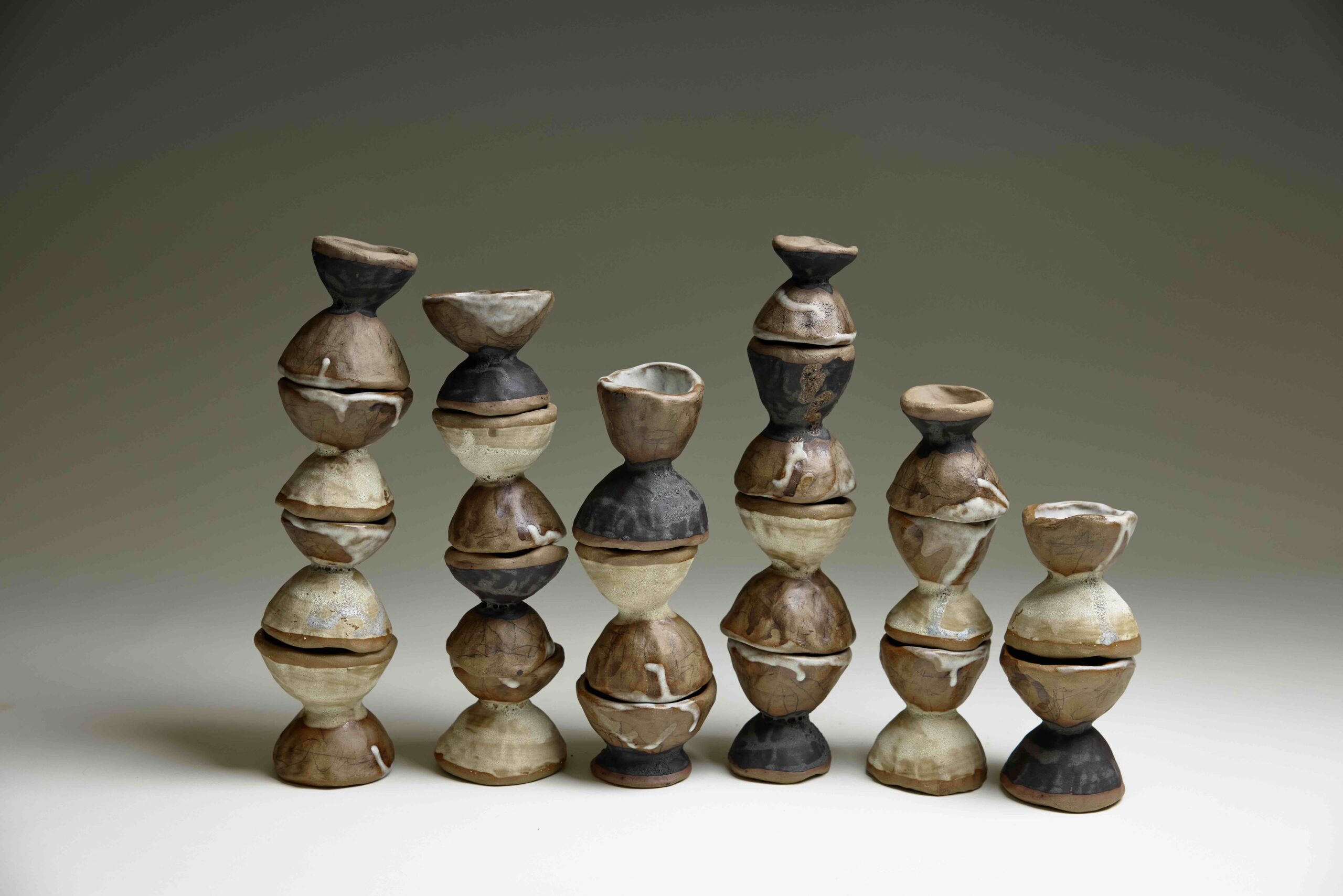
Lily Glass, A Cup for Every Breastfeeding Session
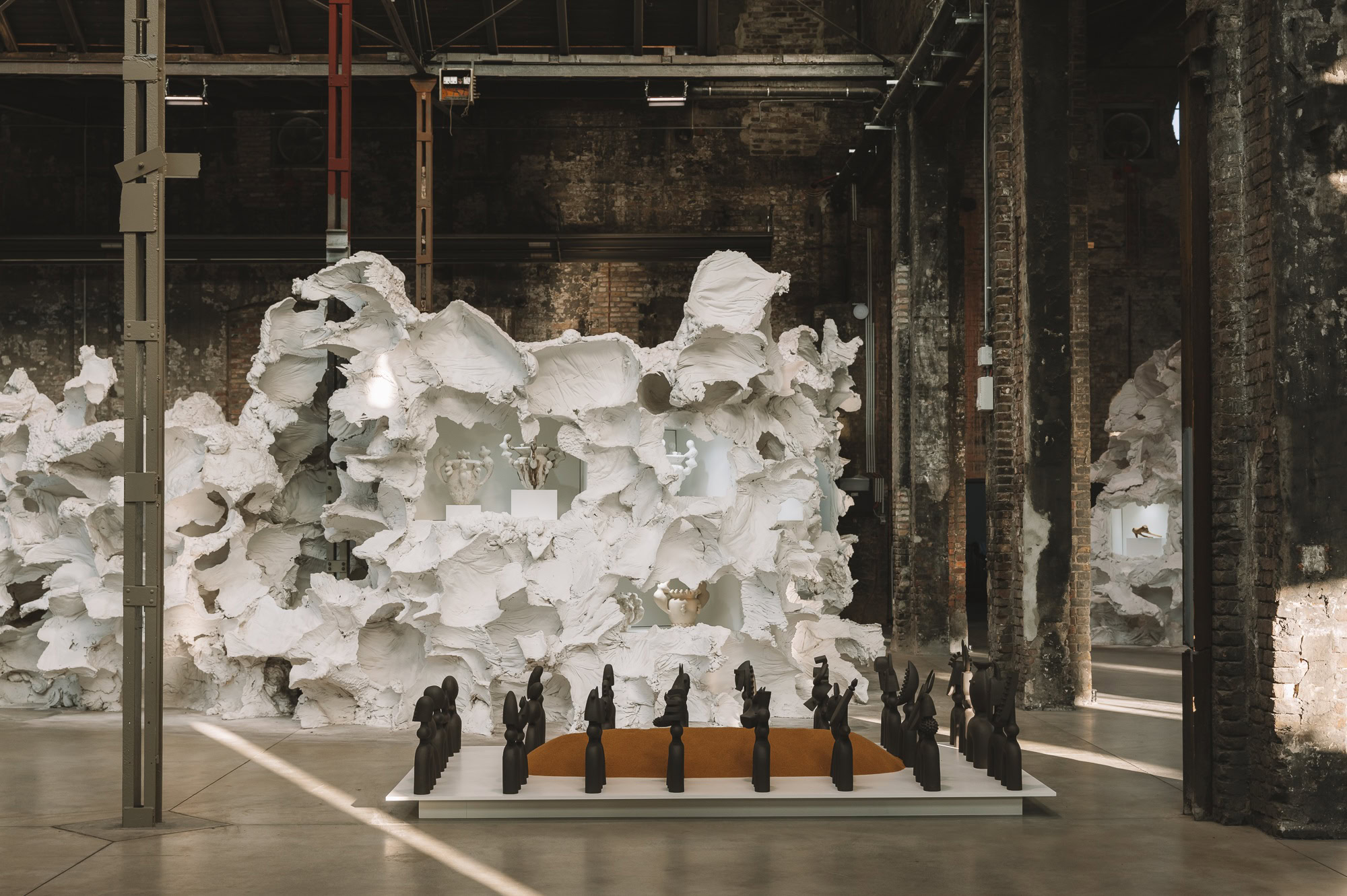
When displayed together, the cups recall small communion vessels, echoing the ritual symmetry of Eucharistic chalices arranged for collective use. The installation A Cup for Every Breastfeeding Session by American artist Lily Glass comprises 622 hand-carved ceramic cups, each holding two ounces (the approximate amount a newborn consumes in a single breastfeeding session). Through repetition and accumulation, each vessel functions as a unit of nourishment, scaling care into a visible system in which maintenance, feeding and repetition become material form.
In the aptly titled exhibition Quantifying Care, Glass turns toward the friction in her own motherhood journey, which drove her to examine the labour of care through her ceramic practice. She is compelled by a central tension, asking why care work often feels more demanding and less rewarded than its cultural framing suggests. She situates this inquiry within overlapping systems of belief: ingrained capitalist values, where work is only legible when input equals measurable output, and a religious upbringing that implicitly and explicitly shaped expectations of women’s roles, including the idea that such labour should be met with inherent fulfilment. Working within and against these frameworks, she begins to examine caregiving through both lenses. What was once associated with docile domesticity begins to register as forceful, disciplined and materially consequential.

Just because care work is often quiet or performed in solitude does not mean it is simple or insignificant. As she begins to measure acts of care as one might measure production (tracking time, repetition, and output), the term ‘free labour’ becomes unstable, revealing its ethical and economic complexity. The unseen infrastructure of care is vast: the UN estimates it as a 1.9 trillion dollar global system without which economies would collapse. Yet it is precisely its invisibility that allows it to persist as a background condition rather than foreground recognition. Care work disrupts this illusion by placing humanity back into focus. And yet, when care is isolated, it exhausts; when it is seen, it reveals its own endlessness — but also its necessity as a shared rather than a private structure.

Clay for Glass is a medium that insists on the body. It engages both hands, requiring bilateral attention that mirrors cognitive integration — conscious and subconscious working in tandem. Ceramics, often categorised as craft, sit within a contested hierarchy: who decides what is art, and what is craft? Why is one elevated while the other is dismissed, especially when craft so directly meets essential human needs — warmth from textiles, nourishment from vessels, continuity from objects made to be used? In this sense, clay becomes not only a material but an argument.

Care and clay overlap: both are acts of making that serve a function while carrying feeling. ‘I fear the majority of us touch machines more frequently than other humans on any given day. Our hands, our bodies know how to care for one another if we let them. And it is a more complementary act than we often remember,’ Glass remarks. There is a recognition of the tension in translating it into data, yet also an understanding of why such translation is attempted within a culture fluent in metrics. To quantify care is not to reduce it, but to expose the scale of what is usually overlooked.
Noe Kuremoto, Clay-Midwives
Born in Osaka and based in London, Noe Kuremoto works with hand-built ceramic forms that sit between sculpture, craft and contemporary myth-making, returning to clay as a counter-material to digital acceleration: an elemental medium grounded in earth, water, fire and touch where care re-emerges as slow, tactile attention. Initially distancing herself from ceramics as a teenager, she later reoriented toward it after working in performance and video, drawn to its demand for sustained presence — a process in which making cannot be separated from maintenance, failure and repair. ‘I want my pot to remember what we forgot,’ she states, positioning clay as an archival surface of care. ‘We’ll never truly know what a Jōmon potter was thinking 10,000 years ago. But the clay leaves clues. Long before rice farming. Before Buddhism. Before written language — there was clay. Born from fire. Made by hand. Swollen bellies. Curved backs. Mother-and-baby figures. Not decoration. Devotion.’

In this reading, the vessel is not a passive object but a holding structure — what she calls ‘protectors’, ‘clay midwives’, ‘spirit-keepers’, where care is materially encoded as containment, survival and transmission across time. Her practice draws on Japanese mythology, fairy tales and animist understandings of nature, where clay becomes a site of distributed agency rather than inert matter. Within this logic, care is not a representation but a condition: a way of binding body, memory and environment through form. In the exhibition JŌMON: A Mother’s Anthem, sculptural stoneware vessels register the ambivalence of motherhood — its joy, exhaustion, fear and attachment. It refuses idealisation in favour of lived, uneven attention. Clay here operates as both surface and structure for care’s contradictions, holding what cannot be resolved into clarity.
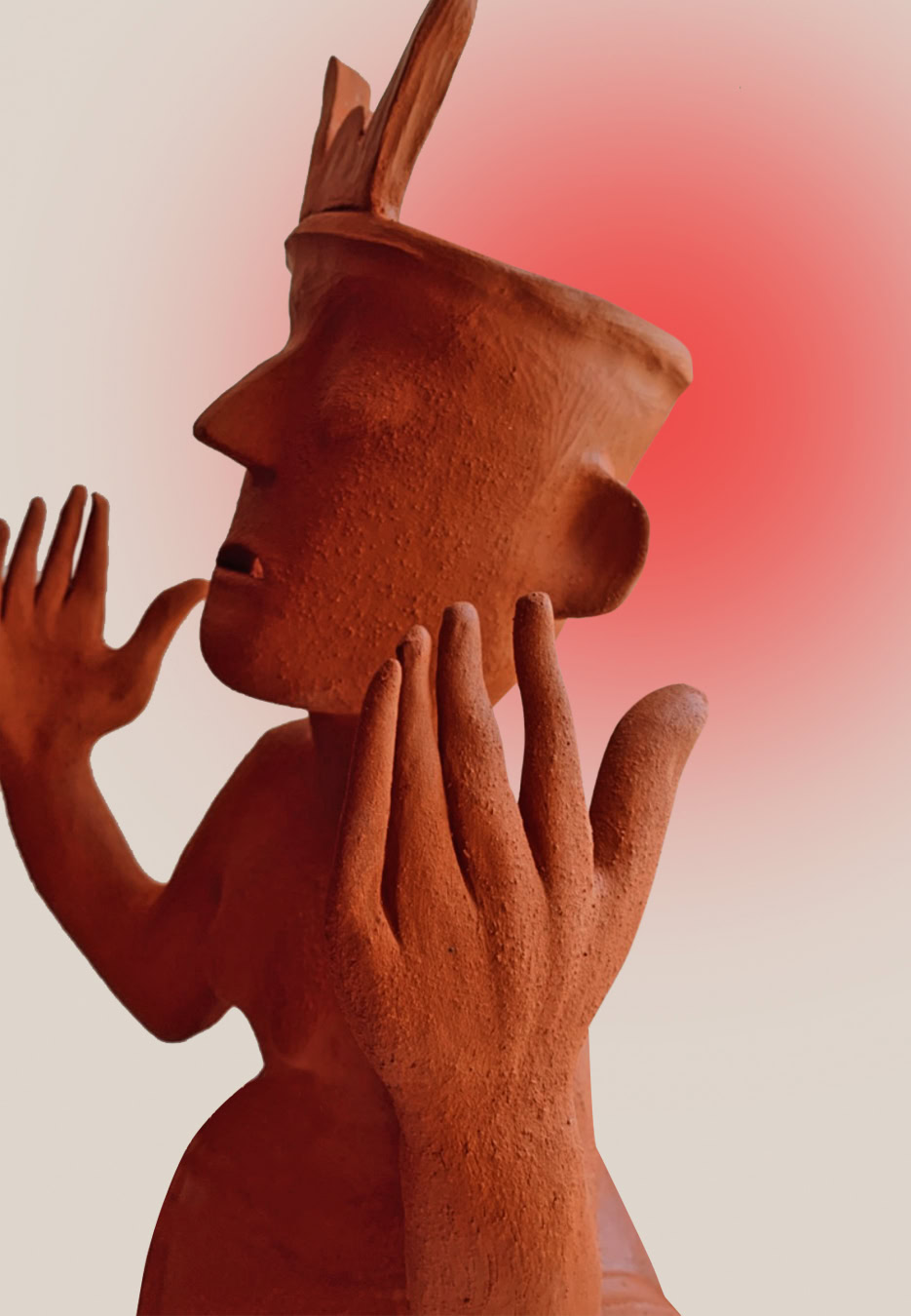
Previously, Kuremoto’s series Dogu Ladies, inspired by Jōmon-period figurines (c. 14,000–300 BC), extended this logic into a contemporary register. While these ancient forms — marked by enlarged eyes, accentuated breasts, and wide hips — are often read as fertility symbols, Kuremoto reframes them as talismans of contemporary care and endurance. The works function as propositions rather than reconstructions: figures that re-activate archaeological memory as a living system of care. The collection of ceramic Dogu Ladies pays tribute to working mothers, shaped by the artist’s own experience of navigating motherhood alongside a demanding career. Rather than stabilising motherhood as identity, the works register it as ongoing negotiation ‘between exhaustion and continuity, labour and attachment, presence and absence. They become vessels of shared condition: for those measuring time in fragments, balancing work and care, or reconfiguring life around shifting forms of dependence and support.’

‘They are for the woman who longs for a child while questioning what it may demand of her life… In all these moments — uncertain, demanding, profound — this talisman stands as a gesture of solidarity,’ she states. An offering of shared endurance rather than resolution, the works reposition care as a collective infrastructure. In this sense, Kuremoto’s practice also reframes archaeology itself as a site of projection rather than fixed knowledge. The Jōmon vessel becomes not a historical object but a speculative interface, through which care is read backwards and forwards in time. Clay holds this ambiguity: artefact and proposition, survival and interpretation, what is preserved and what is continuously remade.
Aleksandra Szczodry, Back into the Womb of the Goddess
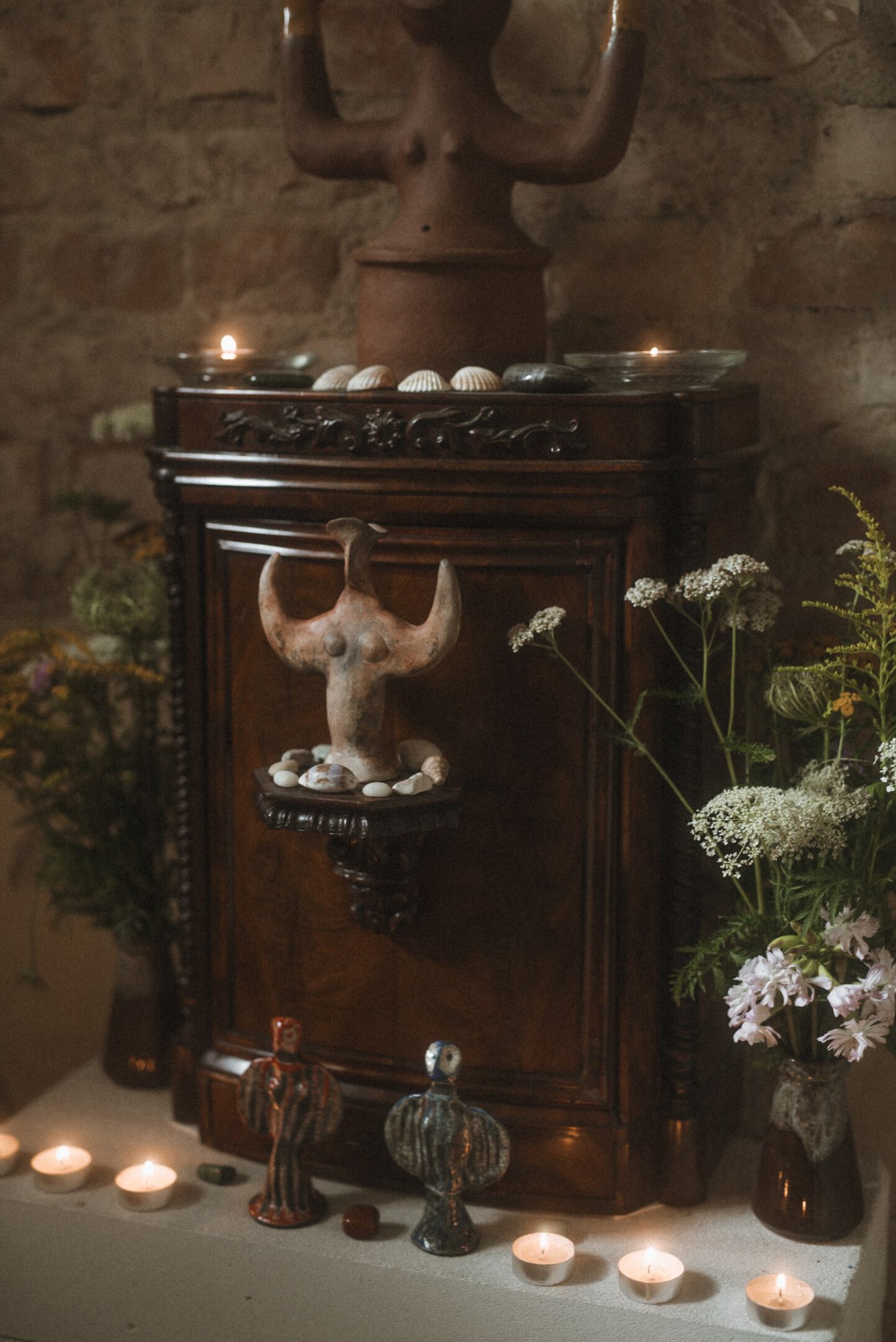
The way women are treated shares its source with the destructive treatment of the natural environment. We exhaust the Earth; we do not listen to it, Aleksandra Szczodry suggests, linking care and extraction as parallel systems of control over bodies and landscapes. In a world ‘full of logos and male authority,’ the artist turns to the goddess as an alternative framework of relation and value. In Polish cultural narratives, the maternal figure is central to care yet subordinated to paternal authority, assigned labour without power. Rather than inverting this hierarchy, Szczodry displaces it: the maternal becomes ecological and planetary, with care extending from the intimate to systems of life, echoed in figures like Bogini Pokoju (Goddess of Peace) from 2025 and Bogini Wody Życia (Goddess of the Water of Life) from 2024, where the divine is immanent, sustaining, shared.
Szczodry’s practice emerges from a gradual unthreading of a Catholic upbringing in a village outside Warsaw, where early religious immersion gave way to a sustained search for alternative spiritual and philosophical frameworks. Rather than abandoning transcendence, she reorients it. A decisive shift came in 2007 with her participation in a women’s circle led by Joanna Eichelberger, where she encountered Goddess-centred, shamanic frameworks and ritual forms of sisterhood, including monthly Full Moon ceremonies that framed spirituality as cyclical and embodied. After Eichelberger’s death in 2021, this trajectory continued through Anija Miłuńska and, via her, the archaeomythologist Marija Gimbutas (1921–94). Gimbutas’s contested theory of ‘Old Europe’ — a Neolithic culture she described as egalitarian, peace-oriented and single Goddess-centred — offered an alternative cosmology in which social and spiritual life is organised around the affirmation of life, the acceptance of death, and symbolic rather than hierarchical structures.

In the context of war, ecological crisis and intensified global capitalism, this becomes a speculative ground for imagining forms of coexistence beyond patriarchal orders. At the centre of Szczodry’s work is the Great Goddess as a conceptual figure for self-generating life: existence understood as continuous cycles of emergence, dissolution and return. Drawing on Old European symbolic systems — particularly the double spiral — she frames time as non-linear and recursive, with life unfolding from an unknowable origin, expanding toward fullness, and contracting back into the womb of the Goddess. Death is understood not as an endpoint but as return and re-emergence, replacing linear eschatologies with a model of continuous renewal that displaces fear with continuity. Within this cosmology, nature, stars, planets and human beings are seen as expressions of a single living field, where the Goddess is less deity than an endless source of matter and meaning.

Referencing Luisa Francia’s formulation of ‘woman everywhere’, Szczodry treats the Goddess as an immanent condition: a distributed material unity that collapses divisions between creator and creation. Working with clay and sculpture becomes a tactile mode of participation in a wider field of relation. Through this process, the hand registers interdependence across human and more-than-human life, what she describes as a ‘Great Mystery’. Rather than dissolving subjectivity, this entanglement produces presence, concentration and a reduced sense of existential strain.
Across her work, the figure of the Mother appears not as a sacrificial archetype but as a generative principle. Although she has no experience of motherhood, Szczodry reflects on the idea that artistic practice is a creative birth process, where works are treated as entities requiring care, patience and sustained attention. Art-making becomes a practice of cultivating what she terms a feminine principle: capacities of emergence, maintenance and responsiveness. Care is an ecological relation. It is a learned practice grounded in interdependence between humans and the living world, resonating with critiques of patriarchal extraction and with deep ecology’s rejection of anthropocentrism.
Vinita Mungi, Forest Bodies
Vinita Mungi describes an immediate attraction to ceramics, recalling her first encounter with the medium as a moment of recognition. Initially working in a wheel-throwing class, she was drawn instead to the adjacent sculpture studio, sensing early on that sculptural ceramics would define her practice. The process-based demands of the medium — its technical complexity from construction through to firing — require sustained attention and immersion, which deepened her commitment. This intensity is inseparable from clay’s volatility; its fragility, unpredictability and propensity for collapse are precisely what anchor her practice. Ceramics becomes a site where control and failure remain in constant negotiation, and where making unfolds as care under pressure — continuous attention enacted through risk, repetition and repair.

Working with clay also carries an ecological memory shaped by her upbringing in the Nashik district of Maharashtra, where proximity to landscape informs an ongoing attention to natural systems. In her practice, this translates into dense sculptural environments where bodies, terrains and built forms are no longer distinct categories but interwoven conditions. Plants, forests, mushrooms, insects and architectural structures cohabit with abstracted bodily and genital forms, not as focal points but as dispersed elements embedded within wider material ecologies. Figure and environment are folded into one another, producing a continuum in which identity is not fixed or isolated but distributed across natural and constructed worlds.
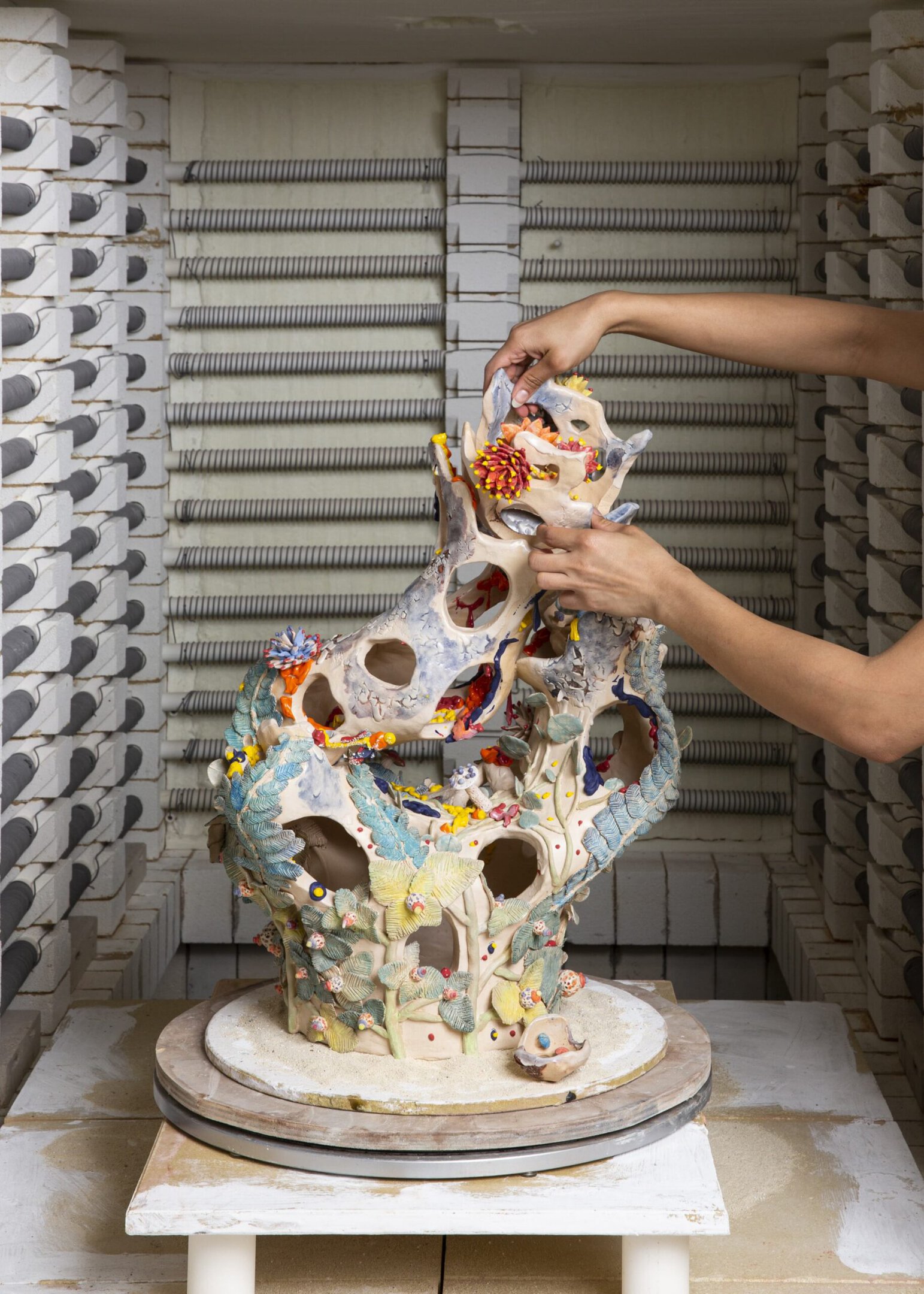
At first glance, these works read as immersive ecological fields; yet closer attention reveals how carefully bodily fragments are embedded within them, dissolving any stable boundary between the human and the living environment. In this sense, care is not a representational theme but a spatial and material logic — present in how forms are arranged, concealed and sustained within shared environments. Rather than positioning nature as a backdrop, Mungi constructs environments in which relation itself becomes the organising principle, and where attention is constantly redirected toward what is usually overlooked or rendered invisible.

These concerns extend into questions of gender and female identity within contemporary Indian society, which she describes as both persistent and structurally conflicted. Her education in the United States prompted a critical reassessment of how deeply her artistic formation had been shaped by Western feminist frameworks, leading her to reorient her research toward Indian women artists, activists, poets and intellectuals associated with postcolonial feminist movements. This shift functions less as a reference than as re-anchoring — an attempt to situate her practice within alternative genealogies of thought and embodied experience.

Within this context, Mungi’s work responds to what she identifies as the male-dominant ideological construction of gender in India, using symbolic representations of the human form and genitalia to address its cultural tensions. These elements are abstracted and woven into natural and architectural environments, where body and setting become indistinguishable. Through this strategy, she constructs a speculative register in which sexual identities (chosen or existing) circulate without hierarchy or exception, as ordinary as plants, flowers, or built structures. Rather than illustrating identity politics, her work displaces them into ecological systems, where visibility is redistributed through scale, texture and proximity. Her practice insists on a reorganisation of perception, where looking itself becomes an ethical act. Care emerges here as sustained attention: a refusal of erasure, and a method of holding bodies, identities and environments within the same field of visibility without hierarchy or exception.