








Yayoi Kusama, one of Japan’s most renowned contemporary artists, known for her iconic polka-dot sculptures, paintings and installations, died in Tokyo on 14 August at the age of 97.
Born in Matsumoto, Japan, in 1929, Kusama experienced visual and auditory hallucinations from childhood, which she later translated into the repetitive motifs of her art, such as the famous dots. Art has become a way for her to express her inner world and to deal with what she has been experiencing.
Feeling confined by the patriarchal postwar Japan and lacking support from her conservative family, she moved to New York in 1957, where she became a significant figure in the art scene, gaining recognition for her Infinity Nets — the first major series of her career, containing canvases covered with repeated loops of paint.
Later on, Kusama began developing another of her famous series, the Infinity Mirror Rooms. In these immersive installations, objects and viewers appeared to multiply endlessly. Her works stemmed from a concept of ‘self-obliteration’, through which the artist strove to dissolve the boundaries between the self and the surrounding world. She was also involved in the anti-war movements of 1960s America, creating a series of performances or happenings that often involved nude participants covered in the recognisable polka dots.
In 1973, Kusama returned to Japan, where her art was, at first, largely criticised. She suffered greatly with her mental health and in the second half of the 1970s she checked herself into a psychiatric hospital, where she voluntarily spent the rest of her life. There, with the support of the doctors, she was able to further develop artistically, and interest in her work revived from the 1980s onwards, following a series of retrospectives. In 1993, Kusama became the first Japanese solo artist to represent the country at the Venice Biennale.
Her work was exhibited internationally at the most renowned institutions, such as the Museo Nacional Centro de Arte Reina Sofía in Madrid, the Centre Pompidou in Paris, and the Whitney Museum of American Art in New York. Her 2021 exhibition at Tate Modern in London lasted 3 years, continually extended due to its immense popularity. In 2016, she was named one of TIME Magazine’s 100 Most Influential People.
She painted until her last days and remained dedicated to her iconic style, which brought her recognition in the contemporary art world and beyond.
-

Yayoi Kusama exhibition, Tel Aviv Museum of Art, 2022. Photo: Lizzy Shaanan, PikiWiki Israel. CC BY 2.5 -

Yayoi Kusama exhibition, Tel Aviv Museum of Art, 2022. Photo: Lizzy Shaanan, PikiWiki Israel. CC BY 2.5 -
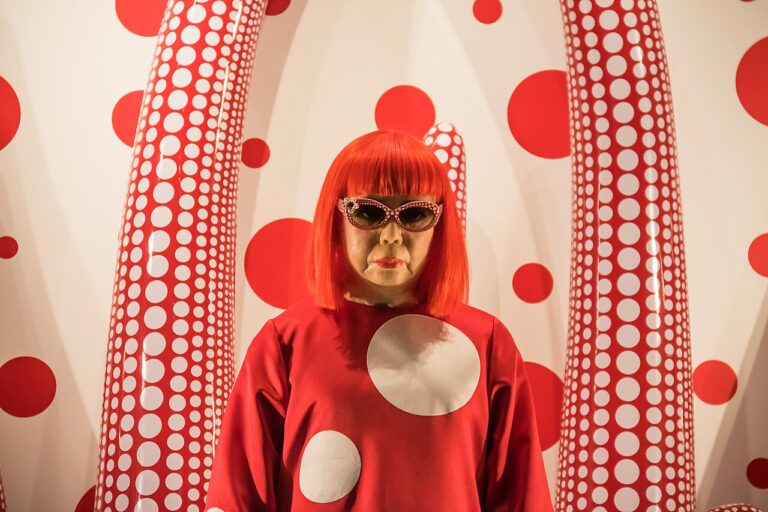
Yayoi Kusama, artwork at Louisiana Museum of Modern Art, Humlebæk, Denmark, 2015. Photo: Susanne Nilsson, CC BY-SA 2.0 -

Yayoi Kusama, Pumpkin, 2015, La Balade pour la Paix, Montréal, 2017. Photo: art inthecity. CC BY 2.0 -

Yayoi Kusama, The Spirits of the Pumpkins Descended into the Heavens, 2015, National Gallery of Australia, Canberra. Photo: Ncysea, 2019. CC BY-SA 4.0


