






In the moving image art “Attention Capital in the Age of Surveillance Capitalism,” created in 2025, Chonghao Hua depicts modern humans not as free users of digital technology, but as objects under constant surveillance and evaluation. Moreover, the artist draws our attention to the fact that each of us is subject to daily control by the system, oblivious to the fact that today this control rarely requires direct coercion.
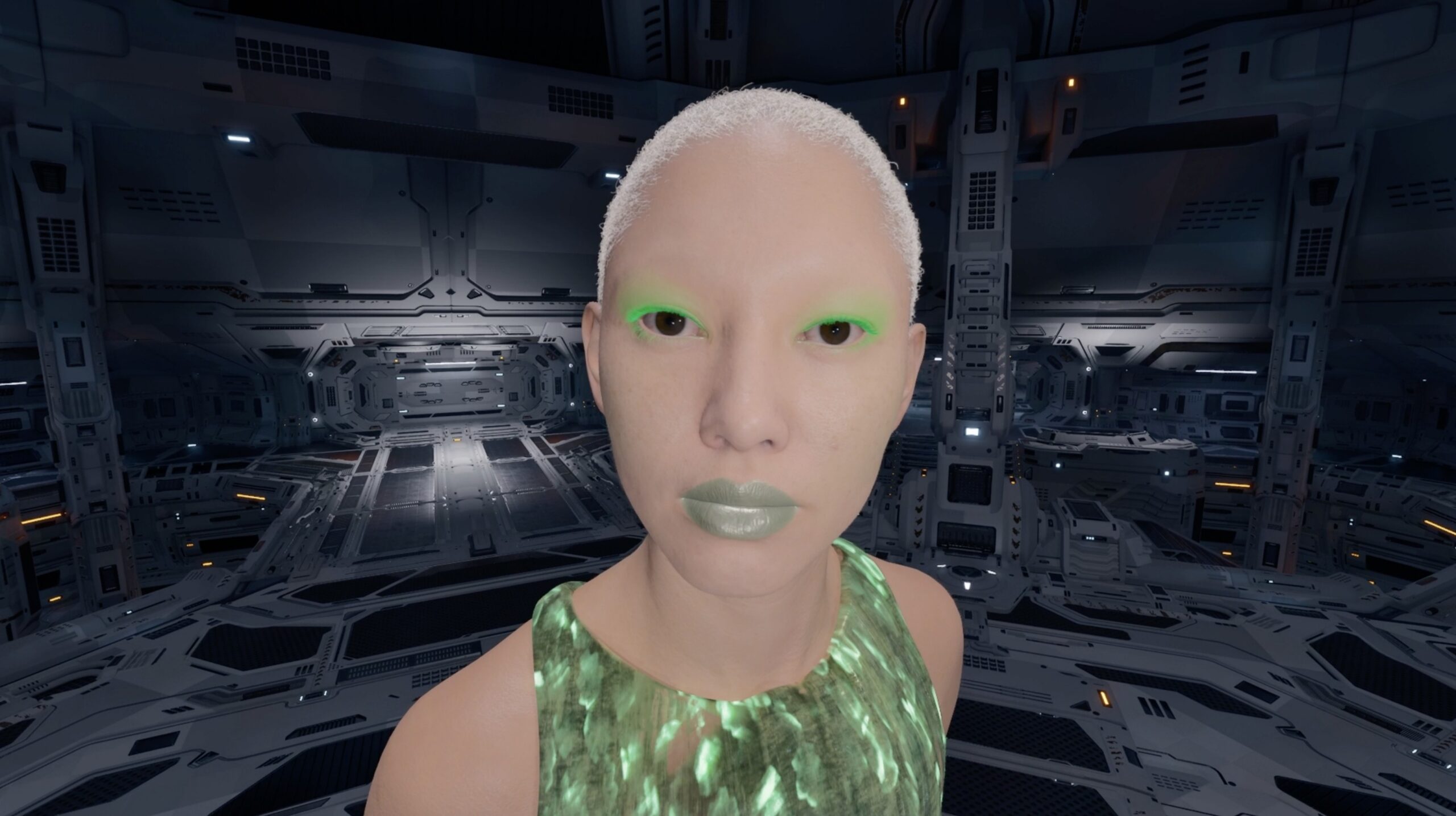
The entire visual dramaturgy of the art video is built around several objects. These are primarily the human figure, virtual clothing, and a mirror, all locked in repetitive actions. The character constantly changes their appearance, as if trying to find the right version of themselves. This is not a typical identity game, where each new shell appears to be the result of adaptation to external demands. The person themselves becomes a project that must be continually adjusted.
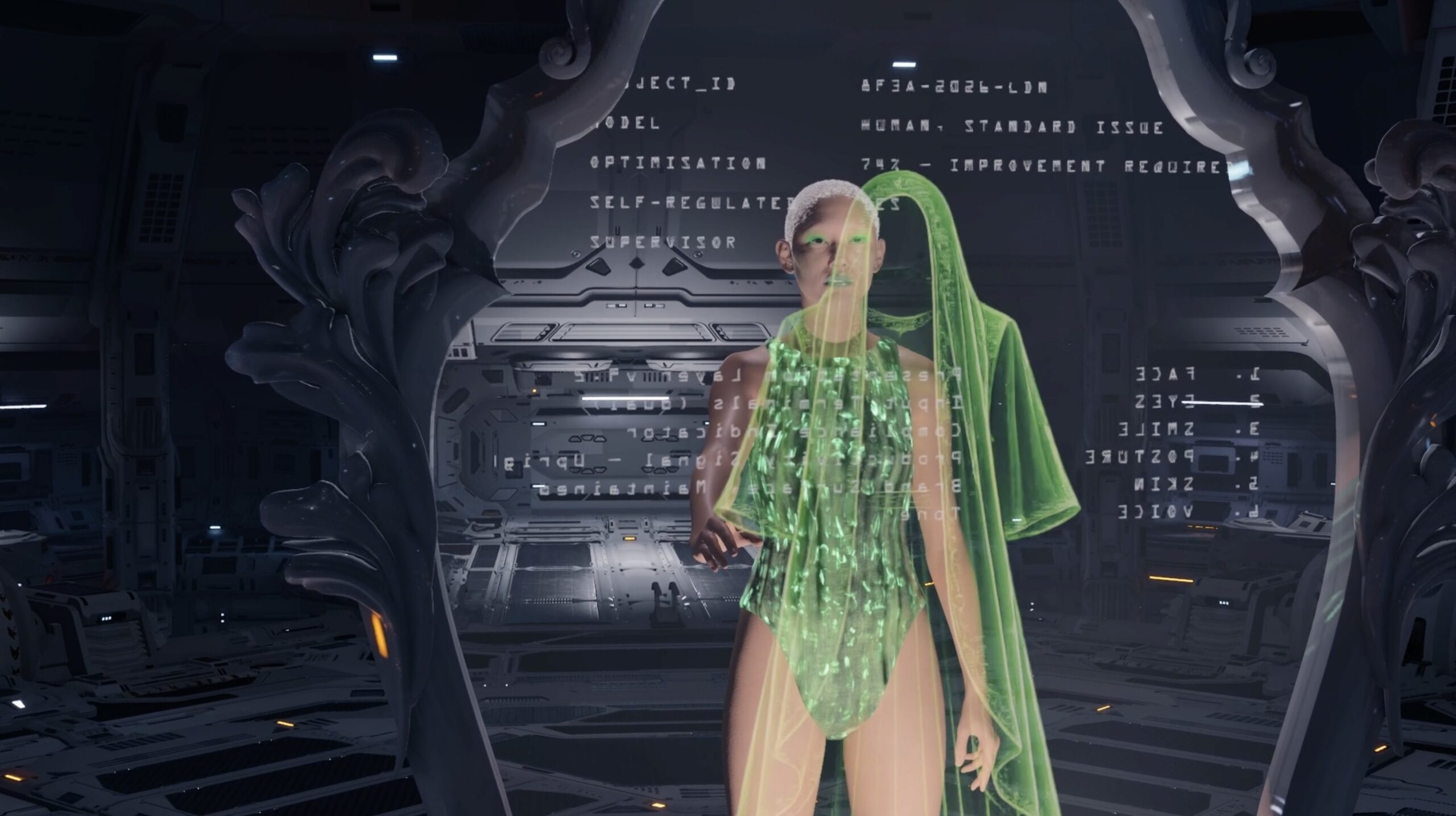
The artist pays special attention to the image of the mirror. In the culture of many peoples, the mirror is traditionally associated with self-knowledge and an individual perspective. However, in Chonghao Hua, it becomes a tool of control. The protagonist of the art video looks at himself, but simultaneously seems to be checking whether he conforms to the parameters of the system set by the environment. We see how self-observation gradually becomes a form of self-discipline.
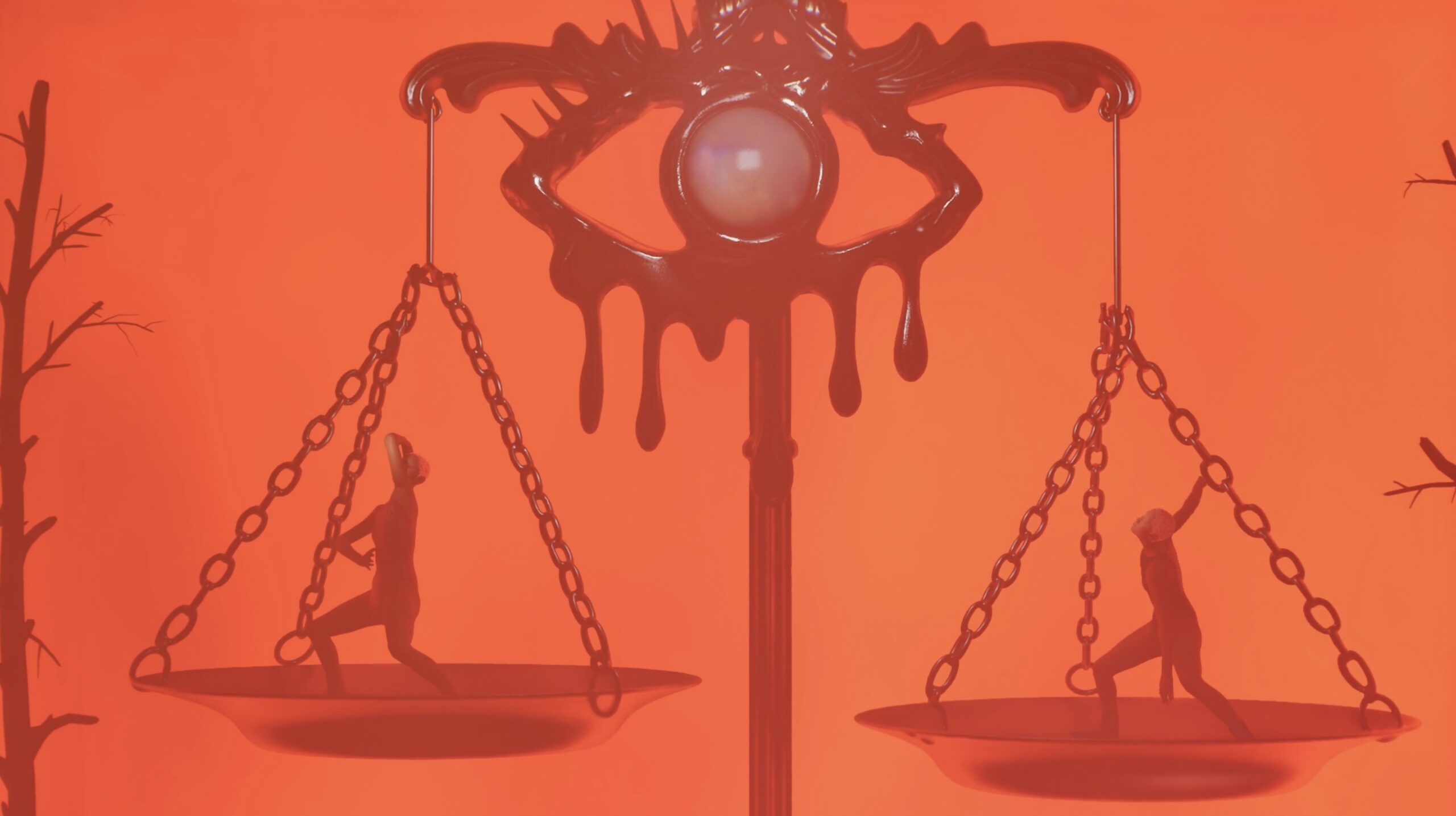
Another central image in the composition, in a state of constant imbalance, is a scale. It accurately conveys the logic of digital attention limitations. However, equilibrium is impossible here.The user must continually react, choose, refresh, demonstrate, and maintain attention. Any pause signifies a break from the existing system. Therefore, the repetitive movement of the characters is perceived not as a free action, but as an obligation.
Overall, the artist deliberately uses an artificial, almost sterile visual environment. Its conventionality is important to the author because he is not attempting to realistically reproduce the digital world, but rather to create a model of it, where the body, space, and behavior are subject to a certain unified logic. Bright colors, virtual costumes, mechanical movements, and abrupt scene changes reinforce the sense of an environment in which the human being no longer exists entirely independently.

This methodology characterizes Chonghao Hua’s entire artistic practice. He works with moving image and performance through repetition, staging, and programming of behavior. Furthermore, we constantly see his subjects in his artworks performing actions that gradually lose their individuality. As a result, the body becomes simply an instrument for the execution of someone else’s will. This transition from expression to execution is one of the artist’s main motifs.
“Attention Capital in the Age of Surveillance Capitalism” is compelling because it doesn’t portray control as an external, obvious force. The most disturbing thing here occurs within the individual, as they begin to monitor themselves before the system does. Thus, their attention, time, and self-image become resources that can be measured and consumed.

Consequently, Chonghao Hua demonstrates a simple yet fundamental phenomenon occurring in the era of “surveillance capitalism”, that people no longer lose subjectivity when their freedom is taken away, but when they begin to independently comply with rules they no longer notice. Yet this is a whole new level of dependence.
Written by Valentina Shaeva


