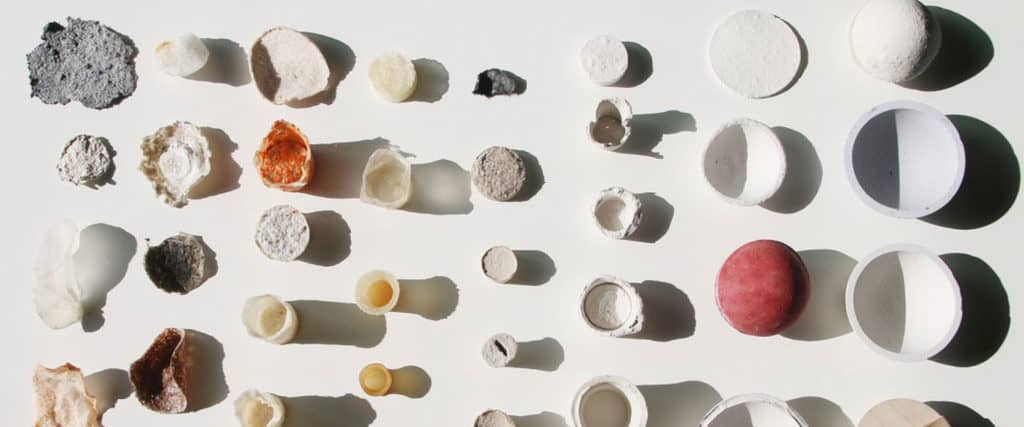
By creating at the crossroads of discipline, structure, universality, raw sensitivity, and intuition, Anika Naporowska’s practice explores transgression and transcendence, aiming to move beyond individual perspective and blur the boundary between artist and material. Her ability to combine forms illustrates a fluency in conscious juxtaposition.

She says she would have always found her way to sculpture, as if it were fated. Anika’s first encounter with sculptures was back in high school. In 2024, she graduated with a Master’s degree in Sculpture at the Magdalena Abakanowicz University of the Arts in Poznań. Today, she’s a multidisciplinary artist, working across traditional and digital sculpture, ceramics, drawing, 3D animation, poetry, and narrative practices.
Contemporary Lynx awarded Anika’s ceramic sculpture, Capitalist Pig (2025), with the Special Mention at the 8th Student Biennale of Small Sculptural Forms. The piece manifests as a piggy bank, an object where innocence and economic logic quietly collide, representing the thriftiness and restraint of the common people. However, it also presents itself as a roasted pig head, a symbol of the aristocracy’s debauchery and luxury. Conscious of societal emotions, Naporowska’s works lend a certain tangibility to subjects that are often intangible.

Her master’s degree work, O pozytywce, która otworzyła się sama (“About the music box that unlocked itself”, 2024), displays an approach to mysticism and abstraction, reminiscent of one introspective beyond her years. It merges trance-based narration, digital body animation, and sculptural form to investigate identity, subjectivity, and the emancipatory potential of the creative process. While Słyszę się na zewnątrz, choć usta mi nie drgną (“I can hear myself on the outside, though my lips do not move”, 2022) shows her skill in presenting a subject, an ear, in various transgressive forms.

We spoke to Anika to delve deeper into her artistic workflow, raison d’être, and the dichotomy of two souls inhabiting her artistic self.
Sophia Kalinowska-Werter: In 2022, you created a site-specific installation at Galeria Miejska Arsenal in Poznań. When participating in exhibitions or creating installations, how often does the exhibition space become your starting point?
Anika Naporowska: This was the only experience in my artistic path where I had the chance to begin working from the space itself, and I remember it very fondly. Space sets the boundaries of form, essentially creating it, while form defines the character of space, making it experiential rather than neutral — so in a way, they are one. This way of working, therefore, felt the most organic to me.
I remember that in 2022, working in the context of the Arsenal gave me a strong sense of grounding. At first, I resisted it a little, but once I accepted it as part of the process, it began to bring me relief.
My creative process is usually very dynamic, intense, and psychologically destabilising, so reminding myself that the exhibition would actually take place in time, and that the work would exist in a real space — and was not just a projection of my mind — felt surprisingly healthy for me.
Mysticism, as I understand it, is the experience of God in every moment, existence, place, and form, and the extension of that experience to other people. A grounded religious experience — a living God encountered intimately, rather than iconography, ideas, or dogma. Such an encounter requires a space which, through interventions such as sculpture, can become a shared body.
Some time ago, instead of thinking about creating another sculpture, I started thinking about the kind of space in which I would like to place my three unfinished sculptures. The answer was simple — a church. The immediate consequence was several hours spent browsing abandoned churches for sale. The realisation was exhilarating: it was actually possible. This called for pragmatic action — a quick walk to Żabka to buy a winning lottery ticket. I was absolutely sure it would work! Unfortunately… not this time. Too bad the installation was only temporary; it would be fascinating to create a space like this on a permanent basis.

SKW: You describe your creative process as an encounter between two archetypal figures: an ascetic monk and a wild child. Does one of them sometimes dominate? And do you see clear differences in your work depending on which of these entities takes the lead?
AN: That happens often, and I feel the difference clearly and in great contrast. Initially, I create my work from the inside. So, first, I feel the shift in my body before I see it on the surface of my work. The child is restless and intense, bringing a lot of potential energy to the work, but also chaos that it cannot comprehend on its own. Just as a child is beloved, yet exhausting even for itself, let alone for a more stable system. It is faster than the form of work alone, so it functions somewhat blindly, creating directly through itself. Hence, the chaos that eventually overwhelms it, and for the work to continue, the monk must take its place.
From the level of my body, I feel clarity of vision, purification, and calmness. I turn off the music, limit my movements to the bare minimum, lose the desire to leave the house or do anything else, as if time has stopped. The monk’s helm appears in the later stages of work, and if it lasts too long, it becomes unbearable for the wild child, who regenerates during its work and returns to the natural desire to live their own life. This doesn’t interest the monk; he cares only for fulfilling his sadhana. However, his heart softens when the helpless childlike emotions knock at the gates of emptiness, and he is forced to step down.
The child is grateful and often greets the body with dance. I think it’s a good match: the child feels accepted and understood, even loved, and the monk’s inner world is introduced to something new that he himself cannot create, because his task is to maintain the system. Only when the child’s energy works together with the monk’s energy can the entire system be transformed, and that is probably the personal meaning of my creativity.
“From the level of my body, I feel clarity of vision, purification, and calmness. I turn off the music, limit my movements to the bare minimum, lose the desire to leave the house or do anything else, as if time has stopped.”

SKW: You work as a multidisciplinary artist. Do you usually know instinctively in which medium you will create a certain project, or does that decision appear later in the process?
AN: I make my decision about the project’s medium intuitively. I basically don’t even make the decision: the form, idea, contents, and medium all come to be in a packet. However, at the beginning, it’s quite far from me, as if behind a fog. I am the one who must change and develop spiritually in order to get closer to it. As if love were the medium, and everything else– a dance of form, even time itself.

SKW: Your Capitalist Pig takes on the subject of late capitalism- a phenomenon that touches all of us. How significant, if at all, are society’s collective thoughts and emotions while creating this or other projects?
AN: I am an emotionally hypersensitive person and highly alert in terms of consciousness, so social moods and collective emotions resonate quite strongly with my emotional and cognitive empathy. You could say that I absorb them like a sponge. When it comes to this particular work and the phenomenon of late capitalism, what strikes me most is the hollowness I encounter in people’s eyes. It is as if the system, by making society dependent on external stimulation, has led to the internal devastation of individuals. Evoking superficial emotions, activating primitive instincts- all this encourages compulsive reactions and ill-considered decisions.
Maintaining a state of eternal dissatisfaction in a world where the only real value is the attention of the consumer’s mind, which, from the perspective of achieving a higher range of stimulation or a higher level of simulation, makes it ineffective to invest in working out the code of one’s own emotions or painstakingly exploring one’s inner world. I have the impression that this causes some strange dissociation in people.
I don’t know, sometimes I get the impression that I live in a graveyard of the spirit. I think I often create in order to find hope for a better tomorrow for humanity within myself in the face of all this, or so as not to get caught up in this game. Contemplating nothingness and playing with imagination is a truly beautiful way to spend time. I would recommend it to everyone.
“I often create in order to find hope for a better tomorrow for humanity within myself in the face of all this, or so as not to get caught up in this game. Contemplating nothingness and playing with imagination is a truly beautiful way to spend time.”
SKW: Creating work with a political nature, do you sometimes experience political burnout? If so, how do you deal with it, and does it affect your artistic practice?
AN: Capitalist Pig is maybe my only work that could be categorised as art with a political nature. Although when creating it, I thought of capitalism more as a contemporary filter of reality, a model for building interpersonal relationships, or a way for individuals to connect with the world. So I was referring to some kind of prototype, an ideal reality, rather than to current politics itself.
For me, unfortunately, it all inevitably leads to total escalation, so instead of unconsciously feeding the spectacle with my own emotions, I prefer to use them as fuel for action, necessary to complete the mission I have been given in this life. In other words, I consciously choose to act on an individual scale, guided by it to the metaphysical dimension, instead of trapping my emotions in areas over which I have no control anyway. I suppose this is how I deal with potential political burnout.

SKW: In one of your previous interviews, you mentioned a “happy accident” when you removed a sculpture from its form too quickly, which significantly influenced the further development of your work. If that moment had never happened, do you think your work would have followed a similar path?
AN: Perhaps it would be similar, but definitely not the same. I know from experience that all happy accidents or unhappy accidents change the trajectory of fate to some degree. By interrupting the current loop of reality or the dominant theme of life, they help you set a new course, also in creative work. It is worth working with them with courage and curiosity.
SKW: Are specific projects that you realise connected in some way – thematically, formally, or intuitively?
AN: I think so. I see in them the expression of a single path and several recurring themes, for example, a sense of circling around one’s own core, feeling caught in a loop, a movement forced by the process of transformation, the search for a language for the unspeakable, finding the essence in a “freeze frame,” and a sense of separation. This intertwines with shared experiences, the pursuit of truth, transcending the ego, trauma, the boundary between life and death, and the non-linearity of time. My projects communicate the existence between the concrete and the abstract, fate, a sense of imprisonment, oppressive heaviness, and hard-won lightness. It was only during this enumeration that I realised that all these themes are connected by the process of expanding self-awareness and the search for liberation, which I now identify with God.

SKW: What can we expect from you in the near future? Do you plan to create rather spontaneously, or do you already have clear plans regarding the direction in which you would like to develop?
AN: I have two open writing projects: one about social subjects involving drawn elements, and the second about a metaphysical topic with sculptural components. I created them last year using the flow technique, in a state of deep crisis of identity and meaning, which, looking at it from a different perspective, could simply have been reprogramming for transmission. The external effects of internal transformation are unknown to me, and I look to the future with immense, childlike curiosity.
However, I have a feeling that what may come next no longer belongs to my artistic path — and I find that comforting, as I have realised that I never quite felt at home on it. I hope that I will finally be able to reach Him, and that this will have a positive impact on reality as a whole. Namaste!