In a Venice Biennale season shaped by national spectacle, institutional diplomacy, and cultural branding, South African artist Gabrielle Goliath has presented something far quieter and far more unsettling. Following its cancellation from South Africa’s official Biennale pavilion over references to Gaza, Elegy has opened independently inside the thirteenth-century Chiesa di Sant’Antonin in Venice’s Castello district, transforming mourning into a form of political resistance and asking whose suffering is publicly recognised, and whose lives remain systematically excluded from collective grief.
The cancellation of the South African Pavilion by Minister Gayton McKenzie, who reportedly described the work’s references to Gaza as “divisive,” sparked backlash and an unsuccessful legal challenge. Yet rather than silencing the project, the controversy intensified its urgency. With support from organisations including Ibraaz, the Bertha Foundation, and Fondazione ICA Milano, Goliath and her collaborators mounted the exhibition independently, turning Elegy into both an artwork and a broader confrontation with censorship, memory, and solidarity.
Through sound, ritual, and black feminist thought, Goliath offers not simply a lament for the dead but an insistence on the value of lives too often rendered disposable.
Running from 5 May to 31 July, before travelling to London in October 2026, accompanied by a catalogue launch and the community-driven Curriculum of Shared Breath, Elegy gathers voices, histories, and acts of collective mourning into a meditation on colonial violence, femicide, displacement, and political erasure. Through sound, ritual, and black feminist thought, Goliath offers not simply a lament for the dead but an insistence on the value of lives too often rendered disposable.

Mourning as a Political Practice
Originally trained as a painter, Goliath’s practice focuses on survival, political representation, and the lived realities of non-conforming bodies. Over the past decade, she has consistently returned to a central question: whose lives count, and whose deaths are recognised as worthy of mourning?
Elegy, an ongoing performance work that Goliath has developed since 2015, is a critically acclaimed multidisciplinary sound and video installation that commemorates the unjust killing of women, queer communities, and victims of colonial violence. The work stages a ritual lament for victims of femicide in South Africa, the Herero and Nama genocide, and Palestinians killed in Gaza. Through performance and installation, participants hold a single sustained mournful note in honour of victims of gender-based violence and systemic political killings. Over the past decade, the work has been presented in Johannesburg, Cape Town, São Paulo, Paris, Amsterdam, Munich, Basel, and beyond.

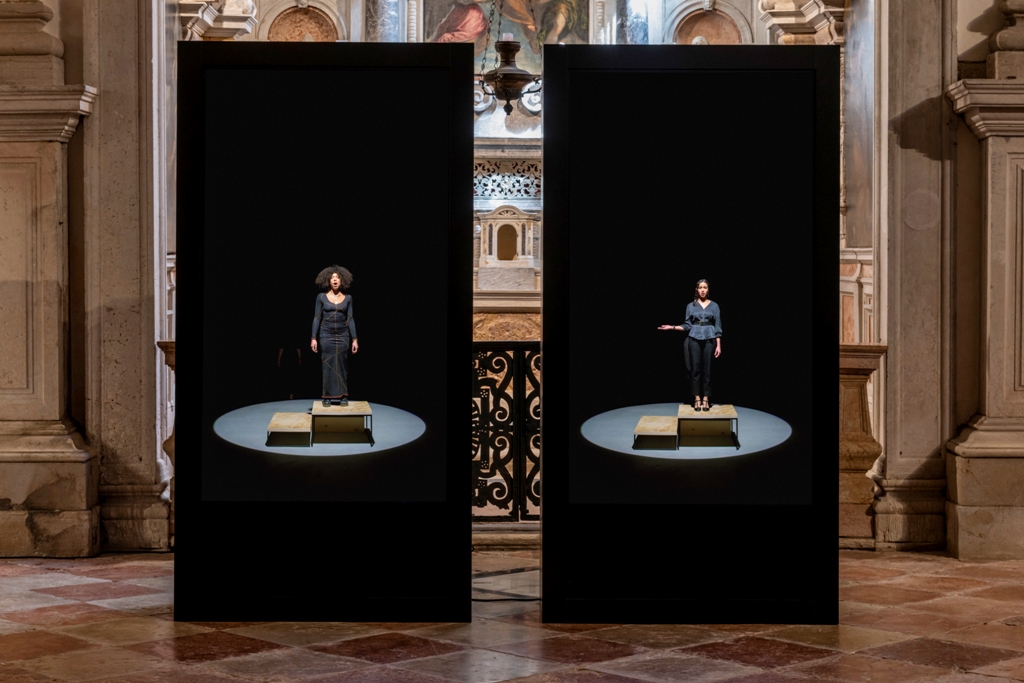
Inside the XIII Century Chiesa di Sant’Antonin, Goliath has installed several filmed versions of Elegy. The spoken words are as important as the image; women’s voices in the work hold a single note, then separate, then merge again, creating a lament that resonates strongly and poetically through the church’s stone acoustics. The setting intensifies the emotional and conceptual force of the installation. Black and brown bodies appear in dialogue with Christian figures painted across the church’s murals, sharpening the work’s meditation on whose lives are publicly mourned and whose are historically excluded from collective remembrance.
Black and brown bodies appear in dialogue with Christian figures painted across the church’s murals, sharpening the work’s meditation on whose lives are publicly mourned and whose are historically excluded from collective remembrance.
In Venice, the installation includes three new suites of performances commemorating South African student Ipeleng Christine Moholane, two murdered Nama women ancestors, and Heba Abunada, who was killed in an Israeli airstrike in Khan Yunis in October 2023. Arranged across eight monumental video screens, the work immerses viewers in sound, light, and collective mourning, drawing participants into what Goliath describes as a shared labour of imagination, care, and connection.
Elegy is a cry, a lament, a tender refrain of remembrance, repair, and black feminist love. Yet it is also a theatrical installation and, in Venice, references to the Commedia dell’Arte feel almost inevitable. One can think of Honoré de Balzac’s The Human Comedy, and of a literary lineage stretching through Fyodor Dostoevsky, Saul Bellow, Hertha Müller, Irène Némirovsky, Naguib Mahfouz, and even Heba Abunada — writers who confronted human suffering in their work, often experiencing it firsthand and to devastating extremes. The narration of suffering, oppression, but also of pride in one’s human and cultural roots, is not a matter of fetishism or hypocrisy; it is a question of intellectual honesty and a symbol of freedom.

The narration of suffering, oppression, but also of pride in one’s human and cultural roots, is not a matter of fetishism or hypocrisy; it is a question of intellectual honesty and a symbol of freedom.
A Space for Profound Reflection
Alongside the Venice exhibition, Goliath continues to expand Elegy beyond the installation itself through publications, readings, and public programming. In a Biennale environment shaped by national pavilions and official narratives, her independently mounted work proposes something quieter yet more unsettling: that art can still function as a space for public grief, solidarity, and political imagination, even when institutions attempt to close those spaces off.
Central to the presentation is the launch of the Elegy Reader, co-produced with Ibraaz Publishing. Bringing together poetry and texts responding to histories of displacement, colonialism, and genocide, the publication expands on many of the themes explored in the exhibition. Featured poets include Heba Abunada, Forough Farrokhzad, Danielle Legros Georges, and Maneo Mohale.

The independent exhibition arrives at a significant political moment, as women, LGBTIQ+ communities, and allies in South Africa continue to mobilise against the ongoing crisis of femicide in South Africa, while the country itself has also taken a leading role at the International Court of Justice in defending Palestinian lives. As Goliath declares, “Convened in this exhibition is a gathering space, a sacred chamber in which to sound a reparative work of loving and longing. We hold a note — a black femme chorus — and in the face of cancellation, threat, and incommensurable losses, dare to think and dream the world differently”.
She deploys the term ‘survivor’ not to erase the traumatic experience and social inscription of victimhood, but rather to insist upon the insurgent, incendiary, quotidian practices of refusal, imagination, and repair enacted in the everyday lives of these individuals.
Following the cancellation of Elegy, Goliath said she has received an outpouring of support and solidarity from international artists as well as members of her local community. “Many people are also thinking of this in relation to apartheid-era censorship,” she explained. “I think that that’s why there’s been such a deep sense of betrayal, because our constitution enshrines the right to freedom of expression”.

She speaks of her work as attending to the present-day conditions of differentially valued life. She addresses the structural ways in which black, brown, femme, queer, trans and indigenous individuals seek to live, love, survive and thrive, in spite of black femme negation and conditions of political impossibility that render these lives precarious, disposable and prone to violence. She deploys the term ‘survivor’ not to erase the traumatic experience and social inscription of victimhood, but rather to insist upon the insurgent, incendiary, quotidian practices of refusal, imagination, and repair enacted in the everyday lives of these individuals. This is survival as an active, agential political life-work.
This is an artistic work of uncommon maturity, particularly in a cultural moment so often marked by superficiality and ignorance, conditions that do not spare the Venice Biennale itself. Yet Elegy remains one of those rare exceptions: a work capable of moving audiences through its conceptual beauty while simultaneously opening space for profound reflection.