






Arriving in the Slovenian capital at the end of May, one could clearly feel the electrifying atmosphere. And it was no coincidence, as this year’s Ljubljana Art Weekend (LJUW) was much more intense than a typical art fair. Over four days, the festival brought to life an unfamiliar urban fabric, presenting to the uninitiated a decentralized and evocative view of the city’s contemporary art ecosystem. Organized by RAVNIKAR Projects and curated by the international collective behind ETC. Magazine — marking its fifth anniversary — LJUW dissolved the capital’s invisible thresholds.
By embedding contemporary interventions directly into the historic core, the programming quietly subverted Ljubljana’s postcard-perfect tourist venues, charting a friction-filled bridge between highly visible, romanticized heritage sites and raw, liminal spaces.
By embedding contemporary interventions directly into the historic core, the programming quietly subverted Ljubljana’s postcard-perfect tourist venues, charting a friction-filled bridge between highly visible, romanticized heritage sites and raw, liminal spaces. The festival ultimately staged a crucial arena for dialogue between local artists, international curators, and collectors, demanding a critical reexamination of the spaces we routinely take for granted.

Coming Full Circle. Nostalgia vs. Institutional Selectivity
At the core of this year’s programming was the conceptual focus named Full Circle. The theme interrogated the unstable terrain between personal recollection and official history, exploring the reflective potential of contemporary art to challenge the status quo and grant social visibility to neglected narratives.

This underlying thesis deeply mirrored the tensions surrounding the recently inaugurated 61st Venice Biennale in 2026. The global landscape in Venice, marked by heightened friction and controversies regarding national representation, has profoundly divided cultural communities over the systemic roles of administrations, institutional governance, and historical gatekeepers. These highly charged debates echoed forcefully across LJUW, prompting a reciprocal dialogue between local art professionals and the audience.
Within this resonant atmosphere, the curatorial team advanced a crucial distinction: while personal memory is frequently romanticized or mythologized, official history remains bound to institutional selectivity and power structures within the archive. Monuments themselves, often rendered invisible within the urban fabric, manifest what they historically overlook through their symbolic structures of simplification.

A focal epicenter of this critique was the central exhibition at RAVNIKAR, poetically titled Around every circle another can be drawn. The exhibition brought together a potent polyphony of regional and international artistic voices navigating migrations, geopolitical tensions, and transitional frictions. Within this space, intimate and affective reflections intertwined with the complex, lived experiences of warfare, social exclusion, and the heavy heritages of colonial legal frameworks or bureaucratic classifications.
Crucially, these inquiries extended far beyond traditional, mainstream gallery walls. By staging Klara Kracina’s exploration of logistical infrastructures at Alkatraz Gallery and the collaborative project Trin Alt & Tobias Izsó: Shelved at Space for Art NÓT, the programming anchored these specific artworks directly inside alternative, un-institutionalized liminal environments. Operating within these grassroots, independent hubs allowed the practices to occupy the raw, non-traditional territories required to effectively critique institutional neglect. Together, these artists carved out a space for radical imagination, rewriting the gaps left by institutional failure.

This institutional critique culminated in The Crit Club’s performative debate staged within the historic sports space of Sokolski dom Tabor. Crit Club functions as a radical discursive format in which participants step completely outside their professional roles — whether as artists, researchers, curators, or writers — to engage in collaborative role-play scenarios. By confronting provocative, often absurd questions about art, expertise, and the rigid conventions of art discourse, the debate destabilized standard academic hierarchies.

The panel featured active participation from Manca G. Renko, Alenka Pirman, Andrej Škufca, and Stephanie Bailey. This cross-disciplinary assembly allowed for a multifaceted dissection of structural institutional limitations. Pirman’s renowned practice, which relentlessly questions the status quo of art institutions and exposes their frequent fatigue to confront ethically problematic contemporary issues, found a dynamic echo in the contributions of her fellow panelists. Her ongoing dialogue through the lens of hybrid, fictional institutions, conceptualized within the festival’s accompanying publication, curated by the ETC. collective, perfectly mirrored the Crit Club’s shared subversion of established art-world authority and traditional gatekeeping.
In a world increasingly dictated by algorithmic filters that bury certain historical realities while magnifying others, and contemporary warfare weaponized by AI-driven systems that excuse social accountability, Full Circle posed a haunting question: Are we doomed to an endless repetition of historical violence, or can we return to the past specifically to rethink the future? Rather than offering passive answers, the festival pushed its audience to confront the space between moral clarity and political paralysis, examining the ethics of witnessing crisis in real time, and the validity of refusal, boycott, and active presence.

From the Intimate Tea Table to Liminal Sonic Hubs
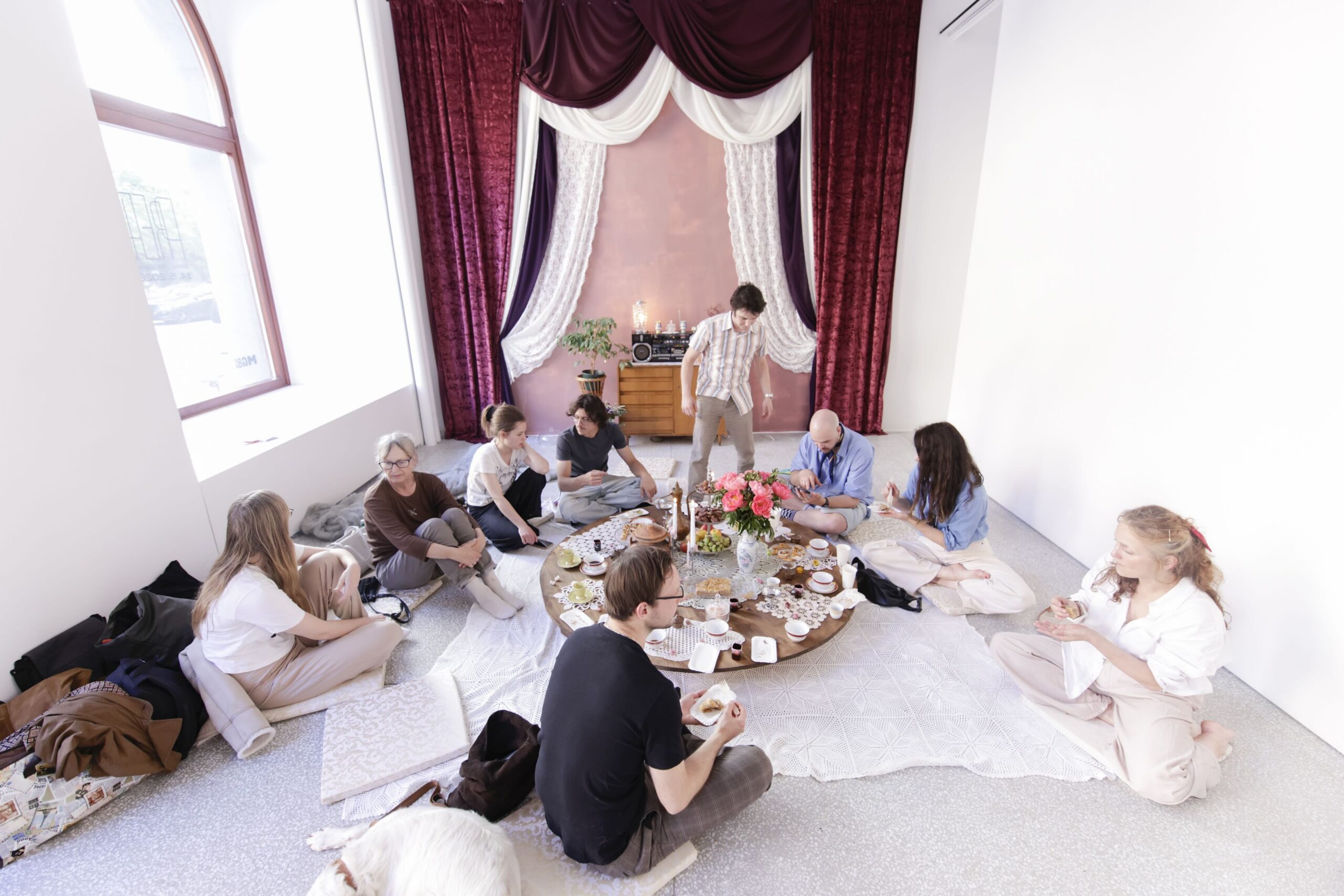
The curated strength of LJUW lay in its capacity to manifest global anxieties through intimate, human-scale encounters. At the Mala Galerija, directly connecting the festival to the local academic and research community of the Academy of Fine Arts and Design (ALUO), the conceptual became physical around a performative tea table. As part of the gallery’s exhibition Intertwined, artist Emira Bećirović invited visitors into an intimate performance and get-together right inside the exhibition space. In this setting, visitors sat side-by-side to share space, sip tea, and eat typical Slovenian baklava sweets, opening up safe zones for personal reflection and utilizing artistic practice as an active apparatus for cross-border cultural exchange.
By utilizing venues that tend to be physically located too far from the center or are inherently difficult for the general public to access, LJUW dissolved rigid programming. It replaced institutional gatekeeping with an organic, borderless invitation to participate in the city’s most radical, transitional subcultures.
Moving from the intimate to the experimental, the festival’s curated tours offered unparalleled access to the city’s hidden creative sub-layers. While RAVNIKAR led insightful curatorial walkthroughs of classic white-cube spaces, Kapelica Gallery hosted a series of one-of-a-kind studio visits that pushed deep into the city’s periphery. Participants stepped directly into strict, active liminal spaces, clandestine laboratories, and hybrid cultural hubs dedicated to experimental music. These visits allowed observers and professionals alike to enter highly specialized environments where scientists, artists, and the local community reunite creatively and spontaneously to share their inspirations.
By utilizing venues that tend to be physically located too far from the center or are inherently difficult for the general public to access, LJUW dissolved rigid programming. It replaced institutional gatekeeping with an organic, borderless invitation to participate in the city’s most radical, transitional subcultures.
Social Muscle Memory. Blasting Open the Continuum
The cyclical tension of the festival is further expanded by a diverse assembly of artists examining the complex interplay of memory, archives, and performativity. Looking closely at these collective works, their artistic strategies vividly evoke the foundational philosophy of Walter Benjamin’s seminal essay, On the Concept of History.
The unique way these practitioners confront the past stages a profound, unspoken dialogue with Benjamin’s critique of linear time. Instead of treating history as a passive timeline of homogeneous, empty events, these contributors expose how every document of culture carries hidden, conflicting layers of structural violence — often maintained by institutional frameworks at the cost of silenced minor perspectives.

The diverse practices on display seem to actively brush history against the grain, bypassing a mechanical copying of facts to uncover forgotten, suppressed narratives. This resonance was heavily anchored by the special screening of IRWIN group, Igor Zupe: An Apology for Modernity at the City Museum of Ljubljana, alongside their acclaimed work Time for a New State. These moving-image pieces deeply interrogated the living archive and future trajectories of the NSK State in Time, a state existing entirely without territory, anchored only through time, memory, and continuous civic performance. Crucially, the screening was followed by an in-depth discussion with Hana Čeferin and IRWIN members: Zdenka Badovinac and Igor Zupe, which allowed the audience to untangle the complexities of statehood, historical memory, and artistic legacy in real time.
To break the cycle of repetition, participating practitioners seize the past not the way it historically was, but as an unexpected, vital flash of danger in the present moment — blasting open the continuum of history to reveal a weak power capable of rewriting the gaps left by institutional neglect.
By grounding these artistic interventions across a diverse network of spatial topographies, weaving from Ljubljana’s most liminal, unregulated spaces into local museums and dedicated independent cinemas, LJUW activated the past as a volatile constellation of unfulfilled possibilities. This collaborative, city-wide integration of alternative urban hubs and established cultural infrastructure forces the contemporary witness to locate the fractures within the loop. To break the cycle of repetition, participating practitioners seize the past not the way it historically was, but as an unexpected, vital flash of danger in the present moment — blasting open the continuum of history to reveal a weak power capable of rewriting the gaps left by institutional neglect.

A Critical Milestone
By embedding these radical artistic experiments into everyday urban spaces, Ljubljana Art Weekend did more than showcase the breadth of Slovenian contemporary art. It positioned Ljubljana as a vital, international site of critical exchange.
As ETC. Magazine marks five years of amplifying underrepresented voices from the Baltics to the Balkans, this edition of LJUW proved that when the phrase Never Again is reduced to an online hashtag, contemporary art still holds the unique power to disrupt the loop, demanding that we look closer, stay present, and refuse to forget.


