If you are not spending this summer writing an amateur, probably unpublishable science-fiction novel, what are you even doing? In these anxious times of record-breaking heatwaves, geopolitical tremors, and borders that seem to vibrate with silent hostility, speculative fiction has ceased to be a literary genre; it has become our default cognitive defence mechanism.
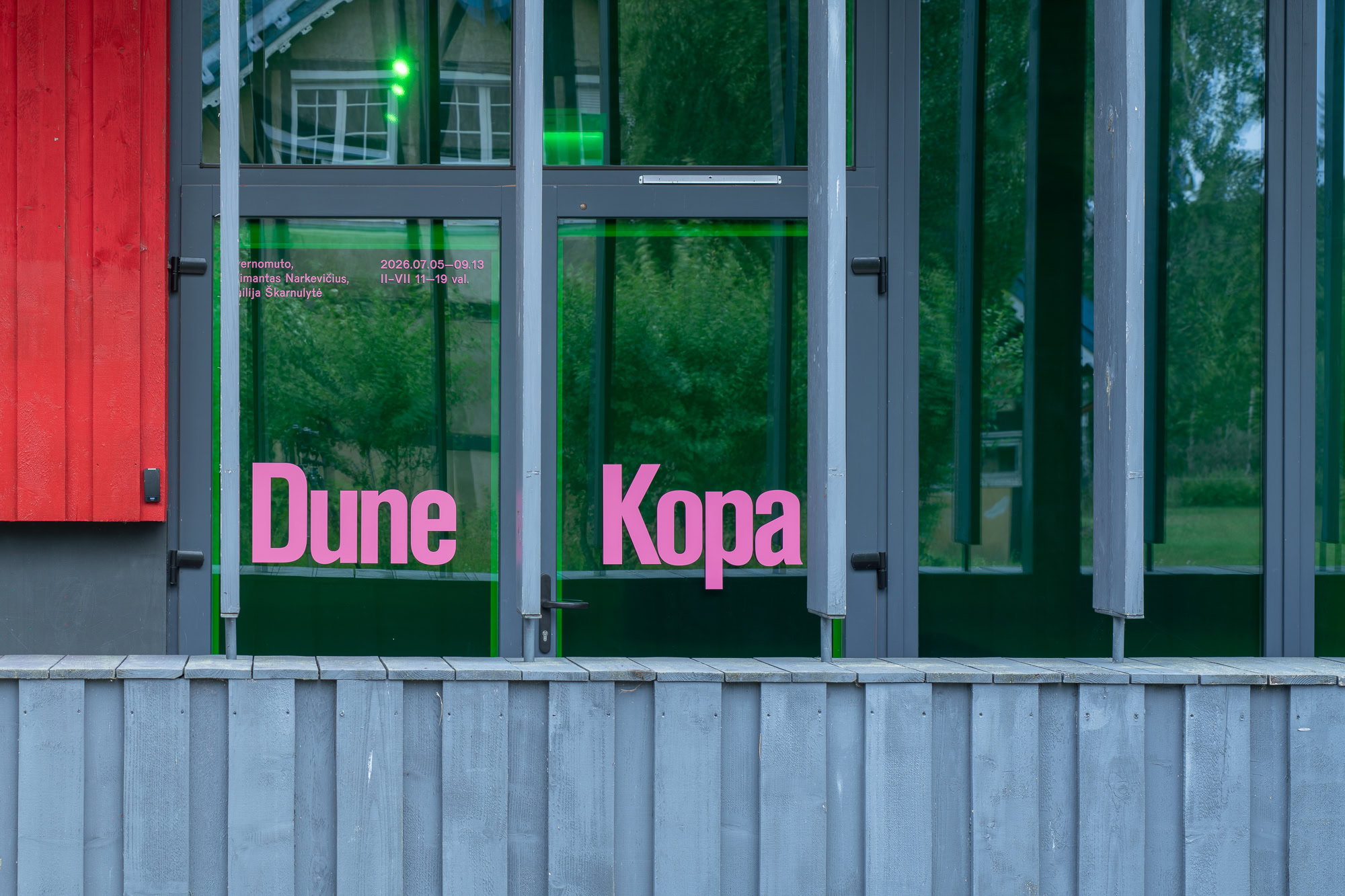
This summer, at the edge of the Baltic, where the Curonian Spit stretches its ninety-eight-kilometre sand-spine between Lithuania and Russia, Nida Art Colony of Vilnius Academy of Arts has transformed into a containment vessel for these precise premonitions. The summer exhibition Dune, curated by Neringa Bumblienė, approaches Neringa not merely as a postcard-perfect UNESCO heritage site, but as a real yet myth-laden territory – an arena where human anxiety, ecological precarity and deep time collide under the blazing sun.

A Non-Human Nervous System
To enter the exhibition is to experience an act of immediate biological submission. One is instantly bathed in a dense, chemical, grass-neon green light emanating from the windows, courtesy of the Italian artist duo Invernomuto’s cross-media installation, Triton (2023–ongoing). It is the green of a toxic oasis, a swamp under an artificial sun. At first, the monochrome is blinding, a sensory assault that flattens the room into a singular, vibrating frequency. But as you linger, a quiet miracle of physiological adaptation occurs. Your eyes adjust; the neon green recedes into an ambient background hum, and the hidden gradations of the other works begin to crystallise. You acclimatise.

The installation reminded me of something unexpected. For anyone familiar with the history of painting, its pervasive green glow may recall the colour of verdaccio – the medieval and Byzantine underpainting technique famously used by Giotto and his contemporaries. Renaissance masters realised that by laying down a monochromatic green foundation before applying warm flesh tones, the final portrait gained a startling, three-dimensional depth, mimicking the veins and cool shadows pulsing beneath human skin. In unfinished frescoes or works in which the upper glaze has worn away over time, the green foundation is exposed. Standing inside Invernomuto’s installation, I realised that the analogy extended beyond the gallery walls: the same green light settled over the architecture, objects and visitors alike, tinting our skin and absorbing us into the image. For a moment, I felt less like an observer than a figure suspended inside an unfinished painting – almost like one of the salamanders submerged in green water, a spectral draft of a body waiting for a warmer layer of flesh that may never arrive.

That amphibian association is not merely metaphorical. The green light is the visual emission of a non-human nervous system. Triton is connected via live-streamed data to two ancient rock basins in Pietra Perduca, Northern Italy, where a wild colony of salamanders resides in pools carved into the stone during the Iron Age. Cameras scan the water’s surface, and custom AI software translates the ripples, movements and temperature shifts of these amphibians into real-time soundscapes and light modulations. The gallery becomes a giant, reverberating musical instrument played by the unconscious choreography of amphibian creatures. It is a dizzying, trans-species translation: the ancient, sacred waters of the Apennines whispering directly to the shifting sands of the Baltic.
Listening to the Stones
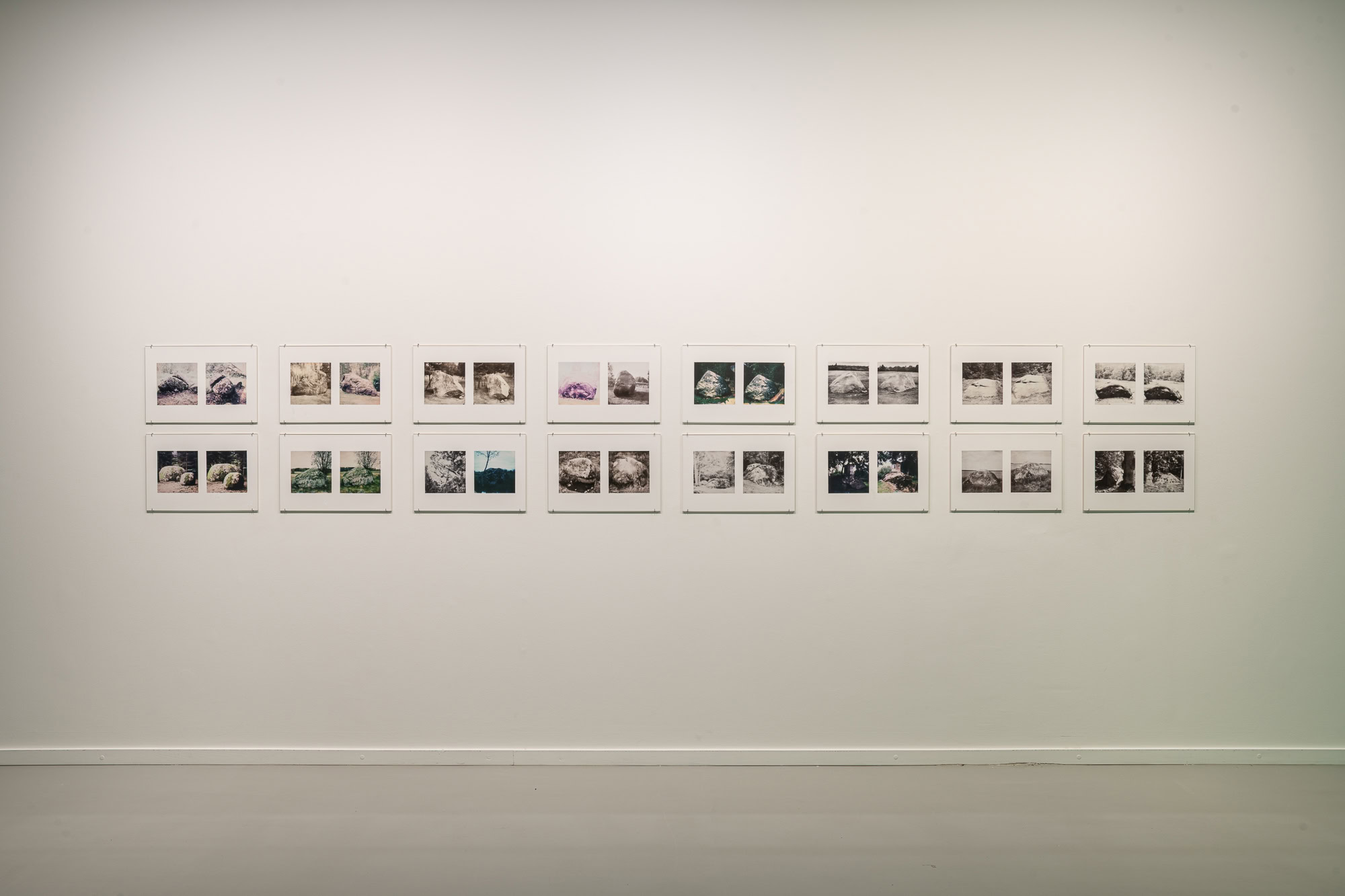
If Invernomuto liquefies the gallery with green light and aquatic data, Deimantas Narkevičius petrifies it with the heavy silence of glacial debris. In his photographic series Akmenys po du (Lithuanian for Stones in Pairs, 2023), Narkevičius presents large, solitary boulders scattered across the Lithuanian countryside. These massive stones are geological anomalies, torn from Scandinavian bedrock during the last Ice Age and dragged south by retreating glaciers. For millennia, they have occupied a crucial, shifting role in the human imagination: first as pagan altars for sacrificial fires, then as Christianised sites of prayer, and later as silent markers of collective memory.
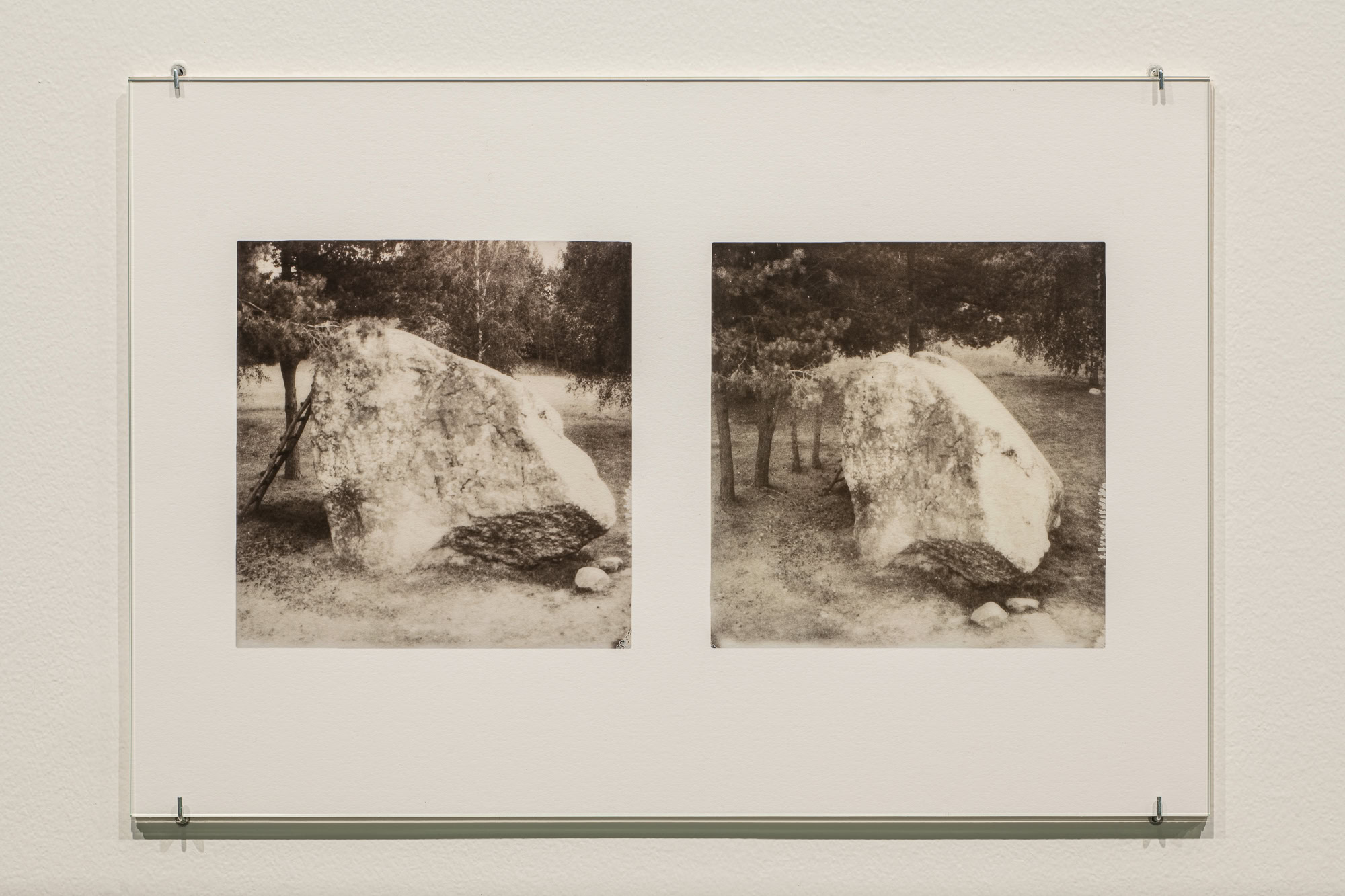
Narkevičius photographed each boulder twice – from different angles or during contrasting seasons – using Polaroid film, subsequently scanning the prints. The resulting images are bathed in warm, grainy, sepia-adjacent tones that feel aggressively anachronistic. They look like late nineteenth-century archival discoveries, yet they were captured in the summer of 2023. By doubling the stones, Narkevičius denies the viewer a single, definitive gaze. The two perspectives never quite merge into a perfect stereoscopic image; instead, they create a small, vibrating gap of uncertainty. We are left looking at monuments that refuse to sit quietly in the present, existing instead in a state of permanent, lithic amnesia. Through pareidolia, faces begin to emerge from their surfaces, and some forms even resemble fetal sonograms, prompting the thought that this instinct to recognise bodies in stone may have preceded the impulse to carve and sculpt them.
Archaeology of the Future
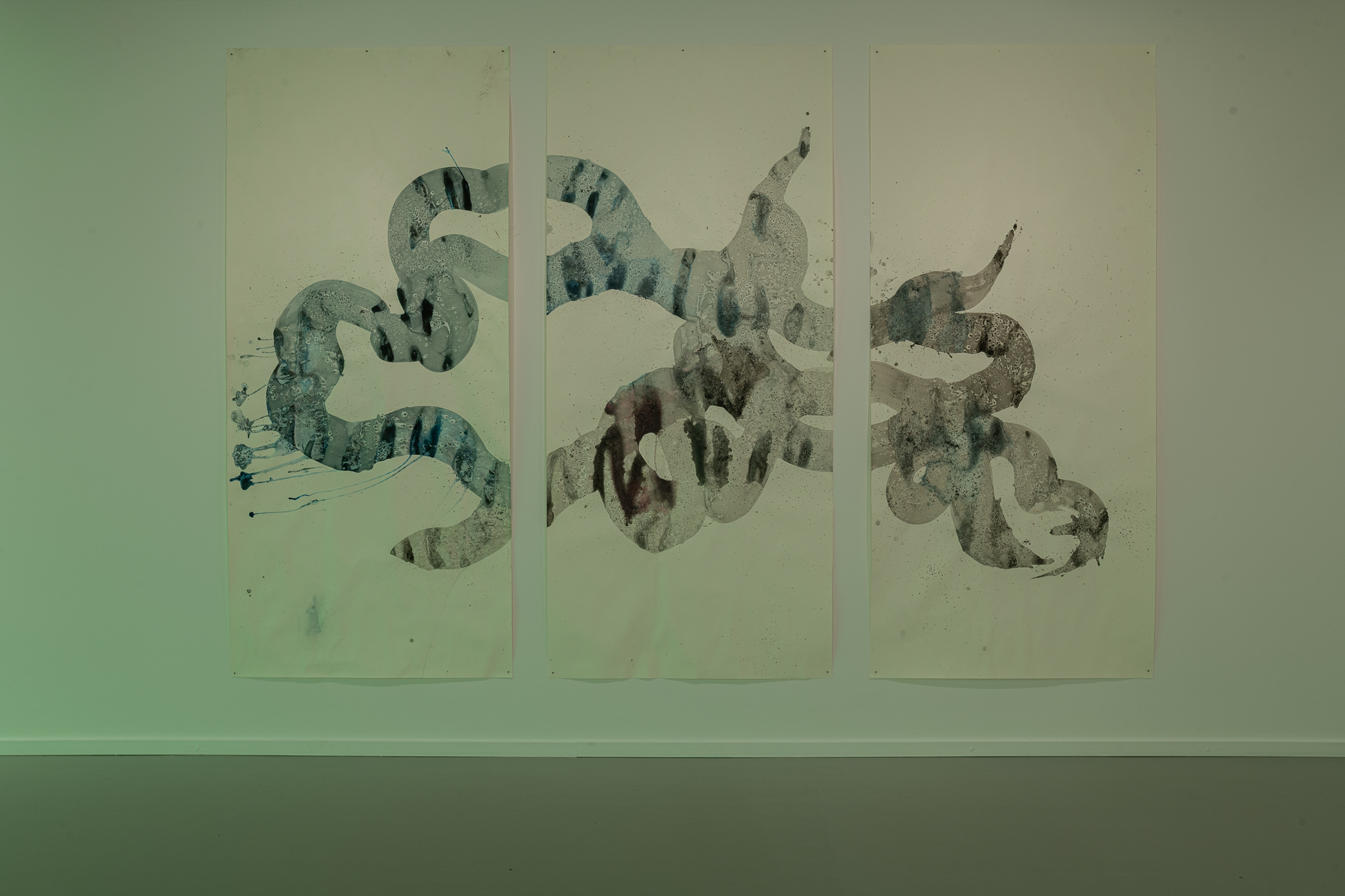
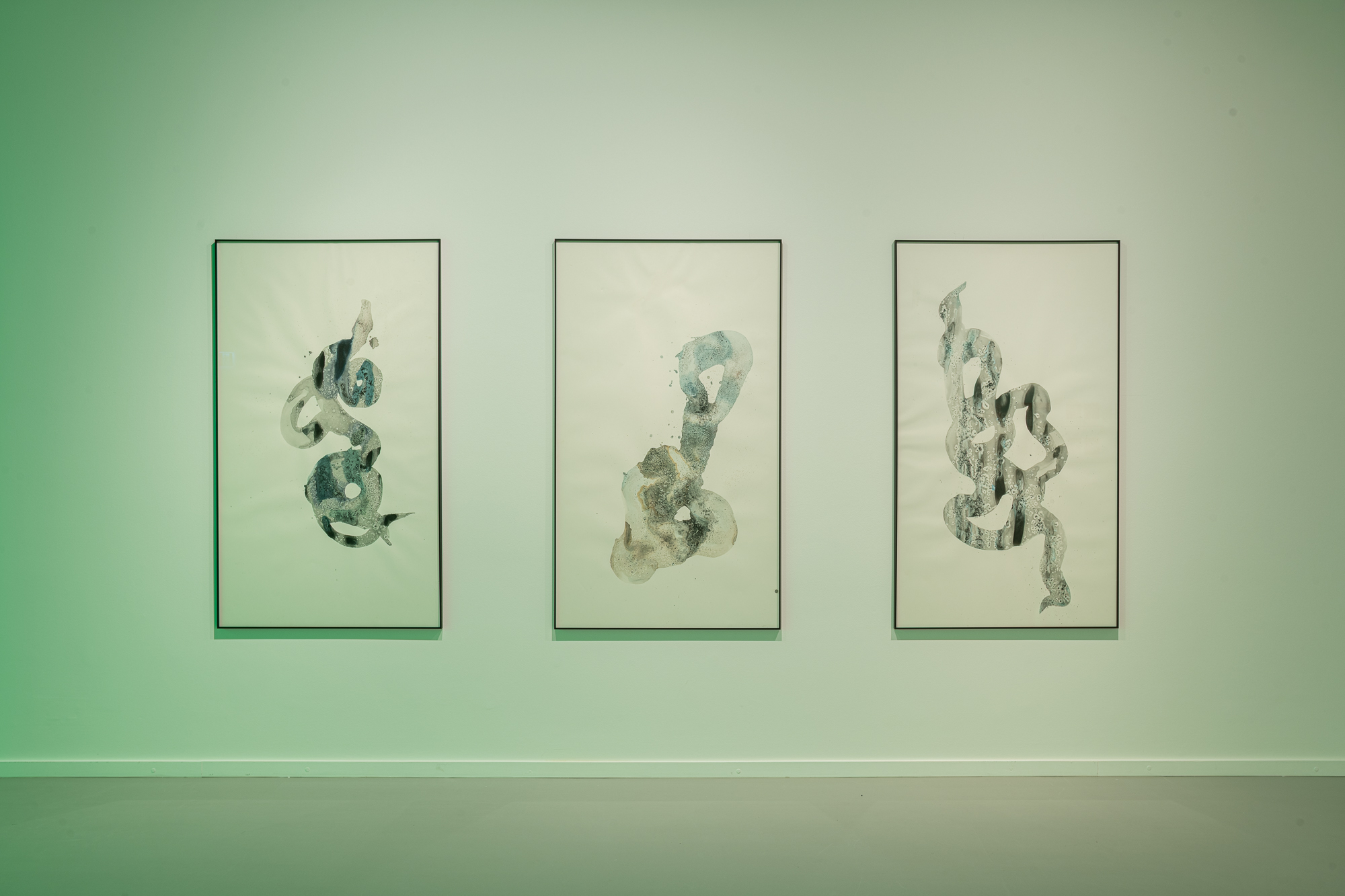
This dialogue between deep time and technological future-casting finds its most delicate manifestation in Emilija Škarnulytė’s drawings and glass sculptures. Created during her residency at NAC, Škarnulytė’s drawings of aquatic microorganisms and ritualistic objects are rendered in iron oxide – the very dust that stains both the prehistoric caves of Lascaux and the barren deserts of Mars. It is a material that functions as a universal geological archive. Alongside these drawings rest her glass objects, If Water Could Weep (Mermaid Tears), from 2023-24, cast in neodymium glass. Neodymium is a rare-earth element that possesses a highly unstable visual identity: under natural sunlight, the glass appears a soft lavender-violet, but under fluorescent or other artificial light, it shifts into a cold, icy blue. These ‘tears’ do not represent a romanticised grief; they are the physical manifestations of a planet undergoing rapid chemical mutation. Their surfaces seem at once mineral, bodily and marine – like crystallised organs, fossilised drops, or fragments of some post-natural reef. They belong neither entirely to geology nor to biology, but to a speculative material state in which the categories of nature, technology and ruin have already begun to dissolve.

Hovering above them, the projection appears like a phantom double or an afterimage of the objects below – an imagined form of future amber, no longer golden, warm or nostalgic, but acidic, irradiated and strangely alive. If traditional amber preserves the deep past, trapping insects, air and organic debris inside its hardened resin, this future amber seems to preserve the consequences of our own present: toxicity, extraction, climate disturbance, synthetic light. The artist’s gaze here feels almost archaeological, but displaced forward in time. She looks at our era as if from a future excavation site, treating today’s ecological crisis not as an abstract warning, but as already-material evidence – something that has hardened, glowed, mutated and survived us. Like the shifting colours of the glass, our understanding of the environment changes depending on the spectrum of light – and political will – through which we choose to view it.
Learning to See the Future
The curator’s invocation of Frank Herbert’s Dune is not merely thematic; it is structural. Neringa, much like Arrakis, is an artificial landscape. The pine forests that blanket the spit were planted in the nineteenth century in a desperate, heroic effort to stabilise the drifting sand dunes that threatened to swallow entire villages. It is a landscape born of discipline, community and ecological foresight – the very qualities Herbert championed.
Yet, the true genius of the exhibition lies in its somatic aftereffect on the viewer. To leave the exhibition space is to experience an involuntary, secondary performance. Stepping back out into the natural daylight of the Curonian Spit, the world is suddenly dyed in an intense, hallucinatory, apocalyptic pink. This is the physiological compensation of the retina – a beautiful, temporary fiction produced by the eyes after being saturated by Invernomuto’s green. It is a stunning metaphor for the entire exhibition: we cannot look at the real world without carrying the coloured filters of our speculative anxieties. By the time we acclimatise to the green of our current, troubled reality, the pink is already waiting for us outside – a reminder that the future is already here, changing the colour of everything we thought we knew.

‘All power is limited,’ Alia whispers to Stilgar in the passage from Dune Messiah that acts as the exhibition’s literary compass. In Nida, where the sand is always trying to swallow the forest, and where the border wall stands just beyond the trees, this limitation is a daily reality. Dune is not an escape into science fiction; it is a training manual for the quiet end of our own epoch. It reminds us that if we are to survive the coming deserts – both ecological and geopolitical – we must first learn to stand in the green underpainting of the world, patient, unfinished, and listening to the stones.