





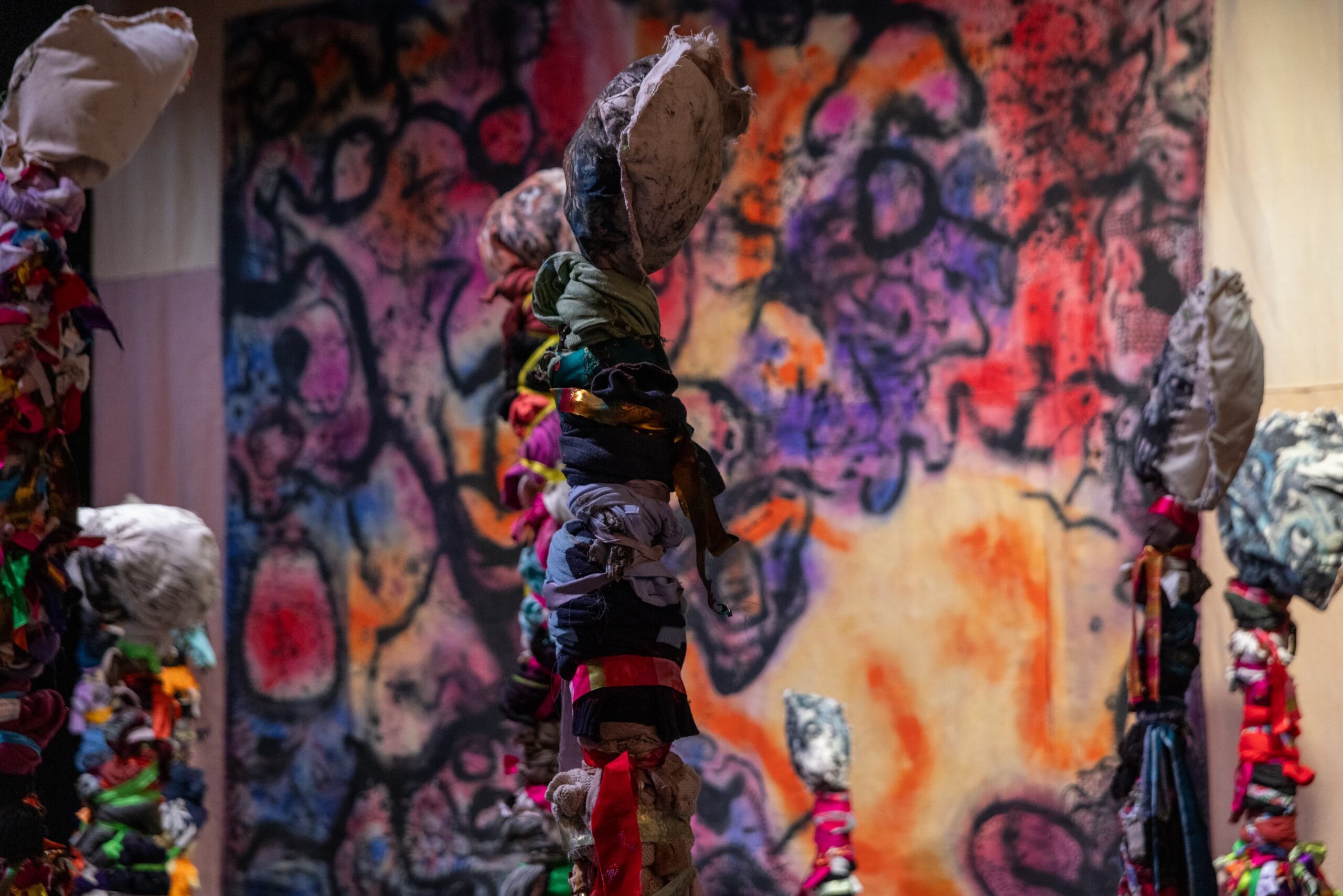
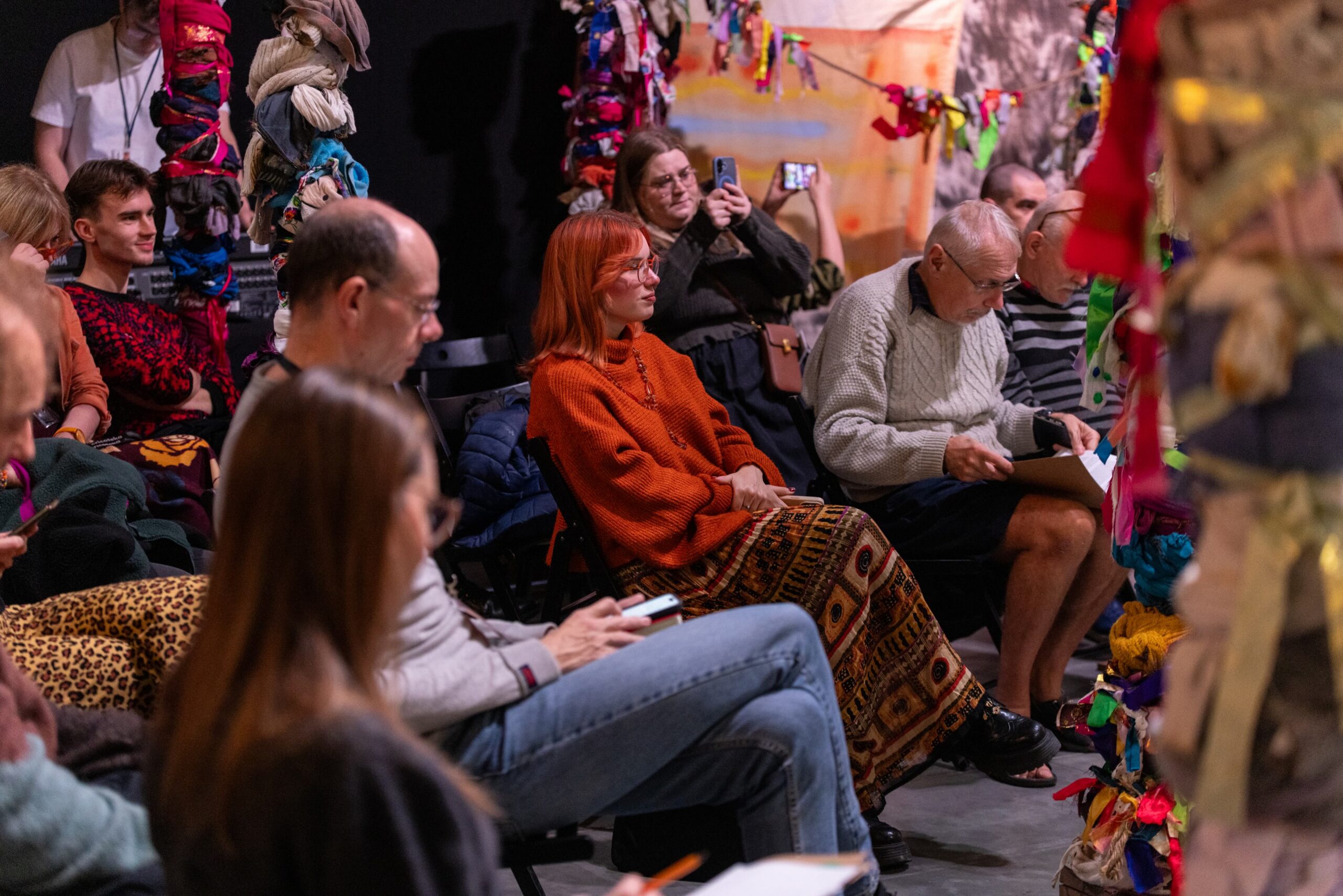
A tent-like structure made of large-scale painted textiles and humanoid figures creates an unusual setting at the 24th edition of Sacrum Profanum Festival in Kraków. Up in the gods is a collaborative installation by Korean-Polish artist duo Si On and Jakub Julian Ziółkowski, presented at Cricoteka in Kraków. Somewhere between a theatre set, an exhibition space and a ritual site, it invites audiences to experience music from within a space shaped by the artists’ imagination.
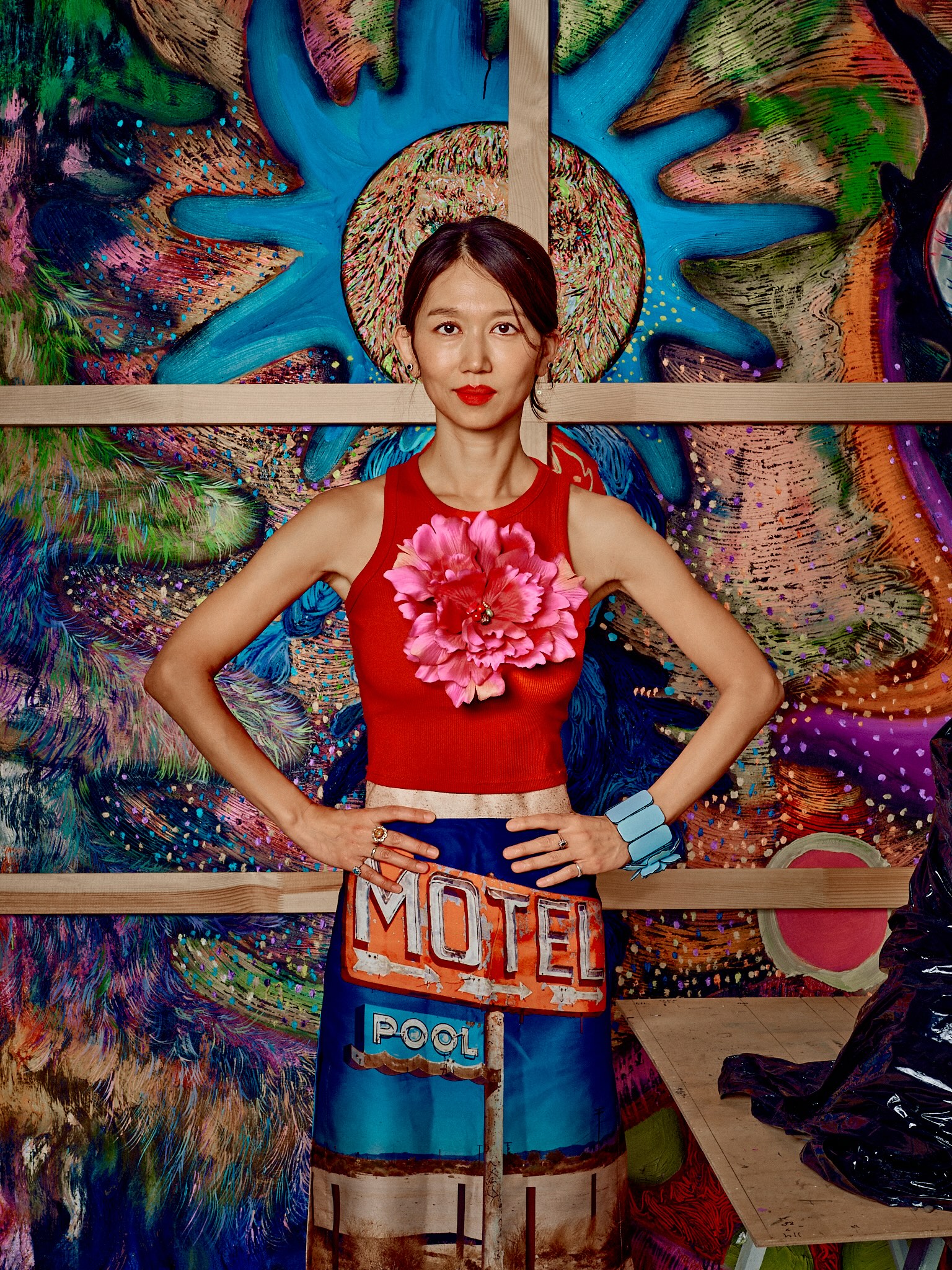
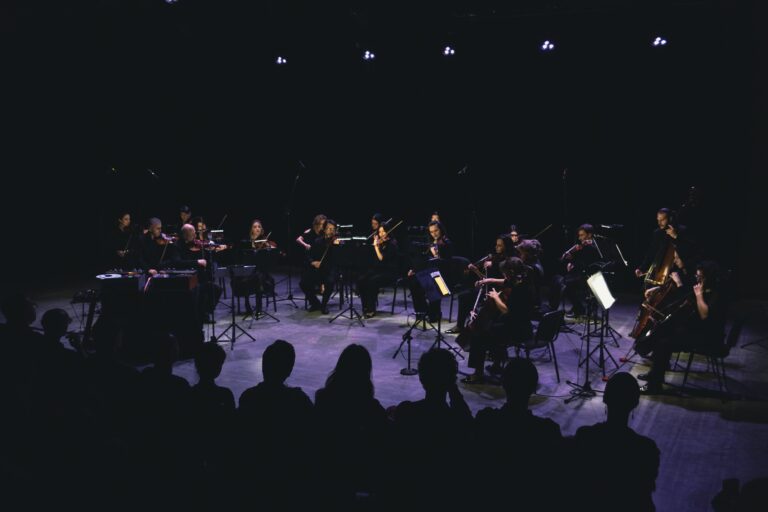
From 6 to 11 November, the installation at Cricoteka will provide the setting for a series of concerts as part of Ritual, the festival’s main concert programme. It brings together a wide range of musical traditions — from medieval songs and folk instruments to experimental compositions. Each day’s performances will be linked by musical-ritual interventions by Ziółkowski, who will take on the role of master of ceremonies.
Alongside the main programme, this year’s festival introduces Initiations — a new strand of events aimed at making contemporary music more accessible to wider audiences. It will include sound workshops, meetings with artists, musical activities for children and events designed for groups with specific needs.

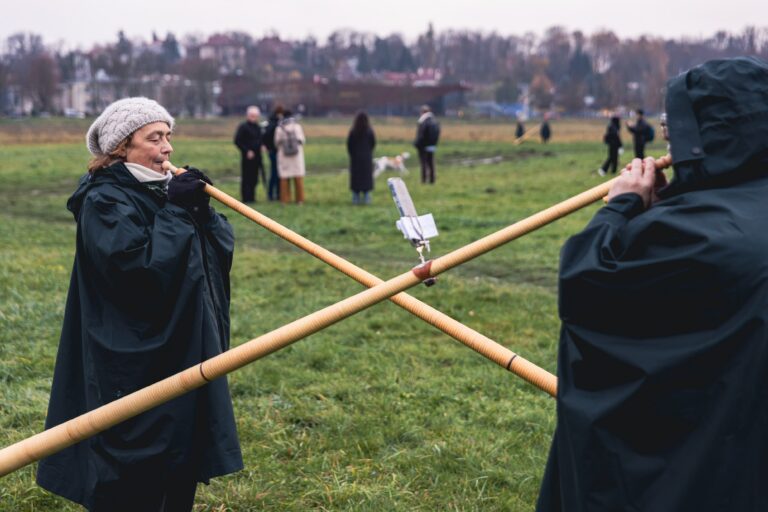
The wider programme takes music beyond conventional concert venues, with performances taking place in unique spaces such as the Main Reading Room of the Jagiellonian Library. On its final day, the festival will take to the streets, bringing together La Nòvia and Krakow Improvisers Orchestra in a large acoustic ensemble that will parade through Kraków’s Old Town.
Ahead of the festival, we spoke to Kamil Kuitkowski, the curator of Up in the gods, about the collaboration between Si On and Ziółkowski, the role of ritual in contemporary art, and the possibility of creating new forms of togetherness through shared experience.
Aleksandra Mainka-Pawłowska: The title Up in the gods refers to the highest and, at the same time, cheapest seats in historic London theatres, intended for spectators on the margins of the theatrical spectacle. What inspired you to use this expression, and how does it relate to the installation being created for Sacrum Profanum?
Kamil Kuitkowski: I came up with the title while sitting on a hill in one of London’s parks, reflecting on the word Ritual, which we had initially used to name the installation. Just before that, I saw an exhibition of Ana Mendieta’s work. In her art, she performed rituals on herself, in a sense, but also subverted and disrupted established orders. As I was sitting there thinking, rather unexpectedly, I remembered the terribly silly film Enola Holmes, which had a theatre-related plotline and a word puzzle involving the term for the highest row of seats in a theatre. I did a bit of digging into the subject, and decided that “up in the gods” was just what we needed. Si On and Kuba picked up on it immediately.
Especially since this is an installation in a theatrical space, designed to facilitate a shared experience. What Kuba and Si On are doing enters into a dialogue, on the one hand, with theatre in general and with Tadeusz Kantor, and on the other, with performance and the experience of being together.
I also find the title Up in the gods particularly interesting as a kind of disruption. It was an expression used by the upper classes, in a sense mocking those in the lowest seats. But in this rare context, the lower-class spectators were the ones who were looking down on them. Our installation reclaims the term. It takes place on a theatre stage where that class division no longer exists. And that is precisely what the visual construction of the space and the entire programme of performances are intended to achieve. In a sense, we are inviting everyone into the world of the gods, but here everyone is a god.
It was an expression used by the upper classes, in a sense mocking those in the lowest seats. But in this rare context, the lower-class spectators were the ones who were looking down on them. Our installation reclaims the term.

AMP: How did the creative collaboration between Kuba and Si On unfold? How did they manage to bring together their different perspectives within a single project?
KK: The answer is very simple – they are married. This is their first collaborative installation in eight years, but they live together and have studios next to each other, so inevitably they influence one another. Si On had been on my mind for many years as an artist I wanted to invite into a dialogue with Kantor — I felt there was an uncanny material affinity between them. When the idea of organising Sacrum Profanum at Cricoteka emerged, along with the plan to create a visual arts project for the occasion, I thought Si On and Kuba Ziółkowski were among the few Polish artists working on a monumental scale, in a way that completely redefines the space. What is more, Kuba also makes music, plays and performs.
Their work challenges the traditional distinctions between visual arts, painting, sculpture and performance in various ways. When I first presented the idea to Kuba, he showed me his most recent works, which were a kind of large-scale, almost theatrical textiles. Si On’s works became a natural extension of these: her anthropomorphic totems inhabit this “tent” alongside the audience. The dialogue between them came about entirely naturally, because that is simply how they are. After all, they live together and work alongside one another, and complement each other remarkably well.

AMP: Did the fact that they come from different cultural backgrounds and have distinct artistic experiences influence the form of Up in the gods?
KK: I will give you a somewhat subversive answer: I am not even sure what culture Kuba Ziółkowski comes from. I think he reaches towards much deeper roots, beyond geographical and cultural divisions, and, as he once put it himself, he simply conveys what is hidden in deeper layers.
Si On is indeed an artist from Korea, but she worked in Japan for many years, later in New York, and has been living in Poland for the past eight years, so she too carries the experience of multiple cultures.
All of this makes it difficult to place them within a single cultural framework. In a sense, together they create an entirely new quality and a kind of microcosm.
All of this makes it difficult to place them within a single cultural framework. In a sense, together they create an entirely new quality and a kind of microcosm.
AMP: Spirituality, intuition and personal mythologies play an important role in the artistic practices of both artists. What role do you think ritual can play in contemporary art, and what does it mean in Up in the gods?
KK: Here we can return to Kantor, for whom ritual and automythology were absolutely essential. His work, particularly his theatre, has resonated – and continues to resonate – around the world. To the point that in Korea, they staged their own version of Wielopole, Wielopole, reproducing the performance score exactly, because what Kantor did was universal. I think Kuba and Si On possess a similar degree of universality, allowing visual art to become something more and to open itself up to other kinds of experience. First symbolically, and perhaps later in a very real sense, it transforms reality.
In Up in the gods, the established order is inverted: the relationship between time, the stage and the audience, as well as the distinction between what constitutes the installation and what constitutes the music. In this way, Si On and Kuba’s installation may have a transgressive power.
Every cell in our bodies experiences reality, so expanding our experience to include what lies beyond the visual creates a total experience.
AMP: So ritual is precisely this transformation of reality?
KK: Yes. Today, we are experiencing an inundation of post-New Age ideas and new spiritual practices, which makes the use of the concept of ritual somewhat dangerous. But perhaps, in a world searching for new forms of spirituality, art is precisely where the possibility of genuine experience lies. I am reminded of one of the worlds in Star Trek, where there is no religion, but everyone engages in art, which in a sense takes the place of religion.
Experiencing art is a ritual in a metaphysical sense. As a curator, I am constantly involved in the creative process, and through this I undergo continuous transformation. I believe this is what art, cultural institutions, festivals and new projects are for: to help us discover new ways of inhabiting reality and to transform alongside it.
I have been working with performance for many years, and many of the projects I create have a public, participatory dimension built into them. As I mentioned earlier, I deeply believe in the experience of engaging with art – or even being inside it. Many of my projects are constructed around precisely this idea.

AMP: The very concept of ritual is associated not only with visual elements, but also with music and the whole atmosphere surrounding it.
KK: Of course. I think that at some point, Enlightenment Europe drilled into us the idea that we are nothing but eyes, making us forget about all our other senses. Every cell in our bodies experiences reality, so expanding our experience to include what lies beyond the visual creates a total experience. This is precisely what theatre and performance do: they restore the fullness of our experience of reality.
Many will say that these are merely symbolic gestures, but I always repeat that art precedes discourse. Before we recognise and name certain problems, art is the first to identify them and offer solutions.
AMP: The description of the installation refers to the idea of creating a new form of community through the shared experience of art and music. The installation blurs the boundaries between the stage, performers and audience. What kind of encounters between people would you like to make possible through this project?
KK: What is interesting is that the title refers to nineteenth-century London and the old class divisions that existed at the time. And yet today we are also a society that is radically divided and polarised. What is more, new gods have emerged: Big Tech, another Cthulhu of capitalism, which deprives us of direct experience.
The power of performance, whether musical or rooted in other traditions, is invaluable precisely because it is unmediated. It is simply about being in the presence of another human being, through which we build a sense of community.
Many will say that these are merely symbolic gestures, but I always repeat that art precedes discourse. Before we recognise and name certain problems, art is the first to identify them and offer solutions. Perhaps it is naïve, but in the 1960s, before the cynicism of the 1980s set in, people spoke of utopia and of building a new reality through community. When we talk about slogans such as “Let’s be together” or “Let’s love one another”, we sometimes feel a little embarrassed, but I believe these ideas are not foolish at all. They are simply fundamental.
-
Sacrum Profanum 2025, photo by Katarzyna Kukiełka -
Sacrum Profanum 2025, photo by Katarzyna Kukiełka -
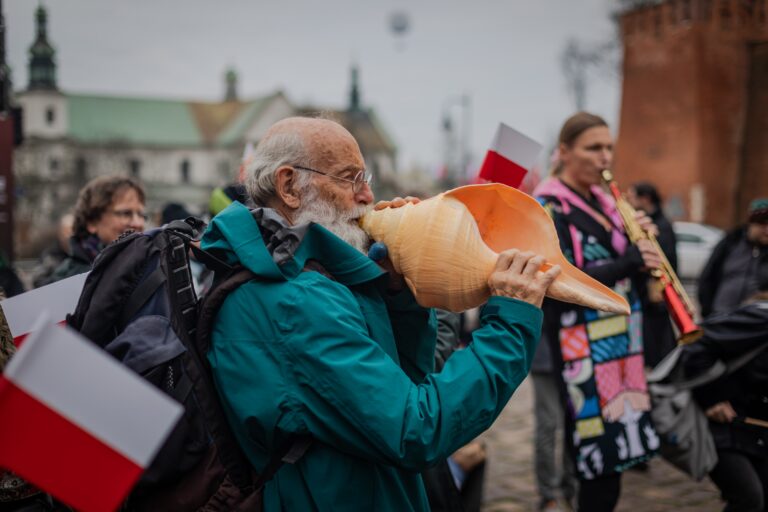
Sacrum Profanum 2025. Marsz Niepodległej Muzyki (March of Independent Music), 11.11.2025. Photo by Alicja Rzepa -
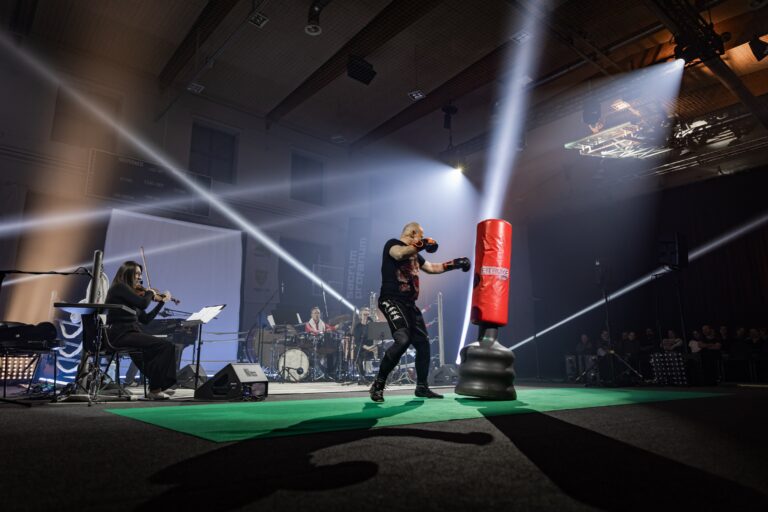
Sacrum Profanum 2025. Kwartludium, Kultura Fizyczna (Physical Culture) at Dom Harcerza, 8.11.2025. Photo by Alicja Rzepa