





A good exhibition does more than simply present artworks. It creates the conditions through which artworks enter into relationships with one another and through which audiences can experience those relationships. Today, curating extends beyond selecting and arranging objects. It is a practice of organizing encounters between history, institutions, technology, and lived experience. To visit an exhibition, therefore, is not simply to look at individual works, but also to observe how the exhibition itself operates.
I have primarily worked within relatively small art ecosystems, connecting artists and institutions across borders and maintaining a sustained interest in artistic practices that emerge outside the traditional centers of the art world. My interest in exhibitions has also been shaped by my experience of producing them. As a director of a private foundation in Seoul, I learned how much labor, money, trust, negotiation, and invisible coordination are required before an exhibition can finally appear to an audience as if it had simply come together. A show may appear complete at the moment it opens, but the conditions that made it possible are rarely visible to the audience.

This perspective became more concrete during my time as a residency curator at Residency Unlimited (RU) in New York. Moving between artists’ studios, residencies, independent art spaces, nonprofits, and museums made me see exhibitions less as the result of curatorial decisions alone than as the outcome of complex networks of collaboration. These networks depend on relationships, trust, and institutional knowledge accumulated over time. I also became aware that access to these networks is itself shaped by existing relationships and structures. At RU, I experienced how a simple introduction, made through an existing relationship of trust, could open a conversation I could not have entered on my own. It changed the way I look at exhibitions. I now think not only about the artworks they present, but also about the institutional structures and relationships that make them possible.
From this perspective, the 2026 Whitney Biennial appeared to me as more than an exhibition examining American art. It became a way of looking at how the American art ecosystem organizes itself.

The Structures Behind Exhibitionmaking
The 82nd Whitney Biennial brings together artists, duos, and collectives working across the United States and beyond, while asking what might be considered “American.” Its curatorial framework emphasizes different histories, geographies, forms of life, and systems of power, bringing them together through what the Whitney describes as “togetherness through difference.”
The exhibition resists a single narrative. Migration, labor, ecology, memory, technology, community, and political identity coexist without being resolved into one overarching argument. Yet I was not entirely convinced by how successfully this coexistence was achieved. At times, the desire to make difference visible felt so conscious that the works seemed to remain on their own trajectories rather than forming a larger whole in which they could affect one another. I had expected the Whitney Biennial to operate on another level. Instead, I encountered tensions that I had already experienced elsewhere: how difficult it is to allow fundamentally different positions to coexist while also preventing the exhibition itself from becoming fragmented.

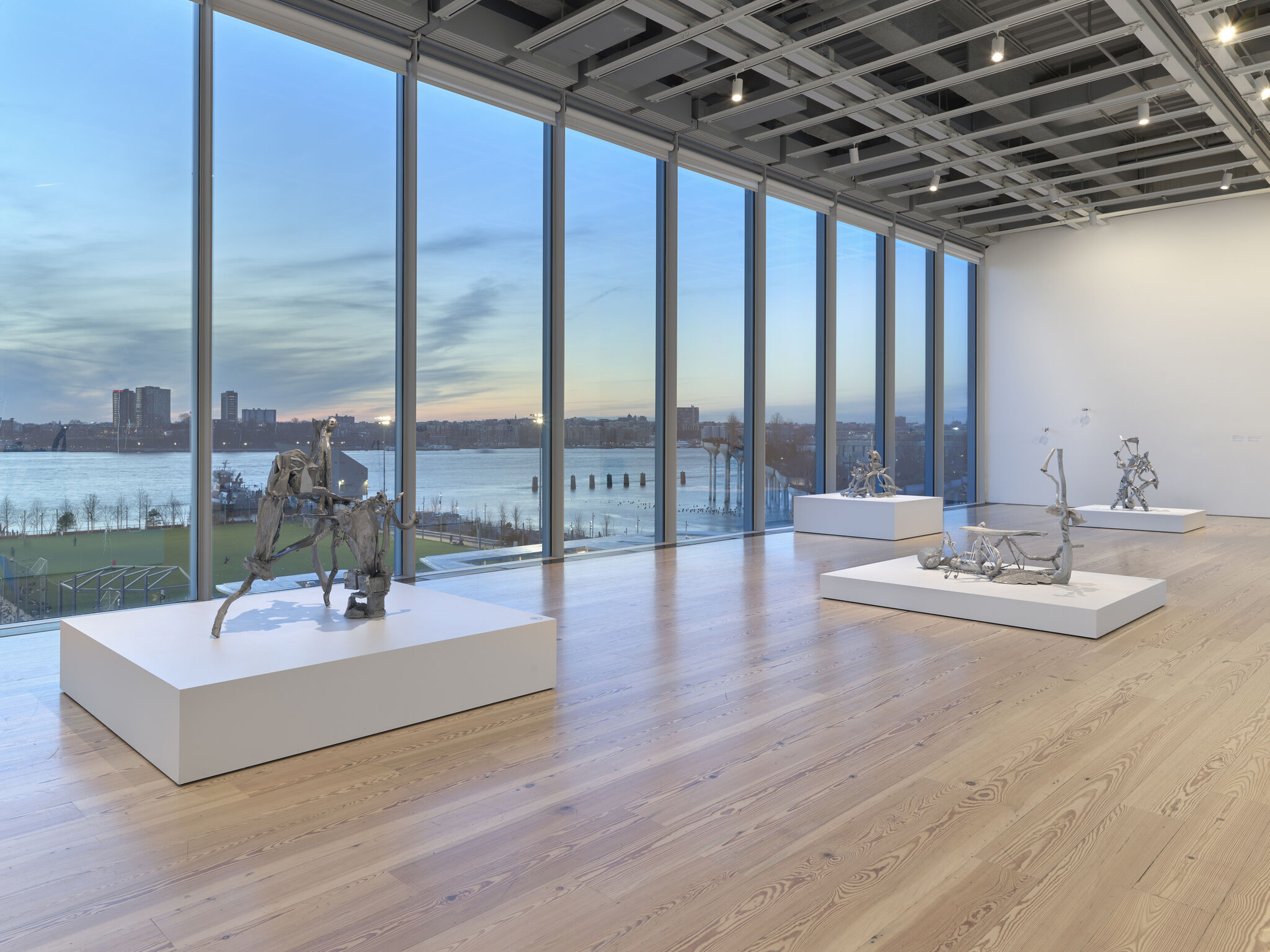
This became most apparent in the spatial organization of the exhibition. After leaving, I began scrolling through the photographs I had taken on my phone and noticed something unexpected. I had taken far more photographs of installations than of individual artworks. The points where walls met, the distances between works, the positions of projectors, the placement of captions, and hidden cables kept appearing in my photographs.
Looking more closely, I realized that I had not been documenting installations. I had been documenting curatorial decisions.
Why does the wall turn at precisely this point?
Why are these two works positioned directly opposite one another?
Why is the label placed several steps away from the work rather than immediately beside it?
These questions led to a simple realization. Installation is not merely a technical solution. It is a curatorial language through which an exhibition shapes experience.

One of the moments that made me think about this most strongly was Precious Okoyomon’s installation Everything wants to kill you and you should be afraid (2026). The number and scale of the hanging dolls and other elements occupied a considerable amount of physical space, extending beyond the large installation itself and onto the surrounding walls. I found myself wondering why this artist had been given so much space. It felt disproportionate to the work, but more importantly, the allocation of space itself seemed to function as a declaration of institutional importance.
I was not necessarily judging whether the work deserved that space. What I was questioning was what happens when space itself becomes a means of declaring value. In a museum, square meters are not neutral. They are resources. Giving an artist a large environment also gives them a unique degree of visibility, time, attention, and position within the movement of audiences through the exhibition.
This became particularly apparent in Michelle Lopez’s large-scale video installation. What initially caught my attention was not the image itself, but the projection environment. Having organized independent exhibitions myself, I know how often financial constraints determine whether an artist’s intended presentation can be fully realized. The projector, sound system, and quality of projection at the Whitney therefore appeared to me not simply as technical equipment, but as institutional decisions about how faithfully the sensory experience intended by the artist could be constructed.
I have experienced the opposite. There have been times when I wanted to use a better projector for a video work but had to compromise due to cost. There have also been times when I wanted to darken a space more completely but could not because other works were being exhibited nearby. Even painting a wall black can become a serious decision once the cost of restoring the space is factored in.

In another exhibition, I worked with major international artists, and one of Kader Attia’s works required bread to be baked to a specific degree of browning. In the end, I baked the bread myself at home while preparing the exhibition. That experience stayed with me because it made me realize how much heat, labor, money, attention, and care disappear behind what eventually appears to an audience as a completed exhibition.
The Whitney’s installations therefore produced a particular kind of awe in me. I have seen major biennials and museums provide extraordinary resources to artists, and I know that institutions such as the Gwangju Biennale can also support ambitious production. What struck me was not simply that the Whitney could do these things, but how clearly its institutional capacity became visible through encounters with the works. The infrastructure behind the artworks seemed almost visible within the artworks themselves.
I had a similar experience with the installation For a Just War against America (2026) by Enzo Camacho and Ami Lien. At first, the folded publication placed beside the work looked like an ordinary museum handout. Only after reading it did I discover the instruction asking visitors to return it to its original place, and realized that it was not exhibition literature but a publication by the artists.
The publication traces a continuous history from the Philippine-American War to contemporary military alliances, the mining industry, the dispossession of Indigenous land, and environmental destruction. Colonial history is not presented as a closed chapter of the past, but as an ongoing political structure embedded in contemporary geopolitical and economic systems.

Its form was equally important. The visitor unfolds it, reads it, folds it back, and returns it to its original place. The work does more than communicate information. Through this sequence of physical gestures, history becomes something that remains open, revisited, and reconstructed rather than fixed as a narrative belonging to the past.
Yet I also sensed a contradiction in the fact that a work so directly critical of American power was being exhibited within the Whitney itself. Its presentation there does not necessarily diminish its critical force. On the contrary, its presence demonstrates the institution’s capacity to accommodate criticism of the political and historical structures within which it operates. But that capacity raised another question for me. What happens when an institution becomes sophisticated enough to accommodate even its own criticism?
The Braille labels installed throughout the exhibition prompted a similar shift in perspective. Despite having worked with visually oriented exhibitions for many years, I realized that I had rarely imagined the museum from the perspective of a visitor who cannot see. The presence of Braille surprised me precisely because I had never really thought about it before.
Accessibility was not simply an additional service added to the exhibition. It was a curatorial decision embedded in its design from the beginning. It reminded me that the conditions of encounter are never universal. An institution does not simply determine what audiences see. It also determines the forms through which they can encounter a work.
The Whitney Biennial therefore seems to invest less in constructing a single unified narrative than in creating conditions in which heterogeneous works can coexist without erasing their differences. The works maintain their autonomy rather than explaining one another, entering into new relationships instead. Ultimately, what the exhibition reveals is not diversity itself, but the structure that makes diversity possible.

The Power in Managing Difference
It was at precisely this point that I began to question the distinction between pluralism and the institutional management of difference. Every exhibition, regardless of scale, selects, edits, arranges, and manages. To criticize this process itself as institutional power would be too easy. I also manage relationships between works when I curate exhibitions. The more interesting question is not whether institutions manage difference, but who has the authority and resources to manage it, and how that authority has been accumulated.
I had experienced this authority elsewhere in New York. When I saw Anicka Yi’s work again at the New Museum in New Humans: Memories of the Future, I was surprised not because the work itself had changed, but because the curatorial context had altered the way I understood it. Within that exhibition, her work became part of a much larger narrative about changing definitions of technology and the human.
That experience made me think again about institutional authority. A great institution is not simply a place that presents great artworks. It is a place that allows us to see familiar works in new ways. But the authority to create such conditions is the result of relationships built over years with artists, curators, collectors, researchers, funders, and other institutions. It is also built through reputation.

In this sense, the Whitney’s authority does not lie simply in its ability to select artists. It also lies in an accumulated authority that allows it to bring particular artists together, provide them with space and production resources, and make their relationships visible to a large audience. The institutional power of the Biennial, then, is not simply the power to control difference. It is the power to create the conditions through which difference becomes visible, legible, and capable of producing consequences.
This also resembled the broader ecosystem I encountered across New York. Studios, residencies, nonprofits, and museums may appear to operate independently, but in practice they participate in a continuous circulation of people, ideas, and resources. The Whitney Biennial is not the endpoint of this circulation, but one of the places where the structures underlying it become visible.
Residency Unlimited showed me this structure on a much smaller scale. An introduction that began within the residency could lead to a museum researcher, another curator, another artist, or another institution. What circulated through this process was not simply information. It was trust. I came to understand that a residency does not simply provide time, space, and a studio. One of its most valuable resources may be a network of trust that allows someone to enter conversations they could never have entered alone.
Before spending time in New York, I may have overvalued America as an almost mythical place where the art world operated on another level. The Whitney Biennial weakened that illusion. The exhibition was not perfect. At times it felt fragmented, overly conscious of its own pluralism, and strangely similar to institutional contradictions I had experienced elsewhere.

But that disappointment also made something else clearer.
New York is still New York.
Its power does not come from the idea that its institutions are perfect. It comes from relationships, resources, trust, reputation, and institutional ambition accumulated over decades. These structures make certain encounters possible at a scale that remains difficult to reproduce elsewhere.
As I left the museum, I returned to the question with which I had begun.
The 2026 Whitney Biennial was not simply an exhibition about what America chooses to exhibit. Rather, it demonstrated how different histories, communities, political positions, and artistic languages can be organized within a shared space without being reduced to a single narrative. At the same time, it revealed that the ability to organize such differences is itself a form of institutional power.
What has remained with me longest is not any individual artwork. It is the structure that made it possible for those works to enter into relation with one another.
Perhaps this is how America curates itself. Not by producing a single image of itself, but by building institutions capable of bringing contradictory images, histories, and identities into the same space. That achievement is real. So is the power behind it. And the more capable an institution becomes of accommodating difference, including criticism of itself, the more carefully we may need to look at the structures that make such accommodation possible.
Written by Taeho Choi