



[polska wersja językowa poniżej]
Few words carry as much symbolic and emotional significance as “home”. It’s a shelter, continuity, and a sense of belonging – a space that grounds identity and anchors experience. Home acts as a spatial archive of our lives, holding memories embedded in familiar smells, sounds, views, or tastes. Its image becomes a kind of talisman carried wherever we go. Even if the physical place no longer exists or is simply out of our reach, its mental image often outlives the material structure.
Leaving or losing one’s home frequently entails feelings of grief, bewilderment and longing for that sense of stability once taken for granted. For those deprived of it, the image of home becomes an especially charged symbol, expressing an existential need for rootedness.
South Korean artist Do Ho Suh and Ukrainian artist Daria Koltsova approach the theme through personal experiences of departure and loss. While Suh’s practice reflects voluntary migration and Koltsova’s responds to the rupture of war, their artistic languages share striking similarities.
Both articulate the subject of home through fragile materials that evoke its vulnerability. It’s rematerialised as a trace of a solid structure – neither fully present nor entirely absent, but an echo of a place. Their works raise broader questions about art’s capacity to preserve intimate images: how can the idea of a space be translated into artistic form? And what becomes of the memory of a home once it is left behind?
Their works raise broader questions about art’s capacity to preserve intimate images: how can the idea of a space be translated into artistic form? And what becomes of the memory of a home once it is left behind?
To Walk a House
Do Ho Suh (b. 1962) works primarily in sculpture, installation, and drawing, often exploring issues of identity, belonging, and displacement in a globalised world – particularly in relation to the concept of home. Throughout his career, he has resided in various cities worldwide, having graduated in Oriental Painting from Seoul National University before moving to the U.S. to expand his artistic education at the Rhode Island School of Design and Yale University. In his most renowned pieces, Suh attempts to recreate the spaces he had inhabited, using fragile architectural forms made of sheer materials, such as nylon or silk. In these ephemeral reconstructions, the artist transforms intimate memories into navigable spaces.

When discussing his art, Suh refers to a Korean expression “to walk a house”, which he heard as a child from carpenters building his family home in Seoul. The house was a “hanok” – a traditional Korean house, designed to be modular and fully movable. This experience inspired him to pursue the idea of a portable house and challenge the concept of permanence in architecture. He wanted to design a house that could be easily packed into a suitcase and transported. His practice is grounded in the idea that relocating a structure also means relocating the memories embedded within it.
His Korean home recurs throughout his work, highlighting his cultural roots. For instance, in his 2012 installation titled Seoul Home/Seoul Home/Kanazawa Home/Beijing Home/Pohang Home/Gwangju Home/Philadelphia Home, halls of his childhood are reconstructed using light teal silk fabric and steel tubes for support. His pieces are always handmade and hand-stitched, reflecting years of training with Korean artisans. What stands out in Suh’s works, however, is the contrast between the fabric’s sheerness and the detailed depiction of ornaments and architectural details.

While the intricacy of his works makes them seem tangible, the material’s translucency gives them an elusive, dreamlike quality. In Suh’s installations, the house is merely a trace of the physical structure, rooted in the artist’s memory. But memories are not fixed. They shift over time, become layered with subsequent experiences, and gradually fade. As memories diminish, the mental image of the house grows weaker.
Suh’s exploration of memory and architecture goes beyond his childhood home. In the 2024 installation, Nest/s, the artist combined fragments of various places he’d inhabited into a tunnel of interconnected rooms. Within it, visitors can find a section of his Korean home, the entrance to his New York apartment building, or a part of his studio in London. Each space features a different colour, yet they blend seamlessly thanks to the material’s translucence, which creates a sense of permeability. This mirrors the unstable nature of memory, with images overlapping and resisting clear boundaries. But Suh’s installation isn’t limited to simply representing memory; it spatialises it. Moving through the layered corridors, the viewer becomes physically implicated in the act of recollection. This immersive quality transforms the act of reminiscence into an embodied experience.

Permeability and fragmentation in Do Ho Suh’s works also emphasise the experience of living in a globalised world, marked by cultural displacement. In his installations, home – traditionally a foundation for our sense of identity – no longer appears as a coherent whole, but as an accumulation of fragments under constant reconfiguration. It becomes a mutable and precarious construct. Another of his 2024 installations, Perfect Home: London, Horsham, New York, Berlin, Providence, Seoul, showcases this fragmentation even more clearly. It is built of multiple colourful, detailed pieces that depict elements from his previous homes, such as doorknobs, lamps, or electrical outlets. They are displayed within a nearly transparent pavilion made of sheer, white fabric. The objects are floating in space, scattered and removed from their original context. They are suspended between presence and absence, showing that belonging in a place is neither fixed nor fully secure. It is negotiated through fragile structures that remain permeable and vulnerable to dissolution.
Ultimately, Suh’s fabric architectures reframe our understanding of home. Rather than a stable structure, home emerges as a mental and emotional construct – assembled from fragments, carried across borders, and continuously reshaped by experience. It offers a sense of belonging wherever we go, while staying vulnerable and constantly changing. Its walls are thin, echoing the fragility of cultural rootedness in a globalised world.
Postcards from Home
Daria Koltsova’s (b. 1979) practice spans installation, video and performance. Coming from Kharkiv, her art explores themes of memory and trauma, emphasising the influence of politics on personal lives. After Crimea’s annexation in 2014 and Russia’s full-scale invasion of Ukraine in 2022, she focused on the impacts of war on Ukrainian society, examining the relationship between protection and resilience, and between permanence and fragility. She often uses delicate materials such as glass and cloth in her work, with her stained-glass installations in particular reflecting on the vulnerability of memory, Ukraine’s cultural heritage and the impact of the war on her homeland’s landscape.

Her 2023 installation, Tassellated Self, stands as the most monumental example. Measuring 690 cm in width, 315 cm in height, and weighing approximately 300 kg, it was created for the exhibition Here and Now: Modernism in Ukraine 1900-1930s & Daria Koltsova at the Museum Ludwig in Cologne, Germany. The piece was intended to engage in a dialogue with Ukrainian modernist and socialist art traditions, which have been widely appropriated by Russian art history. Koltsova built a colourful image of Ukraine’s rich landscape, featuring modernist architecture, blades of yellow wheat and symbols from local folklore, incorporated into the form of a towering, radiant sun.
The building depicted in Tessellated Self is called Derzprom, an icon of early modernist architecture, situated in Kharkiv. Built in 1928 in the constructivist style, it holds significance for Koltsova as a symbol of her hometown despite its connection to the country’s troubled history and its subjugation under the Soviet Union. Much like other buildings in Ukraine, Derzprom is under constant threat of being destroyed by Russian missiles. For Koltsova, depiction becomes an act of preservation – a way of safeguarding an image when the physical structure itself remains under threat. However, the use of glass highlights the vulnerability – as buildings are reduced to rubble, the memories attached to them risk erasure as well.

The artist further investigates the issues of preserving memories of her home, understood here broadly as the country, in the projects Postcards from Home (2024) and Kiosk (2025). Similar to Do Ho Suh, Koltsova attempts to create a memory prosthesis, something portable, but in the form of stained-glass postcards depicting the Ukrainian landscape. As inspiration, she used photographs taken by herself, her friends, or those found on social media. The landscapes are reduced to minimalist symbols and colourful stained-glass pieces. Included among them is also the Ukrainian flag, itself representing a field of yellow wheat and the blue skies above it. These symbolic compositions serve as Koltsova’s personal collection of memories and mental images. Like all memories, these images are fragmented, blurred, and simplified, yet in Koltsova’s work, they acquire an added dimension. Traditionally reserved for churches and sacral artworks, stained glass here sanctifies the landscape itself. Home, especially when threatened, becomes a potent symbol, an image of sacred significance.
In the Kiosk, the artist expands the postcards project by transforming it into an installation within a genuine kiosk she found in Ukraine. This shift emphasises the potential of sharing inherent in the postcard format. We often buy them at similar stands to share with family and friends. For Koltsova, a kiosk is fundamentally a space of exchange – whether for goods, news, or rumours – and functions as a social gathering point.

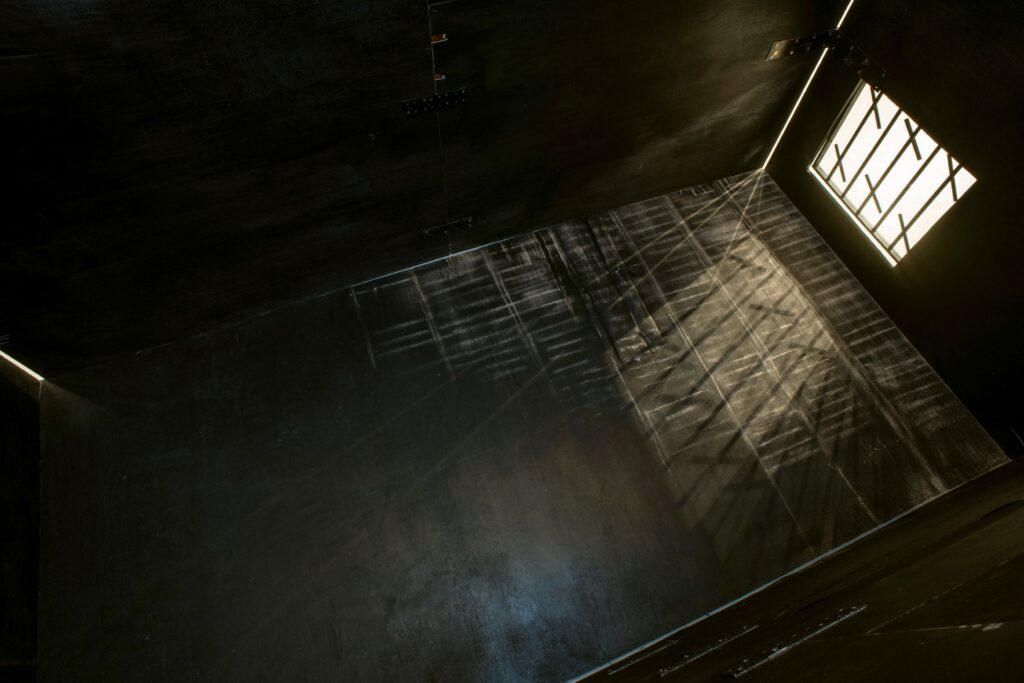
Here, it also acts as a chapel, especially when viewed from the inside, surrounded by the stained-glass windows. Through this installation, the artist creates an immersively intimate experience, inviting viewers to actively engage with the structure. It highlights the role of light in accentuating the glass images and the material’s natural porosity.
Like Suh’s fabric architectures, Koltsova’s glass installations dissolve the boundary between interior and exterior. She similarly highlights the ephemeral, fragmented nature of mental images of home and the elusive character of memory.

Yet in Koltsova’s practice, fragility carries a different charge. If Suh’s translucent houses suggest permeability and gradual erosion of the sense of rootedness in a globalised world, Koltsova’s glass structures evoke the constant possibility of the shattering of one’s identity. The home here is not merely reconfigured by the experiences of migration; it is threatened with sudden and complete disappearance. In the context of war, belonging is not simply unstable. It is endangered. Memory becomes both sanctuary and resistance, preserved in luminous yet breakable forms that mirror the precarious state of the country itself.
If Suh’s translucent houses suggest permeability and gradual erosion of the sense of rootedness in a globalised world, Koltsova’s glass structures evoke the constant possibility of the shattering of one’s identity.
W pamięci domu.
Trwałość i kruchość w twórczości Do Ho Suha i Darii Koltsovej.
Niewiele słów niesie ze sobą tak silny ładunek symboliczny i emocjonalny jak „dom”. To schronienie, ciągłość i poczucie przynależności – przestrzeń, która kształtuje tożsamość i porządkuje doświadczenie. Działa jak archiwum naszego życia, przechowując wspomnienia zapisane w znajomych zapachach, dźwiękach, widokach czy smakach. Jego obraz staje się talizmanem, który nosimy ze sobą, gdziekolwiek jesteśmy. Nawet jeśli fizyczne miejsce przestaje istnieć albo jest dla nas niedostępne, jego wyobrażenie często trwa dłużej niż materialna struktura.
Opuszczenie lub utrata domu wiąże się często z żalem, zagubieniem i tęsknotą za stabilnością, którą wcześniej braliśmy za coś oczywistego. Dla tych, którzy zostali go pozbawieni, obraz domu staje się szczególnie znaczącym symbolem – wyrazem głębokiej potrzeby przynależności.
Południowokoreański artysta Do Ho Suh i ukraińska artystka Daria Koltsova podejmują ten temat, wychodząc z osobistych doświadczeń wyjazdu i straty. Choć w przypadku Suha jest to dobrowolna migracja, a u Koltsovej – dramat wojny, ich sposoby wyrazu artystycznego wykazują zaskakujące podobieństwa.
Oboje mówią o domu poprzez kruche materiały, podkreślające podatność na zniszczenie. Dom zostaje „urzeczywistniony” na nowo jako ślad solidnej struktury – nie w pełni realny i nie całkiem utracony, niczym echo miejsca. Ich prace stawiają szersze pytania o zdolność sztuki do zachowywania intymnych obrazów: jak przełożyć ideę przestrzeni na formę artystyczną? I co dzieje się z pamięcią domu, gdy zostaje on porzucony?
Ich prace stawiają szersze pytania o zdolność sztuki do zachowywania intymnych obrazów: jak przełożyć ideę przestrzeni na formę artystyczną? I co dzieje się z pamięcią domu, gdy zostaje on porzucony?
Spacerując po domu
Do Ho Suh (b. 1962) tworzy przede wszystkim rzeźby, instalacje i rysunki. W swojej twórczości często podejmuje kwestie tożsamości, przynależności i wykorzenienia w zglobalizowanym świecie – szczególnie w odniesieniu do idei domu. Mieszkał w różnych miastach na świecie. Ukończył malarstwo orientalne na Uniwersytecie Narodowym w Seulu, a następnie wyjechał do Stanów Zjednoczonych, by kontynuować edukację artystyczną w Rhode Island School of Design i na Uniwersytecie Yale. W swoich najbardziej znanych projektach próbuje odtworzyć przestrzenie, w których mieszkał, budując delikatne formy architektoniczne z prześwitujących materiałów, takich jak nylon czy jedwab. W tych efemerycznych rekonstrukcjach intymne wspomnienia zamieniają się w przestrzenie, przez które można przejść.

Mówiąc o swojej sztuce, Suh przywołuje koreańskie wyrażenie „nosić dom”, które słyszał jako dziecko od cieśli budujących rodzinny dom w Seulu. Był to „hanok”, tradycyjny dom koreański, projektowany w sposób modułowy i możliwy do transportu. To doświadczenie zainspirowało go do rozwijania idei domu przenośnego i podważania pojęcia trwałości w architekturze. Chciał stworzyć dom, który można by spakować do walizki i zabrać ze sobą. Jego praktyka opiera się na przekonaniu, że przeniesienie budynku oznacza również przeniesienie osadzonych w nim wspomnień.
Motyw koreańskiego domu powraca w jego twórczości jako znak kulturowych korzeni. W instalacji z 2012 roku zatytułowanej Seoul Home/Seoul Home/Kanazawa Home/Beijing Home/Pohang Home/Gwangju Home/Philadelphia Home (“Seul Dom/Seul Dom/Kanazawa Dom/Pekin Dom/Pohang Dom/Kwangdzu Dom/Filadelfia Dom”), artysta odtwarza korytarze pamiętane z dzieciństwa z jasnoturkusowego jedwabiu, rozpiętego na stalowej konstrukcji. Wszystkie jego prace są wykonywane i zszywane ręcznie, odzwierciedlając lata nauki u koreańskich rzemieślników. Uderzający jest kontrast między przejrzystością tkaniny a precyzyjnie oddanymi detalami architektonicznymi.
Choć misterność wykonania sprawia, że prace wydają się niemal namacalne, półprzezroczysty materiał nadaje im ulotny, niemal senny charakter. W instalacjach Suha dom jest jedynie śladem fizycznej struktury, zakorzenionym w pamięci artysty. A pamięć nie jest stała – zmienia się, nakłada się na kolejne doświadczenia i z czasem blednie. Wraz z nią słabnie także obraz domu.

Jednakże refleksja nad pamięcią i architekturą wykracza w jego twórczości poza dom rodzinny. W instalacji Nest/s (“Gniazd/a”) z 2024 roku artysta połączył fragmenty różnych miejsc, w których mieszkał, tworząc tunel połączonych ze sobą pomieszczeń. Można w nim odnaleźć część jego koreańskiego domu, wejście do nowojorskiego budynku, w którym mieszkał, czy fragment londyńskiej pracowni. Każda przestrzeń ma inny kolor, ale dzięki materiałowi płynnie przechodzą jedna w drugą, tworząc wrażenie przenikalności. Oddaje to niestabilny charakter pamięci, w której obrazy nakładają się na siebie i wymykają jednoznacznym określeniom. Instalacja nie tylko przedstawia pamięć. To ona właśnie nadaje jej formę przestrzenną. Przechodząc przez “warstwowe” korytarze, widz fizycznie uczestniczy w akcie przypominania. Wspomnienie staje się doświadczeniem cielesnym.
Przenikalność i fragmentaryczność prac Do Ho Suha podkreślają również doświadczenie życia w zglobalizowanym świecie, naznaczonym kulturowym wykorzenieniem. Dom – tradycyjnie fundament tożsamości – nie jawi się tu jako spójna całość, lecz jako zbiór fragmentów, które wciąż podlegają przekształceniom. Staje się konstrukcją zmienną i niepewną. Jeszcze lepiej widać to w instalacji z 2024 roku Perfect Home: London, Horsham, New York, Berlin, Providence, Seoul (“Idealny dom: Londyn, Horsham, Nowy Jork, Berlin, Providence, Seul”). Składa się ona z wielu kolorowych, drobiazgowo wykonanych elementów przedstawiających detale z dawnych mieszkań artysty – klamki, lampy czy gniazdka elektryczne. Zostały one umieszczone w niemal przezroczystym pawilonie z białej tkaniny. Obiekty unoszą się w przestrzeni, oderwane od pierwotnego kontekstu. Zawieszone między obecnością a nieobecnością pokazują, że przynależność do miejsca nigdy nie jest dana raz na zawsze. Powstaje w niepewnych strukturach, które łatwo ulegają rozpadowi.
Ostatecznie tekstylne architektury Suha zmieniają nasze myślenie o domu. Nie jest on stabilną budowlą, lecz konstrukcją psychiczną i emocjonalną, złożoną z fragmentów, przenoszoną przez granice i nieustannie kształtowaną przez doświadczenie. Daje poczucie przynależności, gdziekolwiek jesteśmy, a zarazem pozostaje podatny na zmiany. Jego ściany są cienkie, tak jak kruche bywa zakorzenienie w zglobalizowanym świecie.
Pocztówki z domu
Twórczość Darii Koltsovej (ur. 1979) obejmuje instalację, wideo i performans. Pochodząca z Charkowa artystka podejmuje tematy pamięci i traumy, podkreślając wpływ polityki na życie prywatne. Po aneksji Krymu w 2014 roku i rozpoczęciu pełnoskalowej inwazji Rosji na Ukrainę w 2022 roku skupiła się na skutkach wojny dla ukraińskiego społeczeństwa, badając relacje między obroną a odpornością oraz trwałością a kruchością. Często wykorzystuje delikatne materiały, takie jak szkło i tkanina. Jej witrażowe instalacje odnoszą się szczególnie do wrażliwości pamięci, dziedzictwa kulturowego Ukrainy i wpływu wojny na krajobraz ojczyzny.

Najbardziej monumentalnym przykładem jest instalacja z 2023 roku, Tessellated Self (“Mozaikowa jaźń”). Dzieło o szerokości 690 cm, wysokości 315 cm i wadze około 300 kg powstało na wystawę Here and Now: Modernism in Ukraine 1900–1930s & Daria Koltsova (“Tu i teraz: Modernizm w Ukrainie 1900-1930 & Daria Koltsova”) w Museum Ludwig w Kolonii. Praca miała na celu wejście w dialog z tradycją ukraińskiego modernizmu i sztuki socjalistycznej, które w historii sztuki często przypisywano Rosji. Koltsova stworzyła barwny obraz ukraińskiego krajobrazu – z modernistyczną architekturą, żółtymi kłosami pszenicy i motywami z lokalnego folkloru – ujęty w formę promiennego, monumentalnego słońca.
Budynek przedstawiony w Tessellated Self to Derżprom – ikona wczesnej architektury modernistycznej w Charkowie. Wzniesiony w 1928 roku w stylu konstruktywizmu, ma dla artystki szczególne znaczenie jako symbol rodzinnego miasta, mimo że wiąże się także z trudną historią podporządkowania Ukrainy Związkowi Radzieckiemu. Jak wiele innych budynków w kraju, Derżprom jest stale zagrożony zniszczeniem przez rosyjskie rakiety. Dla Koltsovej samo przedstawienie staje się aktem ochrony – sposobem ocalenia obrazu, gdy fizyczna struktura może w każdej chwili zniknąć. Wybór szkła podkreśla jednak kruchość tego aktu – gdy budynki zamieniają się w gruzy, wspomnienia z nimi związane również mogą przepaść.
Artystka rozwija temat zachowywania pamięci o domu – rozumianym szerzej jako ojczyzna – w projektach Postcards from Home (“Pocztówki z domu”, 2024) oraz Kiosk (2025). Podobnie jak Suh, próbuje stworzyć rodzaj „protezy pamięci”, czegoś przenośnego – w tym przypadku w formie witrażowych pocztówek przedstawiających ukraiński krajobraz. Inspiracją były fotografie wykonane przez nią samą, jej przyjaciół lub znalezione w mediach społecznościowych. Krajobrazy zostały uproszczone do minimalistycznych znaków i kolorowych fragmentów szkła. Wśród nich pojawia się także flaga Ukrainy – symbol żółtego pola pszenicy i błękitnego nieba. Te kompozycje tworzą osobisty zbiór wspomnień i obrazów z pamięci. Jak każde wspomnienie, te też są fragmentaryczne, rozmyte, uproszczone, lecz w jej pracach zyskują dodatkowy wymiar. Witraż, tradycyjnie kojarzony z kościołami i sztuką sakralną, nadaje tu krajobrazowi niemal święty charakter. Dom – zwłaszcza zagrożony – staje się symbolem o szczególnej mocy.

W Kiosku artystka rozwija ideę pocztówek, przekształcając ją w instalację umieszczoną w autentycznym kiosku znalezionym w Ukrainie. Ten gest podkreśla ideę dzielenia się, wpisaną w format pocztówki. Kupujemy je w podobnych miejscach, by wysłać bliskim. Dla Koltsovej kiosk to przestrzeń wymiany – towarów, informacji, plotek – a zarazem punkt spotkań.
Tutaj staje się on także rodzajem kaplicy, zwłaszcza gdy ogląda się go od środka, otoczonego witrażowymi szybami. Instalacja tworzy intymne, immersyjne doświadczenie i zaprasza widza do wejścia w strukturę. Podkreśla rolę światła, które wydobywa barwy szkła i jego naturalną przenikalność.
Podobnie jak tekstylne architektury Suha, szklane instalacje Koltsovej zacierają granicę między tym, co wewnątrz, a tym, co na zewnątrz. Predstawiają to, co ulotne, fragmentaryczne, w obrazach domu i nieuchwytności pamięci.

Jednakże w jej twórczości kruchość ma inny wymiar. Jeśli przezroczyste domy Suha sugerują przenikalność i powolną utratę zakorzenienia w zglobalizowanym świecie, to szklane konstrukcje Koltsovej przywołują możliwość nagłego rozpadu tożsamości. Dom nie jest tu jedynie przekształcany przez doświadczenie migracji, ale grozi mu całkowite i gwałtowne zniknięcie. W kontekście wojny poczucie przynależności nie jest po prostu niestabilne. Jest zagrożone. Pamięć staje się jednocześnie schronieniem i formą oporu, zachowaną w świetlistych, lecz kruchych formach, które odzwierciedlają niepewną sytuację samego kraju.
Jeśli przezroczyste domy Suha sugerują przenikalność i powolną utratę zakorzenienia w zglobalizowanym świecie, to szklane konstrukcje Koltsovej przywołują możliwość nagłego rozpadu tożsamości.

Przedsięwzięcie finansowane w ramach Krajowego Planu Odbudowy i Zwiększenia Odporności (KPO) ze środków Unii Europejskiej – NextGenerationEU w ramach inwestycji A2.5.1 “Program wspierania działalności podmiotów sektora kultury i przemysłów kreatywnych na rzecz stymulowania ich rozwoju”.