Ajamu X (b. 1963, Huddersfield, England) is a darkroom/fine art photographic artist, independent scholar and archivist. Born to Jamaican migrant parents and raised in a northern working-class community, his work unapologetically celebrates the Black queer body, the erotic senses and the sensual material attributes of the photographic act and print.

After his early experience of formal photographic education at Leeds Kitson College of Technology, Ajamu moved to Brixton, London, where he became immersed in the emerging Black arts and activist scene, alongside other key figures such as Rotimi Fani-Kayode, Dame Sonia Boyce and Dirg Aaab-Richards. It was here that the artist further developed his creative, political and sexual expression, living at the Brixton Housing Co-op on Railton Road — what he describes as the neighbourhood ‘frontline’ — and frequenting the alternative spaces, underground clubs and Black queer kink scene.
Today, Ajamu is recognised as a pioneering photographic artist whose practice celebrates Black queer experience and gives visibility to more dissident representations of sexuality, intimacy and desire. His striking black and white analogue portraits reimagine lovers, companions and muses from within his circle as pop-cultural archetypes, such as the bodybuilder and the gangster — a nod to the tradition of twentieth-century artists like Cindy Sherman, who embrace the apparatus in order to restage their own fantasies and comment on society’s wider thirst for image consumption and the provocation of the flesh in the age of mass media.

Dynamic, kaleidoscopic frames of bodies that twist, bend, and contort, as seen in the series A Sensual Chorus of Gestures (2024), evoke the psychosexual compositions of Pierre Molinier’s erotic bricolages and cement Ajamu’s reputation not only as an artist adept at manipulating traditional photographic techniques such as platinum printing but also as a communicator with an inherently erotic intent. For Ajamu, sex is political, and to portray queer Black subjects in states of pleasure and play is to reinscribe what has been historically denied to people outside of the cishet white gaze. Like his contemporary, Rotimi Fani-Kayode, who migrated from Nigeria to Brighton during the country’s civil war and channelled his experiences into producing homosexually explicit work, or Zanele Muholi, who has profiled the LGBTQAI+ community of South Africa since the early 2000s as a self-dubbed ‘visual activist’, Ajamu belongs to a wider network of migrant, refugee and diasporic queer artists shattering racial, gender, and cultural biases to illustrate the fluid and myriad realities of British Black queer lives.
On the occasion of his participation in the group exhibition Gender Stories taking place at the Walker Art Gallery in Liverpool until 31 August, we sat down with Ajamu X to discuss the parameters of the darkroom, the unique relationship of the photographer and their material film, and the value of the physical photographic object in our increasingly digitalised era.

Maggie Kuzan: What was the selection process for your works currently on display in the Gender Stories exhibition at the Walker Art Gallery?
Ajamu X: Thanks to Matt Smith, textile artist, historian, and curator, the images were donated through the Arts Council Cultural Gifts Scheme, and I felt these platinum prints would be a great addition to their collection.
I’m playing around with all these different kinds of looks, leaving space for the viewer’s imagination. What is it that you think you need to see around Black queer bodies? What happens if I, as a Black queer artist, don’t want you to see it?

MK: Could you tell us a little more about the two men in the photographs?
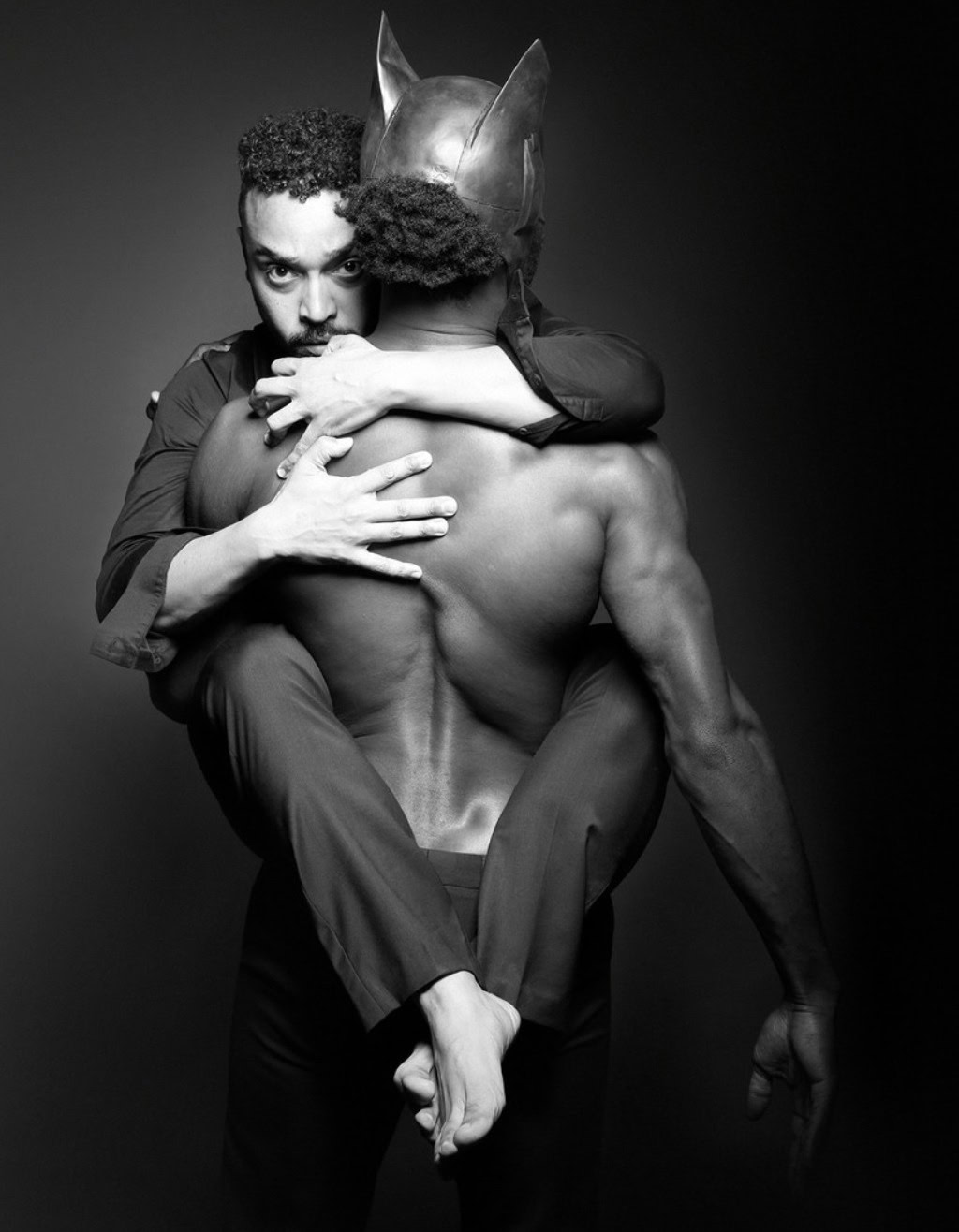
AX: I knew Curtis and Ricky from the Low Down, which was a Black queer club in Brixton during the early 90s. Sadly, Ricky died at a young age. I wanted to capture them together because they’re both simply fabulous. They were part of the Glamour Posse. During the early 90’s, representations of Black masculinity were beginning to shift — both for gay Black men and for Black men more broadly. I was trying to capture that sense of style happening in the nightclub at that particular moment, but they’re also very classical portraits. By removing the gaze, in the images of them from behind, for me, Black queer men have a right not to be legible and, instead, to be read in all kinds of ways, including by other Black queers, too. I’m playing around with all these different kinds of looks, leaving space for the viewer’s imagination. What is it that you think you need to see around Black queer bodies? What happens if I, as a Black queer artist, don’t want you to see it?

MK: Your portraits resist easy readings.
AX: Yes, and the key to that and — this is what we will come back to — is also trying to create beautiful images around Black queer people, that aren’t reportage or documentary photography. Even though it is documenting to Black queers, it is still about creating beautiful images. I think photographs should provide multiple readings. I am drawn to platinum prints from the 1850s, and I’m just kind of dealing with all of that at the same time.
MK: Considering that Black queer lives are often framed through trauma or struggle or identity politics, what does beauty signify to you?
AX: For me, it’s about having another, more nuanced conversation around Black queer aesthetics. Historically, ideas about the Black body have been represented through the visual. I am concerned about Black bodies around the senses, particularly smell, with Black and working-class bodies associated with dirt and contamination. We draw on these cultural ideas about what is beautiful and what is ugly, both consciously and subconsciously. I’m saying that I find Black bodies beautiful, and so the print [for the Walker Art Centre] also has to represent my idea of beauty in the form that I’m working with.
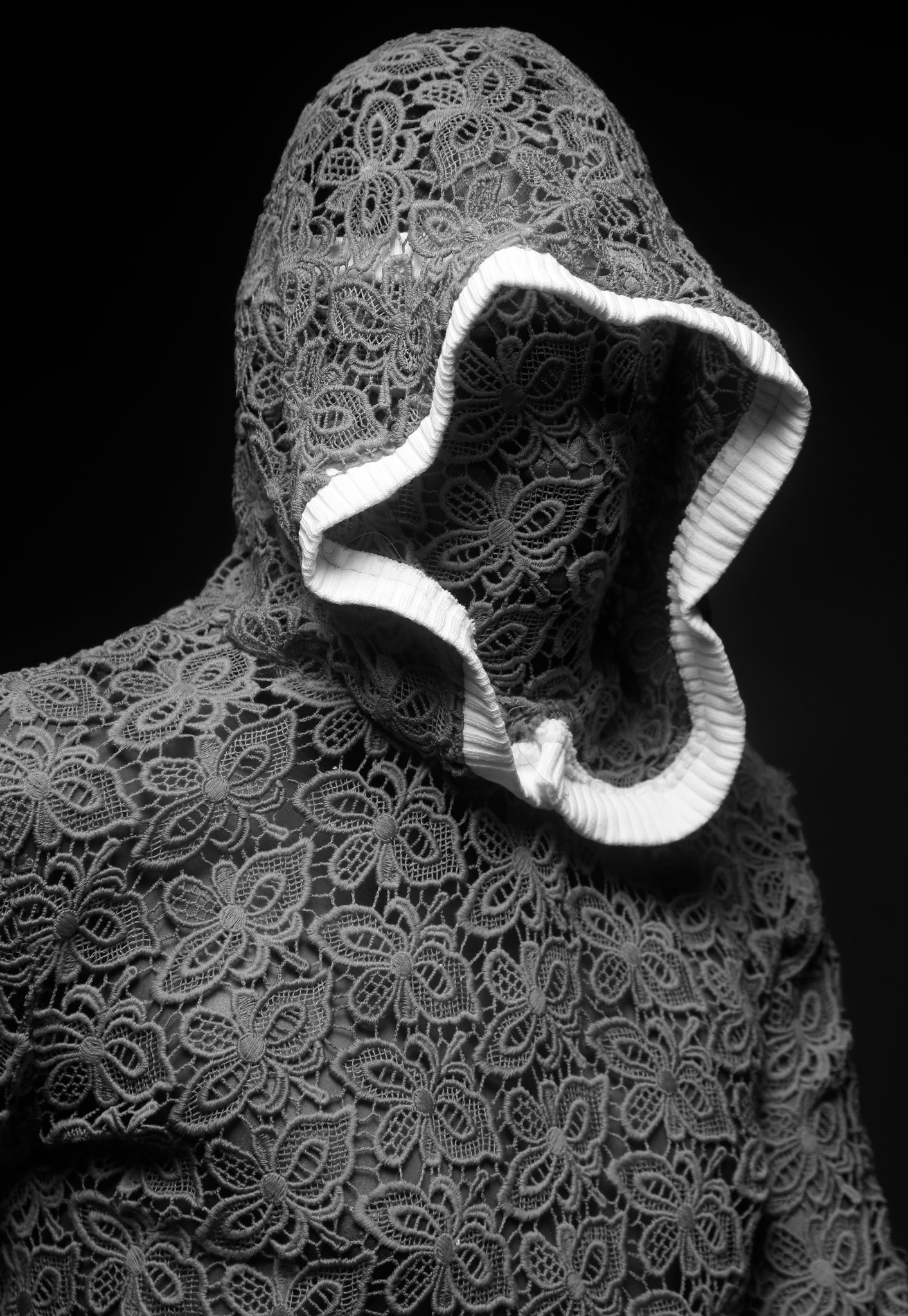
There’s a tendency to frown upon beauty and aesthetics because we expect Black and Brown queer work to do ‘socio-political work’, but for me, beauty and aesthetics are no less political. I am crafting a beautiful image where the platinum print, the paper, the surface, the texture, and the weight are just as important as the content.
There’s a tendency to frown upon beauty and aesthetics because we expect Black and Brown queer work to do ‘socio-political work’, but for me, beauty and aesthetics are no less political.
MK: I was also thinking about the material itself and how your work has a tactile, sensual quality to it. There’s a lot of movement in the series A Sensual Chorus of Gestures (2024). How much does that movement come into the production process? Do you take photos spontaneously, or are they very formal compositions?
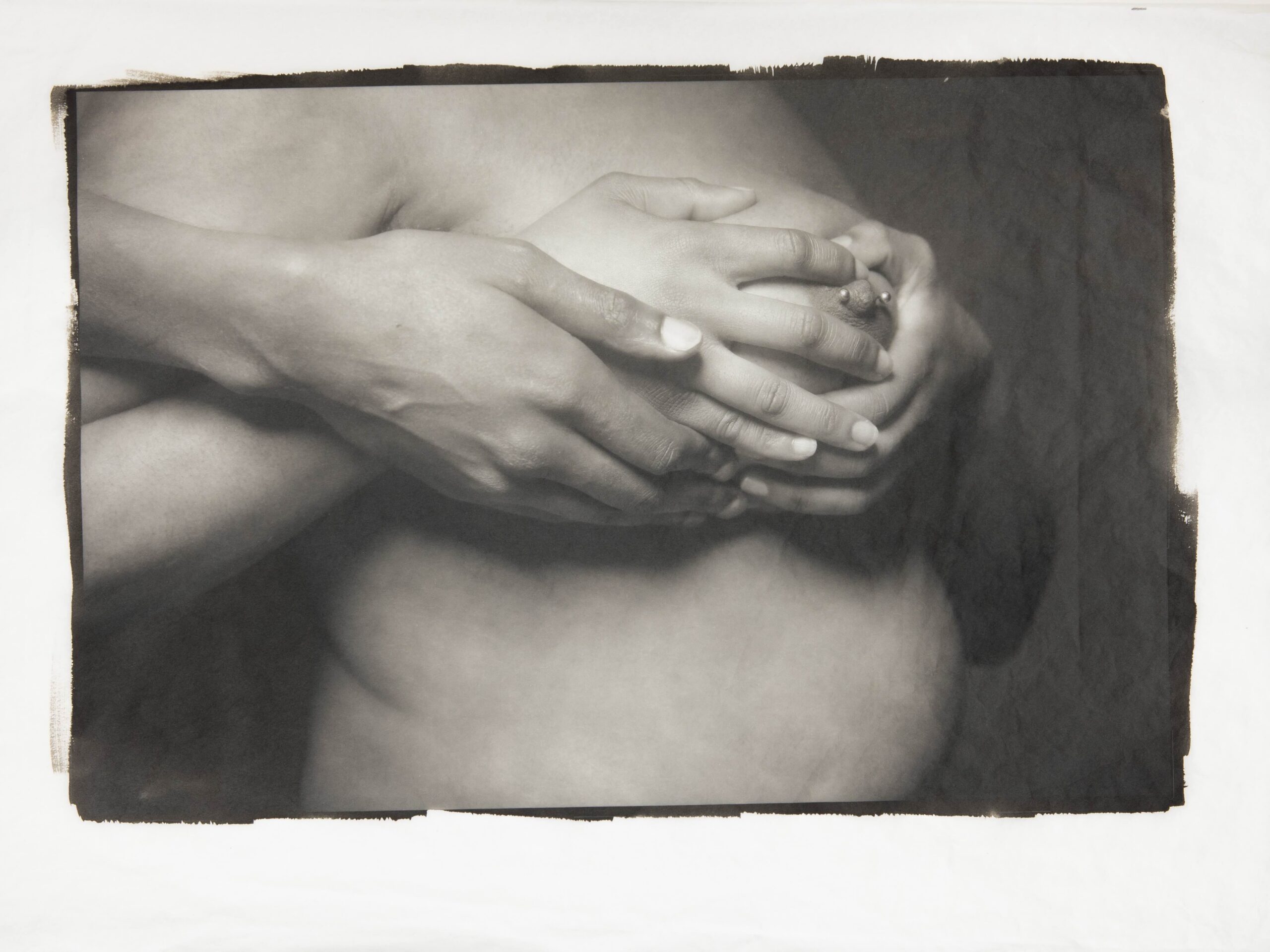
AX: Far too often, process and production are overlooked in Black queer work, even though they’re intimately entwined. For me, a key thread throughout the work is form and making. Not just making the image itself, but what happens before the image emerges in the context of the darkroom. Photography is becoming increasingly dematerialised through social media and our networking culture. In the darkroom, the primary senses are not visual, but touch and smell. Sensuality begins in the making — in the brushstrokes of the platinum print, the texture of the paper, the physicality of the print.
Some works are very formal, and some are more spontaneous. It’s always about what I want the viewer to feel. We need to have a more nuanced conversation around Black queer work that accounts for the materiality of the image, but also the materiality of Black skin in the context of the photograph. Tissue paper is my latest obsession. The wetness of the print touches me back. What it brings to the print is an almost ‘translucent’ quality when framed. When I am working with different paper types, the paper might be tangible, but the quality of the print can not always be put into words, so there is a different kind of sensual logic I am gesturing towards.
MK: I guess you were doing a lot of that for your PhD?
AX: Yes, in my thesis, The Wet Darkroom and Distributed Sensorium. Material Aliveness and the Poetics of Production, I talk about the darkroom as its own material and the non-visual aspects of photography. Photographic discourse or manuals from the 18th century onwards haven’t spoken about the darkroom beyond a site of production.
There is a whole history of language around the photograph — from Barthes, Sontag and Berger — that is locked into semiotics, but we also have to step back to think about the darkroom and the senses it involves, such as touch, smell, and — you could argue — taste. There’s the fixer, the strongest scent in the darkroom; the closest smell to it is vinegar. There are also the way you move in and through the room as you’re printing and processing, failures and mistakes. And then there’s time.
I talk about tactile time — in the darkroom, there’s more of a chronological time of developer, stop, fix, wash, but I am more interested in embodied time, a Kairos quality time. Time is felt and sensed, hence it’s grappling with the space of making. There’s a long history of artists unpacking the working studio, but I believe the darkroom is still a new conversation. Both in the photographic darkroom, the sex darkroom or other darkrooms, touch and smell become primary. It could also be a way to think about our own internal darkrooms.

MK: You frequently use masks in your works, such as in your my play box series. What attracts you so much to them?
AX: I like the idea of masquerade, and I think identity is performance. It’s about invention, not discovery. The thing is that people project onto what kind of mask it is, and their projections might have nothing to do with the image they’re seeing. I’m trying to play around with that in terms of the Black body, a gendered body, and do something slightly different.
I feel that we hide and reveal simultaneously, and some people can access that and others can’t. At times, I draw upon my own fantasies around the person wearing the mask, and I have muses — Hakeem Kazeem, Kween Ramel — some folks I come back to again and again over the years or decades. Sometimes, only the model and I will know exactly why they might be wearing a mask — it’s kind of an inside joke between us. Only one person knows why I wore that wedding dress in my self-portraits from the early 1990’s.
I like the idea of masquerade, and I think identity is performance. It’s about invention, not discovery. The thing is that people project onto what kind of mask it is, and their projections might have nothing to do with the image they’re seeing.
MK: You founded rukus! Federation with fellow artist and collaborator, Topher Campbell, in 2000 to document Black LGBTQAI+ life in Britain. How important has friendship been in your networks of care?
AX: The rukus! archive grew out of a need to document, capture and create materials around Black queer lived experiences, opening up a different kind of conversation around us. Yes, part of it is around networks of care, but we also shouldn’t lose sight of networks of tension. I don’t try to dress up the politics of being queer. Of course, there’s care and desire, but there’s also friction and tension because we don’t always handle differences well. Personally, I’m not really interested in what makes us similar. I’m more into how we deal with differences in ways that still show kindness, care, love and grace. How we constantly dance around all these things that are difficult and challenging. My thinking on the rukus! archive has shifted radically since those early days. I’m now more concerned with the black queer body as a porous archive and the ways it holds memories and secrets.
MK: You’re in the studio today. What are you working on?
AX: I am working on a new series around my fetish — hands and feet of my muses — called An Exquisite Sound of Paper. I printed 23 platinum prints, which will be presented on 23 different paper types. This number is not arbitrary, as there are 23 pairs of chromosomes in our bodies.
When you’re in the darkroom, printing or processing, the paper butts up against the tray and makes noises. Other operations involve sound as well, like print washing. Once again, I’m bringing out that sensuousness of the making process. I’m trying not to privilege the visual, but to show what other sensory experiences are involved in creating a photographic image. This project will also include making my own paper for the first time. The thing that I touch and the thing that touches me back.
I’m trying not to privilege the visual, but to show what other sensory experiences are involved in creating a photographic image.

BIO
Ajamu X is a British artist, curator, archivist and activist of Jamaican descent. His work is held in major public collections in the country and internationally, including Tate Modern, London; the Gallery of Modern Art, Glasgow; Autograph, London; and the Neuberger Museum of Art, New York. His photographs, Ricky, Glamour Posse (1993) and Curtis, Glamour Posse (1993) are currently on view at the Walker Art Gallery, Liverpool, as part of the group exhibition Gender Stories (until 31 August 2026).