




Along the Vistula River in the historic part of Krakow, over a surprisingly sunny two days in October, an international group of scholars, artists, art historians, curators, critics, and more gathered at the contemporarily designed Cricoteka to try to untangle and deconstruct the ever-pervasive myth of the artist as genius against the past, present, and future of the single-artist museum. A common theme emerged over the days and discussions: these museums work best as spaces for questions and possibilities for exploration that connect the past with present needs and perspectives, rather than solely as containers of a settled past.

The international conference was opened by Cricoteka director Natalia Zarzecka and curator Jarosław Suchan. Zarzecka discussed the museum’s institutional evolution, while Suchan offered a reflection on different ways a single-artist museum can be conceived, and the motivations behind these choices, drawing on Tadeusz Kantor’s preliminary sketches for Cricoteka’s building and the alternative names the artist considered for the institution.
While the myth of the artist-as-genius is widely discredited, it still persists in popular culture across media and industries, and, in many ways, is the foundation on which the single-artist museums were built. The problem, as many speakers attested, is who the myth has admitted (and excluded): artists celebrated to what Suchan called an “idolatrous status” historically, and still often today, are almost always white and male. The challenge then was to ask whether these museums can be more than hostages to that myth, and how they might acknowledge it with nuance while imagining a more expansive, collaborative, and critical future.

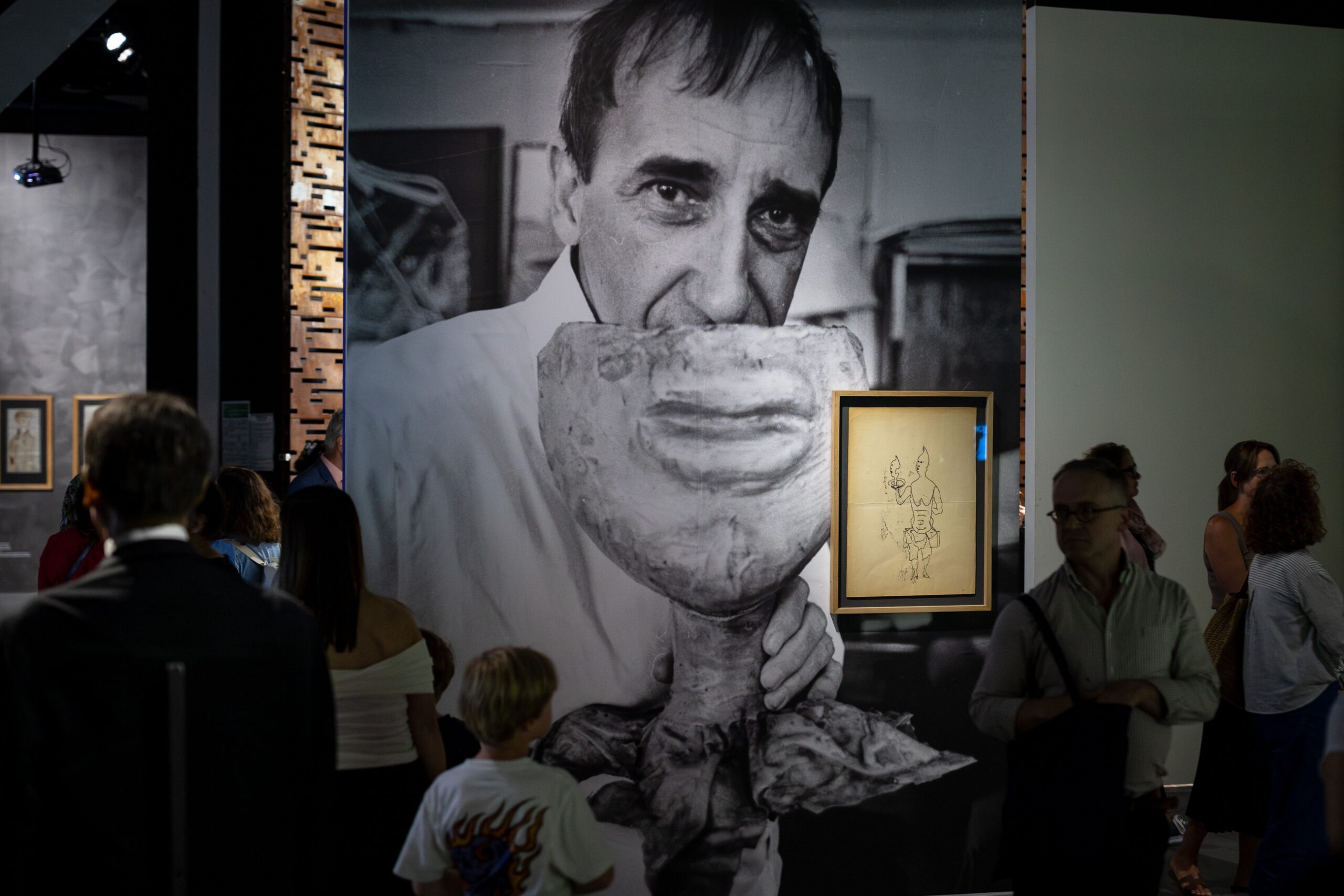
Cricoteka, the conference organiser, served as an umbrella case study. Built around Tadeusz Kantor’s legacy, it has grown and evolved from archive into a multi-faceted platform through living artistic events, The Playing with Kantor festival, and projects developed with and around performers and children. Speakers from across geographies — including from Norway, the UK, Switzerland, and Poland — shared their own experiments, while the programme also included guided exhibition tours, the opening of I Was Kantor’s Assistant Director. Andrzej Wajda at Cricoteka, and a visit to Tadeusz Kantor’s Studio.

Beyond the genius myth
Kantor saw the museum as a shelter for “the poor and fragile substance of art”, a counterpoint to Adorno and Smithson’s view of museums as graveyards. Speakers largely agreed that the genius narrative is a pitfall to recognise, deconstruct, or challenge, even as their artists differed in how political they were in their times and practices, or how much they self-identified as “political artists” — with Munch perceiving himself in this way significantly, whereas Kantor did not.

Caroline Ugelstad of MUNCH described a shift in the interpretation of Munch from biography and psychology toward feminist, gender, and political readings, and the creation of Scandinavia’s first curatorial post for Indigenous art so Sámi work is met on its own terms. Meanwhile, Anne Barlow of Tate St Ives took on the “frozen in time” mythology around Barbara Hepworth’s house and garden through new scholarship. During the discussion, a resonant goal not just in the case of Hepworth but in other single-artist museums was that, while keeping and preserving an artist’s work and studio is vital, the histories and choices about which histories are kept are rarely neutral. Who gets to decide who is honoured? How do we make sense of the preservation of a work if the artist’s original intent was for its ongoing use, which would result in its natural destruction over time?

Care, decay, and the living object
A fascinating query across multiple discussions that varied in approach was how to look after the work, the space, and remnants left behind by an artist? Barlow described conservation done to monumental works of Hepworth installed in the open garden space of the museum, so visitors could bear witness to the care involved in maintaining works that weather the elements.

Andrzej Przywara of the Avant-Garde Institute in Warsaw went in an opposite direction by following Edward Krasiński’s method of ephemeral action and intervention with minimal conservation that requires accepting entropy. In Krasiński’s studio, situated in a residential block in Warsaw, the objects are allowed to slowly decay, as was the artist’s intent, letting ideas speak through fragile, disappearing objects. The feeling being that conventional conservation would compromise a work where materiality, context, and place are inseparable. A powerful image from 2007 captures this intent: a glass pavilion adjacent to the artist’s studio stands empty, serving as a frame for decay.

Roland Wetzel of the Museum Tinguely added a third dimension to the problem: kinetic art inherently destroys itself through friction, so long-term care would require it to cease performing. The museum’s approach is to provide documentation of the sound and footage of works too fragile to run anymore, accepting that restoration changes the original intent of the piece. Preservation, in other words, is a dynamic and complex position that does not have one single solution or formula to follow, but requires weighing many factors and thoughtful contextualization.
From custodian to platform
Several speakers showed how one artist’s legacy can deepen understanding of a field, create space for exploration across disciplines, and provide opportunities and resources for future generations of artists.

Laurence Sillars of the Henry Moore Institute in Leeds discussed the Henry Moore Foundation, established in 1977 to support sculptors through grants and open calls, as well as to provide a shared centre for research alongside its exhibition spaces. Its aim is to re-read sculpture in the present tense and recover overlooked histories, such as the ephemeral work of Senga Nengudi, an influential Black artist whose practice and work were excluded from memory-keeping, with some works lost or not surviving.
The aforementioned Roland Wetzel also addressed both vertical and horizontal research, treating an institutional lens and contemporary relevance as mutually dependent. He noted that since the pandemic, Museum Tinguely in Basel has shifted towards holding fewer exhibitions and prioritising longer-term partnerships and networking as a key resource allocation.

Coming from Zakopane in the Polish mountains, Julita Dembowska presented the Hasior Gallery, which keeps the presence of sculptor Władysław Hasior alive without freezing him in time: a website tab lets visitors pick a question and hear him answer it — a project assembled by hand through extensive research, not AI. Dembowska noted that Hasior believed art has a social role, and the museum’s task is to keep one eye on the past and another on the future.
Access as method
Access came up as a way of making knowledge, not an accommodation or courtesy added at the end.
Sillars described a two-year exhibition at the Henry Moore Institute, developed with blind and partially sighted audiences that treated blindness as a source of knowledge rather than an accessibility issue to be accommodated. This led the institution to change its layout, marketing strategies, and work descriptions. At Tate St Ives, touch tours and audio guides by local students offered new ways of experiencing Hepworth’s garden. Museum Tinguely’s recent exhibition on the five senses addressed touch, sound, and accessibility, while Cricoteka’s immersive exhibition and playspace Wild Frolics was developed in collaboration with children.
A pervasive question that continually emerged throughout the discussions was: who can take part in the making of knowledge, how can we make the process more egalitarian and what conditions need to be in place for this to be possible?
Ownership, belonging, and data
Many of these museums are holders, not necessarily owners, of the works they care for, and rely on funding across municipal, private, and other sources. For example, MUNCH is custodian of roughly 28,000 works for the city of Oslo. Artists who crossed borders throughout their lives and careers add layers of complexity to the issues of belonging: in the case of Tinguely, who was Swiss but spent a significant part of his life in France, questions arose about how single-artist museums can or should speak to local, national, and international levels of connection to place and community. Who has the right to claim an artist in relationship with a particular city or place — and why?

Additionally, technological progress has introduced a new, evolving responsibility to contend with. Collections generate vast amounts of images, metadata and records. The speakers raised questions about cultural data production, its proper use and guidelines, especially in relation to AI. Several concerns emerged across contexts and geographies, including that AI could reinforce historical inequities by privileging the already dominant.
Where next?
The speakers disagreed and proposed a variety of interventions and methods, ranging from open conservation to managed decay, but they shared a few common premises. One was that the aim should not be solely to protect an individual legacy or object, but to keep questions of relevance and responsiveness to current cultural and geopolitical landscapes open. They emphasised the need to explore the possibilities of what an artist’s influence can bring for the future, not just its existence in the past.

The conference offered a much-needed entry point for expanding the discourse around single-artist museums through further exchanges across different geographies, histories and cultural contexts. Many open questions remain on what the future of such work could involve in practice. Could peer networks of single-artist institutions create space to share not only approaches but also mistakes? A clear need for working sessions on digital tools in institutions and on AI governance became apparent, as did the need for programmes that examine whose histories are preserved. Future exchanges should also invite institutions and artists not represented in this particular conference, such as museums devoted to women artists, artists of colour, and non-Western single-artist spaces. Finally, the cases presented at the conference point to the potential of more access-led co-curation.
If the genius myth asks us to look at one figure, these two days invited us to look around and beyond the individual: at the collaborators, communities, and audiences who keep an artist’s work resonating by continuing to ask questions without needing a singular answer. The museums that embrace this tension may be the ones that find more imaginative, collaborative ways to carry forward an artist’s legacy that can stand the test of time.

Acknowledgements
The conference was organised by Cricoteka, the committee — Director Natalia Zarzecka, Jarosław Suchan (concept and chairing), Małgorzata Paluch-Cybulska and Adam Nehring — and in cooperation with the Adam Mickiewicz Institute. The event was a part of the project “Kantor. Vision Therapy” and the main idea of the conference directly corresponds to the exhibition under this title, presented at the Cricoteka.
Thank you to moderators Dorota Jarecka, Arkadiusz Półtorak, and Magdalena Ziółkowska, and to speakers Caroline Ugelstad (MUNCH / Munhmuseet Collections), Anne Barlow (Tate St Ives), Andrzej Przywara (Avant-Garde Institute), Roland Wetzel (Museum Tinguely), Laurence Sillars (Henry Moore Institute), and Julita Dembowska (Tatra Museum). The conference was co-financed by the Ministry of Culture and National Heritage from the Culture Promotion Fund, with the Małopolska Region and the Adam Mickiewicz Institute, under the Minister’s honorary patronage for the Tadeusz Kantor Jubilee Year.