



To make a collage is to bring together fragments that once belonged to other wholes, each carrying a story of its own. Brought together, they take on new life. There is something in this process that comes remarkably close to Ivana Fischer’s understanding of identity: we begin with what we have inherited, accumulated, and have been given, but the arrangement is never entirely fixed.

This idea runs throughout Wild Gene, the Croatian artist’s current solo exhibition at the Trotoar Gallery in Zagreb, where I met her as she prepared for the opening. Entering the gallery, I was struck by the unexpected ease with which childhood toys coexist with anatomical imagery. They form a surreal visual language that feels both familiar and strange, inviting the kind of open, childlike curiosity we often lose in adulthood. “Exploring identities has followed me from the beginning,” she tells me. “It is an inexhaustible subject.”

The Making of an Identity
Born in Osijek in 1982, Fischer graduated in Animated Film and New Media from the Academy of Fine Arts in Zagreb in 2008. She initially imagined working with classical animation, but found its two-dimensionality limiting. Discovering Jan Švankmajer’s stop-motion films, with their raw materiality, distinctive sound and patina-soaked visual worlds, opened another direction.

Fischer began assembling a storyboard for her first film using magazine fragments and intuitively discovered collage, following the pieces that caught her attention. The storyboard eventually became a work in its own right. “It happened spontaneously,” she recalls, “and collage has been my medium ever since.” Once she immersed herself in filmmaking, she describes entering a kind of bubble, carrying the world of the film with her even after leaving the studio.

Fischer’s personal experiences often provide an initial impulse for her work, but she does not approach them autobiographically. Instead, they become emotional triggers that are gradually abstracted into broader motifs. Questions of identity were already taking shape in I (2009), a short animation in which a voyager attempts to free herself from her body and enter a fictional world. They become more pronounced in The Room (2011), perhaps the clearest early meeting point of the themes and visual tensions the artist continues to explore today.

In a hotel room, a female doll waits for her lover. Their encounter is staged almost like a ritual for her, which takes her to a floating, pleasing state of mind. Through the artificial body of a discarded doll, the intimate scene opens up broader questions about desire, vulnerability and objectification, balancing the grotesque with something unexpectedly tender. The film received the Grand Prix at the Festival of Croatian Animated Film, was broadcast by ARTE, and was selected for the New Directors/New Films award at MoMA and the Film Society of Lincoln Center in New York.

In the stop-motion film Déjà vu (2016), childhood memory surfaces as a collection of vivid but disconnected images, fragments detached from the larger context that once held them together. Its deliberately discontinuous frames mirror the way memories resurface: incomplete, altered by time, and increasingly difficult to separate from imagination. Plastic dolls, some dressed in elements of a folk costume, move through the landscape of Kopački Rit, where something intimate and geographically specific gradually takes on a more elusive quality. Nature appears lush and strangely charged. Figures seem suspended between a remembered childhood and a past that can no longer be reliably reconstructed. Memory remains alive and present, something that can still be felt. Whether that persistence is a comfort or a burden, I wonder.

Presented two years later as a solo exhibition at the National Museum of Modern Art’s Studio Josip Račić in Zagreb, the collage series Face Blindness turned towards perception and the many forces through which a person comes to recognise themselves: biology, family, education, social structures and the gaze of others. “I focused on portraits and on what actually remains of a person in our memory. I have always struggled to remember faces, so I began wondering whether we remember people through their appearance at all, or through something else”, says Fischer. In this work, collages are torn, not cut. The images meet along irregular edges, their fibres introducing an element she cannot fully control. Their bright colours and humorous poses lend the portraits a playful quality, while darker fragments introduce a subtle tension. Lines and small visual disruptions further unsettle the compositions, breaking their rhythm before it can settle into a fixed pattern – something Fischer sees as equally necessary in life.

The later Hungry for a Tribe series (2024–2025) shifted the emphasis towards community and longing for closeness. Bodies, animals, interiors and fragments of found imagery overlap in layered, messy compositions, as though family life and its places of safety were being reconstructed from memory. There is warmth in these worlds, but also distance and absence. “We seem more connected than ever, but there is an illusion in thinking that means we truly know one another,” Fischer tells me. Her “tribe” emerges in searching for a sense of belonging that extends beyond blood ties.
What Comes After Belonging
Wild Gene, her new exhibition at Trotoar gallery, picks up this thread at a different point. “I understand our wild gene, as I call it, as the urge to keep fighting that is essential to survival. You know there is an end, that one day you will become part of the earth, yet you still carry fears that keep pushing you forward. That is what drives everything.” Taking place between 18 September and 7 November, the show brings together a new series of around thirty collages, Fischer’s first three-dimensional collage works and the new stop-motion film After Belonging.

At the centre of the film is a figure familiar to her practice: a vintage plastic doll. Drawing loosely on memories of growing up in Baranja, the artist dresses her in traditional costume – an identity seemingly ready to be worn – only to gradually strip away the role of the “beautiful young woman” until she is left in rags. For part of this passage, she is accompanied by a small plush fawn, a silent companion that eventually disappears, leaving her to continue alone. There is something compelling in the doll’s fixed expression: seasons change, roles fall away and her body deteriorates, yet her face remains untouched by what is happening around her. Her inability to respond only heightens her objecthood, turning the passage of time into a quiet reminder of how little control we ultimately have over it. Eventually, the body returns to the earth, while nature carries on. The title leaves the film hanging on an open question: what comes after belonging – to a family, a community or even a world?

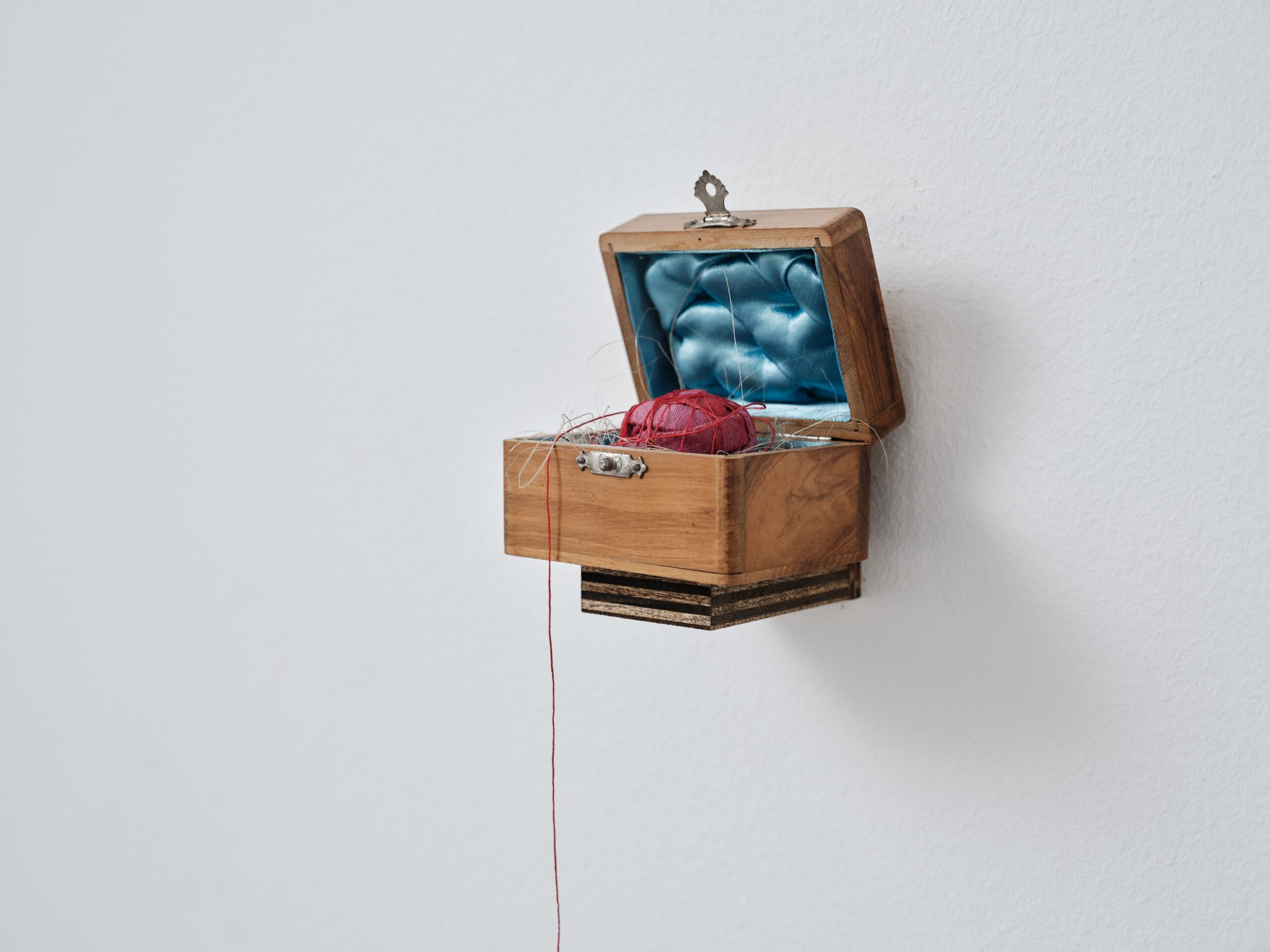
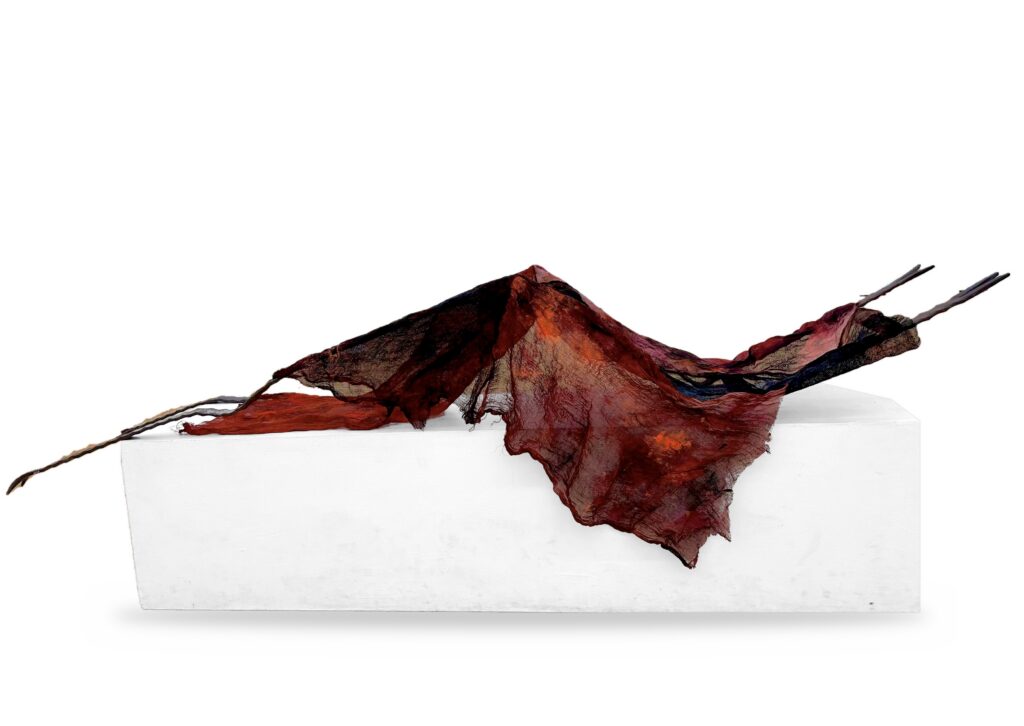
Fischer’s “3D collages” bring her images into physical space, somewhere between collage, object and miniature stage set. Suspended against a large folds of translucent, dusty-pink fabric the weathered wooden boxes become small worlds in their own right. A scenography of sorts, especially when dramatically lit after dark. Anatomical forms – lungs, a heart, a brain – coexist with human figures, animals, landscapes and fragments of domestic life, their unlikely encounters producing a peculiar mixture of beauty and unease. Nothing is polished away: hinges, worn wood, loose fibres, knots and uneven edges remain visible. A red thread winds through several of the works like a lifeline, sometimes taut, elsewhere tangled and loose. In another, blood and earth meet symbolically in small vials – the life coursing through the body alongside the ground to which it remains bound.
“I always add a little humour because tragedy and comedy are two sides of the same coin. One has to go with the other – they’re simply inseparable”, the artist tells me, as we stand surrounded by works that inhabit that very duality.
Fischer’s art finds its freedom in rearrangement, in possibility, in choosing new connections, in returning to an old image and discovering that it can still be read differently. Humour and unease, tenderness and loss, the ridiculous and the frightening keep slipping into one another. Perhaps that is what makes these strange little worlds feel so familiar: life rarely asks us to experience one thing at a time.