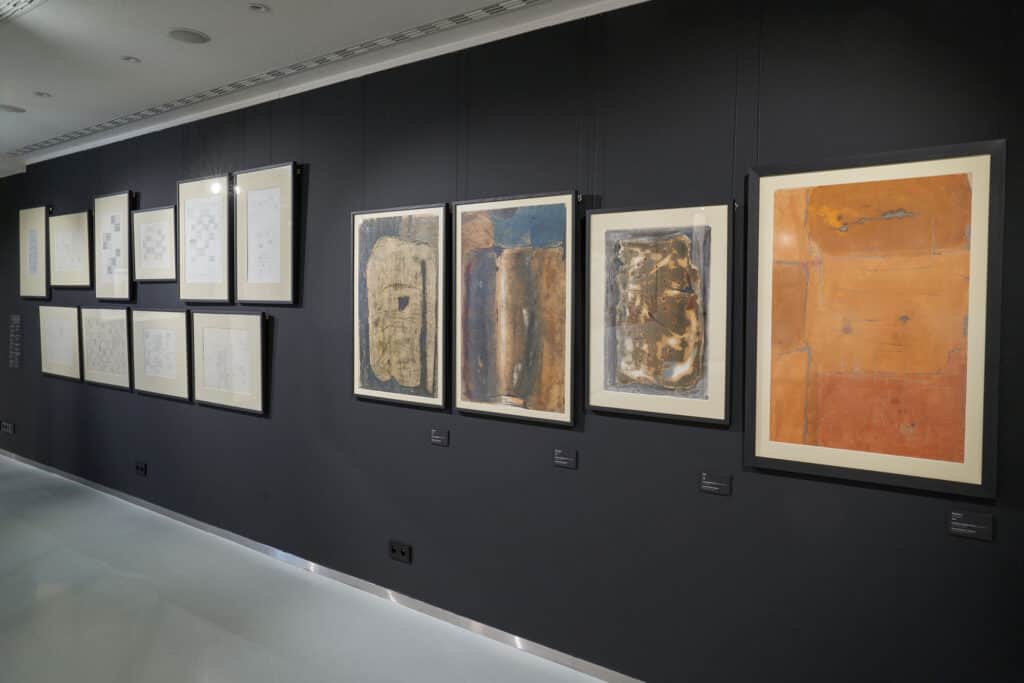
Once a year, Prague seems to turn itself inside out. For four days in late September, Prague Art Week draws visitors to the city — from the grand halls of the National Gallery and Kunsthalle Praha to private collections, artists’ studios and rooms that rarely open their doors. The fifth edition, held from 24 to 27 September 2026, brought together more than a hundred events, across around forty institutions and galleries. For a few days, the city itself became an exhibition space, bringing its different histories, communities and artistic scenes into temporary proximity.

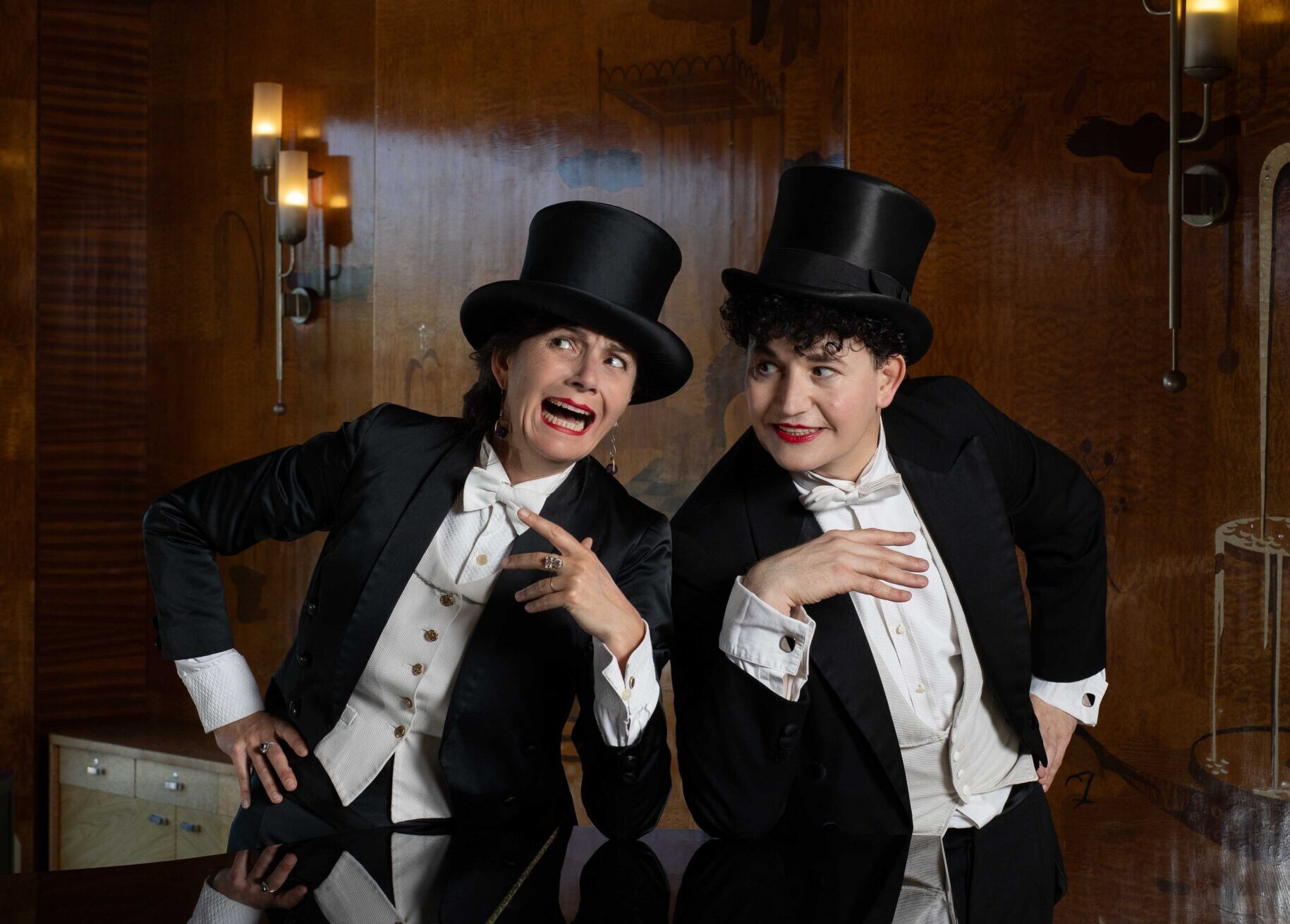
Among the projects presented during this year’s festival was Le Chat Noir, organised by KodlContemporary, a Prague gallery accustomed to extending its program beyond its own walls. Following last year’s exhibition at Laichter House, the gallery moved into Parnas, a historic restaurant on the Vltava embankment, for an exhibition by Julie Béna and Mark Ther, curated by Natálie Kubíková. Béna, a French artist who divides her time between Paris and Prague, joins theatre, cabaret and performance, along with her own recurring characters. Ther, a Czech artist, moves between drawing, video and installation, often returning to questions of queer identity and the repressed histories of Central Europe. Le Chat Noir marked their first exhibition together.
A room with a long memory
Before encountering the works, the visitor encounters Parnas itself. For more than a century, the restaurant has been a meeting place for artists, filmmakers and politicians, from the bohemian circles of the First Republic to the FAMU film community and the jazz and underground scenes of the 1970s. Its history is inseparable from a particular kind of Prague social life, where conversation, performance and politics could unfold around the same table.

The interior bears traces of that history. Teak panelling runs through the rooms, interrupted by delicate Art Deco intarsia made with materials such as mother-of-pearl. Because of its beautiful craftsmanship, dating back to the 1930s, the interior is sensitive to humidity, temperature and physical contact. Parnas is rarely open to the public, so entering it already carries a sense of occasion.
That distinction matters. Parnas is not simply a backdrop for Le Chat Noir. It is a work of art with its own history, one that the exhibition had to enter rather than replace. Instead of attempting to transform it into a gallery, Béna and Ther allowed the restaurant to remain recognisable. Their works sit alongside the existing interior, sometimes almost moulding into it, and sometimes making us look at it differently.
Parnas is not simply a backdrop for Le Chat Noir. It is a work of art with its own history, one that the exhibition had to enter rather than replace. Instead of attempting to transform it into a gallery, Béna and Ther allowed the restaurant to remain recognisable.

A space between theatre and reality
Large drawings on canvas occupy the walls of the Parnas main hall. Their sketch-like lines are reminiscent of scenography, as though they belonged to a stage whose story had not yet been fully revealed.

Béna’s glass lamps are dispersed across the tables. Above them hangs the Jester, a monumental figure inspired by historical French automatons. Elsewhere, glass, canvas, mechanical movement and light begin to overlap. Nothing quite settles into a single category: object, prop, sculpture or stage set.
The exhibition does not try to tell us which parts are authentic and which are performed. Instead, it seems more interested in what happens when the two become difficult to separate.
Parnas in and of itself already has something of this theatrical quality. Béna describes it as an Art Deco gesamtkunstwerk, where art, design and architecture become inseparable. At the same time, some parts of the interior are later additions rather than original elements, making the relationship between the historical and the reconstructed less straightforward than it first appears.
This ambiguity feels important to Le Chat Noir. The exhibition does not try to tell us which parts are authentic and which are performed. Instead, it seems more interested in what happens when the two become difficult to separate.

The magician and the moon
In one corner of the restaurant, a small velvet curtain marks the entrance to another world. In that world, there is Béna’s The Magician and the Moon, her first automaton. A key is turned, gears begin to move, and the magician slowly comes to life.
There is something immediately theatrical about it. The velvet curtain recalls the cabaret, a recurring reference in Béna’s practice, while the mechanical movement gives the piece a slightly uncanny quality of an old stage illusion. Yet, within Parnas, the work feels surprisingly quiet. It does not interrupt the room so much as emerge from it.
There is sentimentality here, but it never settles comfortably into nostalgia. The atmosphere can feel affectionate one moment, and slightly strange the next.

This is one of the things that makes the exhibition feel different from what one might expect from either artist. Both Béna and Ther have practices that can be theatrical, provocative and deliberately excessive. Here, however, the effect is much more delicate. Ther’s drawings look almost unfinished. Béna’s glass and mechanical works are intricate but restrained. Even the velvet curtain, with all its associations with cabaret and spectacle, functions almost as a whisper of theatre rather than a declaration of it.
There is sentimentality here, but it never settles comfortably into nostalgia. The atmosphere can feel affectionate one moment, and slightly strange the next.
A presence among the guests
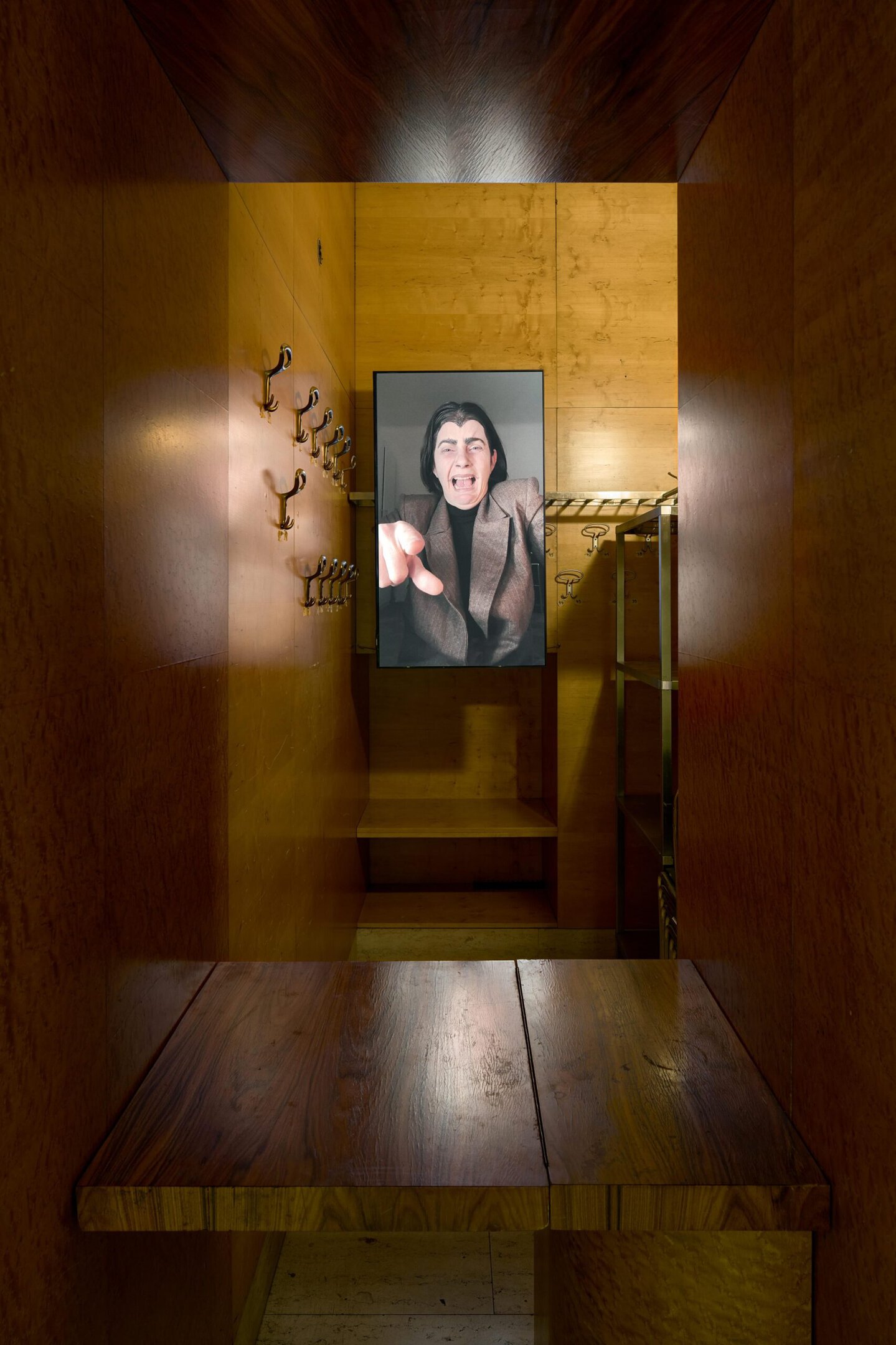
On the opening evening, the distinction between exhibition and gathering became even harder to locate. The restaurant filled with guests, conversations and movement. Somewhere among them was Jean, one of Béna’s recurring characters.
There was no stage, no announcement. Jean simply appeared among the guests, moving around the edges of the room, pulling exaggerated expressions, approaching people and watching their reactions. Rather than placing himself at the centre, Jean seemed to circle the group, coming closer to particular people and testing how much space he could occupy before becoming impossible to ignore. If one wasn’t paying enough attention, it was possible to miss him entirely. Guests had to notice that something slightly unusual was happening around them before they could recognise it as a performance at all.

Nearby, a pianist from Café Slavia moved between classical music, jazz and the occasional pop song. His presence was not incidental either. He has been connected to Parnas for years, making the music feel less like something brought into the exhibition and more like another part of the space itself. The repertoire moved between periods and genres almost as naturally as the evening moved between exhibition, performance and social gathering.
For Béna, the pianist also recalled the soft masculinity of Bohumil Hrabal’s I Served the King of England, introducing another vision of Central European social life.
Béna’s Jean belongs to a recurring world within her practice, populated by characters who communicate through gesture rather than speech. His exaggerated masculinity, physical humour and moments of uncertainty brought another kind of historical figure into Parnas, one less monumental than those usually associated with the history of the restaurant.

The performance therefore did not simply happen inside the exhibition. It made the people watching it part of the work, whether they realised it or not.
The repertoire moved between periods and genres almost as naturally as the evening moved between exhibition, performance and social gathering.
A room, replayed
Parnas remains visible throughout Le Chat Noir. Its history is not replaced by the exhibition, nor does the exhibition attempt to disappear into it. Instead, the two occupy the same space, each changing the way the other can be seen.
The lamps illuminate tables that once belonged to another social world. Ther’s drawings turn walls into fragments of scenery. A mechanical magician appears behind velvet, while Jean moves around the edges of a crowd. The pianist plays, guests talk, and, for a moment, the restaurant becomes something between an exhibition, a performance and a gathering.
Much of it could easily go unnoticed.
Perhaps that is what makes the exhibition feel so closely connected to Parnas. The space has always been a place where different forms of social life overlap, where conversation, performance and everyday life can occupy the same room.
Le Chat Noir does not resolve that ambiguity. It quietly replays it.