Zuzanna Szary’s paintings move between intimacy, domesticity, food, desire, and the politics of the body. The artist creates a visual language grounded in softness, sensuality, and queer everyday life. Drawing on personal experience as well as references to figures such as Gertrude Stein and Alice B. Toklas, she approaches painting as a space where lesbian identity, care, resistance, and vulnerability intertwine.
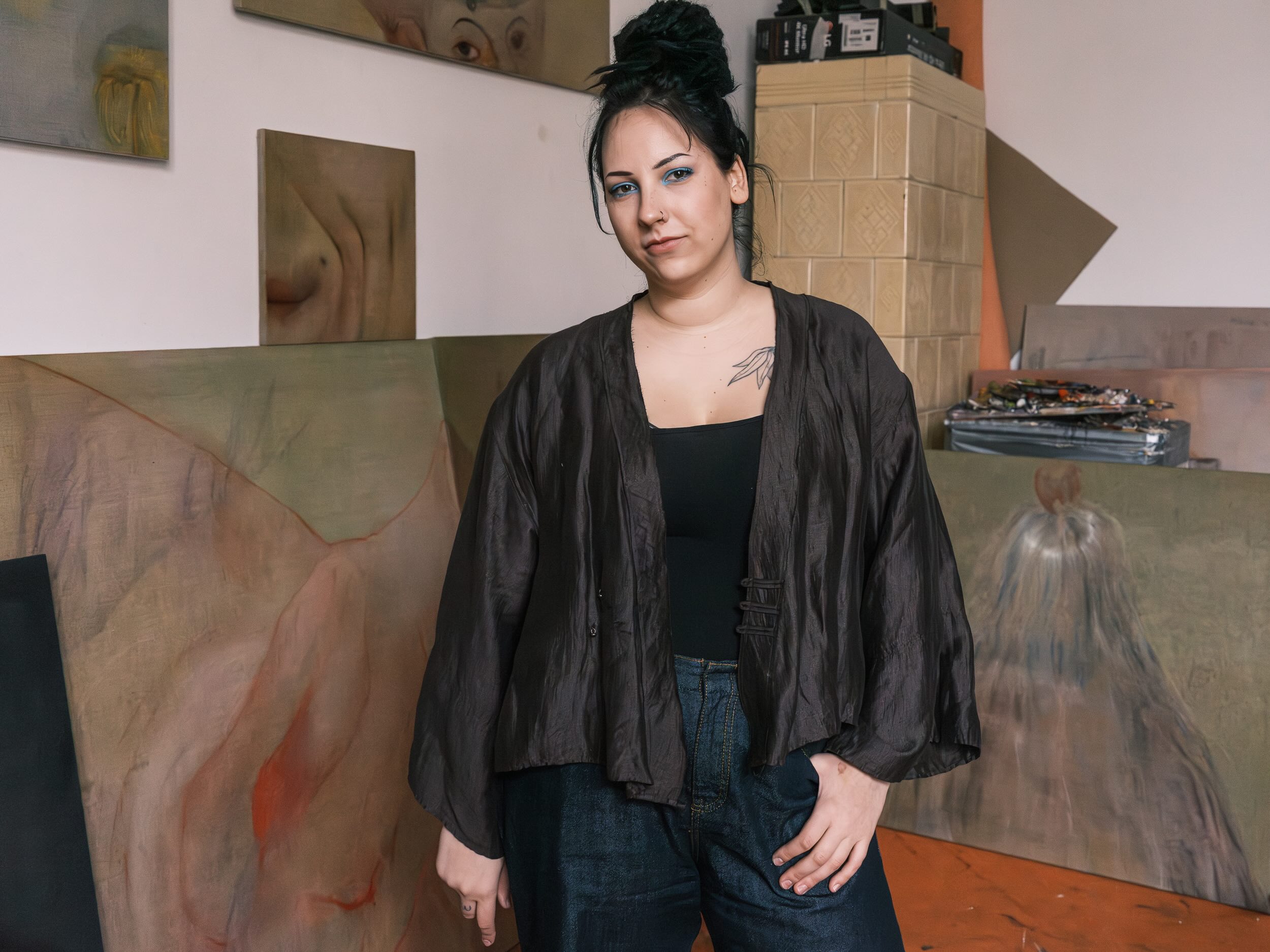
In this conversation with Wojciech Szymański, Szary reflects on her beginnings as a painter, the role of the kitchen within queer domesticity, the pressures surrounding gender and bodily norms, and the political potential of softness, roundness, and slowness in a culture shaped by productivity and discipline.
Wojciech Szymański: Tell me, when did you decide to become a painter?
Zuzanna Szary: I remember when I discovered I wanted to be a painter. I also remember when I discovered I was a lesbian. Where do you want to start?
WS: Wherever you want. Are those things connected? Did you discover right away that you wanted to be a lesbian painter?
ZS: No, that’s not it. I’ll start with being a lesbian. I found out back in junior high. I remember my first kiss was with a girl I was close to in elementary school, who later became my girlfriend in junior high. That was also when I first kissed a boy. Considering it was junior high, he really was a cool boy. But I remember when I kissed him, I was so disappointed; it just wasn’t it. Why did it suck so bad? But when it comes to painting, I only started after high school, after the exam. I always wanted to be creative, to make films, music, but not paintings. It was only after the depression I had when I graduated, a whole year of clinical depression, that things picked up and I started to paint. That’s how I prepared for my studies. For a year and a half, I worked as a nanny, lived with my parents, and painted. Then I got into the Academy of Fine Arts.

WS: You want to say more about your time at the Krakow Academy?
ZS: I never went to an arts high school and never studied painting. I always just painted my own stuff, mainly portraits, lots and lots of portraits of the partners I had, and very few still lifes. And in the first year, I ended up in a studio where they did lots of traditional painting, and there turned out to be an awful lot of still lifes, especially those featuring pots. I had a minor breakdown because I started wondering if I was cut out for it. Most of the people around me painted pots really well. Not me. After a year, the professor running the studio said it was better I hang the pictures I’d come to the studio with for the year-end exhibition, and not the ones I’d spent all year painting. Luckily, the next year you could choose your studio, and I took the one run by Andrzej Bednarczyk. I didn’t know anything about it except that it was where you had the most freedom; not many pots, you could do what you wanted. So I painted bodies again, body parts, and faces. I felt I was back on track, and I found my feet in that studio.
WS: And when did you begin painting lesbian life?
ZS: That’s what I did from the start: mainly my partner at the time, then the next one. Then I started dating Nina, and she wouldn’t let me paint her. She said she didn’t want to be another muse. And in fact, I’ve only recently started painting her, because she finally agreed. After eight years together, she decided now I can.
WS: Portraits of women are now a marginal part of your work. It seems that, paradoxically, you’ve come around to still lifes. The pots from the first year have come back to get you.
ZS: True. I’ve made peace with still lifes because I can now paint them on different terms. Nina has noticed, however, that my pictures of food, cooking, and the home have no cutlery, pots, plates, or other things associated with preparing food and cooking. There’s only food, food as such, very sensual. Maybe because Nina does the cooking at home, I mostly devour it, often with my hands.

WS: Is the kitchen an important part of your home?
ZS: Yes, it is. It sets the rhythm of the day, it’s a place for our everyday shared rituals, a place haunted by eros, as in Renata Lis’s piece1. Nina really likes cooking. I go with her to the market, I help out, and I consume what she makes. I often just sit in the kitchen while she cooks and keep her company, talking to her.
WS: What does she generally cook?
ZS: Always vegetarian food. I haven’t eaten meat since I was eleven. Surprise, surprise: I’m a lesbian, so of course I’m a vegetarian.
WS: Really? Do they always go together?
ZS: Didn’t you know? Today you’re a vegetarian, tomorrow a homo! It’s common knowledge among homophobes, self-explanatory. I bet most of the gay people you know don’t eat meat, right?

WS: And in your case, that checked out? First, you discovered you were a vegetarian, then a lesbian?
ZS: Of course. Vegetarianism made me a lesbian.
WS: But you also paint pictures inspired by The Alice B. Toklas Cook Book, with poultry and pigs’ heads. In the context of the series as a whole, those animals are for eating, correct? That doesn’t strike me as a vegetarian manifesto. Have you ever wanted to go vegan?
ZS: I have, but I’d like to add something about those animals. They’re not just dead in those pictures. They’re half-dead and half-alive. There’s no sliced heads and blood, no steak or ham. No such depictions. The animals are whole; they’re alive, yet they could be dead. When I painted them, I was thinking more about death as such, not just death in terms of consumption.
WS: Cuisine and food are frequent themes in contemporary women artists, such as Consumer Art by Natalia LL or Semiotics of the Kitchen by Martha Rosler. Both those works are, of course, more rooted in gender politics than sexuality. Your new pictures of food are different. Through references to Alice B. Toklas and your own life, you problematize cuisine from the standpoint of non-heteronormative sexuality and politics, lesbian or queer.
ZS: In single-sex relationships, the kitchen is less likely to be the site of gender oppression, as in Martha Rosler’s work. The gender of the kitchen in queer homes, including lesbian ones, is automatically deconstructed. This queered kitchen becomes a different space — its function goes beyond the straight model, the patriarchal relationship. There are none of those divisions hallowed by tradition: the guy with the hammer, the gal with her potato peeler. The lines are fluid. One person does this, the other does that. In our home, Nina cooks. Nina cooks, and I set out and arrange things.

WS: What’s the role of Gertrude Stein and Alice B. Toklas in the pictures inspired by The Alice B. Toklas Cook Book?
ZS: The relationship between Gertrude Stein and Alice B. Toklas and their home inspired me in the Tender Buttons exhibition at the BWA Ostrowiec Świętokrzyski last year. They’re also essential, of course, in terms of the new pictures, which are often about eating. Tender Buttons really was more about the space of their lesbian home and relationship. Stein was definitely the main protagonist there. Even the title came from Stein. The second exhibition, Zuzanna M. Szary Cook Book, refers directly to Alice, who became equally vital. I like that, especially since their real relationship reminds me of straight ones, with Gertrude playing the professionally fulfilled man, and Alice the woman who plays housekeeper and cooks, in something like a supporting role. We know, at any rate, that she really was treated like a supporting character.
WS: Yes, after Gertrude’s death, Alice was basically robbed by the Stein family. She lost their shared apartment and their valuable art collection. Her later life was a struggle. She coped with financial hardship until the end of her life. That story is both deeply sad and deeply relevant when we think about the systemic homophobia in today’s Poland and what’s happening with the recent verdict of the Supreme Administrative Court when it comes to registering same-sex marriages sealed abroad. What’s it like being a young lesbian in Poland in 2026?
ZS: I feel good, but I’m very privileged, because I live in a bubble where I don’t experience any homophobia. My parents are OK, and Nina’s are, too. On the other hand, it hurts me that I can’t get married, that we can’t be a family in the eyes of the law. I wish that were possible and that the state protected my rights and recognized the space for my family and me. That’s really important to me. I’ve already spent time mourning that space.

WS: On the other hand, your lesbian home-studio is a kind of alternative to heteronormative, legally acknowledged structures. I imagine that someone might say the need to formalize a relationship is understandable, but it also seems terribly bourgeois. I know loads of people who live in informal relationships, and they’re fine with that.
ZS: If I were a straight guy, I think I’d dream much less of getting married. But I’m a lesbian, and it’s off-limits, and I long for it. I also long for the ritual of a wedding, and for the sense of security that only the state and its institutions can provide. When I was very young, and I already knew I was a lesbian, I thought that by the time I was thirty, that, fucking hell, at least common-law relationships would be introduced.
WS: Yes, I think I thought so too. But the reality is, it’s 2026 and once again they’re holding talks about whether there’ll be common-law or not, and our supposedly liberal prime minister ignores the Court of Justice of the European Union and the Supreme Administrative Court of Poland when it comes to recognizing same-sex marriages concluded abroad. And added to all that is a situation where almost no one does gay or lesbian art, because everyone’s doing queer art, which has been made into such a token gesture. I think every exhibition venue in Poland has had at least two queer shows. But when we did the Tender Buttons show, you called your paintings lesbian. And I admitted you were right, we were doing a lesbian exhibition; it was lesbian, not queer.
ZS: Right. At that point, I needed powerful, old-school lesbianness and a strong lesbian identity. Today, a great many things can be queer in a simple way. If, for instance, something’s a bit odd or even uses a peculiar aesthetic, that’s queer as well.

WS: I’d say that everything can be queered, of course, but maybe not everything is queer. When we did that exhibition, I also felt the need to turn to a lesbian sensitivity and homosensuality. Of course, that turn could be called queer, but I didn’t need that term at the time. When you think of your painting, is it more lesbian or queer?
ZS: No doubt it’s both; it’s queer because it’s lesbian. It’s about lesbian bodies and relationships that are queer, not just non-heteronormative, but also non-homonormative. The piece by Dorota Kotas mentions a fit body exemplified by firm biceps2. That fitness touches everybody, regardless of their sexuality. For instance, a straight man, but a soft one, he’s also got it rough in a way, right? I think what I paint—food, body parts, pudginess, softness—is a kind of resistance against that pressure.
WS: In Dorota’s piece, I was really surprised that she described the need to have a supple body from a lesbian perspective and the intensity of her description. I had thought that was just female, not specifically lesbian.
ZS: Women in general feel a lot of pressure tied to appearance; they’re meant to be beautiful, aesthetically pleasing, easy on the eyes, and they’re supposed to enjoy it. It’s an awful anachronism, but it’s still rampant in the culture.

WS: Sure, but the same goes for men, especially the young or middle-aged ones; it’s either the cause or the effect of the masculinity crisis, or both.
ZS: Of course, though I think men have a few more props to begin with, just because they’re men. It means they’re automatically seen to be active, taking the initiative. But if they’re sensitive, they’re sometimes perceived as soft, and that’s a crime against manhood. Or not able enough. When I first read Dorota’s piece, I thought about how I myself felt in my distant high school days. I’m speaking of high school because around then, or just a bit earlier, I figured out that I liked girls. And I remember I really had the feeling that I had to have the small breasts and big biceps Dorota describes, to be quite agile and able to make girls like me. If I were “feminine,” soft, pudgy, I thought no woman would want me. That’s why I thought I had to be masculine, or at least unisex. I fantasized about having no breasts, of just having a totally flat rib cage. I’m over it now. I’m older, I’ve been in a relationship for years, and I basically accepted the fact that I’m a woman and I’ve got the body I do. “Womanly,” soft and round, so automatically a bit pudgy and nondescript, not agile enough. I don’t want to say soft bodies always have those connotations, but potentially they qualify as such by today’s body-discipline regimes.
WS: So what you paint is, in fact, opposed to those biceps in Dorota’s piece, correct?
ZS: Yes, insofar as those biceps are a symbol of exerting yourself to be a fit, agile, always-active subject. Because pudgy and soft mean fat and lazy — that’s the associations most people have, unfortunately. I’m not talking about the widespread ignorant fat-phobia; I mean all kinds of softness, roundness, flabbiness, of time, how it is spent and passed.
WS: Does that mean we can say your paintings praise roundness, and roundness is an aesthetic category opposed to exertion? Roundness vs. the taut string? The patch of color vs. the grid?
ZS: Right — and formlessness versus structure. When I was a very young lesbian, I wanted to be firm, and I was afraid the world would be hard on me if I wasn’t supple and fit. I wanted to be a dynamic girl. And now I’ve been round and soft for some years, even flabby. And I’m fine with it.
WS: Well, I don’t think you’re flabby yet.
ZS: Maybe not yet, but just about. Anyway, my body definitely does not meet the thirty-year-old female body expectations, for everything to be tucked in and where it should be. Softness makes me think of relaxing, which means it can be a form of resistance against the body regime and the capitalist concept of time (work). A soft body is a slack body, a body unhitched or detached from the system that corresponds to action, straightening up, an erect body. Poland is apparently the second hardest-working country in Europe, after Greece. You have to give it your all to be fulfilled. That sets us apart from the rest of Europe, which has slowed down. We’re pressing on for the record: growth, increase, hard numbers.

WS: Are you trying to say that your paintings and praise of lesbian roundness oppose a capitalist efficiency and concept of time?
ZS: I think that’s connected to a soft, theoretically weak, and slack body.
WS: What are you going to work on now? Do you want to carry on exploring food, sexuality, and lesbian herstories like Alica B. Toklas and Gertrude Stein? Or would you prefer to close that chapter and do something completely different?
ZS: I don’t know. I’m just putting on an exhibition I’ve spent over half a year preparing, so I have yet to start a new phase. I do think those themes you mentioned will still appear and continue. Definitely softness as a figure of resistance and roundness as a category I’ve long been working on will stay. I can’t just draw a line through them. The hard cut and the line come from an approach that’s totally different from softness. What should we title this conversation?
WS: Maybe another quote from Gertrude Stein? “Lifting Belly”?
ZS: “Lifting Belly, Soft Bodies.”
1 – Renata Lis’s text “U-Turn, or: Eros in the Kitchen” is going to be published in Zuzanna Szary’s book Tender Buttons at the end of May 2026. The book edited by Wojciech Szymański accompanies two of the artist’s exhibitions: Tender Buttons (2025) and The Zuzanna M. Szary Cook Book (2026).
2 – Dorota Kotas’s text “Dykes and Their Bodies” is going to be published in Zuzanna Szary’s book Tender Buttons at the end of May 2026. The book edited by Wojciech Szymański accompanies two of the artist’s exhibitions: Tender Buttons (2025) and The Zuzanna M. Szary Cook Book (2026).