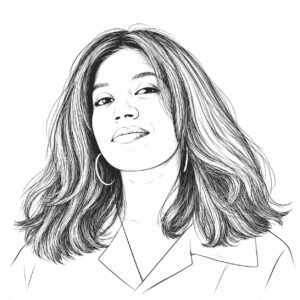
In Alexander Aburanem’s practice, painting is pushed to the threshold of physical endurance. His monumental surfaces, often extending up to six meters, refuse stillness. Metal is cut, scorched, hammered, and wounded before pigment settles across it. The resulting works exist between excavation and confession: emotionally charged terrains where abstraction, figuration, and memory collide with industrial force.

Aburanem’s trajectory into art remains strikingly unconventional. Trained in International Relations and Economics, with an early career in private banking and high-end art acquisition, he entered the studio not through academic orthodoxy but through proximity to systems of value and exchange. Before dedicating himself fully to art in 2015, he worked closely with major international galleries, purchasing works for elite collectors. Yet immersion in the art market ultimately produced the opposite impulse: the need to create rather than circulate objects. “It was like a first marriage,” he has remarked of his former career. “I’m on my second one now…with art.”

Between Control and Surrender
This tension between control and surrender defines his practice. Aburanem frequently speaks of scale as a strategy for losing authority over the image. Large-format works destabilise the artist’s ability to comprehend the composition at once, forcing him into what he describes as a meditative state. The surface becomes a site of accumulated gestures, mistakes, and transformations. A flower dissolves into an animal, a body mutates into cloud-like form, and fragmented marks eventually cohere into what the artist calls a “harmonic language.” His process mirrors the volatility of financial charts: daily fluctuations collapsing into larger rhythms over time.

Recent works push this language further through the brutal materiality of metal. Thick impasto flowers emerge from scarred aluminium sheets; molten pigment, plastic, and wax are burned directly onto surfaces that retain the memory of impact. These floral compositions resist delicacy. Instead, they function as violent interruptions, destabilising traditional associations of beauty and fragility. Light catches on dents and abrasions, activating the surface as something unstable and alive. Aburanem is less interested in representation than in vibration: the way damaged metal reflects light, carries sound, and records force. Beauty, in these works, emerges through abrasion.


His connection to metal originates in childhood memories of accompanying his father to a machining factory, where the smell of grease and steel became embedded in his sensory memory. His return to industrial materials is therefore not merely aesthetic but psychological: an attempt to physically re-enter and reconstruct the emotional architecture of the past.

Painting as Excavation
The emotional core of the work reveals itself through scattered autobiographical inscriptions. One of the untitled works bears the handwritten phrase “I miss my dad,” appearing almost unconsciously during the artist’s process. In newer figurative compositions, urgent statements such as “I AM THE LAST OF MY KIND” and “STOP CALLING ME NAMES” are scrawled across woven fabric and layered over distorted bodies and translucent gestures. These fragments read like involuntary thoughts surfacing mid-process, exposing vulnerability beneath the aggression of the material. Text in Aburanem’s work is never illustrative; it operates instead as another physical gesture, carrying the immediacy of graffiti, confession, or emotional residue.

What makes Aburanem’s practice compelling within contemporary painting is his refusal of stylistic permanence. He moves fluidly between gestural abstraction, fragmented figuration, intimate sketches, flowers, machinery, and scenes of daily life without allegiance to a singular visual identity. Rather than cultivating a fixed signature, Aburanem approaches painting as an ongoing excavation, diving intensely into one visual language before abandoning it in search of another. The result is a body of work defined not by resolution, but by perpetual searching.

The text was written based on an interview between Alexander Aburanem and Anna Azens.