






How do you narrate experiences that have been reduced to data, statistics and headlines? How do you recover the individual from within a nation that has been demonised, instrumentalised and deployed as a pawn in political games? How do you sustain a relationship with a place that both shaped you and cast you into exile?


These questions lie at the heart of Hidden Narratives, on view at Galeria Promocyjna in Warsaw until 7 November 2026. Curated by Sasha Velichko, the exhibition brings together the work of six Belarusian artists chosen through an open call of the same name. Their works explore whether individual experiences can form a shared voice – one capable of preserving memory, articulating loss and imagining a nation beyond the narratives imposed upon it. Divided between two rooms, the works vary in form and approach, but share an interest in how personal experiences can become part of a larger story without losing their individual character.

Shared Archives
Family archives have long been a place in which one could try to establish one’s identity or a sense of belonging. Of having roots. The exhibition opens with Diana Leonova’s Matryoshka (2025), Richetresque blurred black-and-white paintings depicting blown-up fragments of her grandmother’s family snapshots. The series focuses on memory, everyday life, and the ways relationships are maintained across time and distance. The photographs are personal and ordinary, but through their enlargement and transformation, they become records of a family history that might otherwise disappear.

Across the room, Olga Kirillova’s Secret Folder (2021) also draws on a photographic archive, but one left to her by a close friend before her death. The friend had asked Kirillova to delete any intimate photographs in the archive. The artist respected this request, but before doing so she recreated the images using her friend’s camera and carefully sourcing clothes similar to those worn in the original photographs. The original photographs were then destroyed, while the situations they recorded were brought back in another form, raising questions about memory, loss and the ethics of keeping someone’s image alive.

Reaching for a less personal archive, Masha Sviatahor in Promised Butterflies (since 2025) turns to photographs of political events, parades and speeches, which she combines into collages featuring enlarged images of caterpillars, cocoons and butterflies. These insects are often associated with transformation and the hope for change. In Sviatahor’s works, however, they remain frozen. Their transformation is interrupted and never completed, suggesting a future that is continually promised but never fulfilled.

Reimagining Tales and Folklore
Myths and legends are among the oldest cultural vessels of identity; they unite generations through a shared sense of traditions and values. This is exemplified by the Belarusian myth of the fern flower – a bloom that appears once a year deep in the forest, bestowing knowledge and wealth upon its finder. The fern also appears in the pages of the Belarusian passport, a detail referenced by Sasha Kulak in her video installation and accompanying zine, I DO NOT MAKE PLANS (2024). While the fern and the passport ostensibly promise freedom and the prospect of a better life, the Belarusian government has recently imposed restrictions on passport renewals and the issuance of new documents. At the same time, a global migration crisis is intensifying, claiming the lives of thousands who attempt to cross national borders through forests. Although they venture into the woods seeking salvation, the forest often becomes their undoing. Kulak’s work transforms the fern flower into a symbol of both hope and the tragic gap between what is promised and what is actually found.

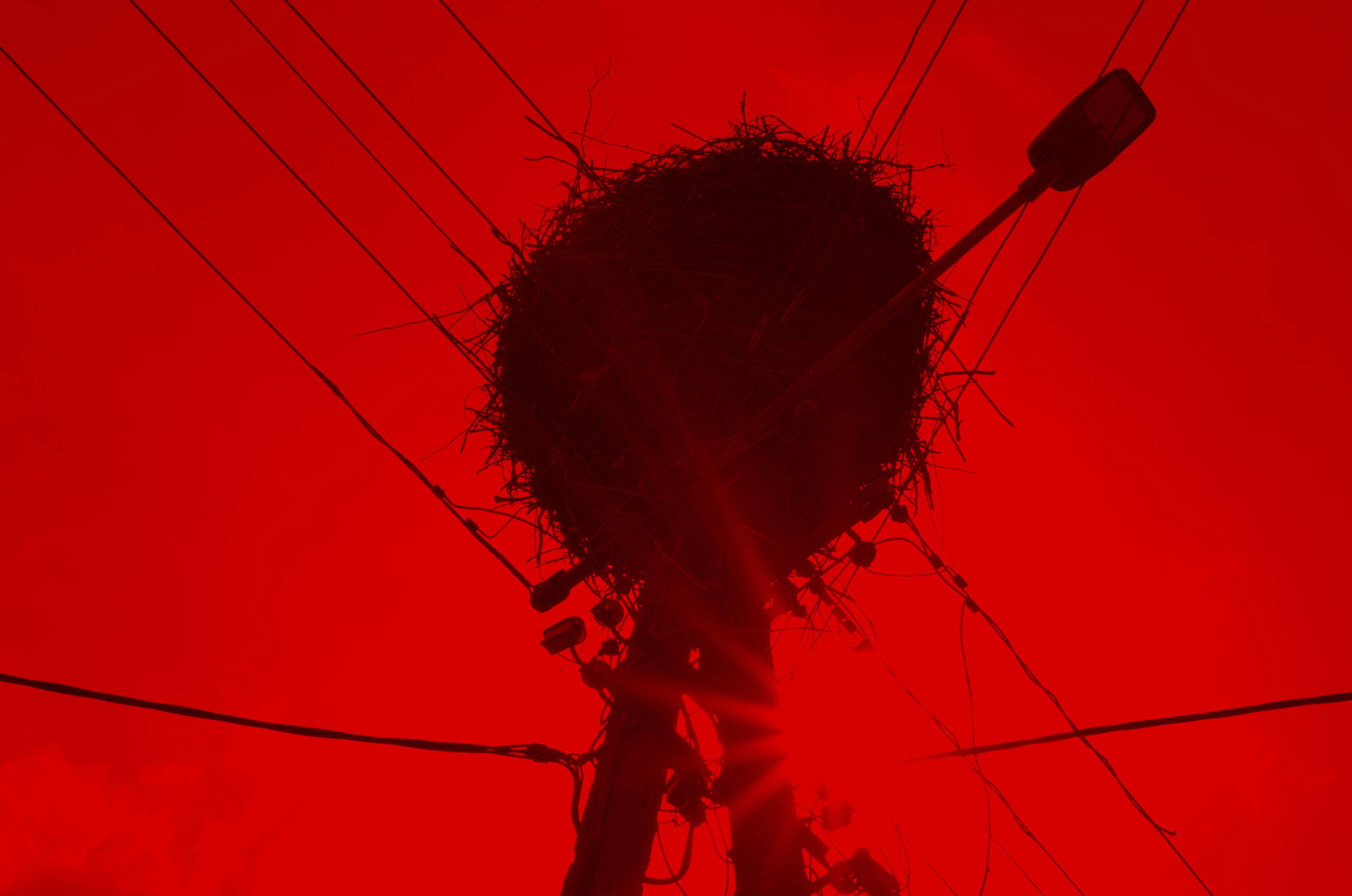
In the second room, Sasha Smal’s CUT//OFF (2026) turns to another symbol from Belarusian folklore: the stork. Associated with home and return, the bird becomes a way of thinking about freedom of movement. A stork can cross human borders without permission, while people are restricted by passports, fences and changing political circumstances. Smal’s CUT//OFF is an intricate, almost lace-like, paper cutout of a cloud of storks that wraps around a fragment of a steel border fence. By placing the freedom of the bird against the restrictions imposed on people, the artist draws attention to how closely movement and nationality are connected.

Borders Not Recognised by Nature
This tension between movement and borders continues in Yuliya Tsviatkova’s short film In the Animal’s Skin (2025). The film focuses on the border fence running through the Białowieża Forest, built to prevent refugees and migrants from crossing into Poland from Belarus. The fence has also affected the forest itself, disrupting the movement of wildlife through an ecosystem that does not recognise the borders imposed by humans. Tsviatkova brings these two forms of movement together. People trying to cross the border and animals moving through the forest are both confronted by a structure that changes the landscape and limits movement. Hence, the forest becomes a space where political decisions, human displacement, and the natural environment intersect.
Across the exhibition, the artists repeatedly return to the question of what remains when movement, memory and belonging are disrupted. Taken together, the works in Hidden Narratives resist reducing Belarus to a set of political events or media images. Instead, they return to individual lives, personal memories and everyday experiences. The exhibition does not attempt to present a single story of Belarusian identity. Rather, it reveals how identity is shaped through fragmented memories, relationships, absences and acts of persistence. In doing so, it offers a space in which Belarus can be understood through the voices of those who continue to negotiate their connection to it from within and beyond its borders, rather than as an abstract political subject.


