Ma perché frode è de l’uom proprio male,
più spiace a Dio; e però stan di sotto
li frodolenti, e più dolor li assale.
But because fraud is man’s peculiar vice,
more it displeases God; and therefore the fraudulent stand lowest, and more pain assails them.
— Dante Alighieri
Niclas Castello’s La diabolica commedia: Prelude galvanizes around Dante less as literary heritage than as a functioning chronicler of contemporary crime, punishment, and scandal. The project relocates figures such as Jeffrey Epstein and the burning White House into Dante’s architecture of sin and punishment, inserting present-day figures into a long art-historical canon that runs from Botticelli’s manuscript drawings to Bouguereau’s academic inferno and, more recently, Julian Schnabel’s film In the Hand of Dante.

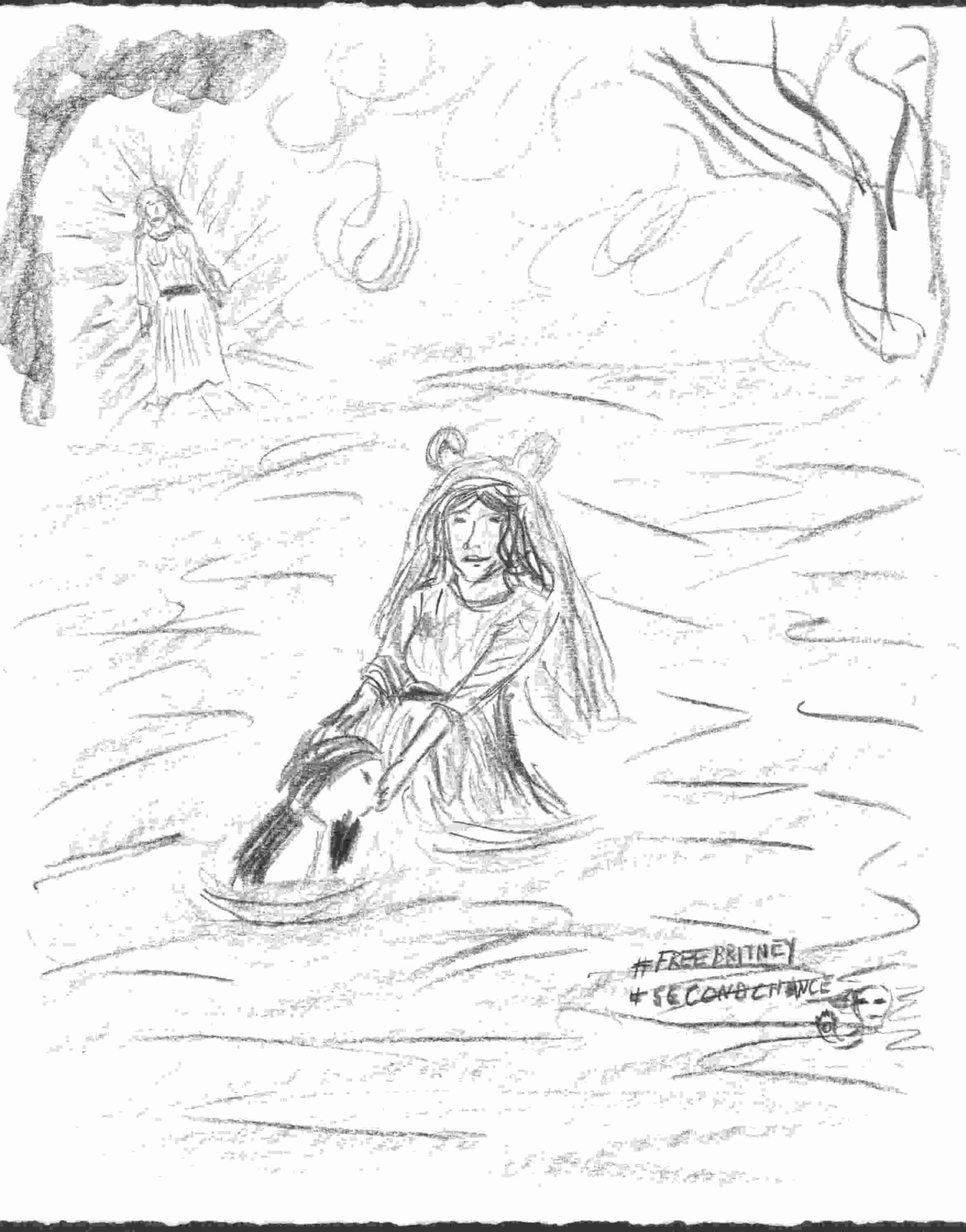
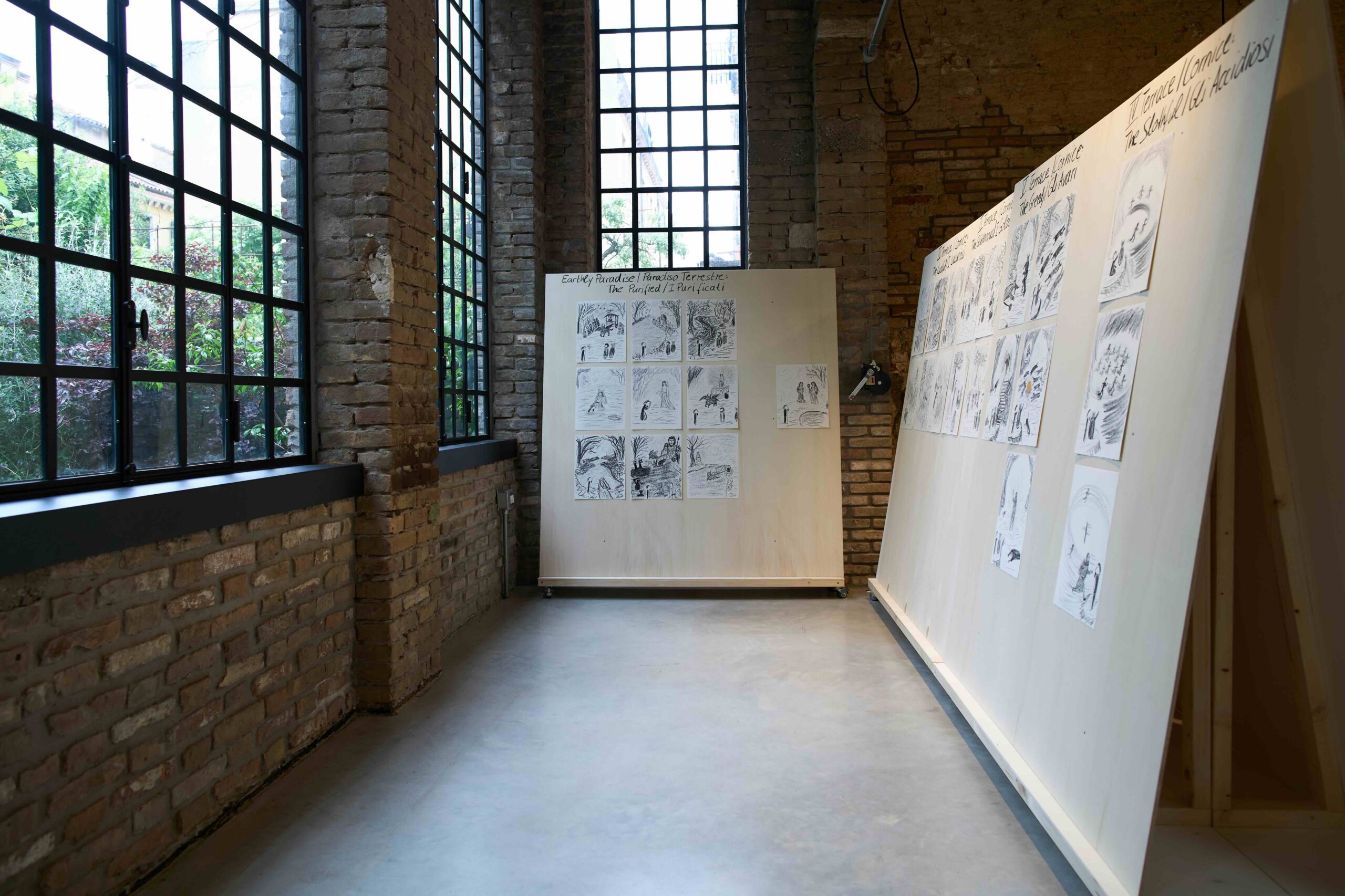
The exhibition constitutes a condensation of Castello’s multi-year engagement with Dante Alighieri’s Divine Comedy, explicitly described as a new body of work that extends his exploration of the fourteenth-century poem. Developed since 2022, the project comprises over 220 drawings that translate Dante’s epic into a contemporary visual taxonomy, many of which are highly personal and oriented toward current political and social issues. In the exhibition, it is accompanied by a 250x150x60 cm tall translucent rectangular cube with a crumpled up canvas painted with the figures of Virgil and Dante inside.
The project relocates figures such as Jeffrey Epstein and the burning White House into Dante’s architecture of sin and punishment, inserting present-day figures into a long art-historical canon that runs from Botticelli’s manuscript drawings to Bouguereau’s academic inferno and, more recently, Julian Schnabel’s film In the Hand of Dante.
Installed in May 2026 during the Venice Biennale in the Cannaregio neighborhood, the work is set within a context where international art, tourism, and institutional visibility intersect, raising the question of how embedded we have become in a new, more virulent version of Dante’s hell. The exhibition feels like an overdue bill, beckoning us to come to terms with the multivariate ways our modern world has become a living hell.

The Architecture of Judgment
This spatial arrangement organizes Dante’s three realms — Inferno, Purgatorio, and Paradiso — into a physically navigable sequence, aligning different zones of the venue with different segments of the Commedia. Within this architecture, Castello systematically assigns contemporary actors and events to Dante’s categories of sin, reclassifying them according to the poem’s taxonomy of fraud, violence, lust, and other vices rather than by their juridical or media labels.

Jeffrey Epstein is singled out in accounts of the project as one of the figures placed in Dantean hell, indicating that Castello explicitly engages with the recent convergence of sexual exploitation, financial structures, and elite networks surrounding Epstein’s case. Other figures appear less directly named but are implicated through recognizable attributes, settings, or institutional symbols: in one drawing, we encounter WikiLeaks, while in another, Mother Teresa. The project thus operates as a proto-classificatory system: a visual re-inscription of contemporary actors into a medieval but still operative matrix of crime and punishment. Like if Dante and Dostoyevsky had a baby — my kind of content.
Just as Dante uses recognizable figures, such as Florentine families, popes, and emperors to structure Inferno’s population, Castello uses the White House — seat of the U.S. executive — as a shorthand for state power and its potential moral collapse, imagining it engulfed in flames within a Dantean infernal landscape.
Within this system, specific motifs function as nodal appendages that condense political authority and crisis into rapidly legible icons. Just as Dante uses recognizable figures, such as Florentine families, popes, and emperors to structure Inferno’s population, Castello uses the White House — seat of the U.S. executive — as a shorthand for state power and its potential moral collapse, imagining it engulfed in flames within a Dantean infernal landscape. By re-anchoring these images in a system where each act or figure is assigned a definite place within a hierarchy of offenses, Castello reverses the flattening effect of media circulation.

Against Algorithmic Flattening
The artist’s method includes a technological component that directly addresses how contemporary image economies process sin and scandal. For La diabolica commedia: Prelude, he used generative AI tools to help devise scenographies for the interventions in Venice, generating initial proposals that gave him pause. When asking ChatGPT to consider how it could outline Dante, the algorithm misinterpreted many of the story’s original cantos. Castello’s response was to spend months correcting, overriding, and effectively “arguing with” these outputs, using Dante’s original corpus as the source material for more than 220 original drawings presented in the exhibition.

AI functioned as a diagnostic tool that exposed how contemporary machine vision tends to neutralize Dante’s specific moral architecture into interchangeable spectacle, whereas his own manual practice re-imposed precise distinctions between sins, circles, and historical referents that connect directly to today. Castello’s process highlights an important contrast between computational generalization and textual fidelity: where the AI collapses different types of wrongdoing into visually similar infernal clichés, the artist’s drawings distribute figures and motifs across a rigorously differentiated topography.

That tension also clarifies the “visual economy of sin” in a narrower sense. Generative AI models trained on vast image datasets mirror dominant conventions in depicting hell, punishment, and crime, often drawn from entertainment genres that prioritize spectacle over moral high ground. Castello’s act of correction — guided by a medieval text that carefully calibrates degrees and kinds of wrongdoing — can be read as an attempt to reassert that taxonomy against a flattening algorithmic regime. The resulting drawing corpus can thus be seen both as an adaptation of Dante and as a critique of how contemporary technical systems imagine sin, but also a critique of how AI systems flatten stories and turn them into slop in our modern world.
Castello’s process highlights an important contrast between computational generalization and textual fidelity: where the AI collapses different types of wrongdoing into visually similar infernal clichés, the artist’s drawings distribute figures and motifs across a rigorously differentiated topography.
La Commedia Across Visual Culture
Castello’s individualized placement of Epstein and other figures in Dantean settings has clear precedents in different art-historical Dante traditions as well. Botticelli’s late fifteenth‑century manuscript illustrations for the Divine Comedy — a set of 92 surviving full-page drawings — track Dante’s journey verse by verse, framing encounters with named sinners and demons. In these drawings, Dante and Virgil appear multiple times within a single sheet to indicate temporal progression, while the damned are identified by their attributes, gestures, or inscriptions, embedding individualized stories within a coherent spatial structure. Botticelli’s sheets combine the serial architecture of the poem with a focus on particular sinners’ narratives, calibrated to the expectations of a Medici patron and a manuscript readership, becoming, in effect, the way in which Medieval peasants visualized concepts like punishment, heaven, purgatory, and hell.

Meanwhile, William-Adolphe Bouguereau’s Dante and Virgil (1850) offers a nineteenth-century example of individualized sinners within a different regime of visibility: the French academic salon. In his interpretation, both Dante and Virgil can be seen looking over the Eighth Circle’s bolgia of falsifiers, as Gianni Schicchi sinks his teeth into Capocchio’s neck, surrounded by other tormented figures. Capocchio, an alchemist and friend of Dante, was visualized by the artist as punishment for falsifying gold, and Schicchi for fraudulent impersonation. Bouguereau depicts their sins through hyper-muscled bodies, a vampiric bite, and expressive faces in a shallow, stage-like space. Here, individualization serves the logic of academic exhibition: a small number of named figures embody an entire moral category, with the painting offering a single, theatrically charged glimpse into infernal justice that serves both social and political purposes.
All three artists operate within specific visibility regimes: the illuminated manuscript for an elite Florentine reader and the large canvas for a public salon jury and audience. Castello’s Venice project extends these logics into a contemporary regime dominated by mass media and digital circulation, where leaks and networked platforms operate as systems of modern hell.

Compare this to Julian Schnabel’s In the Hand of Dante, a film that has been torched by critics on account of its unauthentic take on Dante. His 2025 film, running 153 minutes, is based on Nick Tosches’s 2002 novel and follows a handwritten manuscript of the Divine Comedy discovered in a hidden Vatican cellar, which then makes its way to a mob boss in New York City before ending up with Tosches himself. The narrative alternates between the twenty-first century — where the manuscript passes through thieves, priests, killers, and a mafia don named Joe Black — and the fourteenth century, where Dante, in exile, searches for meaning through philosophy, love, and writing.
All three artists operate within specific visibility regimes: the illuminated manuscript for an elite Florentine reader and the large canvas for a public salon jury and audience. Castello’s Venice project extends these logics into a contemporary regime dominated by mass media and digital circulation, where leaks and networked platforms operate as systems of modern hell.
In Schnabel’s film, judgment is not spatialized into circles but distributed along the manuscript’s trajectory: each party that handles the document exposes its own relationship to greed, violence, faith, and artistic value. The New York mob, Vatican officials, and the writer figure all become implicated in different forms of sin — avarice, sacrilege, complicity — in their efforts to possess and authenticate Dante’s text. Schnabel thus treats the original manuscript as a kind of moral test that reveals the status of contemporary actors, much as Dante’s imagined afterlife reveals the true nature of his Florentine contemporaries. Yet as a cinematic adaptation, it lacks the efficacy of modern painting. I have never been a fan of directors taking books they have not written and putting them on screen, but I suppose if it worked for Scorcesi and Mario Puzo in The Godfather, it can work for Schnabel and Tosches too.

Dante’s Enduring Legacy
Taken together, La diabolica commedia: Prelude and In the Hand of Dante show how Dante’s categories of sin are being repurposed under contemporary media conditions where images and narratives of wrongdoing circulate rapidly and globally. Castello’s Venice corpus uses the taxonomy of Inferno and the broader tripartite structure of the Commedia to sort present-day actors and events into differentiated spaces of punishment and judgment. Schnabel’s film, by contrast, dramatizes the circulation of the Commedia itself as an object of desire within criminal and institutional networks, showing how sin and authorship intersect around the handling of a manuscript across seven centuries.
Against the backdrop of Botticelli’s manuscript illustrations and Bouguereau’s academic inferno, Castello’s and Schnabel’s works can be seen as current nodes in a long sequence of Dante adaptations, each shaped by specific visibility regimes and media infrastructures. Botticelli’s individualized sinners address a narrow elite audience through the codex; Bouguereau’s Capocchio and Gianni Schicchi address the academy and the public salon; Castello’s Epstein and burning White House address a global audience already familiar with these scandals through news and social media; Schnabel’s manuscript and mob don address viewers reached via festivals and streaming algorithms.
Against the backdrop of Botticelli’s manuscript illustrations and Bouguereau’s academic inferno, Castello’s and Schnabel’s works can be seen as current nodes in a long sequence of Dante adaptations, each shaped by specific visibility regimes and media infrastructures.
In each case, Dante’s moral architecture provides a schema for deciding what kind of wrongdoing is at stake, how it should be pictured, and where it should be placed — whether in a circle of hell, a cinematic plotline, or a Plexiglas cube in a labyrinth. All of these artists serve as an ever-present reminder that Dante remains today — as he has since the 14th century — a fountain of inspiration for artists in dialogue with morality and virtue, heaven and hell.