
Visiting the UFO Art Gallery in Kraków this summer at the turn of June and July was a chance to experience a dense, almost electrifying atmosphere permeating the exhibition space. Samuel Kłoda’s latest exhibition, Creak, Crash, and Crow, transformed the gallery into an affective battlefield, combining heavy impasto and garish colors of profound intensity. Navigating the elusive boundary between physical matter and the raw emotions (hidden beneath layers of color), the artist transforms the experience of perception, combining the tangible weight of paint with visceral, corporeal affect and the pervasive tension of inner turmoil.

Between Decay and Improvisation
Overlapping associations merge with spectral memories directly within the physical strata of paint. As the medium undergoes physical dissolution and decay, it is balanced by an agile, gestural brushwork that converts the canvas into an active archive of hidden histories. Rather than adopting detached irony, Kłoda assumes a post-ironic stance that freely converses with echoes from the collective cultural imagination. His work remains provocative yet radically candid in its depiction of a world on the brink. In this apocalyptic yet campy land, dark visions take shape through vibrant fields of color that clash with distorted forms, song-like motifs, and ominous birdlike figures that inhabit the pictorial field. Yet this bold, expressive approach conceals a profound delicacy; Kłoda’s universe willingly risks forfeiting its affective authenticity to a single miscalculated gesture.

Intuition and subtle restraint become the primary compass in this spiritual inquiry — one that reached its peak intensity during raw jazz improvisations in July 2026, when the UFO Art Gallery hosted the experimental stage of the 31st Krakow Jazz Festival, filling the space with resonant sound. The gallery offered the festival and the local audience a unique perspective on the artistic experience, enabling them to perceive the profound potential of dialogue between abstract, expressionist canvases and the local and international experimental jazz scene. This live intervention demonstrated a profound formal affinity between the gestural freedom of expressive oil on canvas and the raw, wailing textures of acoustic instrumentation and electronic sounds.

Beyond the Canvas
The central challenge driving Samuel Kłoda’s practice is maintaining the raw authenticity and lightness of direct sensory experience. At the same time, he continuously takes the risk of experimenting with intense, juxtaposed color palettes and fragmented, sometimes figurative elements that dictate the spatial relationships between bodies and matter. Navigating this terrain, the artist inevitably confronts the historical legacy of the Krakow Colorists (Capists), consciously deconstructing and intensely reducing their painterly tradition.

In his dense, expressive compositions, such as Happy Together (2026) and Severed Hand (2026), Kłoda does not hesitate to materialize fleeting affects as exploding biomorphic and deconstructed floral remnants, translating the raw friction of contemporary social anxieties and the density of emotional experiences directly into layered pigment. Through a deeply visceral, somatic engagement with the medium, which extends to micro-movements, the fragmented nature of our hyper-stimulated reality fractures into abstraction and dissolves into an evocative sensory landscape. Here, the traditional two-dimensional boundaries of the canvas are shattered, leaving behind rivulets like bodily fluids dramatically dripping down the wall in the wake of this process of becoming. The painterly surface actively defies its two-dimensional limitations through fleshy textures and thick layers of oil. These elements form into three-dimensional structural folds and sharp, thorny protrusions that aggressively emerge to pierce the viewer’s space.

Materializing Affect
Rather than limiting himself to an academic fascination with decorative harmony, Kłoda extracts a raw, pulsating fleshiness from the piling folds of pigment, forcing the paint to cease representing form and instead become corporeality itself, provoking a further escalation of tension and unease. This intensity of affect highlights a profound relational dynamic between the artwork and the observer, allowing new connections to emerge between potentially incompatible orders.
As philosopher Brian Massumi posits, a framework central to Michalina Sablik’s curatorial text, reality is shaped not only by linear, cause-and-effect logic or random events, but by an autonomous dimension of pre-linguistic intensity, tension, and sensory intuition that directly influences the behavior of material, visual perception, and the established order of things. In Kłoda’s work, this affective force becomes visible through striking color combinations, where deep social anxiety can paradoxically coexist with an intoxicating visual pleasure.

This tension and psychological friction extends far beyond the confines of the canvas, as Kłoda freely juxtaposes his raw compositions with sensual, everyday objects removed from their traditional context that carry a huge emotional and symbolic weight in our collective imagination — above all, the melting candles and wilting flowers present in the gallery space. Deliberately drawn from the traditionally stable, “bourgeois” reservoir of still life, these motifs undergo an accelerated process of decomposition. The objects literally implode under the weight of their own painterly excess, unable to withstand their own saturation, and reorganize themselves into entirely new visual arrangements that intensify a pervasive sense of domestic claustrophobia and existential anxiety.

A Polyphonic Space
This dialogue between intense pigment, critical reflection, and the immediate vibration of sound completely immersed the viewer in a total, multisensory environment of evocative intensity. The open, multilayered nature of this semantic intensity was further unpacked during the curatorial visits at the gallery led by Kamil Kuitkowski, Zofia Małysa-Janczy, and Agnieszka Sachar. Bringing their distinct critical perspectives into the physical gallery space, they uncovered fresh readings of Kłoda’s work. In particular, Małysa-Janczy filtered the decaying forms through the lens of Timothy Morton’s philosophy. By evoking Morton’s concept of dark ecology and the uncanny interconnectedness of our age of polycrises, she reframed the toxic color palettes not as mere personal anxieties, but as visceral symptoms of an overwhelming global dread. Coupled with the theoretical and curatorial insights of Kuitkowski and Sachar, these tours guided the audience through the murky psychological undercurrents hidden beneath the layers of impasto, successfully translating the raw material presence into a polyphonic, shared discourse.
Ultimately, broad social tensions and fleeting perceptual intuitions find their permanent physical form as captured data on Kłoda’s canvases, where the intensity of semantic references coalesces into a profound visceral experience bordering on pleasure. The key to understanding this work lies within the very overflow and rupture of content, unfolding across a physical and sensory landscape where heavy pigment and critical thought permanently capture the raw friction of our contemporary moment.
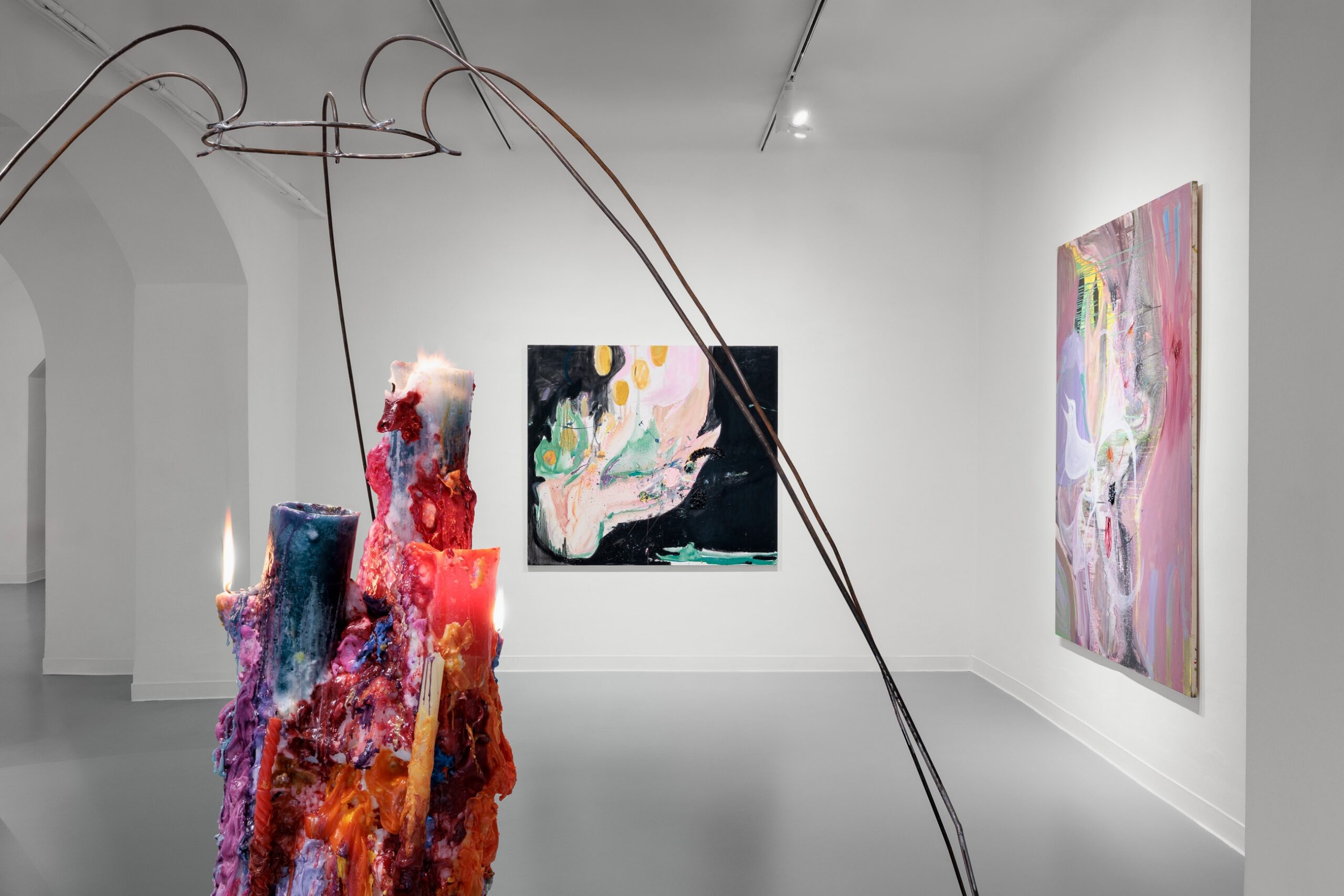
Creak, Crash and Crow. Samuel Kłoda
16 June – 2 August 2026
UFO Art Gallery, Kraków
curator: Michalina Sablik