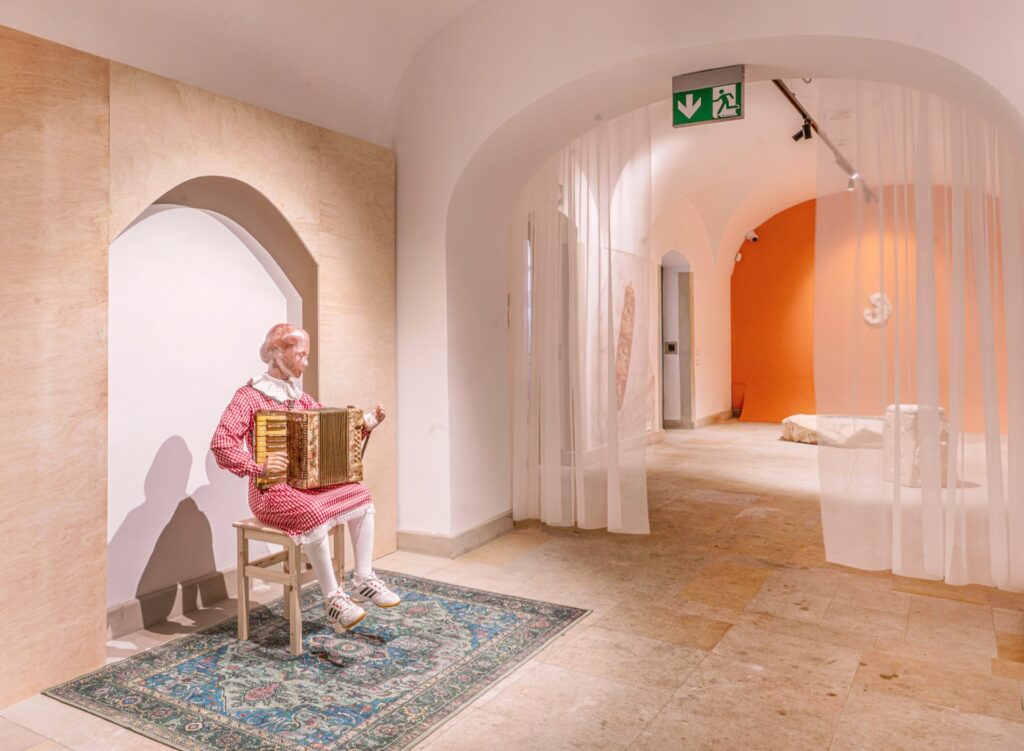
The Poster Museum in Wilanów, established in 1968, is the world’s first institution of its kind. After being closed for nearly five years for a major refurbishment, it has recently reopened. For many Varsovians and design enthusiasts, it felt like reuniting with an old friend who had returned considerably improved. For the first time in its history, the museum now has a permanent exhibition. Polish Poster. The Collection is the heart of the reopening, and it is, in the most literal sense, a history of Poland told through the images its people were shown on walls, bus stops, theatre foyers, and factory corridors.

The museum’s collection holds over 63,000 works: from the late 19th century to the present day, including those by international artists such as Pablo Picasso, Andy Warhol, Roy Lichtenstein, Milton Glaser, and Robert Indiana. But above all, it focuses on presenting Polish culture through a 130-year-old history of poster art. From Young Poland’s symbolism to some of the most influential images of the communist era, the exhibition at the Poster Museum presents the poster not simply as a functional object, but as a medium through which art, ideology, and everyday life continually intersect.
The First Museum of Its Kind and How It Came to Be
The establishment of a museum dedicated entirely to the poster was not, in 1968, an obvious proposition. The poster is, by nature, an ephemeral object, designed to be pasted on walls, exposed to the weather, and eventually torn down. Jan Lenica, one of the defining figures of the Polish Poster School, described the very concept of a poster museum as an exotic bird in a cage: the form belongs to the street, and institutionalising it risked severing it from the conditions that gave it meaning. That tension has never entirely disappeared, and it gives the museum’s existence a certain productive paradox.

The case for preservation had nonetheless been building for some time. The idea that the poster possessed genuine artistic value had been circulating in Polish cultural circles before the Second World War, and the collection began to form even before the museum existed. In 1948, Polish poster art achieved significant international recognition at the poster festival in Vienna. By the time the museum opened two decades later, the argument was well established.
The person most responsible for turning that argument into an institution was Janina Fiałkowska. Working as a curator in the Department of the Poster within the National Museum’s structure from the early 1960s, she fought for years to secure the museum’s establishment against considerable institutional resistance, driven by the conviction that the poster deserved the same respect accorded to painting or sculpture. The decisive moment came in 1966, two years before the museum opened, when Fiałkowska curated the first ever retrospective exhibition of Polish poster art – Od Młodej Polski do naszych dni (From Young Poland to Our Days). Showing 468 works, it was the proof-of-concept the project needed. The exhibition ran alongside the first International Poster Biennale at Zachęta, and together the two events established Warsaw as the centre of the international poster world. The museum, which opened on 4 June 1968, was largely the result of Fiałkowska’s determination.
Six Chapters, 130 Years
The current exhibition features over 240 works illustrating Polish history through 130 years of posters, arranged chronologically and divided into six sections, starting with the turn-of-the-century Young Poland artistic movement, followed by posters created in the interwar period, and those from the Second World War, including the 1944 wartime poster urging people to participate in the Warsaw Uprising. What runs through all of it — though the curators would be the first to say there is no single common thread among so many works — is the persistence of the poster as a form that transcends its functionality. There is no requirement that an informational poster be beautiful, yet Polish artists made it so again and again.
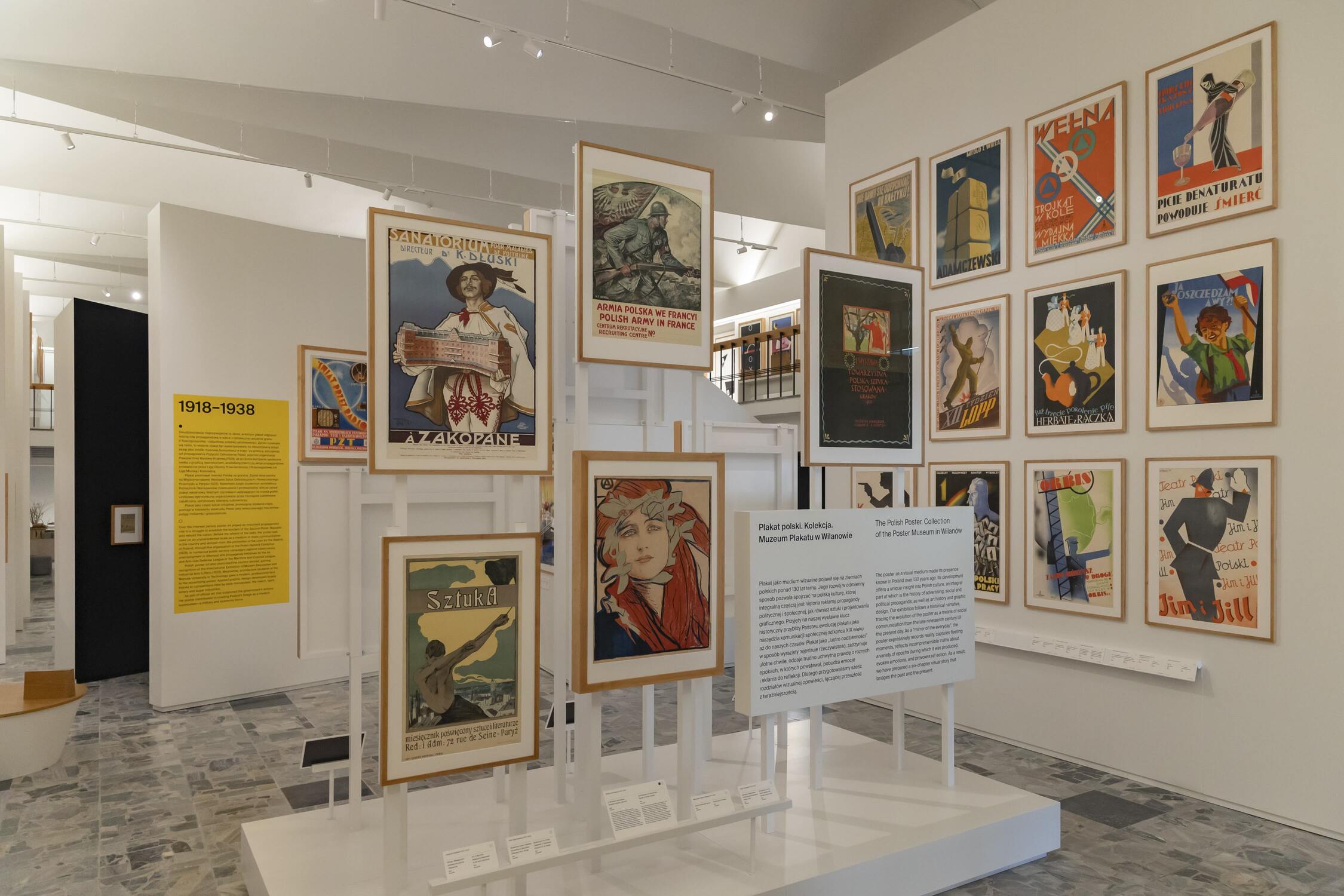
Take Stanisław Wyspiański and the only poster he ever made, and the earliest theatrical poster in the Museum’s collection. It is rooted in the Art Nouveau style and Symbolism from which Polish poster art would eventually develop its own distinct visual language. In the interwar decades, the language shifted towards something flatter, more graphic, more modern, and more fluent in the international visual grammar of the avant-garde.
The wartime chapter is clearly marked with contrasting black walls, black frames, and black passe-partouts. The curation also highlights the disparity between posters made in emigration, which developed differently from those produced inside occupied Poland, resulting in two visual languages evolving under the same pressure but in very different circumstances.

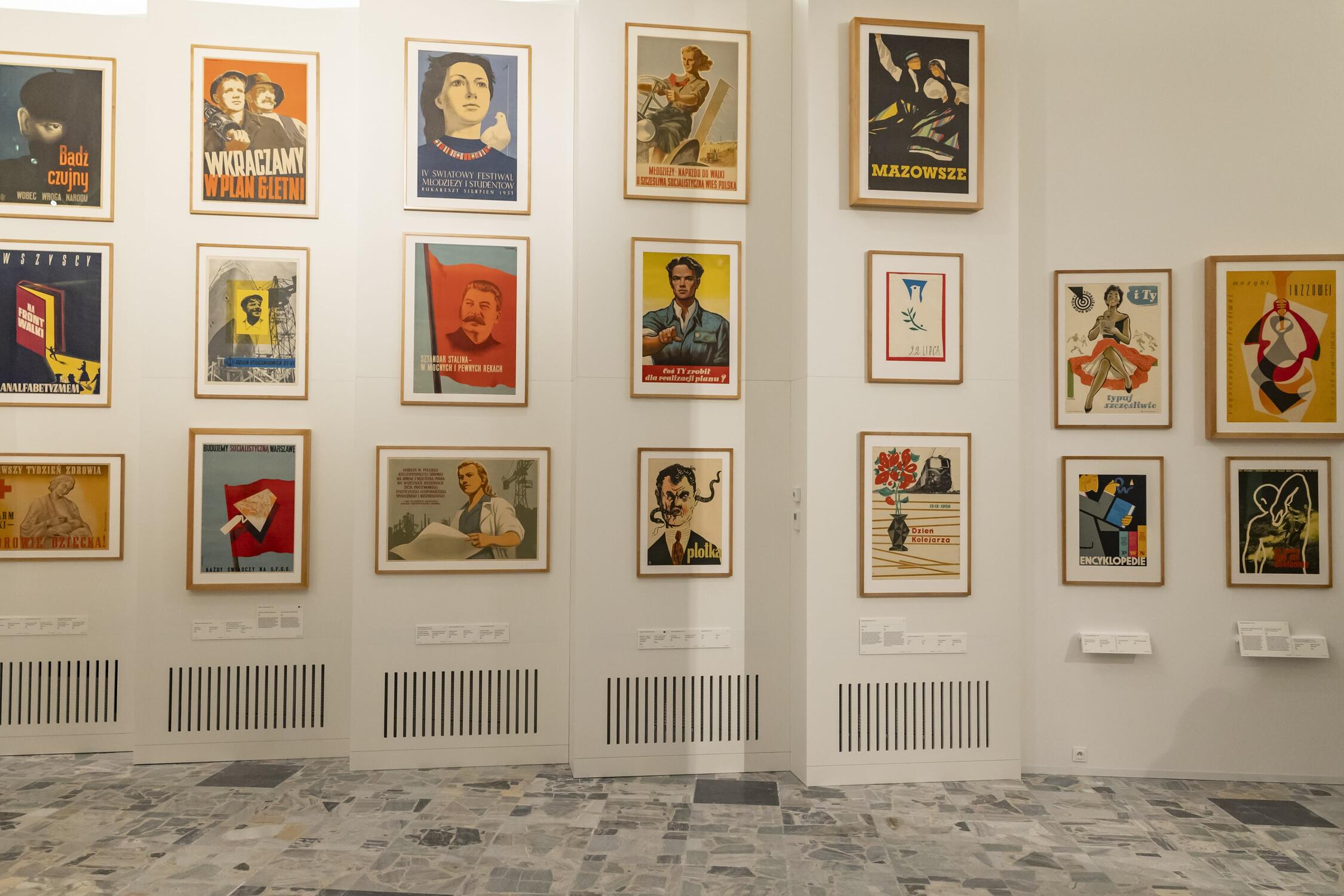
What follows is the postwar propaganda section, which is perhaps the most historically revealing part of the exhibition. These posters offer a direct impression of how the state addressed its citizens: workers, families, and society at large. Health and safety notices, political campaigns, production drives. They show not what was true but what was said, and in that gap lies a great deal of history.
Another chapter is dedicated to the Polish Poster School and is an undeniable centre piece of the whole exhibition. Rooted in the country’s painting tradition and shaped by the conditions of working under the communist system, the School produced works that went on to influence graphic design internationally. Politics seeped into cultural imagery, while artistic ambition seeped into propaganda. The visual language developed during this period of moving away from painterliness toward something more conceptual and individual continues to influence design today.
Walking through all six chapters, what becomes clear is that the Polish poster was never a neutral object. Co-curator Bożena Pysiewicz explained that the selection criteria included not only the artistic level of the poster but also the history behind each work, noting that poster art always reacted to politics, social change, and the conditions of its own making.

Women in the Exhibition
The exhibition has faced some criticism over the gender ratio of authors within the exhibition. The proportion of works by women relative to men is visibly unequal, and for some visitors, this has been a point of contention. However, the exhibition makes no attempt to impose a parity that the historical record would not support.
Women contributed to Polish poster art across all periods, and they are represented here accordingly, but their numbers in the earlier chapters are smaller because historically they were less numerous. To redistribute that balance artificially would be to subordinate historical accuracy to contemporary expectations, which the curators have deliberately avoided. Moreover, many women artists of those periods worked collaboratively, alongside husbands or other graphic designers, in ways that have made individual attribution difficult and may have historically worked against their recognition.
Several individual works are worth singling out. One of the oldest pieces in the exhibition is a poster by Anna Gramatyka Ostrowska from 1900, made for an exhibition of works by students of the School of Fine Arts for Women. There are two works by Zofia Stryjeńska, one of them a 1925 design awarded the Grand Prix at the International Exhibition of Decorative Arts in Paris. Among newer pieces, it’s worth mentioning works by Maja Wolna, who in 2010 became the first woman to receive the gold medal at the International Poster Biennale in Warsaw, as well as the now-iconic 2016 poster by Ola Jesionowska, which became emblematic of the Polish Women’s Strike.

The Exhibition as Experience
The curators and exhibition designers have made deliberate choices about how visitors encounter these works. Monumental wall installations split the space to form a maze and recall the spirit of early poster exhibitions of the 1960s and 70s. Some of the posters are housed in vertical drawers set into the exhibition space, which visitors are not only permitted to pull open but actively encouraged to do so. It is a small gesture, but with a large effect, as the barrier between viewer and object dissolves, the passivity of museum-going gives way to something more like discovery.
It is also worth noting that every visit to the Museum can be a unique experience. Due to the effects of daylight and humidity, the posters can be displayed only for three months before being rotated with others in the collection. This is a limitation of the medium — posters as paper-based works are fragile by nature, but if properly cared for, they can last for years. This gives curators an opportunity to present the story through different examples within the rich history of poster art.

The Poster Museum’s reopening is a timely reminder that the poster — dismissed by some as a minor form, celebrated by others as the most democratic art of the twentieth century — is a substantial and enduring contribution to art and visual language. That the institution now has a permanent exhibition, after nearly sixty years of existence, is, on one hand, an overdue recognition; on the other, a seemingly genuine statement of intent. And that the collection continues to grow — through acquisitions and artists’ donations — suggests that the poster’s relationship with the museum, however paradoxical Jan Lenica once found it, has become something close to natural.