Throughout the history of painting, the nude has functioned as both an artistic ideal and a site of projection. From Renaissance allegories to modernist experimentation, the body has rarely been a neutral subject. Tawatchai Somkong’s solo exhibition MISS, presented at MATDOT Art Center Bangkok during Pride Month, revisited this tradition by placing trans women at its centre — not as a spectacle, but as ordinary subjects whose presence commands the same dignity and painterly attention long afforded to the canonical female nude.
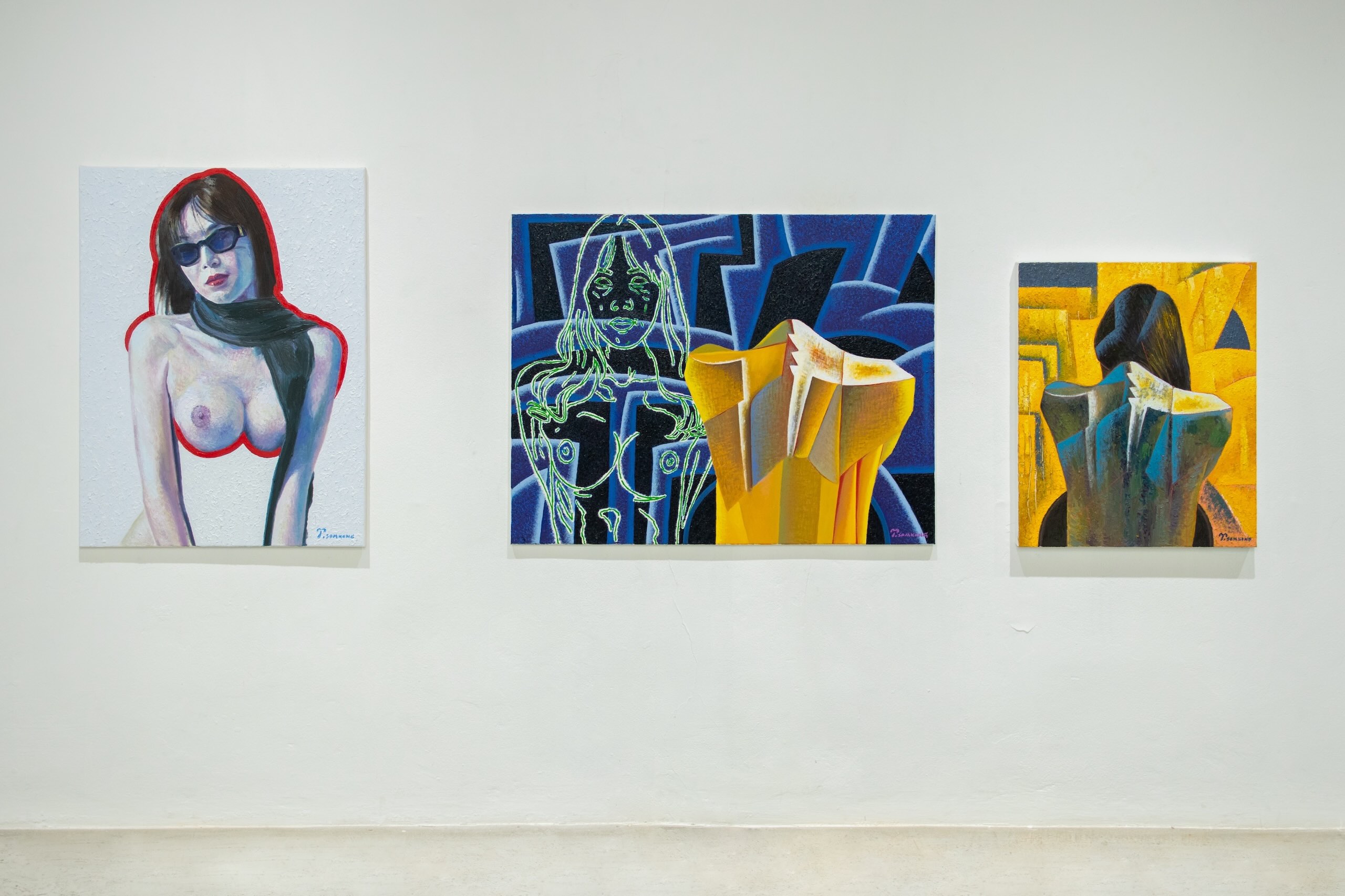
The exhibition brings together a new body of paintings executed in Somkong’s distinctive language of thick impasto and saturated colour. His portraits challenge normative representations of the body while reflecting on the lived realities of transgender women in contemporary Thailand. Hung below eye level, the works require visitors to lower their gaze in order to view them, transforming spectatorship into an embodied gesture of respect. Rather than positioning viewers as detached observers, Somkong implicates them in an ethics of looking grounded in recognition instead of consumption.

MISS is also the legal honorific that many of the women portrayed in Somkong’s show wish to claim after transitioning — a seemingly everyday word that is nevertheless loaded for the bureaucratic, legal and medical debates it sparks. Despite making great strides towards the acceptance of gender diversity — most notably with the official passing of the Marriage Equality Act in 2024 — trans women continue to face social stigma, with rights, protections and acceptance disproportionate to the wider population. They continue to miss out on healthcare and legal recognition, while debates over bodily autonomy and gender identity remain politically charged. Trans-exclusionary rhetoric increasingly occupies online and political discourse, seeking to regulate and define the bodies and identities of non-cisheteronormative people, turning personal matters into subjects of public scrutiny.
MISS is also the legal honorific that many of the women portrayed in Somkong’s show wish to claim after transitioning — a seemingly everyday word that is nevertheless loaded for the bureaucratic, legal and medical debates it sparks.
Against this background, MISS demonstrates how painting can become a space for more viable forms of representation, with Somkong drawing attention to what has historically been missing from the historical canon — the faces, bodies and stories of a group long underrepresented in mainstream society and culture.

Filling in the Gaps
Entering MATDOT’s sweeping white cube space, one is confronted with nude portraits of women rendered in styles drawing from different epochs of art history. Jagged shoulder blades and peaks of a spinal column protrude from a golden back, nodding to Tamara de Lempicka’s geometric assemblages of women. Meanwhile, Pauline Boty’s The Only Blonde In The World is catapulted into twenty-first-century Bangkok in the technicolour ripples framing MISS No.15 (2026) and MISS No. 21 (2026). The simple, dimensionally flat cobalt and sandy shades and mask-like faces in MISS No 6 (2026) and MISS No 4 (2026), on the other hand, recall Matisse’s linear, bold Blue Nudes (1952 and 1954) and Alex Katz’s slick figures.

Yet the works presented at the exhibition are more than simple replicas of the Western twentieth century’s canon of figurative painting. Drawing on this visual vocabulary, Somkong reworks familiar modes of representation to rethink the conventions of the nude itself. His paintings don’t reproduce previous depictions of femininity or beauty, but create a space in which trans women can occupy the genre on their own terms.
Yet the works presented at the exhibition are more than simple replicas of the Western twentieth century’s canon of figurative painting. Drawing on this visual vocabulary, Somkong reworks familiar modes of representation to rethink the conventions of the nude itself.

The Power of the Strikingly Ordinary
Portrayed in languid or reclining poses, with shawl-draped shoulders, or gazes averted behind thick-rimmed cat-eye glasses, the women in Somkong’s portraits are devoid of any sensationalism. Instead, the artist aligns himself with contemporaries in his field of figurative painting, such as the British painter Lynette Yiadom-Boakye of Ghanaian heritage, who paints fictitious subjects drawn from secondary sources in remarkably ordinary scenarios — sitting back in an armchair or playing at the beach.

Sitting upright with one leg crossed in a chair, the figure in MISS No. 23 (2026) nips with her forefingers at the lapel of a bellowing jacket. MISS No. 24 (2026) stands upright while tugging at the seams of a scarf in a pose that appears confident and composed. The models in these works resist any sort of fetishistic reading, so prevalent in capitalist visual culture, and perpetuated by what Paul B. Preciado describes as a ‘megaletch’ — a hyper-consuming subject, driven by commodified desire, turning other people’s bodies into objects for consumption.
Contrary to mainstream media discourse that continues to pathologise non-cisheteronormative bodies — from recurring moral panic around transwomen’s access to female changing rooms, to the historical singling out of Herculine Barbin’s intersex identity as a medical anomaly and fashioning of a bizarre case-study — the women in Somkong’s paintings occupy space with a cool and poised calmness.

The Art of Equilibrium
Somkong’s simple aesthetic language is, in fact, the best tool for challenging the heteronormative gaze. The quietness of his portraits is not passive — they actively resist a visual economy built on consumption and spectacle. Rather than reinforcing the hegemonic gaze of this subject, the women in Somkong’s works lie back, with their chests rising and arms dropped to the sides, wrapped in the artist’s signature thickly applied paint, to destabilise the heteronormative way of looking into another way of seeing.
Somkong’s simple aesthetic language is, in fact, the best tool for challenging the heteronormative gaze. The quietness of his portraits is not passive — they actively resist a visual economy built on consumption and spectacle.
‘I have friends and siblings in the LGBTQ+ community, and I never thought they were different in any way,’ professes Somkong in an interview with ArtsWork. This conscious effort to maintain social equilibrium extends beyond the canvas to the installation decisions throughout the exhibition. The artist deliberately chose to install the artworks below eye level, requiring viewers to bow their heads to view them, as a gesture of respect for this newly recognised form of identity within legal and institutional frameworks.

Beyond Form
From Egon Schiele’s sketches of skewed androgynous, slinky lovers or his masturbatory self-portraits, to outsider Italian Carol Rama’s psychosexual watercolour studies of disabled, contorted bodies spewing crowns of marigolds, while fixed in wheelchair frames, queer and women artists have long challenged ideals and stereotypes of the body through their muddying interpretations of the nude. Although not himself queer, Somkong’s paintings, rimmed in kaleidoscopic waves and fluorescent, twisting, sinewy lashes, tap into a wider non-normative aesthetic that transcends clear-cut dualisms and forms. In his 2006 retrospective exhibition, psychedelic, divine, cosmic compositions such as Phawana (2006) recall Judy Chicago’s esoteric Revelations (2024) project, pushing the limits of form and representation. MISS is therefore not only a show about acceptance but ‘a profound exploration of belief, existence, and the human condition through evolving symbolic language,’ as stated on Somkong’s website.

Returning to the aesthetic plurality of the exhibition, Somkong’s portraits resist normative interpretation. Just as Joan Semmel’s supple jigsaws of limbs and torsos, succumbed to the power of foreshortening, problematise the value of women’s naked bodies beyond the erotic, or Jonathan Lyndon-Chase’s metallic, thick-splayed compositions of Black gay male desire, unapologetically carnal with details of leaking orifices, challenge societal ideals of the Black queer body, MISS invites viewers to challenge their assumptions of the nude beyond the heteronormative gaze.