






[polska wersja językowa poniżej]
In his book Andare per parchi artistici, Paolo D’Angelo provides an overview of historical and contemporary parks across Italy recognised for their artistic value, among which are, eg, the 16th-century sacred grove of Bomarzo, renowned for its grotesque monsters carved in rocks, the Chianti Sculpture Park established in 2004 to host sculptures and installations by artists from all over the world, as well as the Garden of Daniel Spoerri located near Seggiano, and the Tarot Garden conceived by Niki de Saint Phalle nearby Capalbio in southern Tuscany. D’Angelo points to an emergence of a new kind of sensibility towards the environment and nature achieved through the experience of art in such places. In this context, he particularly emphasises the role of Land Art, which, exiting the institutional confines, reformulated the spatial paradigms for the presentation of art.

Yet, when we think about gardens as artist spaces, we realise that it is rarely the case that the natural environment provides a mere alternative to a gallery wall. In fact, their activities remain close to the fundamental objectives of a museum, as they are intended to preserve certain tangible and intangible heritage. Both gardens created by Daniel Spoerri (1930-2024) and Niki de Saint Phalle (1930-2002) can be perceived in terms of consciously programmed artistic legacies, not only consisting of a physical collection of artworks, but also providing a testimony of their initiators’ active participation in an intellectual and creative life within particular artistic milieus.
The process of musealisation that occurs there, apart from the typical freezing of the past in time and space, can also stimulate critical reflection that impacts the present reality by remaining in a conscious and regularly updated dialogue with it. In this way, a garden interpreted as a living museum constitutes a space of exploration leading to (self)knowledge – a phenomenon born already in the times of Wunder and Kunstkammer – private cabinets of curiosities serving as three-dimensional encyclopaedias of the world.
“An archive that can be entered, experienced and shared with the purpose of awakening curiosity, and continuing to stimulate an intellectual and emotional exchange.”
The concept of a garden presupposes a co-existence of human and non-human entities within a natural environment. It also entails a specific dichotomy: on the one hand, nature is its superior ordering force associated with the cycle of life and death; on the other hand, it cannot function without human intervention and maintenance. Hence, a garden created with an artistic intention goes beyond a mere physical territory (although a map still remains a useful tool for orientation within its topography). An embodiment of a subjective vision, a speculative parallel reality that represents the artist’s own microcosm composed of organic and inorganic elements, it also becomes a mindful archive of human relations and collective work. An archive that can be entered, experienced and shared with the purpose of awakening curiosity, and continuing to stimulate an intellectual and emotional exchange.

Giardino di Daniel Spoerri – Hic Terminus Haeret
Having crossed the picturesque Val d’Orcia, but still staying at the foot of the Tuscan extinct volcano, Monte Amiata, whose shape reminded the Italian art historian Cesare Brandi of an Etruscan tomb, we arrive at a gate which says: Hic Terminus Haeret. This Latin phrase uttered by Dido in the Aeneid still remains ambiguous. The Foundation by the same name, established by Daniel Spoerri and Katharina Duwen in 1997, provides the following translation: “the end sticks here”, which can be interpreted as an indication of a spot where all boundaries meet. In his book The Rites of Passage (1909), Arnold van Gennep perceived such ritualistic delineation of borders as an act of marking a sacred territory charged with magical and religious powers that can potentially reduce existential anxiety. Here, already at the entrance, the sacred meets the profane, and our initiation begins.
A total of 115 works have been added to the garden since its founding at the beginning of the 1990s, selected by Spoerri from his own artistic production, as well as contributed by over 50 artists invited by him, occupying their carefully chosen positions across a territory spread over about 16 hectares. Hills, meadows and groves are additionally shaped by the light of the sun gently rising from behind Monte Amiata and operating until a breathtaking sunset. All of the pieces in the garden share a distinctive common denominator – they are based on exchange, friendship and collaboration.

They co-exist in a vivid, yet unforced dialogue, thus responding to the major idea of “collective singularity” declared by the signatories of the New Realism manifesto formulated by Pierre Restany in 1960, among whom were Spoerri, Jean Tinguely, Yves Klein, Arman, Martial Raysse, Francois Dufrêne, Jacques de la Villeglé, Raimond Hains, who were later joined by Niki de Saint Phalle, César, Mimmo Rotella, and Gérard Deschamps. Their communication stemmed from a strongly articulated sociological awareness of art; their goal was the poetic recycling of reality. As Restany wrote: “If man succeeds in reintegrating himself into the real, he identifies the real with his own transcendence, which is emotion, sentiment, and finally, poetry”.
The visit to the Spoerri Garden, which, in my case, was prolonged to a three-day sojourn in one of the five beautiful guest apartments for rent in the villa formerly inhabited by the artist himself, is permeated by a sense of freedom and tranquillity. However, the meaning of many of the sculptures is far from light-hearted. Each work can be identified by a number assigned according to its chronological appearance in the garden. This order does not, however, suggest any particular topographic route. In her book L’Odissea del Giardino (2009), Silvia Abbruzzese offered eight speculative itineraries, which she called the odyssey of the garden, inspired by the motifs from ancient literature and mythology, that refer to the cycle of life, death, and rebirth. Still, there seem to be as many scenarios of the visit as the visitors, since Spoerri’s vision offers no rigid planned route, but favours instinctive discovery of this non-hierarchical coexistence of the artworks that form a diversified, yet harmonious unity.

The project started with Spoerri’s piece Unicorns – Navel of the World (1991). To see it, one needs to climb to the top of a hill historically associated with the beginning of the local settlement. The titular “navel” suggests a symbolic centre, a focal point from which creative energies are further discharged. Nine “unicorns” – hybrids composed of a cast horse skull and a long (narwhal) horn have been arranged within a stone circle. A heavy glove is attached to each of the horns. This gesture could suggest either taking control or forming some kind of symbolic alliance.
“One can describe any object, but one can also describe the story of this object”, believing that the storytelling aspect behind the artwork is much more precious than its actual value.”
Gradually, more and more of Spoerri’s works were inserted in the garden, including his renowned tableaux-pièges – snare-pictures, composed of objects found on flea markets or remains of food attached to a base (be it a box, a table top, a drawer) and hung vertically on the wall. This staging of encounters of discarded objects in a caring gesture of empathy, which enables their preservation by endowing them with hypothetical stories, keeps them “alive” and useful. As Spoerri would say, “One can describe any object, but one can also describe the story of this object”, believing that the storytelling aspect behind the artwork is much more precious than its actual value.
Tableaux-pièges gradually evolved into a more performative movement that Spoerri called Eat Art, a series of actions and initiatives that pointed to the destructive and regenerative aspects of eating, but also its convivial value. Hence, the recurring motif of a table, also present within the garden, has always been of special significance to Spoerri. He continuously explored the dynamics of exchange in the project Take me, I’m yours (2017). It assumed an active involvement of the audience in relation to artworks, which could be taken away free of charge or traded. Whereas the principle of Musée Sentimental implemented in his diverse productions, realised also with his students, concerned the notion of memory that applies both to objects and their broadly understood context.

In fact, numerous works in the garden trigger recollections of some sort of encounters. In this way, the physical map which orients us in space also becomes a sentimental inventory of creative collaborations and contaminations. Enough to mention Othello and Desdemona (1990-91) – an installation of spectral theatrical figures set in motion by Eva Aeppli and Jean Tinguely (Spoerri would call himself a younger brother of the latter due to their strong spiritual and artistic connection). A few meters away, a pile of originally felt slippers cast in bronze entitled No entry without slippers – homage to Joseph Beuys (1986) points to an impact exerted on Spoerri by one of the most important artists of the 20th century. And just a few steps away, we find a seated figure of The Eccentric Reader (1997) carved in marble by Spoerri based on a drawing made by Roland Topor as a symbolic monument to their friendship.
Undoubtedly, the most recognisable of installations in the garden is Spoerri’s Labyrinthine Wall Path (1996/1998). This monumental land art construction was inspired by a pre-Columbian Neolithic drawing symbolic of the cosmic union of the feminine and the masculine. A few years later, just in front of it, Esther Seidel installed a platform for a Visitor cast in bronze. This onlooker seems to be positioned towards Spoerri’s labyrinth or perhaps the nearby rusty tower by Arman entitled Monument to Settledness (1999-2000), composed of outdated and used agricultural machinery. Yet, his gaze is petrified in a timeless rumination, and his perception remains internalised.

On the other side of the garden, we find a big-tiny monument to a collaboration with Nam June Paik (with whom Spoerri shared a passion for collecting objects from flea markets). In his conversation with Hans Ulrich Obrist, Spoerri tells the anecdote that explains the title of this work. Contacted by Spoerri through his gallerist, Shigeko Kubota, and asked for his contribution to the garden, Paik answered: “Tell him to make something as big as the Eiffel Tower”. In response, Spoerri acquired from Paris a small silver pendant depicting the tower and had it put on the pedestal located in the middle of a meadow, which he signed Something as big as the Eiffel Tower.
The aspect of disappearing and reappearing remains close to the mechanisms of memory and the cyclic renewal of nature. Many pieces in the garden are inspired by the symbolism of water – both its enlivening and preserving, as well as its destructive force. Among them are Spoerri’s Meatgrinder Fountain (1962/1991), Adam and Eve (2002), and Acqua Golem (2014), as well as Meret Oppenheim’s Hermes Fountain (1966/1999), Pavel Schmidt’s acqua majm wasser l’eau water voda nero agua (2003), and a humorous Pisser (1977/2000) by Alfonso Hüppi retrieved from obscurity by Spoerri.

The concept of presence and absence captured in an archaeological dimension, in the shape of piled refuse items cast in bronze as a petrified testimony of human existence on Earth, was taken up by Katharina Duwen in her Refuse from the Bronze Age (1997). A metaphoric interplay between objects created by man and the processes of nature taking control over them has been depicted in The Dragon (1998) by Paul Wiedmer, or in Spoerri’s Grass Sofas (1985/1993) and The Tomb of a Poet (1997). Urn Garden – L’abstrait absent. Hommage à Raymond Hains (2006) shows Spoerri’s exploration of the idea of evanescence and rebirth through both personal memory (in this case, of a dear friend) and the life-producing power of nature.

Similar in meaning is Dieter Roth’s Fax Bell (ca. 1970/1998) – a once lively office where ideas and projects were born, now overgrown with wild trees and branches, among which an occasional ringing of a fax machine can still be heard – a useful communication tool in the past, now just a reminiscence of its gone user. Spoerri would often express the idea of vanitas by resorting to the classical motif of a skull, which, in the case of his Skull Chapel (1997), also touches upon the fundamental question concerning the quintessence of humanity. The skulls on the Gorilla Bridge (2008) assume a role of peculiar guardians of a passage over a creek leading towards a grove where, among other works, Spoerri placed Idol (1990) – a replica of a South Pacific fetish adorned with everyday objects of no significance, which eventually became his own tombstone.
Spoerri managed to create a vision based on ephemeral concepts, yet inserted in a lasting natural landscape with an intention of permanence.
Spoerri’s obituary on the Garden’s website is accompanied by a photo of him seen from the back, walking away through Damocles’ Rose Bower Walk (2002/2008) – an installation in the centre of a field composed of a pergola of sickles gradually overgrown by roses and jasmine. This beautiful metaphor of the artist’s last passage is a hopeful one. Asked by Obrist whether there was something he was looking for, Spoerri answered: “Yes, it is the curiosity. Curiosity to know about life, about the sense of life, and the ‘Why’. And about the incredibly varied concepts of time. A mayfly lives just as long as we do, and we live just as long as an elephant. And humanity actually only lives for a million years, which is nothing compared to biomass”.

Thus, Spoerri managed to create a vision based on ephemeral concepts, yet inserted in a lasting natural landscape with an intention of permanence. Its personal and subjective aspect was crucial, hence, according to the artist’s wish, his collection is not to be expanded anymore after his death to maintain its coherence with which it was endowed by this “architect of ideas”, as he would sometimes call himself.
Tarot Garden by Niki de Saint Phalle – a refuge of peace and joy
Heading south towards the Tyrrhenian coast, we arrive at the Tarot Garden, whose monumental architectural sculptures, situated on a hilly olive grove, can be seen already from the Garavicchio road. Open to the public in 1998, this artistic idée fixe took about twenty years to be fully accomplished. The fruit of a versatile and multi-skilled collaboration, it was inspired by Niki de Saint Phalle – the architect, the sculptor and the mother of “this metaphysical and magical garden”, to quote her own words, incised on one of its paths in 1995 in a thanksgiving gesture towards the “family” of numerous co-constructors of her dream.
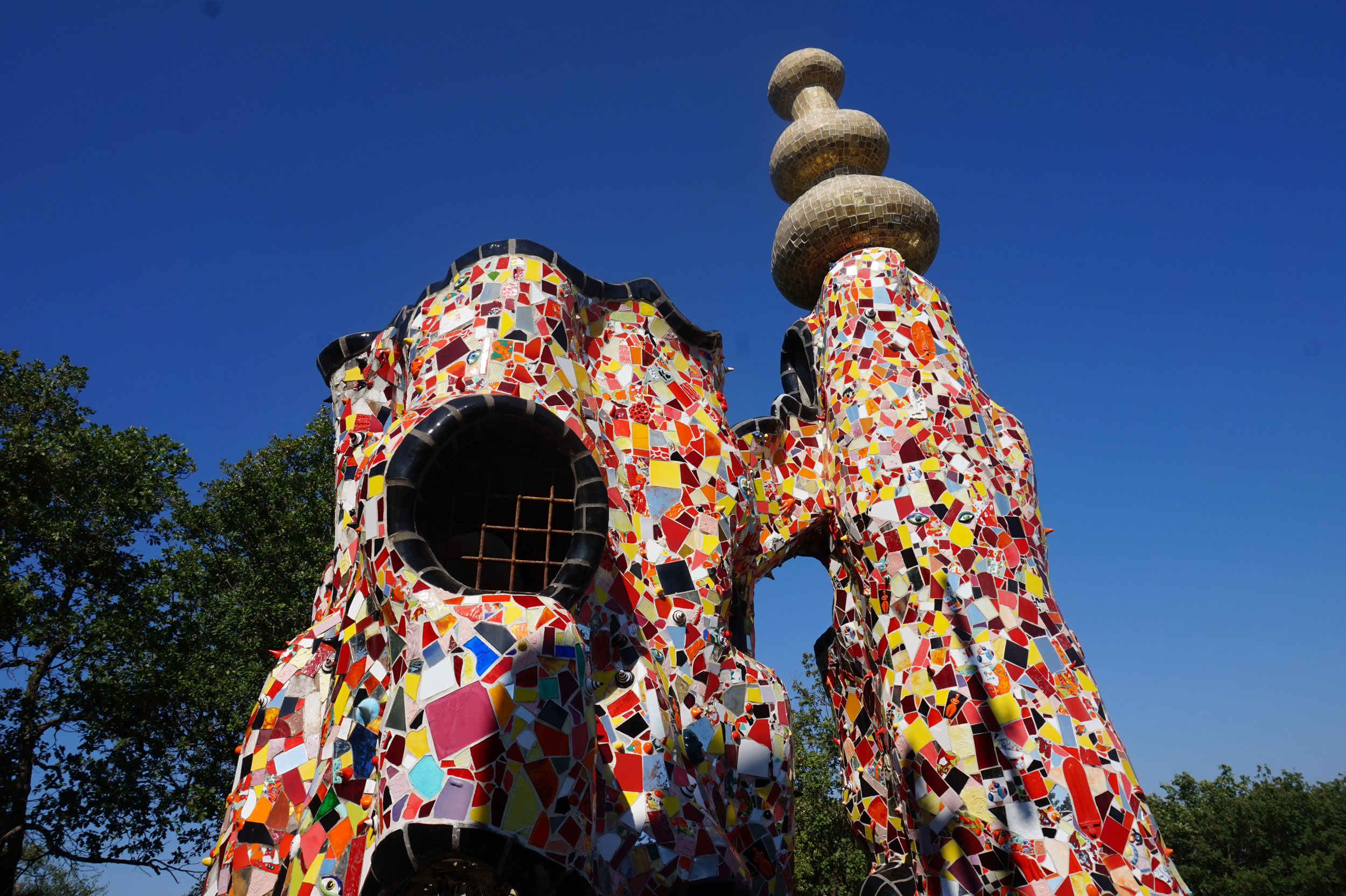
The location of the Tarot Garden resulted from a lucky coincidence, as the land was offered to de Saint Phalle by her friend Marella Caracciolo Agnelli, captivated by the vision shared with her by the artist. Altogether 24 sculptures, out of which 22 represent major arcana of the tarot pack, were located on a sloped terrain of the park. The most monumental ones were built using iron and concrete constructions covered with handcrafted ceramics and mosaics. A comprehensive chronology on the website of the Garden, illustrated with archival photos and quotes from de Saint Phalle, with a detailed list of people involved in the project, provides a vast overview of this collective creative labour from the moment of its conception (i.e. the artist’s discovery of Antonio Gaudí’s Parc Güell in Barcelona in 1955), through extensive research (including the artist’s visits to the Palais idéal by Ferdinand Cheval in Hauterives, France, and the Watts Towers by Simon Rodia in California), resulting in the construction works which started in 1979, until its completion in 1990s.
The artist intended to create a garden of joy, a place of refuge and peace. She was unstoppable in achieving her goal, despite various health and financial problems that appeared along the way (at some point, she even started creating her own perfumes to support the investment). Tarot, with its esoteric implications, became a source of positive energy and (self)knowledge. By 1980, the first architectural sculpture was accomplished – the central High Priestess, symbolising female creativity and strength. Within the following two years, the Empress was built – a sphinx-like figure inside of which de Saint Phalle organised a fully equipped apartment for herself, whose walls and ceilings were almost entirely covered with a mosaic of mirrors.


An interactive map on the institution’s website provides interpretative descriptions of each artwork handwritten by the artist herself. She described this particular piece as follows: The Empress is The Great GODDESS. She is the Queen of the sky. Mother. WHORE. EMOTION. Sacred Magic and Civilization. The Empress, which I made in the form of a Sphinx. I lived for years inside this protective Mother. This gesture of withdrawal into a self-constructed womb of a potent mother-figure seems to be of almost exorcising significance.

Despite the artist’s declarations of ease and glee, one does feel a somewhat disquieting aura underlying some of the works. In the pool in front of the Priestess stands the Wheel of Fortune – a moving machine violently sprinkling water, constructed by Jean Tinguely, the artist’s second husband, who actively supported her in the creation of the garden. He also welded an iron sculpture for the Tower of Babel, symbolising the wrath of God. His other piece, called Injustice, composed of skeletons and skulls entangled into a composition of rusty wires, wheels, crosses and gears, was »imprisoned« inside de Saint Phalle’s figure of Justice, representing self-knowledge and the capability to judge oneself. She decided to illustrate The Choice (or The Lovers) with the figures of Adam and Eve – a colourful couple during a merry picnic, yet accompanied by disturbing symbols – a snake lurking behind their backs, and a little skull inside a halved apple. This card, writes de Saint Phalle, “implies there is a wrong and right choice. A mistake can bring one closer to the truth of ourselves”.
Nearby, the walls that house The Hangman, a card associated with compassion, have been covered with a set of ceramic tiles depicting a love story. This beautiful visual diary, seemingly filled with harmonious joy, is accompanied by written comments – many of them in the form of questions that may imply insecurity and anxiety. Yet, exactly these slightly unsettling undertones that entered the supposedly untouched serenity of this Garden of Eden like deceitful snakes, make the experience so honest and truthful.

The text written by Niki de Saint Phalle and quoted at the entrance to the garden constitutes her ideological testament. She put a lot of emphasis on the fragility of her works and the need for their constant maintenance, executed with care and attention. With acute awareness of the fast-spreading processes of commercialisation affecting the places of artistic and cultural value that become “enslaved to profit and speculation”, she expressed deep concern about the future of her Tarot Garden. Never would she wish it to be desecrated by visitors, “steered around it like a herd of sheep”. It should remain true to its original intention of being a spiritual sanctuary for slow absorption and meditation of its art, a healing experience of the metaphysical power of beauty.
Yet, exactly these slightly unsettling undertones that entered the supposedly untouched serenity of this Garden of Eden like deceitful snakes, make the experience so honest and truthful.
Tam, gdzie spotykają się energie.
Ogrody Daniela Spoerriego i Tarota Niki de Saint Phalle.
W swojej książce Andare per parchi artistici Paolo D’Angelo przedstawia przegląd historycznych i współczesnych parków we Włoszech wyróżnionych za swoje walory artystyczne, wśród których znajdują się między innymi szesnastowieczny święty gaj Bomarzo, znany z groteskowych potworów wyrzeźbionych w skałach, Park Rzeźb w Chianti, stworzony w 2004 roku, aby pomieścić rzeźby i instalacje artystów z całego świata, a także Ogród Daniela Spoerriego położony w pobliżu Seggiano oraz Ogród Tarota zaprojektowany przez Niki de Saint Phalle w pobliżu Capalbio w południowej Toskanii. D’Angelo jednocześnie wskazuje na pojawienie się nowego rodzaju wrażliwości na środowisko i naturę, osiągniętej dzięki doświadczaniu sztuki w takich miejscach.
W tym kontekście kładzie on szczególny nacisk na rolę sztuki ziemi, która wychodząc poza granice instytucjonalne, na nowo zdefiniowała paradygmaty przestrzenne prezentacji sztuki. Jednak gdy myślimy o ogrodach jako przestrzeniach artystycznych, zdajemy sobie sprawę, że rzadko zdarza się, aby środowisko naturalne stanowiło jedynie alternatywę dla ścian galerii. W rzeczywistości takie działania pozostają bliskie podstawowym celom muzeum, ponieważ mają na celu zachowanie określonego dziedzictwa materialnego i niematerialnego. Oba ogrody – ten stworzony przez Daniela Spoerriego (1930-2024) i ten przez Niki de Saint Phalle (1930-2002) – można postrzegać jako świadomie opracowane dziedzictwo artystyczne, składające się nie tylko z fizycznej kolekcji dzieł sztuki, ale także stanowiące świadectwo aktywnego udziału ich twórców w życiu intelektualnym i twórczym konkretnych kręgów artystycznych.
Proces muzealizacji, który tam zachodzi, oprócz typowego “zamrożenia” przeszłości w czasie i przestrzeni, może również stymulować krytyczną refleksję, która wpływa na obecną rzeczywistość, prowadząc z nią świadomy i stale aktualizowany dialog. W ten sposób ogród interpretowany jako żywe muzeum stanowi przestrzeń eksploracji prowadzącą do (samo)poznania – zjawiska, które narodziło się już w czasach Wunder- i Kunstkammer, prywatnych gabinetów osobliwości służących jako trójwymiarowe encyklopedie świata.
Idea ogrodu zakłada współistnienie w środowisku naturalnym istot ludzkich i nieludzkich. Wiąże się to również z pewną dychotomią: z jednej strony natura jest nadrzędną siłą rządzącą, związaną z cyklem życia i śmierci, z drugiej zaś nie może funkcjonować bez interwencji i pielęgnacji człowieka. Tym samym ogród stworzony z intencją artystyczną wykracza poza zwykłe pojęcie fizycznego terytorium (choć mapa nadal pozostaje użytecznym narzędziem orientacji w jego topografii). Jako ucieleśnienie subiektywnej wizji, spekulatywnej równoległej rzeczywistości reprezentującej mikrokosmos artysty złożony z elementów organicznych i nieorganicznych, ogród staje się również świadomym archiwum relacji międzyludzkich i wspólnej pracy. Archiwum, do którego można wejść, którego można doświadczyć, oraz którym można się dzielić w celu rozbudzenia ciekawości i dalszej stymulacji wymiany intelektualnej i emocjonalnej.
“Archiwum, do którego można wejść, którego można doświadczyć, oraz którym można się dzielić w celu rozbudzenia ciekawości i dalszej stymulacji wymiany intelektualnej i emocjonalnej.”
Giardino di Daniel Spoerri – Hic Terminus Haeret
Po przemierzeniu malowniczej doliny Val d’Orcia, ale wciąż pozostając u podnóża wygasłego wulkanu Monte Amiata, którego kształt przypominał włoskiemu historykowi sztuki Cesare Brandiemu etruski grobowiec, docieramy do bramy z napisem „Hic Terminus Haeret”. To łacińskie wyrażenie, wypowiedziane przez Dydonę w „Eneidzie”, nadal pozostaje niejednoznaczne. Fundacja o tej samej nazwie, założona przez Daniela Spoerriego i Katharinę Duwen w 1997 roku, podaje tłumaczenie: „tutaj tkwi koniec”, co można interpretować jako wskazanie miejsca, w którym spotykają się wszystkie granice. W swojej książce „Obrzędy przejścia” (1909), Arnold van Gennep postrzegał takie rytualne wyznaczanie granic jako akt oznaczania świętego terytorium obdarzonego magiczną i religijną mocą, która może potencjalnie zmniejszyć egzystencjalny niepokój. Tutaj, już przy wejściu, sacrum spotyka się z profanum, rozpoczynając naszą inicjacje.
Od momentu powstania ogrodu na początku lat dziewięćdziesiątych dwudziestego wieku dodano do niego łącznie 115 dzieł, wybranych przez Spoerriego z jego własnej twórczości, a także przekazanych przez ponad 50 zaproszonych przez niego artystów. Dzieła te rozmieszczono w starannie wybranych miejscach na terenie o powierzchni około szesnastu hektarów. Wzgórza, łąki i zagajniki są dodatkowo kształtowane przez blask słońca, które delikatnie wschodzi zza Monte Amiata i świeci aż do zapierającego dech w piersiach momentu zachodu. Wszystkie dzieła w ogrodzie mają wspólny mianownik: opierają się na wymianie, przyjaźni i współpracy.
Współistnieją one w żywym, lecz niewymuszonym dialogu, odpowiadając w ten sposób głównej idei „zbiorowej wyjątkowości” ogłoszonej przez sygnatariuszy manifestu nowego realizmu sformułowanego przez Pierre’a Restany’ego w 1960 roku. Do tego grona należeli Spoerri, Jean Tinguely, Yves Klein, Arman, Martial Raysse, Francois Dufrêne, Jacques de la Villeglé, Raimond Hains, a później dołączyli do nich Niki de Saint Phalle, César, Mimmo Rotella i Gérard Deschamps. Ich komunikacja opierała się na silnie wyartykułowanej socjologicznej świadomości sztuki, a ich celem było poetyckie przetworzenie rzeczywistości. Jak pisał Restany: „Jeśli człowiekowi uda się ponownie zintegrować z rzeczywistością, utożsamia on rzeczywistość z własną transcendencją, którą jest emocja, uczucie, a w końcu poezja”.
Wizyta w ogrodzie Spoerriego, która w moim przypadku przedłużyła się do trzydniowego pobytu w jednym z pięciu pięknych apartamentów w willi, w której niegdyś mieszkał sam artysta, przepełniona jest poczuciem wolności i spokoju. Jednak znaczenie wielu rzeźb nie jest wcale tak beztroskie. Każde dzieło można zidentyfikować za pomocą numeru przypisanego mu zgodnie z chronologią pojawienia się w ogrodzie. Kolejność ta nie sugeruje jednak żadnej konkretnej trasy topograficznej. W swojej książce “L’Odissea del Giardino” (2009), Silvia Abbruzzese zaproponowała osiem spekulatywnych tras, nazwanych przez nią odyseją ogrodu, inspirowanych motywami ze starożytnej literatury i mitologii, odnoszącymi się do cyklu życia, śmierci i odrodzenia. Wydaje się jednak, że scenariuszy zwiedzania jest tyle, ile odwiedzających, ponieważ wizja Spoerriego nie oferuje sztywnej, ustalonej trasy, lecz sprzyja instynktownemu odkrywaniu tej niehierarchicznej współegzystencji dzieł sztuki, które tworzą zróżnicowaną, lecz harmonijną całość.
Projekt rozpoczął się od dzieła Spoerriego zatytułowanego Unicorns – Navel of the World (1991). Aby je zobaczyć, trzeba wspiąć się na szczyt wzgórza, które historycznie związane jest z początkami lokalnej osady. Tytułowy „pępek” sugeruje symboliczne centrum, punkt skupienia, z którego dalej rozchodzi się energia twórcza. W kamiennym kręgu umieszczono dziewięć „jednorożców” – hybrydowych stworzeń złożonych z odlewanej czaszki konia i długiego rogu narwala. Do każdego z rogów przymocowano ciężką rękawicę. Gest ten może sugerować przejęcie kontroli lub zawarcie pewnego rodzaju symbolicznego sojuszu.
Stopniowo w ogrodzie pojawiało się coraz więcej dzieł Spoerriego, w tym jego słynne tableaux-pièges – pułapki-obrazy, złożone z przedmiotów znalezionych na pchlich targach lub resztek jedzenia przymocowanych do podstawy (pudełka, blatu stołu, czy szuflady) i zawieszonych pionowo na ścianie. Ta inscenizacja spotkań porzuconych przedmiotów w troskliwym geście empatii, która umożliwia ich zachowanie poprzez obdarzenie ich hipotetycznymi historiami, sprawia, że pozostają one „żywe” i użyteczne. Jak powiedziałby Spoerri: „Można opisać każdy przedmiot, ale można też opisać historię tego przedmiotu”, wierząc, że aspekt opowiadania historii stojący za dziełem sztuki jest znacznie cenniejszy niż jego faktyczna wartość.
„Można opisać każdy przedmiot, ale można też opisać historię tego przedmiotu”, wierząc, że aspekt opowiadania historii stojący za dziełem sztuki jest znacznie cenniejszy niż jego faktyczna wartość.
Tableaux-pièges stopniowo ewoluowały w kierunku bardziej performatywnego ruchu, który Spoerri nazwał Eat Art. Była to seria działań i inicjatyw, które podkreślały destrukcyjny i regeneracyjny charakter jedzenia, ale także jego wartość towarzyską. Dlatego powracający motyw stołu, obecny również w ogrodzie, zawsze miał dla Spoerriego szczególne znaczenie. Artysta nieustannie badał tę dynamikę wymiany w projekcie Take me, I’m yours (2017). Zakładał on aktywne zaangażowanie publiczności w stosunku do dzieł sztuki, które można było bezpłatnie zabrać lub wymienić. Z kolei zasada Musée Sentimental, wdrożona w jego różnorodnych produkcjach, realizowanych również z jego studentami, dotyczyła pojęcia pamięci, które odnosi się zarówno do przedmiotów, jak i ich szeroko rozumianego kontekstu.
W rzeczywistości wiele dzieł w ogrodzie wywołuje wspomnienia pewnego rodzaju spotkań. W ten sposób fizyczna mapa, która pomaga nam zorientować się w przestrzeni, staje się również sentymentalnym spisem twórczych współprac i wzajemnych inspiracji. Wystarczy wspomnieć Othello and Desdemona (1990-91), instalację widmowych postaci teatralnych wprawionych w ruch przez Evę Aeppli i Jeana Tinguely’ego (Spoerri nazywał samego siebie młodszym bratem Jeana ze względu na ich silną więź duchową i artystyczną). Kilka metrów dalej stos oryginalnych filcowych kapci odlanych w brązie, zatytułowany No entry without slippers – homage to Joseph Beuys (1986), zwraca uwagę na wpływ, jaki na Spoerriego wywarł jeden z najważniejszych artystów dwudziestego wieku. Natomiast zaledwie kilka kroków od tego miejsca znajduje się siedząca figura The Eccentric Reader (1997) wyrzeźbiona w marmurze przez Spoerriego na podstawie rysunku Rolanda Topora jako symboliczny pomnik ich przyjaźni.
Najbardziej rozpoznawalną instalacją w ogrodzie jest bez wątpienia Labyrinthine Wall Path (1996/1998). Ta monumentalna konstrukcja w formie land artu została zainspirowana prekolumbijskim rysunkiem neolitycznym symbolizującym kosmiczne połączenie kobiecości i męskości. Kilka lat później, bezpośrednio przed nią, Esther Seidel zainstalowała platformę dla odlewu z brązu zatytułowanego Visitor. Widz ten wydaje się być skierowany w stronę labiryntu Spoerriego lub być może pobliskiej zardzewiałej wieży Armana, Monument to Settledness (1999-2000), złożonej z przestarzałych i zużytych maszyn rolniczych. Mimo to jego spojrzenie jest zamrożone w ponadczasowej refleksji, a jego percepcja pozostaje zinternalizowana.
Po drugiej stronie ogrodu znajduje się wielki-mały pomnik współpracy z Nam June Paikiem (z którym Spoerri dzielił pasję kolekcjonowania przedmiotów z pchlich targów). W rozmowie z Hansem Ulrichem Obristem Spoerri opowiada anegdotę, która wyjaśnia tytuł tego dzieła. Paik, z którym Spoerri skontaktował się za pośrednictwem swojej galerzystki Shigeko Kuboty, poproszony o wkład w ogród, odpowiedział: „Powiedz mu, żeby zrobił coś tak dużego jak Wieża Eiffla”. W odpowiedzi Spoerri nabył w Paryżu mały srebrny wisiorek przedstawiający wieżę i umieścił go na cokole znajdującym się na środku łąki, tytułując dzieło Something as big as the Eiffel Tower (Coś tak dużego jak Wieża Eiffla).
Aspekt znikania i ponownego pojawiania się pozostaje bliski mechanizmom pamięci i cyklicznej odnowie natury. Wiele dzieł w ogrodzie inspirowanych jest symboliką wody — zarówno jej ożywczą i konserwującą, jak i niszczycielską siłą. Wśród tych dzieł znajdują się Meatgrinder Fountain (1962/1991), Adam and Eve (2002) i Acqua Golem (2014) Spoerriego, a także Hermes Fountain (1966/1999) Meret Oppenheim, acqua majm wasser l’eau water voda nero agua Pavla Schmidta (2003) oraz humorystyczny Pisser (1977/2000) Alfonso Hüppiego, wydobyty z odmętów zapomnienia przez Spoerriego.
Koncepcja obecności i nieobecności uchwycona w archeologicznym wymiarze, w postaci ułożonych w stosy odpadów odlanych z brązu jako skamieniałe świadectwo ludzkiej egzystencji na Ziemi, została podjęta przez Katharinę Duwen w jej dziele Refuse from the Bronze Age (1997). Metaforyczna gra między przedmiotami stworzonymi przez człowieka a procesami natury przejmującymi nad nimi kontrolę została przedstawiona w The Dragon (1998) Paula Wiedmera oraz w Grass Sofas (1985/1993) i The Tomb of a Poet (1997) Spoerriego. Urn Garden – L’abstrait absent. Hommage à Raymond Hains (2006) pokazuje za to badania Spoerriego na temat idei przemijania i odrodzenia poprzez osobiste wspomnienia (w tym przypadku dotyczące bliskiego przyjaciela) oraz życiodajną moc natury.
Podobne znaczenie ma dzieło Dietera Rotha Fax Bell (ok. 1970-1998) – niegdyś tętniące życiem biuro, w którym rodziły się pomysły i projekty, obecnie porośnięte dzikimi drzewami i gałęziami, wśród których wciąż słychać sporadyczne dzwonienie faksu. Swego czasu użytecznego narzędzia komunikacji, obecnie jedynie wspomnienia o jego nieżyjącym już użytkowniku. Spoerri często wyrażał ideę vanitas, odwołując się do klasycznego motywu czaszki, który w przypadku jego Skull Chapel (1997) porusza również fundamentalną kwestię dotyczącą kwintesencji człowieczeństwa. Czaszki na Gorilla Bridge (2008) pełnią rolę osobliwych strażników przejścia nad strumieniem prowadzącym do zagajnika, gdzie Spoerri umieścił między innymi Idol (1990) — replikę południowopacyficznego fetyszu ozdobionego pozbawionymi znaczenia przedmiotami codziennego użytku, która ostatecznie stała się jego własnym nagrobkiem.
W nekrologu Spoerriego na stronie internetowej Ogrodu zamieszczono jego zdjęcie przedstawiające go odwróconego plecami do obiektywu, idącego przez Damocles’ Rose Bower Walk (2002/2008) — instalację pośrodku pola, składającą się z pergoli z sierpami, stopniowo porośniętej różami i jaśminem. Ta piękna metafora ostatniej drogi artysty jest przepełniona nadzieją. Zapytany przez Obrista, czy jest coś, czego szuka, Spoerri odpowiedział: „Tak, to ciekawość. Ciekawość życia, sensu życia i ‘dlaczego’”. A także niezwykle różnorodnych koncepcji czasu. Jętka żyje tak samo długo jak my, a my żyjemy tak samo długo jak słoń. A ludzkość żyje właściwie tylko milion lat, co jest niczym w porównaniu z biomasą”.
W ten sposób Spoerri zdołał stworzyć wizję opartą na efemerycznych koncepcjach, jednocześnie osadzoną w trwałym krajobrazie naturalnym z zamiarem trwałości. Jej osobisty i subiektywny aspekt miał kluczowe znaczenie, dlatego zgodnie z życzeniem artysty jego kolekcja nie ma być już rozbudowywana po jego śmierci, aby zachować spójność, którą nadał jej ten „architekt idei”, jak sam siebie czasami nazywał.
Spoerri zdołał stworzyć wizję opartą na efemerycznych koncepcjach, jednocześnie osadzoną w trwałym krajobrazie naturalnym z zamiarem trwałości.
Ogród Tarota Niki de Saint Phalle — oaza spokoju i radości
Kierując się na południe, w stronę wybrzeża Morza Tyrreńskiego, docieramy do Ogrodu Tarota, którego monumentalne architektoniczne rzeźby, położone w pagórkowatym gaju oliwnym, można dostrzec już z drogi Garavicchio. Ta artystyczna idée fixe, otwarta dla publiczności w 1998 roku, wymagała około dwudziestu lat, aby mogła zostać w pełni zrealizowana. Jest ona owocem wszechstronnej i wielozadaniowej współpracy, zainspirowanej przez Niki de Saint Phalle – architektę, rzeźbiarkę i matkę „tego metafizycznego i magicznego ogrodu”, cytując jej własne słowa, wyryte na jednej z ogrodowych ścieżek w 1995 roku w geście wdzięczności wobec „rodziny” licznych współtwórców jej marzenia.
Lokalizacja Ogrodu Tarota była wynikiem szczęśliwego zbiegu okoliczności, ponieważ ziemię tę podarowała de Saint Phalle jej przyjaciółka Marella Caracciolo Agnelli, zauroczona wizją, którą podzieliła się z nią artystka. Łącznie dwadzieścia cztery rzeźby, z których dwadzieścia dwie przedstawiają główne arkana talii tarota, zostały umieszczone na pochyłym terenie parku. Te najbardziej monumentalne zostały zbudowane z żelaza i betonu, a następnie pokryte ręcznie wykonaną ceramiką i mozaikami. Szczegółowa chronologia zamieszczona na stronie internetowej Ogrodu, ilustrowana archiwalnymi zdjęciami i cytatami de Saint Phalle, wraz z dokładną listą osób zaangażowanych w projekt, przedstawia obszerny przegląd tego zbiorowego twórczego przedsięwzięcia od momentu jego powstania (tj. odkrycia przez artystkę Parku Güell Antonio Gaudíego w Barcelonie w 1955 roku), przez szeroko zakrojone badania (w tym wizyty artystki w Palais idéal Ferdinanda Chevala w Hauterives we Francji i Watts Towers Simona Rodii w Kalifornii), które doprowadziły do rozpoczęcia prac budowlanych w 1979 roku, aż do ich zakończenia w latach dziewięćdziesiątych.
Artystka chciała stworzyć ogród radości, miejsce schronienia i spokoju. Była nie do powstrzymania w dążeniu do swojego celu, pomimo problemów zdrowotnych i finansowych, które pojawiły się po drodze (w pewnym momencie zaczęła nawet tworzyć własne perfumy, aby wesprzeć tę inwestycję). Tarot, ze swoimi ezoterycznymi implikacjami, stał się źródłem pozytywnej energii i (samo)świadomości. W 1980 roku powstała pierwsza rzeźba architektoniczna – centralna High Priestess (Arcykapłanka), symbolizująca kobiecą kreatywność i siłę. W ciągu następnych dwóch lat zbudowano Empress (Cesarzową) – posąg przypominający sfinksa, w którego wnętrzu de Saint Phalle zorganizowała dla siebie w pełni wyposażone mieszkanie, którego ściany i sufity były prawie w całości pokryte mozaiką z luster.
Interaktywna mapa na stronie internetowej instytucji zawiera interpretacyjne opisy każdego dzieła sztuki autorstwa samej artystki. Opisała ona to konkretne dzieło w następujący sposób: „Cesarzowa jest Wielką BOGINIĄ. Jest królową nieba. Matką. DZIWKĄ. EMOCJĄ. Świętą magią i cywilizacją. Cesarzowa, którą stworzyłam w formie sfinksa. Przez lata żyłam w tej ochronnej Matce”. Ten gest wycofania się do samodzielnie skonstruowanego łona potężnej postaci matki wydaje się mieć niemal egzorcystyczne znaczenie.
Pomimo deklaracji artystki o swobodzie i radości, w niektórych pracach wyczuwa się nieco niepokojącą aurę. W basenie przed Kapłanką stoi Wheel of Fortune (Koło fortuny) – ruchoma maszyna gwałtownie rozpryskująca wodę, skonstruowana przez Jeana Tinguely’ego, drugiego męża artystki, który aktywnie wspierał ją w tworzeniu ogrodu. Zespawał również żelazną rzeźbę do Tower of Babel (Wieża Babel), symbolizującą gniew Boga. Jego inne dzieło, zatytułowane Injustice (Niesprawiedliwość), złożone ze szkieletów i czaszek splecionych w kompozycję zardzewiałych drutów, kół, krzyży i kół zębatych, zostało „uwięzione” wewnątrz figury Justice (Sprawiedliwość) autorstwa de Saint Phalle, reprezentującej samoświadomość i zdolność do osądzania samego siebie. Postanowiła też zilustrować kartę Wybór (lub Kochankowie) postaciami Adama i Ewy – kolorową parą podczas radosnego pikniku, której towarzyszą jednak niepokojące symbole – wąż czający się za ich plecami i mała czaszka w przekrojonym jabłku. Ta karta, pisze de Saint Phalle, „sugeruje, że istnieje wybór dobry i zły. Błąd może przybliżyć nas do prawdy o nas samych”.
Nieopodal, ściany, w których znajduje się Karta Wisielec, kojarzona z współczuciem, zostały pokryte zestawem ceramicznych płytek przedstawiających historię miłosną. Temu pięknemu wizualnemu pamiętnikowi, pozornie wypełnionemu harmonijną radością, towarzyszą komentarze pisemne – wiele z nich w formie pytań, które mogą sugerować niepewność i niepokój. Jednak właśnie te nieco niepokojące podteksty, które wkradły się do rzekomo nienaruszonej sielanki tego rajskiego ogrodu niczym podstępne węże, sprawiają, że to doświadczenie jest tak szczere i prawdziwe.
Tekst napisany przez Niki de Saint Phalle i cytowany przy wejściu do ogrodu stanowi jej ideologiczny testament. Artystka kładła duży nacisk na delikatność swoich dzieł i konieczność ich ciągłej konserwacji, wykonywanej z troską i uwagą. Mając głęboką świadomość szybko postępujących procesów komercjalizacji, które wpływają na miejsca o wartości artystycznej i kulturowej, czyniąc z nich „niewolników zysku i spekulacji”, wyrażała głębokie zaniepokojenie przyszłością swojego Ogrodu Tarota. Nie chciałaby, aby został zbezczeszczony przez odwiedzających, „krążących wokół niego jak stado owiec”. Powinien pozostać wierny swojej pierwotnej intencji bycia duchowym sanktuarium, miejscem powolnego przyswajania i medytacji nad sztuką, uzdrawiającym doświadczeniem metafizycznej mocy piękna.
Jednak właśnie te nieco niepokojące podteksty, które wkradły się do rzekomo nienaruszonej sielanki tego rajskiego ogrodu niczym podstępne węże, sprawiają, że to doświadczenie jest tak szczere i prawdziwe.

Przedsięwzięcie finansowane w ramach Krajowgo Planu Odbudowy i Zwiększenia Odporności (KPO) ze środków Unii Europejskiej – NextGenerationEU w ramach inwestycji A2.5.1 “Program wspierania działalności podmiotów sektora kultury i przemysłów kreatywnych na rzecz stymulowania ich rozwoju”.


