





Food is at the very base of human needs. It is nourishment, enjoyment, survival, community, family, emotions. But along with that come power, hierarchy and exclusion.
In The Belly of the City, organised by Poland’s National Institute of Architecture and Urban Planning, curator and architect Aleksandra Wasilkowska takes on this multifacetedness in a sprawling exhibition that infiltrates Brussels’s food systems. Artworks appear on delivery trucks, in grocery stores, in stalls, open markets and even in private kitchens and gardens, nudging the audience to see two sides of the places that make up an urban food chain. Focusing on the Polish diaspora in Brussels, Wasilkowska invited eleven artists and collectives to challenge the status quo and look closer at what seems mundane and neutral.
The Power Behind the Plate
Food has long been a political pawn. From feudal control in the Middle Ages to Ireland in the 1840s, when the country continued exporting food even as a million people starved during the Great Famine. Today, a blocked Strait of Hormuz is causing fertiliser and food shortages and rising prices, with the shock moving from shipping lanes to supermarket shelves within weeks. The UN’s Food and Agriculture Organisation also reports that the largest 1% of farms control over 70% of the world’s farmland. Food has never been neutral.
Wasilkowska deliberately avoids staging the exhibition in a gallery, where food could be treated as a subject. Rather, she places it within the infrastructure of eating itself.
These forces are usually discussed at the scale of continents and commodity markets, but they also operate in smaller places such as a delivery route, a shop counter, a kitchen table. This is the scale at which The Belly of the City operates. Wasilkowska deliberately avoids staging the exhibition in a gallery, where food could be treated as a subject. Rather, she places it within the infrastructure of eating itself.

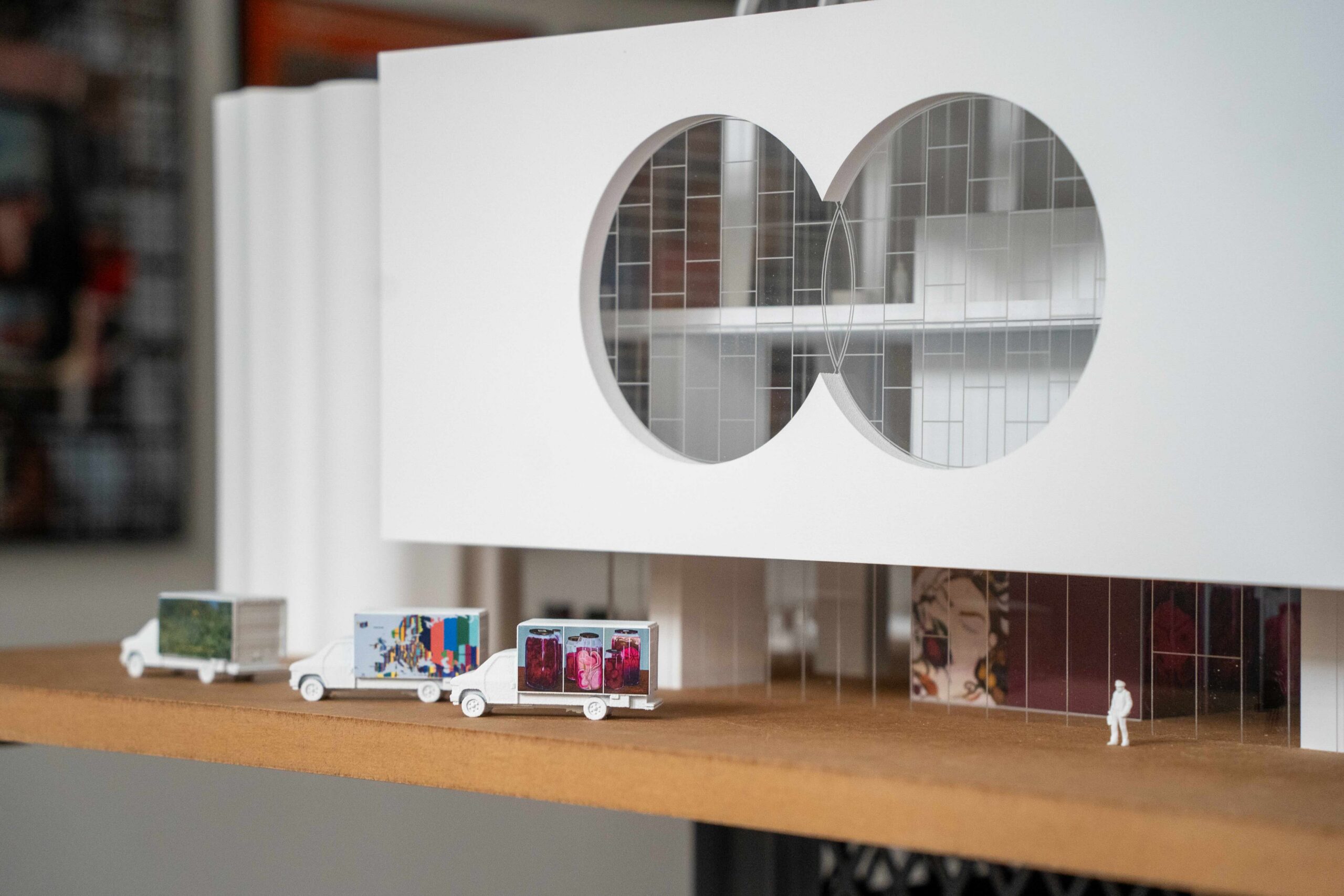
Take the van that brings Polish food to Polish grocery stores in Brussels. Karolina Jabłońska has covered its sides with stickers of her paintings: jars of pickled beets — a symbol of preserving not only food but also memories of people, family, homeland. In Polish slang, a słoik (“jar”) is a provincial who has moved to the capital, and when visiting back home they always get a care package of jarred food and preserves to take back to the city.
The Checkout, the Till, the Window
At the till of the Kubuś grocery store in Ixelles, on the screen that would normally try to sell you something, Krzysztof Kaczmarek stages an argument instead. In his video, two choirs of food products quarrel over how to eat. One sings quotations from Reddit in defence of pleasure and eating as you please. The other answers in the language of health advice and academic argument, with discipline, control and a body to be looked after. Neither wins, but the setting seems to be the point. The checkout is the moment when the choice has already been made, and Kaczmarek’s work places the moral lecture exactly there.

He draws on Pierre Bourdieu’s Distinction, in which taste is a marker of class rather than a private preference, and on Julie Guthman and Melanie DuPuis’s analysis of the neoliberal consumer, who is expected to enjoy abundance and resist it at once. A slim body becomes proof of rationality and worth, and a fat one a personal failure, while industrial agriculture, engineered food and food deserts drop out of view. Seen this way, the quarrel is a false choice.

Other works follow a similar logic into different corners of the food chain. In the window of the Kofiko grocery store, Agnieszka Kurant’s Currency Converter maps things people have used as money: salt slabs paid to Roman soldiers, brightly coloured candy wrappers traded in communist Poland, mackerel in prisons. The work grows out of Kurant’s longtime interest in what she calls phantom capital, the dematerialisation of money and labour in the contemporary economy. The titular converter implies that, in the end, everything is expressible in units of something else, including, as she puts it, human life and freedom. The work is both a description of how the market works and a warning about it.
Near the farm by Place Clemenceau, Dawid Misiorny’s monument of car-body fragments and potatoes refers to a road movie that was never made, about smuggling potatoes from Greater Poland to Norway. Because of phytosanitary rules, the most ordinary of staples becomes contraband, and the work sets the history of hunger against present systems that control the movement of goods and people. The potato brings us back to the famine of the 1840s, and to the migrations it set in motion.

Throughout Anderlecht Market, one of Brussels’ most culturally diverse gathering places, CentrumCentrum presents a sound work and a series of posters. Using sounds and still images captured in Polish allotment gardens, the work contrasts two models of food production. One is a futuristic vision of growing food without soil, explored at research facilities such as Agrotopia. The other is rooted in the everyday practice of growing food for one’s own use in vegetable gardens. The project is inspired by Ursula K. Le Guin’s The Dispossessed, a novel in which anarchist revolutionaries seek to build an egalitarian society founded on solidarity and food justice.

Meanwhile, at the city’s Flagey Market, Janek Simon offers fictional, non-existent fruits that he has invented and 3D-printed, inspired by a painting by Olga Costa — or rather Olga Kostakowsky — an artist born in Leipzig to a family of Ukrainian Jews who emigrated to Mexico at the age of 12. The Fruit Seller is a tribute to Mexico’s post-war economic success, but also, according to the artist, a record of the encounter between a person born in Eastern Europe and the vibrant qualities of life in the Global South. On the hot, dusty streets of cities such as Lagos, Accra or Kolkata, amid the difficulties of everyday life, colourful fruit stalls become portals to other worlds, places of rest and brief sensual pleasure.
Decay, Fermentation and Utopia
Elsewhere, the exhibition turns to imagination and repair. Pola Sutryk’s The Moldy Feast invites participants to a banquet set in a speculative future, where they eat mouldering fruit and compost-filled cream puffs and ask, after Mary Douglas, who decides where “matter out of place” belongs.

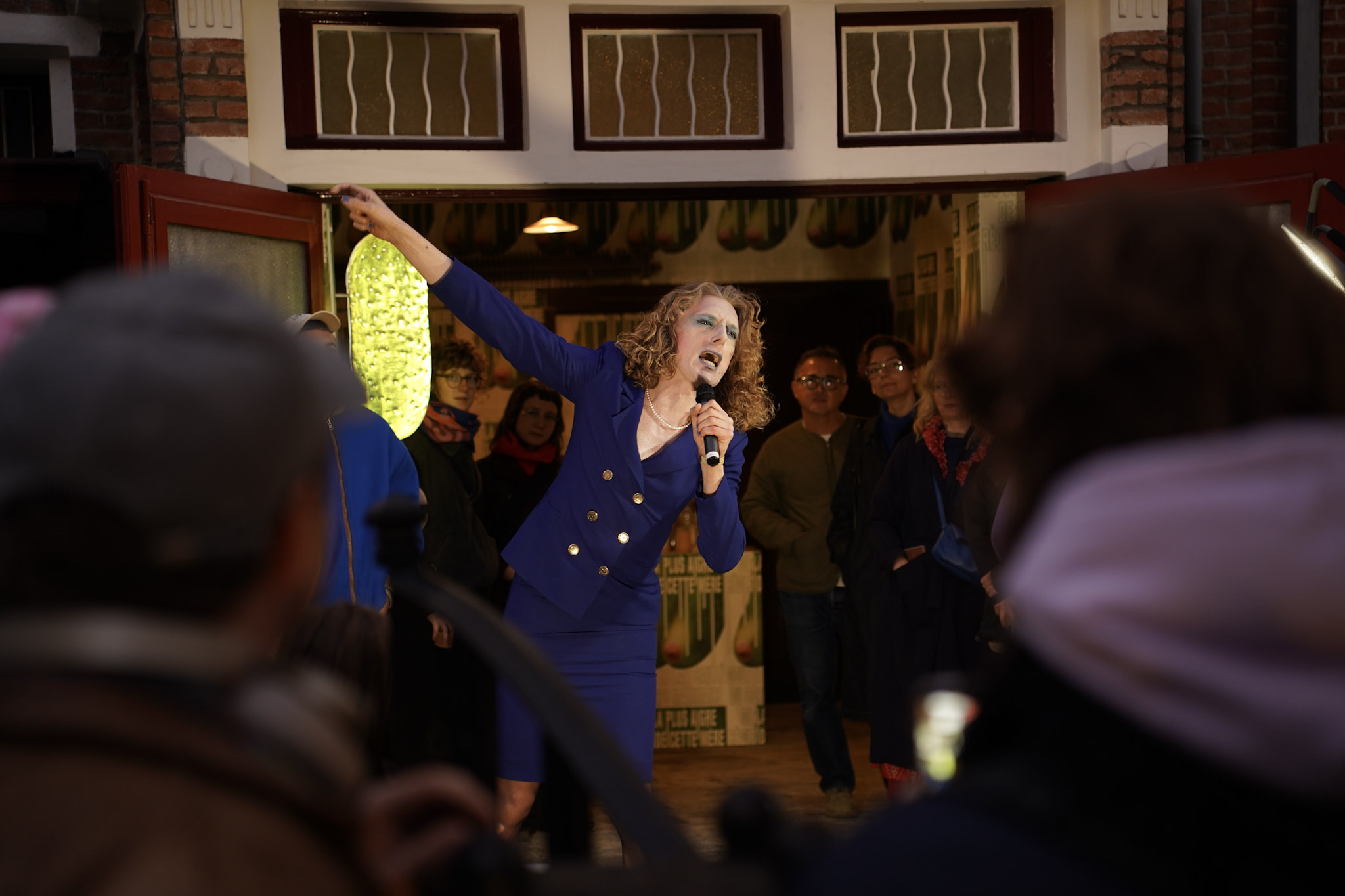
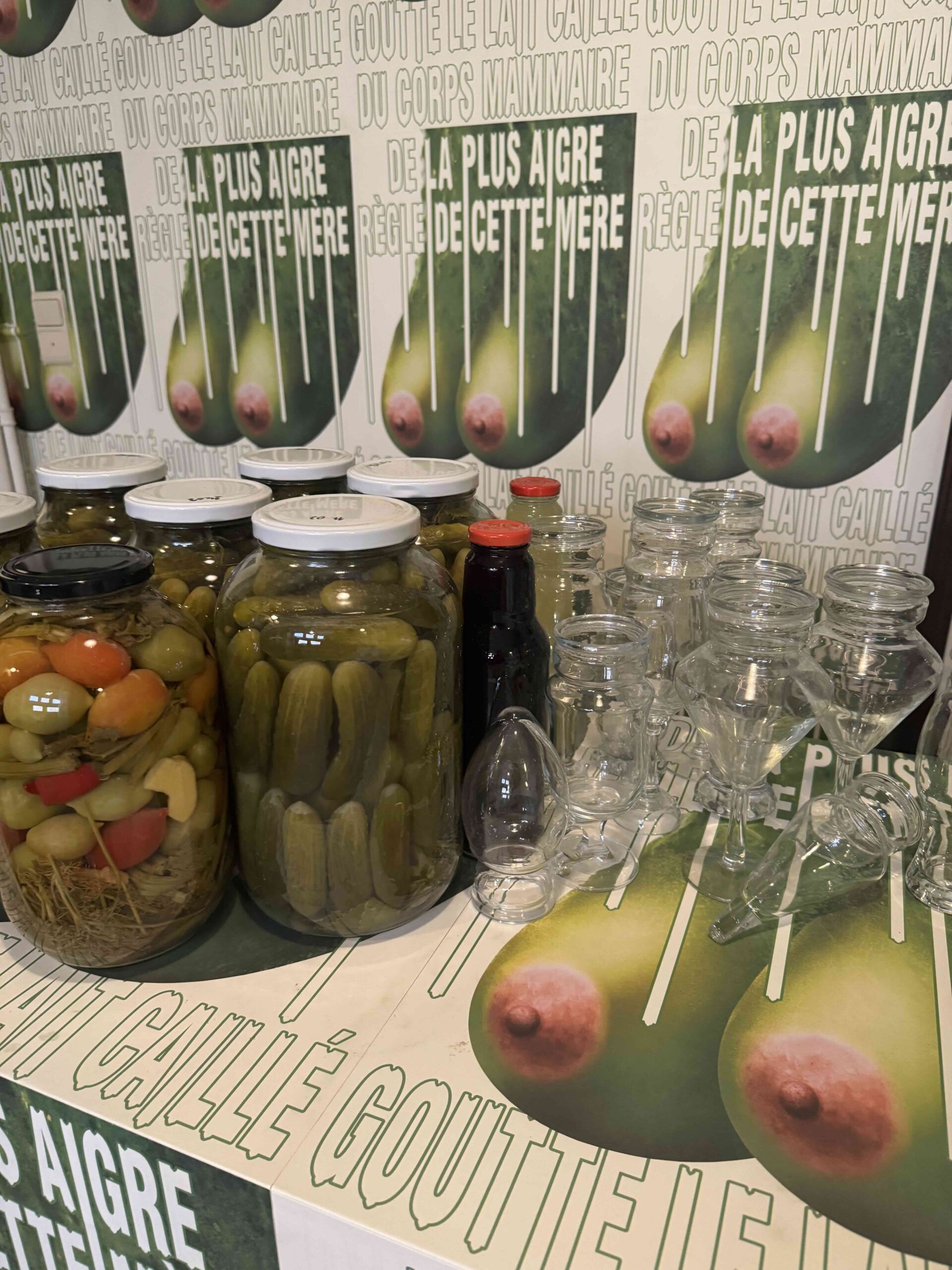
The most unexpected argument in The Belly of the City is made over a glass of brine. In a Polish family’s home in Ixelles, the Berlin-based collective Slavs and Tatars opens a pop-up of its Pickle Bar featuring queer performance by Filipka Rutkowska, and straw craft workshops for children led by Ala Savasevich, and the Spirit of the Bumblebee organ concert by Łukasz Jastrubczak that reflects on working conditions of bumblebees in sterile laboratories of hydroponic farms, where they pollinate crops without soil contact. For Slavs and Tatars, who work in the region between the former Berlin Wall and the Great Wall of China, fermentation is much more than just a culinary technique. It is a way of thinking against the binaries that the Enlightenment left behind: raw and cooked, clean and rotten, civilised and barbarian, us and them. Fermentation sits awkwardly across those lines. It is a process of preservation through controlled decomposition, in which decay is what keeps food alive. This logic extends to people. If we accept that bacteria do the work, that they are the first foreigners to enter the body and stay, then the idea of a pure, self-contained “us” becomes harder to defend.
There is another dimension to this politics of food: the right to belong to a city is often contingent on what one can find, afford and prepare there. It’s not that migrants simply bring their cuisine with them. They have to attempt to rebuild fragments of home through ingredients, shops, rituals and the informal networks that make unfamiliar places inhabitable. These practices rarely register in official accounts of urban planning. Yet a Polish grocery store in Brussels can be more than just a retail outlet. It can be a piece of social infrastructure, sustaining relationships across borders while, at the same time, creating new ones locally.

An Architect’s Answer
The architectural centre of the project is Wasilkowska’s own The Belly of Warsaw: a model for a public food infrastructure on an empty plot in the middle of the Polish capital, housing a food market, an urban farm, a fungarium, a herbarium, a milk bar and a food bank, designed to answer the problem of the urban food desert. The artworks of the Brussels exhibition are imagined inside it, from Janek Simon’s fruit-and-vegetable relief on the façade to Slavs and Tatars Pickle Bar on the ground floor of the building. Art, in this model, is part of the city’s metabolism, giving form to production, transport, decomposition and exchange.
Most exhibitions about food put it on a plate, as a subject to be looked at. The Belly of the City treats food as infrastructure, a network of material and political relationships that shapes bodies, memory and urban space, and it places the artwork inside that network and not above it.

As part of the exhibition, a conference under the title New Foodscapes is being held on 30 October at the La Cambre-Horta Faculty of Architecture, during which academics, architects and artists will analyse these concepts beyond the context of the exhibition itself.
The Belly of the City treats food as infrastructure, a network of material and political relationships that shapes bodies, memory and urban space, and it places the artwork inside that network and not above it.


