



The artistic avant-garde of the first decades of the twentieth century represents one of the most significant turning points in the history of modern European art. Its emergence was linked not only to the rejection of traditional models of representation, but primarily to a fundamental redefinition of the very concept of a work of art. Paintings, sculptures, and architectural designs were no longer perceived solely as vessels of illusory representation, emotional expression or the individual statement of the artist. They were increasingly regarded as autonomous material and spatial structures governed by their own internal principles of organisation, rhythm, proportion, and spatial relationships.


In this view, the avant-garde was not merely another stylistic movement in the history of art, but rather an attempt to establish new foundations for artistic practice and a universal visual language, which was also being developed in Poland. The exhibition Cosmic Geometry, taking place at the Profile Foundation between 18 September and 14 November, provides a rich overview of artistic approaches, illustrating the various ways artists from different generations and movements have used the language of geometry. With this diverse selection, it invites us to consider the extent to which geometry in art can still attain “cosmic” dimensions in the pursuit of autonomy of form, positioning it instead as a means for critical reflection on the world and its changes.
With this diverse selection, it invites us to consider the extent to which geometry in art can still attain “cosmic” dimensions in the pursuit of autonomy of form, positioning it instead as a means for critical reflection on the world and its changes.
From Form to Structure
The main impetus for avant-garde transformations was to challenge the mimetic model of art — that is, one which replicates reality. Instead of asking what a work depicts, the question of how it was constructed became crucial. Once freed from the need to reproduce the external world, form became the subject of independent experimentation, and geometric figures, lines, planes, compositional rhythms, colour schemes and spatial relationships began to function as the fundamental elements of a new visual alphabet. This process led directly towards abstraction, yet at the same time opened up a much broader field for reflection on the relationship between the artwork and the space surrounding it.

This process was particularly shaped by constructivism, which made construction not only a principle for building compositions, but also a means of organising visual reality. The artists ceased to rely solely on intuition and became, in a sense, constructors working with precisely selected arrangements of elements, with geometry, proportion and rhythm perceived as tools for shaping a new visual, sculptural and architectural structure.
Constructivism, however, was not an utterly homogeneous phenomenon. From the very beginning, it revealed a significant tension between proponents of the autonomy of form and artists who advocated transcending the traditional boundaries of art and integrating it directly into the process of shaping social reality. In the former case, construction served as an internal principle for the organisation of the artwork; in the latter, it was a method for shaping a new environment for humankind. This tension between autonomy and functionality became one of the most creative points of contention within the European avant-garde.

In Poland, from the 1920s onwards, the constructivist avant-garde developed its own, highly original model of modern thinking about art, creatively transforming the influences of cubism, suprematism and neoplasticism. Its representatives, including Władysław Strzemiński and Katarzyna Kobro, boldly crossed the boundaries of traditional artistic disciplines, paving the way for new relationships between the object, space and the experience of the viewer.
In Poland, from the 1920s onwards, the constructivist avant-garde developed its own, highly original model of modern thinking about art, creatively transforming the influences of cubism, suprematism and neoplasticism.
When, in the second half of the twentieth century, Polish artists returned to the language of geometry, it was not a mere renewal of the pre-war programme. Although the means of expression remained relevant, geometry ceased to be solely a utopian plan to repair the world or create an ideal order. Instead, it became a tool for a precise examination of the very nature of the image, the mechanisms of perception, the materiality of the artwork, and the relationships between art and the social sphere.

Different Faces of Geometry in Profile Foundation
A key figure in establishing this long-standing continuity was Henryk Stażewski — an artist whose life spanned almost the entire century of the Polish avant-garde. He was actively involved in pre-war avant-garde movements, and after the Second World War, he not only continued his own creative explorations but also became a living authority and patron for successive generations of artists.
Stażewski’s early works focused on the pursuit of an elementary visual language through the reduction of form, vertical and horizontal divisions, and a colouristic rigour reminiscent of neoplasticism. However, the artist was never strict in his adherence to the doctrine — he introduced rounded forms, softened the divisions, and constantly sought new relationships between surface and sign. After a post-war period of figurative work, Stażewski returned to abstraction with new experience, creating iconic reliefs and metal compositions in the 1960s and 1970s.

His work No. 57 from 1975, which is featured in the exhibition at Profile Foundation, constitutes a representation of his approach in which geometry is not a static system, but a dynamic network of relationships experienced over time. Through the use of aluminium — a material with a cool, industrial sheen — the character of the painting’s surface is transformed. It interacts with external light, transforming the object from a mere flat image into one where its materiality becomes an integral part of the visual experience.
In the works of another artist featured in Cosmic Geometry, Jarosław Kozłowski, the language of geometry is transferred into the sphere of conceptual reflection. For him, form is neither an aesthetic goal nor an object of contemplation but an analytical tool that enables the exploration of language structures, mechanisms of perception, and the institutional frameworks of art. His Surface Drawings (1979) revolutionise the traditional way of thinking about drawing as an intimate, small-scale and gestural. Here it acquires an architectural scale. The geometrised graphic structure does not serve a decorative function; it becomes the question of when a graphic mark is transformed into an image, and what conditions determine whether an object is considered a work of art. Kozłowski shifts the focus from the issue of how paintings are constructed to how they function within conceptual and social contexts.

Meanwhile, Józef Robakowski, who was part of the neo-avant-garde scene of Łódź, developed an intermedia practice involving experimental film, photography, video and performative actions. In his approach, visual composition is directly linked to the study of energy, light and physiological processes. The series Energetic Angles, which he has been developing since 1975, is represented in the exhibition by a project on photographic paper created using mechanically abraded metal. Here, a precise geometric arrangement is combined with a direct and physical technological process. The geometric sign is not the result of a perfect freehand sketch but constitutes a tangible record of the interplay of force and hard material. Robakowski’s geometry thus acquires a dynamic dimension — it ceases to be a static description of form, turning into a trace of real energy and movement.
Krzysztof Wodiczko’s practice represents a different approach to the language of geometry. In his early work associated with the Foksal Gallery, he engaged in analytical attempts to move beyond the traditional plane of painting towards architectural and social space. His 1976 installation, Line as Theory, Object, Reality, Image, documented in photographs, consisted of placing a physical line within the gallery space: running along the wall, hanging from the ceiling, and cutting across the corner of the room. In this way, Wodiczko took a fundamental element of geometry out of the plane of the canvas and turned it into a physical object. The line ceased to be a symbol or a sign on a surface; it became a tangible element of architecture, demanding that the viewer redefine the relationship between theory, object and its afterimage.

Furthering its exploration of different perspectives on geometry, the exhibition at Profile Foundation showcases the 1983 composition Motionless Picture: White, Blue, Yellow and Red by Ryszard Waśko. In his paintings and photographic practice, he explored issues of the mathematical organisation of form, sequentiality, and the relationship between the static image and time. Here, the almost mathematical relationships between colours and the divisions of the plane become a record of potential movement. All planes and geometric divisions provoke the viewer’s eye to scan the surfaces, creating an impression of dynamism within completely static compositions.
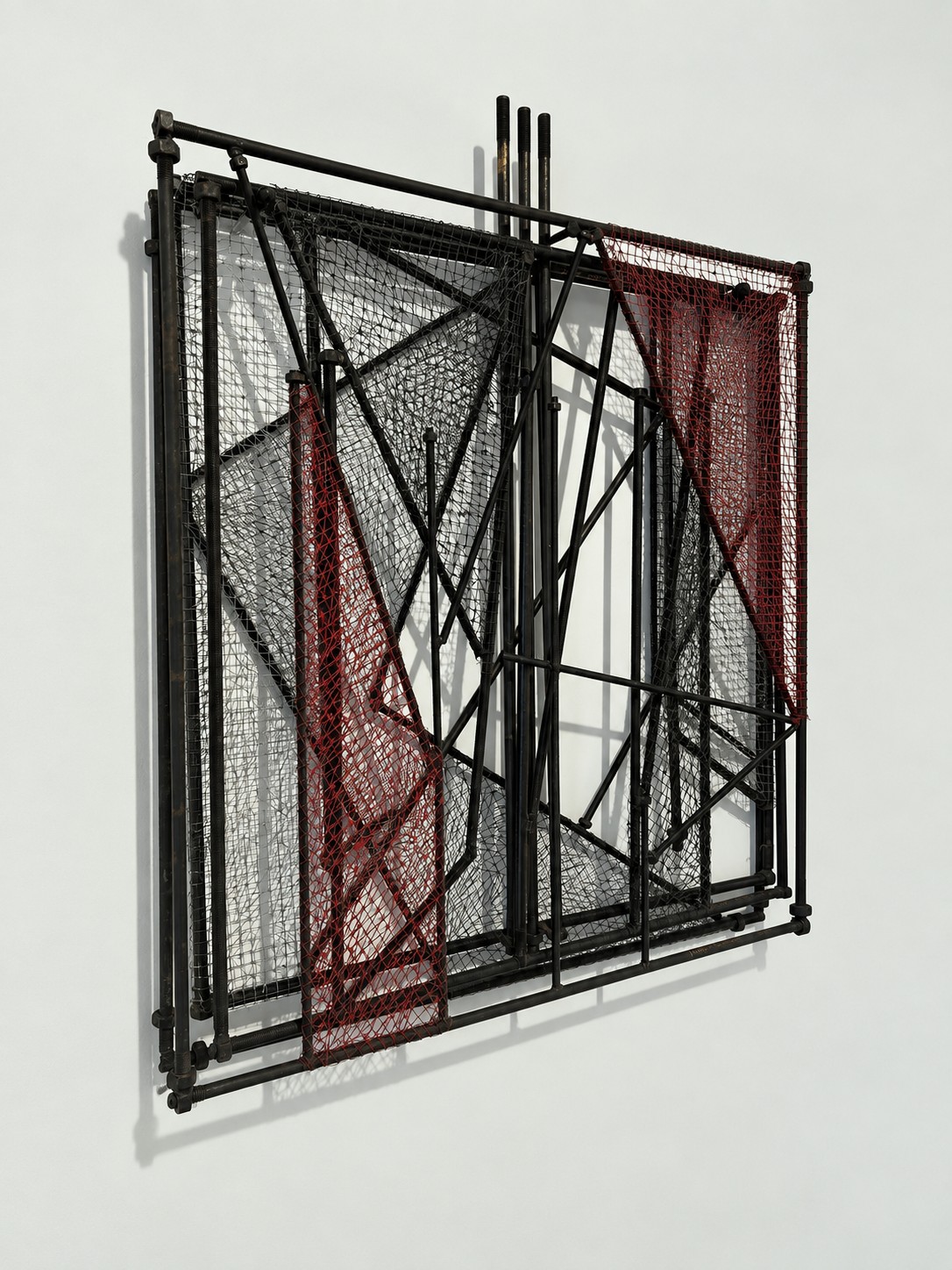
Representing a different approach, Teresa Tyszkiewicz’s works offer a distinct, highly expressive and sensual response to the rigour of geometry, in which geometric structure collides with organic matter and unconventional techniques. This is clearly visible in her composition Frames (2000), on display at the exhibition, which was created using thousands of pins, as well as iron, metal and acrylic. Tyszkiewicz reverses the traditional role of the frame, usually viewed as a secondary element serving merely to enframe the picture. Here, it becomes an autonomous object, and the closely stuck pins give the geometric quadrilaterals an extraordinary surface tension, evoking associations with pain, resistance, armour and physicality. Thus, the geometry in Tyszkiewicz’s work ceases to be cold and abstract and becomes a carrier of a profound material experience.

The youngest generation of abstract artists is represented at the Profile Foundation by Natalia Brandt, whose works fit into the recurring debates on the limits of formal rigour in the contemporary world. Her spatial objects, such as Grammatical Shapes II (2006), employ a variety of materials, departing from the tradition of homogeneous canvas. Brandt constructs an orderly, or even rational, geometric structure into which she introduces deliberate disruptions and shifts. Not choosing between absolute order and chaos, she constructs her work upon the constant tension between the two and reveals fissures within the formal systems themselves.
This panorama of artists is complemented by the works of Jerzy Budziszewski, which originate from the tradition of the Polish geometric avant-garde, yet consistently transcend its historical framework. His decades-long practice demonstrates that the constructivist way of thinking about space and objects retains its creative potential even in modern art.

A Legacy that Remains Open
The selection of works in the Cosmic Geometry exhibition reveals that there was no single universal “geometry” in Polish post-war art. Depending on the generation, the medium used, and the artist’s individual attitude, the language of geometric forms served compositional rigour, the study of perception, the analysis of the status of the object, the documentation of physical processes, reflections on time, and, ultimately, the construction of a sensory experience of matter. In this context, the role of Henryk Stażewski appears to be crucial. The aim is not to trace the works of younger artists directly back to those of the master, but to demonstrate how his years of presence at the very heart of artistic life stabilised and stimulated the development of geometric abstraction. Whilst the generation of the interwar avant-garde shaped the foundations of the system, younger artists inherited not so much a ready-made set of shapes as the freedom to treat elementary visual forms as tools for continuous experimentation.
The aim is not to trace the works of younger artists directly back to those of the master, but to demonstrate how his years of presence at the very heart of artistic life stabilised and stimulated the development of geometric abstraction.

Therefore, the exhibition at the Profile Foundation offers a unique opportunity to reconsider one of the most important elements of Polish visual culture. The showcased pieces demonstrate that the line, the square, the angle and the frame remain vibrant notions and instruments for the analysis of reality and human perception. Recognising the profound continuity of these explorations invites us to view the history of the Polish avant-garde not as a closed chapter in art history, but as an open, constantly updated tradition.