


Recreating scenes from her own life as a young creative in East London, yt (short for Yin Tong) invites us to eat with her in two short video works: eating at yt’s and eating with yt. Through the lens of East London’s gastronomic culture, the two works extend the artist’s ongoing interest in food and the objects associated with dining. They explore the ways in which identity is unconsciously reshaped by place, embracing the awkwardness of forming new connections.
In the first video, we watch yt act as both waitress and guest, being served dinner by herself, in her own kitchen, at a table set for one. Through this everyday act of eating, the artist reveals her inner world, in which food, dining behaviour, love, and society are deeply intertwined. By occupying the roles of both service worker and consumer, she collapses the distinction between those who serve and those who are served. Beyond this reference to service and consumption, the scene brings to mind themes of domestic labour and the roles of women, recalling earlier feminist film works.

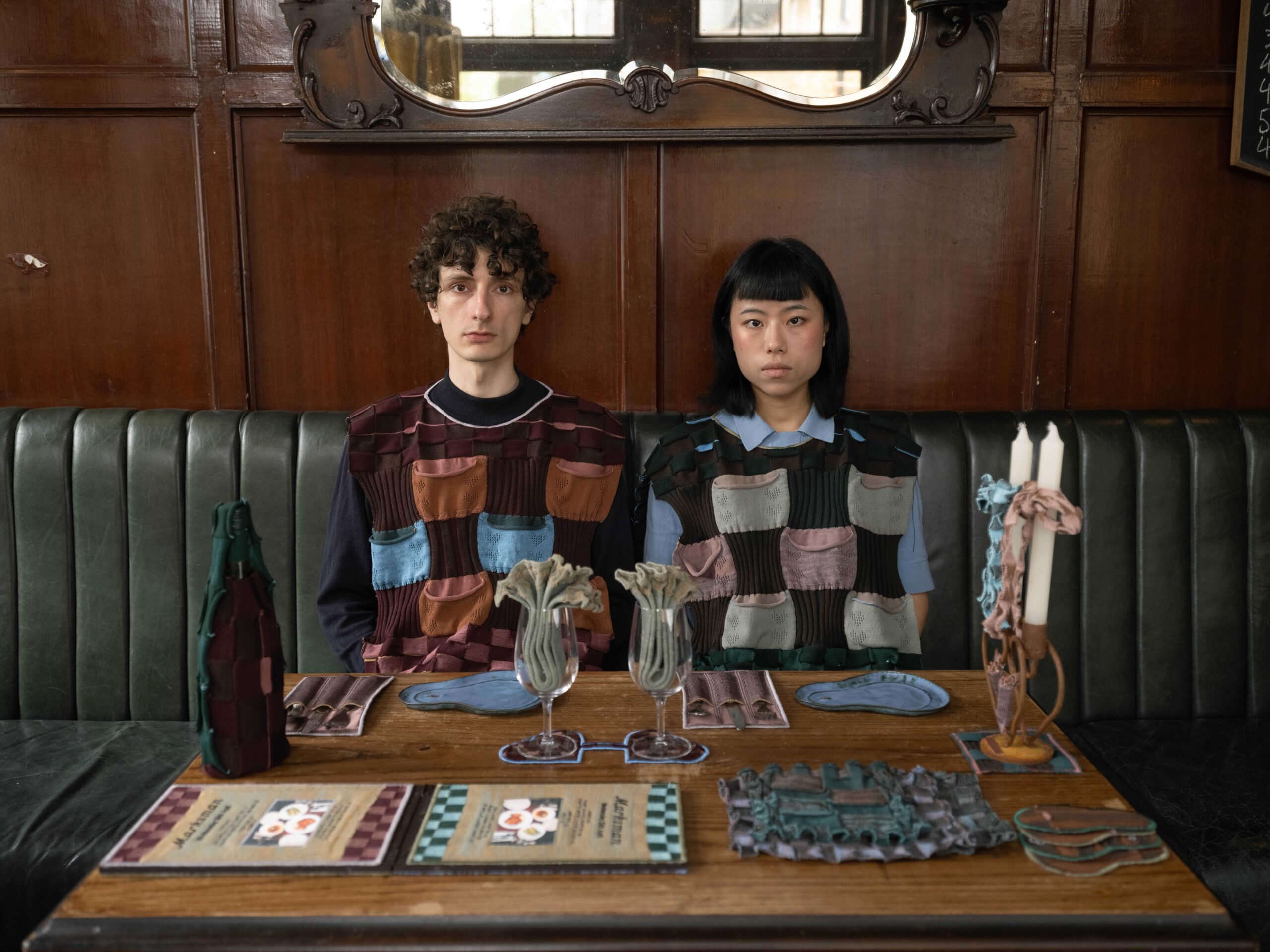
In the latter video, we see yt go for a dinner date at a pub. She and her date wear a shared garment with many pockets, which links them together and becomes a tablecloth when they sit down together for dinner. The shared garment invites us to consider where the boundary lies between two people, and whether something that separates us can also bring us together. As we watch this entirely analogue date unfold in an East London pub, the scene invites us to reflect on the complexities of urban intimacy in the age of dating apps and rapid gentrification.

Both videos have a cozy, analogue feeling, created by 16mm film grain and stop-motion animation, which make the actors’ movements feel slightly unnatural. They were made to present a series of “functional-useless” knitted tableware pieces designed by the artist, developed on domestic and industrial knitting machines and embellished with digital embroidery and fabric lamination. This cheeky presentation of a knitwear collection becomes a work in its own right; the videos successfully move beyond documentation of a new collection, establishing a distinct visual and narrative language.

These video works also make me think about how artists and designers choose to “package” their work. In the films, many things come in packages: the beers are dressed in heart-shaped beer cozies, wine and milk bottles wear tiny aprons. Like a wine apron, most objects we see are not essential to the act of eating but are purely ornamental. For this project, the artist has researched the ways product packaging changes with gentrification to accommodate newcomers to a neighbourhood. This reflection on how everyday objects respond to wider social changes gives the project an additional conceptual layer, although the references are playful rather than overtly critical.

At home, yt takes one bite of her meal. At the pub, beer fills itself at the tap in stop-motion. Later, we hear swallowing sounds as the actors hold their beers conspicuously away from their mouths. All communication takes place through notes passed back and forth, pulled from one of the many pockets on the shared knitted garment. Dishes and food wiggle themselves across the table without human intervention, and the baguette chops itself.

The stop-motion technique is particularly effective in transforming otherwise ordinary daily activities into something slightly surreal. Awkward, chopped movements make the intimacy of eating together feel staged and slightly artificial, never quite allowing us to feel like genuine participants. This feeling is intentional, offering a sarcastic reflection on the lifestyles of middle-class creatives and the gentrification of east London.
The artist’s references for the videos include internet memes, Matthieu Nicol’s photobook on US Army rations in the 1970s and 80s, Czech filmmaker Jan Švankmajer, and classic works of feminist video art like Martha Rosler’s Semiotics of the Kitchen (1975). The works bring together cutesy kitsch and DIY aesthetics from the last century with internet trends like ASMR and mukbang. This playful combination gives the project its distinctive character, while raising questions about how what we consume and where we live shapes our desires, choices, and sense of self.
The choice to address contemporary issues with nostalgic aesthetics resonates with the contemporary analogue movement, a return to physical media in the digital age1. As yt puts it, artists are often the first to take the things around them seriously. After being invited to eat with yt in her kitchen and join her on a date at a cozy East London pub, I’m left with a bittersweet feeling, like falling in love.
Written by Elena Wise