




The leading photography event once again returned to the Grand Palais. Just like every November, enthusiasts of this medium turn their attention to Paris, where the thoroughly renovated glass exhibition hall hosted the 28th edition of the international Paris Photo Fair. The largest event of its kind brought this time 220 exhibitors, including 178 galleries and 42 publishers from 33 countries, further proving its importance in contributing to creative dialogues and questions about the status of contemporary photography.
A broad overview of the works was presented in five sections. The Main Sector consisted of a presentation of works by well-known photographers. The Voices Sector, the conceptual heart of the Fair, featured an exhibition focusing on landscape and kinship, thanks to the collaboration with invited curators Devika Singh and Nadine Wietlisbach. There were also discoveries, highlighted in the Emergence Sector, showcasing 20 projects in the creative exploration of photography. This section demonstrated the energy and creativity of a new generation of artists. Moreover, since 2023, the programme includes the Digital Sector, with the work of artists who incorporate digital realities into their practices. An overview of photographic publications was also presented.
Paris Photo Director Florence Bourgeois and Artistic Director Anna Planas emphasise the desire for further exploration to broaden the artistic horizons of the event. That is why the Polish photography scene was highlighted this year, too, with galleries Monopol, Jednostka, and Raster participating in the Fair. While the Berlin-based Persons Projects Gallery exhibited Zofia Kulik’s works.
Here are our highlights from the Paris Photo Fair for you to explore and keep an eye on.
Veronika Pot. How to revisit a moment?
The works of artist Veronika Pot, exhibited for the first time at Paris Photo in the Emergence Sector by the Belgian Base-Alpha Gallery, document her travels over the past three years. These are not traditional images of mountain landscapes, but multi-layered records of fleeting moments. The artist processes her photographs to achieve a form that allows her to revisit a given moment. Pot works on the photographs in a darkroom, cuts out individual elements, then reassembles them to create compositions, to which she finally adds colour with acrylic paint. The precise photographic record is thus distorted to convey the memory of a moment captured in the landscape, which is also associated with specific emotions. The original image often becomes unrecognisable, raising a question about the context in which it was created. There are landscapes that Pot tries to “re-view”, “re-memorise”, and “re-visualise”. Ambiguity is at the core of the images, perceived differently by each of us.


The paintings were exhibited alongside small sculptures, for which the artist drew inspiration from paintings by Goya, Eugène Delacroix, Gustave Doré, and seventeenth-century hunting scenes. Also originating from the artist’s interest in art history and philosophy, the sculptures were processed to achieve their final form, just like the paintings. They are plastic toy figurines, stripped of some of their original elements and supplemented with new forms – covered with beeswax and coloured with spray paint, giving them an emotional and personal shape and turning reality upside down.

Andras Ladosci. Connected in the shared experience of life
In the Emergence Sector, there were also Andras Ladosci’s works from the series There is a Big River, in Which There is a Big Island, in Which There is a Lake, in Which There is an Island, in Which There is a Small House, Where a Life is Growing in a Womb, presented by Galerie Obsession, Paris.
Andras Ladosci’s art can be described as a celebration of life and its complexity. In his photographs, he particularly emphasises the relationship between humans and their surroundings. Although each of us lives in a different place, we all experience similar aspects of existence. While our experiences are unique, we can all relate to the emotions they evoke. We are entangled in connections that at first glance are invisible. The moments captured by Ladosci depict the intensity of life and the strength of the human spirit, visible especially when we push our bodies and minds to reach their highest potential.

Through the images included in the project and later in the book, the artist explores human existence. The title is merely a pretext for reflecting on one’s own experiences and points to a sense of community. The project draws on the artist’s personal experience as a former professional swimmer. The experience of being part of a community, in his case, a swimming one, prompts us to consider how the actions of individuals are shaped by the actions of the group. The artist uses water to metaphorically illustrate the connections that exist between us. The river, lake, and island are symbols of water that is within each of us. The idea of looking inward is evident across Ladosci’s entire body of work.


Marine Lanier. The garden as a symbol of resistance against climate change
Another highlight of the Emergence Section, presented by Espace Jörg Brockmann, was Marine Lanier’s Hannibal’s Garden project, which focuses on climate change and resistance against it. The symbol of the fight against the difficulties posed by global warming is the Lautaret Garden, located at 2,100 metres above sea level in the Écrins National Park in France, making it the highest located garden in Europe. Known for its exceptional diversity of alpine flora, since the nineteenth century, the garden has been a centre for botanical research and nature conservation, where scientists analyse the vegetation and work on the preservation of individual species.


A spectacular example of the scientists’ work is the Flying Alpine Pasture project, in which eight tonnes of alpine pasture were transported by helicopter and replanted in a river valley to study the impact of rising temperatures on flora. Inspired by their work, Marie Lanier visited this unique place to observe the behaviour of plants, creating dreamlike images of flora and landscapes shown out of context, which can seem almost phantasmagorical. She juxtaposed studies of nature with black-and-white photographs of gardeners.
The images are accompanied by the story of Hannibal, which recurred in conversations with the gardeners. Crossing the Alps was a huge effort and a difficult manoeuvre for his army. What is happening in the Lautaret Garden is also a struggle, but with the upcoming changes. It can be said that in this way, the artist combined science with myth.

Nhu Xuan Hua. Searching for narrative and emotion
In the Main Section, presented by Anne-Laure Buffard Gallery, Paris, there was Nhu Xuan Hua, an artist of Vietnamese origin who gained international recognition as a fashion photographer. However, in her work, she goes beyond the world of fashion, examining memories, thus discovering her Vietnamese heritage. She treats the medium of photography as a tool used to capture moments full of given emotions. Hua claims that the truth is always only an approximation and that we create narratives instead. She searches for narrative and emotion in archival photographs of her family, guided by the process of working on archival footage, which she digitally altered, and the emotions they evoked.
The reworking of the surface of the images, which Hua compares to the act of painting, reflected her experience of filling in the gaps in her understanding of her family and her Vietnamese identity. The artist uses scenography to bring her vision to life, crossing the boundaries of space and the two-dimensionality of the frame, which she fills with fragmentary compositions.


Jeff Cowen. Magic of tradition
Although Paris Photo highlights the latest explorations by artists in the field of medium form, there is also room for a more traditional approach. Jeff Cowen avoids the digital world and remains faithful to old photographic techniques. Making large analogue prints on thick, corrugated photographic paper, his work focuses on ordinary elements of everyday life, which he turns into something unique.
During the event, visitors could see works from the Provence Works series, which attracted many passersby not only for their large size and careful execution, but also for their extraordinary beauty. After years of living and working as a nomadic artist in metropolises such as New York, Berlin, and Paris, Cowen pointed his lens towards Provence. Just as painters such as Cézanne and Van Gogh did, he sought inspiration there, enchanted by the local nature. Each work is a unique, hand-made analogue gelatin silver print, offering the viewer a profound, almost mystical experience. Cowen was presented in the Main Section by WILLAS contemporary, Stockholm.


Elena Subach. Disruption of order
The works of the Ukrainian photographer in her Hidden series may seem ambiguous at first glance due to their fragmentary nature and abstract form. However, upon closer examination and learning about the context, everything begins to come together. The series can be described as a document dedicated to saving Ukrainian cultural heritage from the threat of destruction brought about by war, as well as a record of the artist’s encounter with art, almost literally eye to eye. Urgency, tension and the need for action are all evident here.
Elena Subach used a flash, giving the photographs the feel of forensic documentation. The statues were suddenly transformed into abstract forms, out of place in the surrounding architecture. In the aftermath of the war, a sense of disorder prevailed, affecting even works of art, which had once been placed on pedestals but were suddenly no longer considered sacred. This is symbolised by the image of a man gently cradling a sculpture as it is being moved. Subach was showcased by Alexandra de Viveiros Gallery, Paris, in the Main Section.


Zofia Kulik. Creating in the context of European art
This year’s edition of Paris Photo was marked by a special event – the premiere of the first monographic publication from the Berlin-based Persons Projects by Polish artist Zofia Kulik. The book includes texts by curators and art historians who discuss the complexity of her vital work in the context of European art.
The artist does not confine herself to a single medium, and her oeuvre includes collages, photographs, installations, sculptures, and performances. Kulik has made her mark on the history of photography thanks to her visually compelling and meticulously crafted large-format photographic works. Since the end of the 1980s, the artist has been creating independently, focusing on collages consisting of previously arranged photographs. These works marked a departure from her earlier approach, which was evident in the works of the KwieKulik duo.
The artist decided to play with form, drawing inspiration from well-known patterns and traditions. Visually, the works resemble stained glass windows, mandalas, mosaics, and oriental carpets. The form of the works was thus borrowed, while the content was created thanks to the artist’s photographs. Kulik collaborated for several years with Zbigniew Libera, who became her model and was immortalised while performing various gestures. Zofia Kulik’s photographs mostly refer to the notion of power and the system’s dominance over an individual.


Alma Haser. Going beyond the traditional portrait
Presented by The Phorographers’ Gallery, London, Alma Haser seeks an appropriate artistic form to express her thoughts. The artist combines photography with collage and origami, creating works that aim to expand beyond traditional portraits. She thus reflects on the problems of millennials and subsequent generations. With her background in fine arts, she blurs the boundaries between two- and three-dimensional images in her multidimensional works. She uses inventive paper-folding techniques. The results of her creative endeavours are both surprising and sometimes unsettling.


Julie Cockburn. Colour and texture
Thanks to Julie Cockburn, lost and rejected images are given a second life. The London-based artist (also presented in Paris by The Photographers’ Gallery) has created her own unique language. Cockburn carefully selects second-hand photographs and adorns them using embroidery, collage, screen printing, and painting. For the artist, the very composition of the found images, with their hidden narratives and meanings, is of great importance.
Colourful dots, geometric grids, triangle patterns, screen printing and paint splatters are used to encourage viewers to look behind the façade we create, and to question the way we perceive each other and the world around us. Cockburn’s artistic interventions suggest new stories for the people in the photographs. Though at first glance, these may seem to be relatively simple works, their creation requires focus and skill.


Julieta Tarraubella. Relationship between nature and technology
In the Digital Sector devoted to photography and image in the digital age, one of the most notable projects was The Secret Life of Flowers by Julieta Tarraubella. Flowers, a popular theme in art, were presented in a new way. The exhibition stand of the Rolf Art & Tomas Redrado Art resembled a cyborg garden filled with digital flowers. The artist filmed flowers at various stages of their life cycle, from blooming to withering, as the cameras allowed her to take a close look at the plants. Thanks to technology, a particular stage of a plant’s development can be paused to examine it more closely and capture its beauty.
Tarraubella forces the viewer to reflect on how we perceive nature through technology, as modern solutions can change the way we see and experience it. When we look at the images of flowers shown at Paris Photo, time becomes irrelevant, beauty is just a record of digital data, and the intimate relationship between humans and nature is also lost. Without a doubt, The Secret Life of Flowers takes the viewer out of their comfort zone and prompts them to ask whether future generations will be doomed to interact with nature only in this way.

Maria Michałowska. Faces of landscape
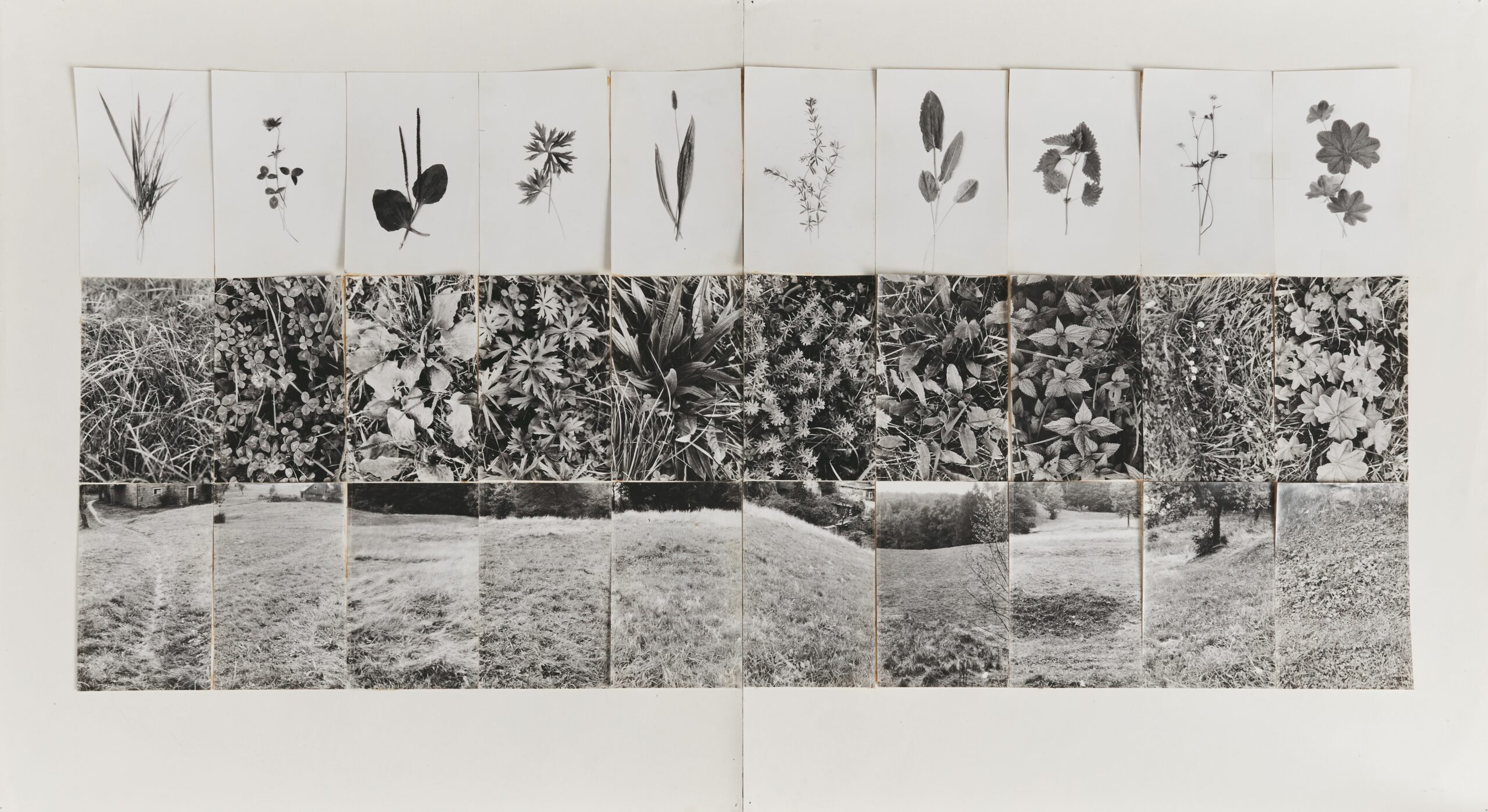
The Voices Sector, constructed around themes such as landscape and kinship, also included works of Maria Michałowska, a Polish artist and a co-creator of the Wrocław avant-garde milieu, represented by Galeria Monopol. Michałowska’s artistic endeavours were an essential voice of the Polish experimental scene of the 1970s. The artist did not limit herself to just one medium, with her work including painting, drawing and, of course, photography.
Her photographic works were a perfect fit for what the curators of the section were looking for, as landscape for Michałowska was a tool for studying ways of seeing the surrounding world. During the Paris Fair, the audience had the opportunity to see her works from the 1970s, in which landscape was the basis for creating typologies and combinations. Repetition and order are evident in the project Topography of Landscape, in which, drawing on the form of a herbarium, the artist created a photographic juxtaposition of plants and habitats. On the other hand, in the project Morphology of the Image, she explored the panorama of Manhattan. Although her works are definitely characteristic of structuralism and conceptualism, they are by no means devoid of emotional and purely aesthetic explorations.