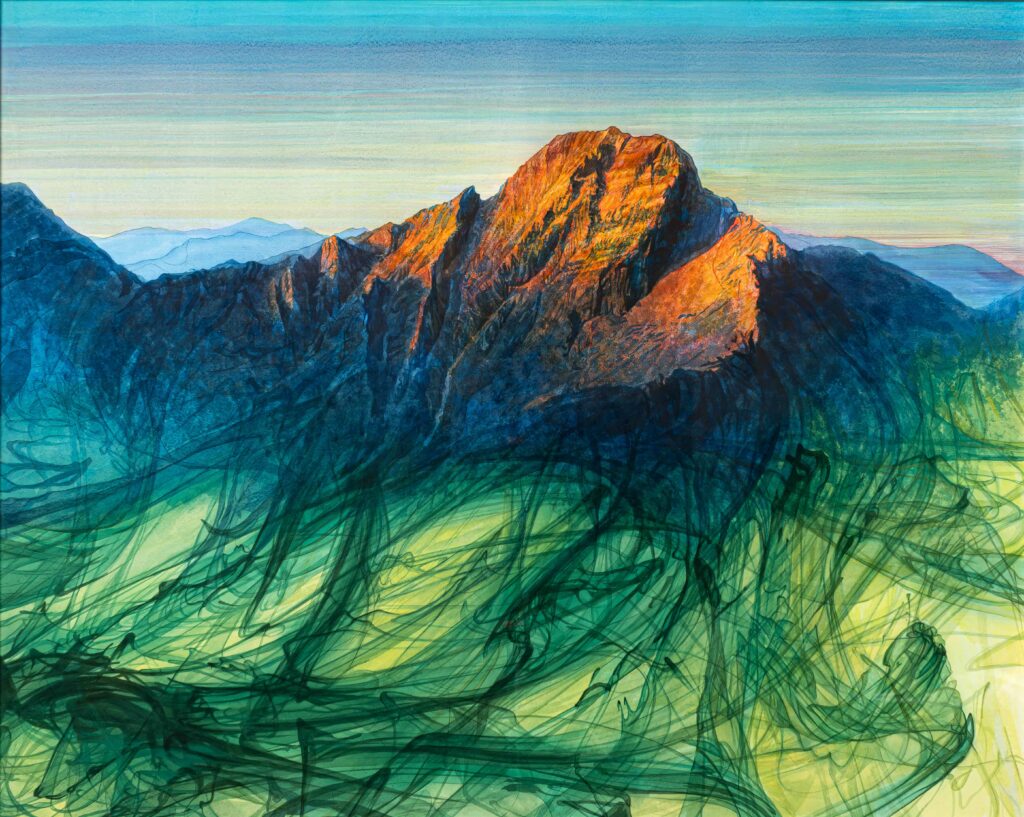
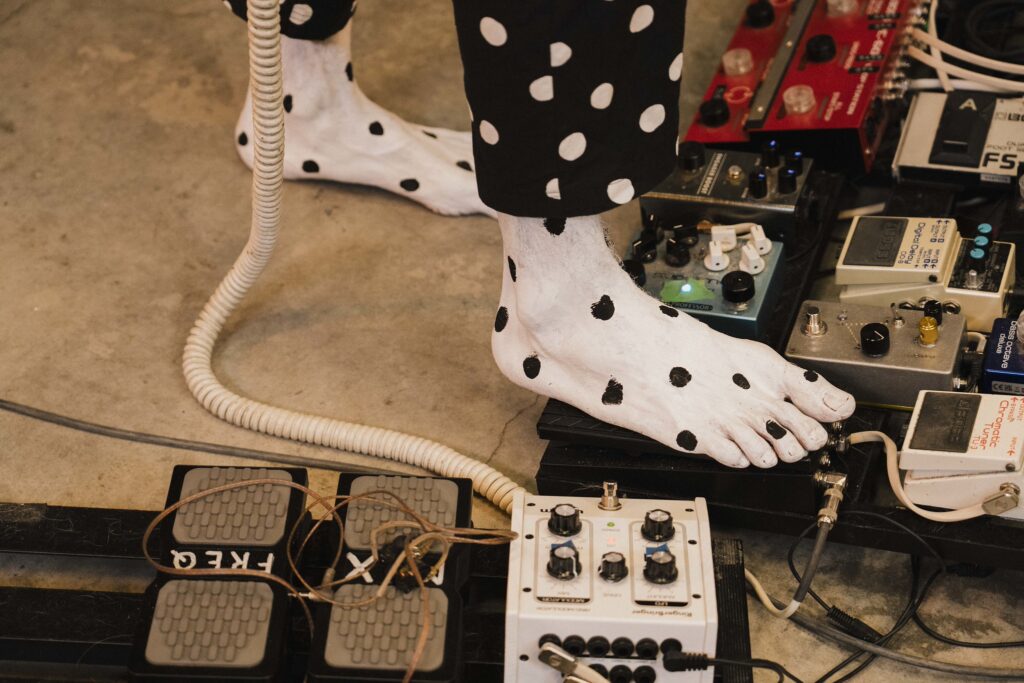
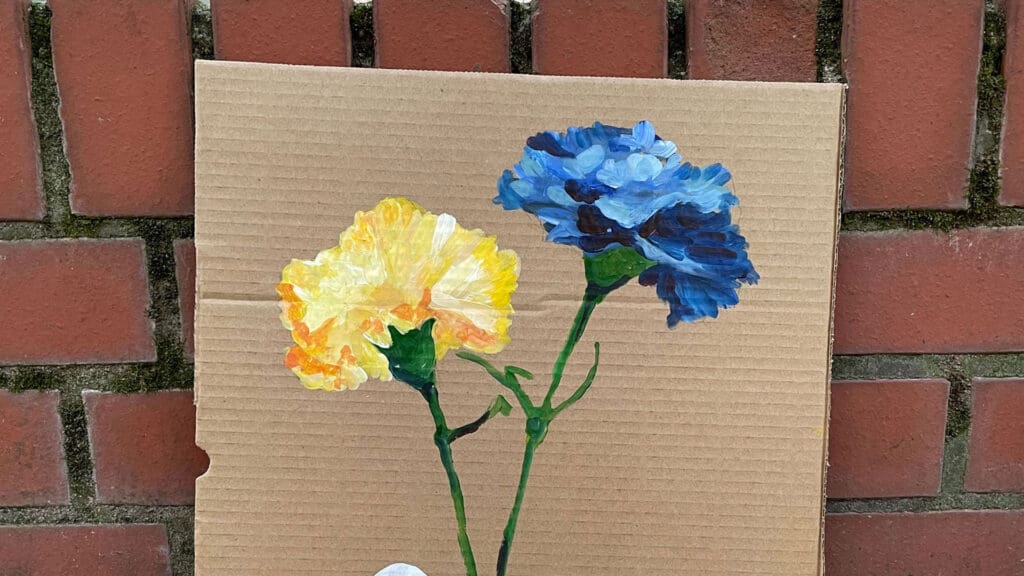
Tired. Sad. Hopeless. Vulnerable. Grieving. Defeated. Drained. Emotions seep from the walls as we walk through the Museum of Modern Art in Warsaw and Kyiv Biennial’s main exhibition, titled Near East, Far West. This year marks the Biennial’s sixth edition and the second consecutive one held outside Ukraine.

Launched in 2015 by Kyiv’s Visual Culture Research Centre, the Biennial emerged from the chaos and exhilaration of the Maidan Revolution. Over the years, it has become a significant event in Europe’s cultural scene, known for showcasing artists from across the eastern part of the continent, and focusing on their shared imperial and colonial histories.
A Biennial in Exile
Since the beginning of the Russian full-scale invasion of Ukraine in 2022, the Biennial has decentralised, collaborating with institutions across Europe. This year, the Kyiv Biennal is supported by L’Internationale, a European confederation of art centres, and hosted by institutions in Ukraine, Poland, Belgium and Austria. The curatorial team comprises Vasyl Cherepanyn (Visual Culture Research Centre), Nick Aikens (HDK-Valand), Zippora Elders (Van Abbemuseum), Charles Esche (L’Internationale), Nav Haq (M HKA), Serge Klymko (Visual Culture Research Centre), and Magda Lipska (MSN Warsaw).

Now, more timely than ever, the Kyiv Biennial reminds us that the conflicts presented are not in some distant land, but rather they are our own issues–our shared history and collective future. The curators have introduced the term “Middle East Europe” to examine the influence of the East on the West, arguing that Europe’s so-called periphery has always been central. With Poland now a crucial player on NATO’s Eastern Flank and holding within its ranks the hopes for the safety of its western neighbours, hosting this exhibition in Warsaw further emphasises that conflicts on Europe’s “outskirts” are in fact ours.
“Now, more timely than ever, the Kyiv Biennial reminds us that the conflicts presented are not in some distant land, but rather they are our own issues–our shared history and collective future.”
Near East. Far West features works by twenty-three artists and duos from sixteen countries, alongside a historical loan of Ukrainian avant-garde art from the Mystetskyi Arsenal. The collected stories focus on the subaltern, the colonised, the victims of imperial ambitions, and the “others”. Various media, including textile art, installations, video art, paintings, sculptures, and photographs, fill the spaces, but despite their common themes, a curious detachment pervades the grand museum rooms. The works seem to circle each other cautiously. While the curatorial effort to highlight shared experiences across different European regions is evident, it leaves us feeling unsatisfied, wishing for more friction and interplay. Either a confrontational dialogue between the pieces or a more complementary relationship. Instead, most rooms feel internally detached by a courteous curatorial consensus.

Stories of Survival and Cultural Resistance
“On long drives from Jerusalem to Haifa, my father would say, If you see cactus, know that a Palestinian village used to be there. Cactus was used to mark the boundaries of a village and to protect it, he explained; it is incredibly resilient against being uprooted and destroyed. The smallest bits of cactus can spawn whole new growths and generations, he tells me”, Basel Abbas’s and Ruanne Abou-Rahme state in their work
Until We Become Fire and Fire Us. Capturing the feeling of walking through the exhibition, a sense of defeat settles in, grappling with the wars and destruction, yet, in that weariness, a flicker of hope remains. Cultures spread through seeds – or bits of cactus – sown in other countries, and in an attempt at necropolitical endurance, I feel a determination that their stories will survive, even if the people do not.

Like Lesia Vasylchenko’s sculpture A Willow’s Lament Etched in Light – a modern Voyager Golden Record crossed with the “2001” monolith. The artist used the latest optical data technology to embed a recording of her grandmother singing a Ukrainian folk song onto a piece of glass, which should surpass all other storage methods and outlive us, carrying that piece of heritage long into the future.
Other pieces embody resilience and an unyielding “fuck you” attitude. Namely, Nikita Kadan’s Silence in the Classroom. This installation consists of rows of desks and chairs surrounded by sculptures on metal frame pedestals. Upon closer inspection, books on Ukraine’s art history are neatly stacked on the desks, ready for study, while the sculptures turn out to have been made from scraps of metal and rubble from war-torn Ukraine. Kadan narrates the resilience of Ukrainian citizens by turning Russian aggression into a counter-narrative of survival and epistemicide into a reinforcement of cultural identity. The installation prompts a comparison to Tadeusz Kantor’s Dead Class. The visual similarities and narratives about experiences in war are clear. However, the emotions conveyed differ with mourning in one, strength and resilience in the other.
On the adjacent wall, two rows of paintings and drawings from the Ukrainian avant-garde from the beginning of the 20th century complement the prop classroom. The selection, curated by Kadan, is part of a larger collection from the Mystetskyi Arsenal, housed on loan at the Museum of Modern Art, in an attempt to safeguard invaluable cultural heritage. Paintings by Oleksandr Bohomasov, Maria Siniakova, and Anatol Petrytsky, among others, enhance Nikita Kadan’s installation like visual aids on a classroom wall, bringing to life the history found in books.

Territories Under Pressure
The next room takes us on another lesson, this time about gas extraction in Siberia and the colonial and diplomatic relationships it entailed. An immersive installation by Philip Goll, Hito Steyerl, and Oleksiy Radynski features a tangle of silver pipes sprawled across the room, doubling as seats to view the two video installations. One of them is a five-channel film titled Leak by Steyerl, which explores the relationship between Germany and the Soviet Union, based on gas supply contracts disguised as a cultural exchange of art and exhibitions between the two countries. Accompanying this is a thoroughly researched timeline by Philip Goll, The End of the Pipeline, which traces the history of this collaboration up until 2022, when it collapsed following Russia’s invasion of Ukraine. The second video, by Radynski, is an attempt to reconstruct the history of exploitation and environmental destruction of Russia’s internal colonies, based on found footage from the 1980s of Ukrainian expeditions to that region.
Another space is dedicated to Lawrence Abu Hamdan’s video, The Diary of a Sky, which examines how Israel’s incursions into Lebanese airspace have turned the once boundless sky into a stifling environment for its residents. The artist discovered that the UN Digital Library contains a record of all the airspace violations by Israel. These flights, conducted in disregard of UN Security Council Resolution 1701 – instituted after the July War of 2006 – form the core of Abu Hamdan’s inquiry into a prolonged campaign of sonic warfare.
By referencing UN records that detail 22,111 unauthorised flights, he characterises these actions as a “long bomb”, a weapon that doesn’t physically strike but instead creates a sustained feeling of threat. As I reclined on the floor, gazing up at the projected sky above, the typically soothing act of resting was violently disrupted by the mechanical whir of drones and the sounds of explosions. One after another, drones zipped ominously through the sky, making me feel uncomfortable and threatened despite my safe surroundings. Today, the piece transcends the specific story of Beirut to engage with a broader issue of hybrid warfare. As Western Europe faces an increasing number of Russian drone incursions, such routine acts of terror are becoming a prevalent mode of oppression.

Oraib Toukan explores a similar theme in her video Offing, further in the exhibition. The title refers to the farthest point of the sea in our view. It, too, much like the sky in Hamdan’s video, is an illusion of freedom. Toukan juxtaposes beautiful, serene shots of everyday life, routines and joy with damning sounds of drones, screams and explosions. I watch scenes of beauty, while listening to a man talking about how he’s scared to go shower, fearing that if the building is bombed, he will die apart from his family, or they without him. For many in Gaza, the sea is the only place left to escape the reality of war, if only briefly, if only in theory.
Oppression may come from the sky and sea, but it primarily originates from the land, as Lana Čmajčanin demonstrates in her large-scale print 551.35 Geometry of Time. The image features multiple maps layered on top of one another. At first glance, they appear illegible, but the outlines of Bosnia and Herzegovina gradually come into view. The artist has overlaid versions of the former Yugoslavian borders, which have shifted due to imperial ambitions, wars, and nationalist interests. Čmajčanin emphasises the instability and artificiality of borders, which are often manipulated by power at a devastating human cost.
But back to the exhibition route, as from Hamdan’s oppressive, dark, and gradually stifling room, I walk out into an awkwardly empty, large space housing the works of four artists. The pieces are pressed up against the walls, like kids during school dances, with not much happening between them. Varying in scale and form, from a monumental, towering collage by Saule Suleimenova, stretching over 10 meters long and depicting the events of Bloody January, when the government of Kazakhstan suppressed protests, killing over 200 civilians, to a series of delicate, palm-sized white embroideries by Majd Abdel Hamid, examples of tatreez, a traditional Palestinian craft.

After the Nakba, this embroidery style became one of the cultural legacies that Palestinians sought to protect. A couple of decades later, following the Six-Day War, it was revived as a symbol of resistance. Hamid’s interpretation of tatreez removes the traditionally vibrant colours, using white thread on cream fabric, which creates the effect of a symbolic fading of heritage. And while such pieces beg for a more intimate display and relationship to the viewer, they instead drown in the scale of the room.
Several artists in the biennial have turned their focus to nature and the impact of war on other living beings. Diana Kavelina’s moving animation Grey Earth tells the story of a soldier and a cow, who, in the midst of the war, are unexpectedly set free by an explosion. Now they face a journey through a war-ravaged land, walking on soil as depleted by human actions as they are. Similarly, Kateryna Aliinyk, in her painting The Joy of the Postponed Death, foregrounds the earth, as she works between micro and macroscales, drawing parallels between her daily life during the war in Ukraine and the everyday lives of insects, mice, and plants.
Monuments, Memory, and Misfires
Another room centres around political and wartime statues, aligning with recent discourse around rethinking and recontextualising their histories and validity. The first work is a series of recent photographs by Artur Żmijewski of the Red Army memorial and mausoleum in Warsaw. The artist employed digital collages to try and introduce a new narrative into their meaning, resulting in a vaguely homoerotic picture strip. However, the series piece feels derivative. The gesture of queering the socialist male body, exposing the latent eroticism of power, used to carry a critical charge in the post-Soviet 1990s. But by now, it merely rehashes visual tropes long exhausted in post-Socialist critique: the ironic détournement of propaganda, the fetish of monumental masculinity, the conflation of heroism with desire. Within an exhibition that tries to be alive with urgency, Żmijewski’s contribution feels inert and redundant.

There is another work by him, hanging in a corner by the exit, easily missed. A small diorama of a doll dressed in a military uniform with a Ukrainian flag, holding a rifle. It’s titled Eikon, and the description explains how it references Orthodox icons and the statue of the Little Insurrectionist, commemorating fallen children in the Warsaw Uprising. The text ends with a statement equating the doll to a saint. However, neither does its aesthetic truly recall icons, nor does it deliver the described promises, and the piece feels out of place in the context of the exhibition. Can the subaltern speak? Additionally, both of Żmijewski’s works were commissioned for this occasion, which in this case, seems more like a friendly deal than a curatorial choice.
“The Biennial succeeds where it matters most: amplifying the voices of contemporary artists and offering a lucid introduction to the geopolitical histories and current realities of “Middle Eastern Europe”.
Overall, Near East. Far West presents a sombre reflection of today’s reality. While it is intriguing to explore various perspectives on similar subjects, the exhibition ultimately feels somewhat insipid. For an event born from revolution, it comes across as surprisingly polite. When addressing themes such as genocide, crimes against humanity, colonialism, and imperialism, I would expect bolder statements and choices, while the exhibition is rather timid. In a world increasingly defined by war and erasure, that hesitation seems like a luxury that art can no longer afford.
Despite that, the Biennial succeeds where it matters most: amplifying the voices of contemporary artists and offering a lucid introduction to the geopolitical histories and current realities of “Middle Eastern Europe”. Equally significant is the success of building a community and network of solidarity between institutions that enabled the biennale’s decentralised form.
Near East. Far West feels like a testing ground for a renewed language of political art that can pertain to both global and local concerns. Following artists like Bałka, Richter, Kiefer, Ristehueber, Goya, or Kentridge, younger generations are now carving out their own path of artistic sensibility.
Near East, Far West – Kyiv Biennial 2025
October 3, 2025 – January 18, 2026
Museum of Modern Art in Warsaw

Supported by Muzeum Sztuki Nowoczesnej w Warszawie.