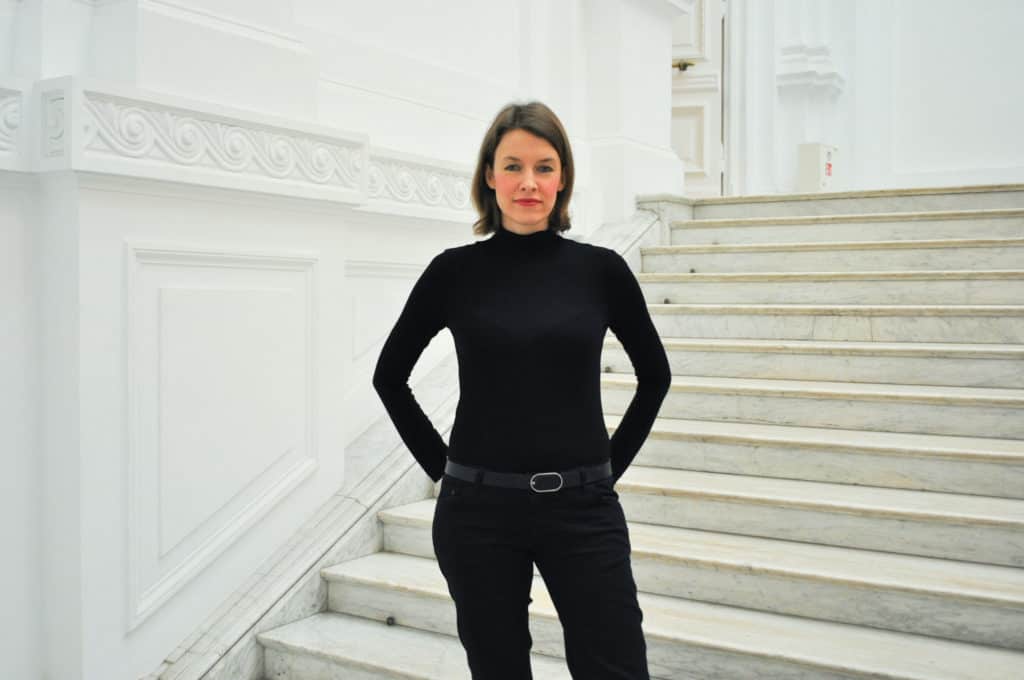


Anna Czarnota draws attention to concepts such as “doomscrolling” and “bed rotting”, two cultural and psychological phenomena that are mirrors of modern society and have their roots in technological advancement. The dynamic between the soul and the space within these concepts is what the artist takes a closer look at.
We met with Anna, a few days after the vernissage of her solo exhibition, No More Lies After 3 a.m., at Krupa Gallery in Wrocław. With the exhibition on display till November 15, the artist asks, “Why can’t nobody rest well anymore?”, and invites the audience to join the search through her art. We discuss the motifs in her works, the symbolic language, the space, and the soul.

Monika Juskowiak: What becomes the starting point for your painting – an emotion, an experience, an observation?
Anna Czarnota: It depends. I have paintings that started with an image I dreamt of, or that just popped into my head randomly. Sometimes I see something in real life, and that becomes a starting point, but as I enter the sketching process, I try to digest why this image means something to me. Then those emotions and thoughts come into the picture – and of course, they’re prioritised in my head above other aspects of a painting.
“As I enter the sketching process, I try to digest why this image means something to me. Then those emotions and thoughts come into the picture – and of course, they’re prioritised in my head above other aspects of a painting.”
— Anna Czarnota
M.J.: Motifs such as heads, dogs, or transforming surroundings appear frequently in your art. Do they form a personal symbolic language?
A.C.: Yes, I definitely try to create a language of sorts through those symbols. Those transformations, phantoms – they’re manifestations of this inner world of a person depicted in the “real” world. To somehow try and see what somebody feels. Or rather… What I feel, although I try to speak about very universal things, I’d like people to be able to relate to them.

M.J.: Concepts like doomscrolling and bed rotting are the key concepts in your solo show at Krupa Gallery. I’m wondering, how do you perceive the relationship between the human and the space it inhabits? For you, is it a real or a psychological space?
A.C.: Psychological space, for sure. And that’s really all there is to it.
M.J.: But, in your opinion, do concepts like doomscrolling and bed rotting serve as metaphors for modern emotional exhaustion? How do you translate that state into the language of your art?
A.C.: Well, to those two, I would add even more phrases like impostor syndrome, intrusive thoughts, and overstimulation. What I wanted to achieve through my exhibition at Krupa Gallery was to ask questions. Questions such as: why can’t anybody rest well anymore? And I don’t just mean sleep (although that’s important) – I mean truly unwind after work. Technology is an obvious first answer, scientifically proven even.
But I don’t hate the fact that I have a phone – it makes my life significantly easier. What I don’t like is this addiction to news, the wasting of emotions on so many things. And the idea of being accessible at all times. Like, I can respond to your email at 7:30 p.m. on Sunday, sure I can, but why should I? Every call and message is suddenly important, and if I don’t respond, I’m rude or whatever. Sometimes I just can’t. And I depict it very differently – probably a picture of my works would explain it better than I can with my words. But I use the language of symbols I mentioned before, and I’m trying to be kind of straightforward.

M.J.: In your paintings, the bed and domestic space become places of both rest and tension. What draws you to this motif?
A.C.: This ties nicely to the “Why can’t nobody rest well anymore?” question I posed for my exhibition. I previously said technology is an obvious first answer, but it’s not the only one. This tension in domestic spaces is something very personal to me because of my experiences. I feel like for many years, when I was younger, I tried very hard to run away from myself – however odd and abstract that might sound.
And so I was always doing something, just in constant movement, always going somewhere, always planning the next thing, the next chore even. Everything but just lying down – until it really caught up to me. Then I had to practically rewire my brain to accept that resting is not being lazy or something. And obviously, all of that happens inside a house, or because of something going on inside the house.
M.J.: The paintings shown at Krupa Gallery focus on the body. In your work, do you see the body more as a physical presence or as a vessel for emotions and symbols?
A.C.: Definitely as the latter, because while I paint mostly figuratively, the body itself isn’t the topic. Even the body-horror moments that exist in my paintings aren’t there because I’m trying to “touch” the body. In my mind, I’m always trying to touch souls – this inner world of a person.

M.J.: I’m really intrigued by the origins of the titles Samosąd (Self-judgement) and Abonent niedostępny (The number you are calling is currently unavailable), which I had the chance to see. What led you to choose these particular titles for those works?
A.C.: Samosąd was a pretty obvious title, because from the beginning I knew exactly that the painting was about that. So, very straightforward – but it fits well, so that’s the end of the story. Abonent niedostępny was meant to be a bit more humorous, and I like it that way, because in the painting, you get a clear answer why the number is unavailable – and I hope at least one person cracks a laugh at some point.
“In my mind, I’m always trying to touch souls – this inner world of a person.”
— Anna Czarnota
M.J.: Do you consider the emotional responses of viewers an integral part of your work – something that completes the dialogue – or do you prefer to see each painting as independent from interpretation?
A.C.: The audience’s response is always crucial for me, because it helps me see what sticks. And it’s reassuring too, especially when I’m wondering, “Will they get what feeling I was trying to evoke?” – and they actually do. That makes me proud. I get about a thousand ideas per minute, so honest feedback really helps me sort through all of it and pick a direction.

Anna Czarnota | No More Lies After 3 a.m.
September 27 – November 15, 2025
Krupa Gallery, Wrocław, Poland