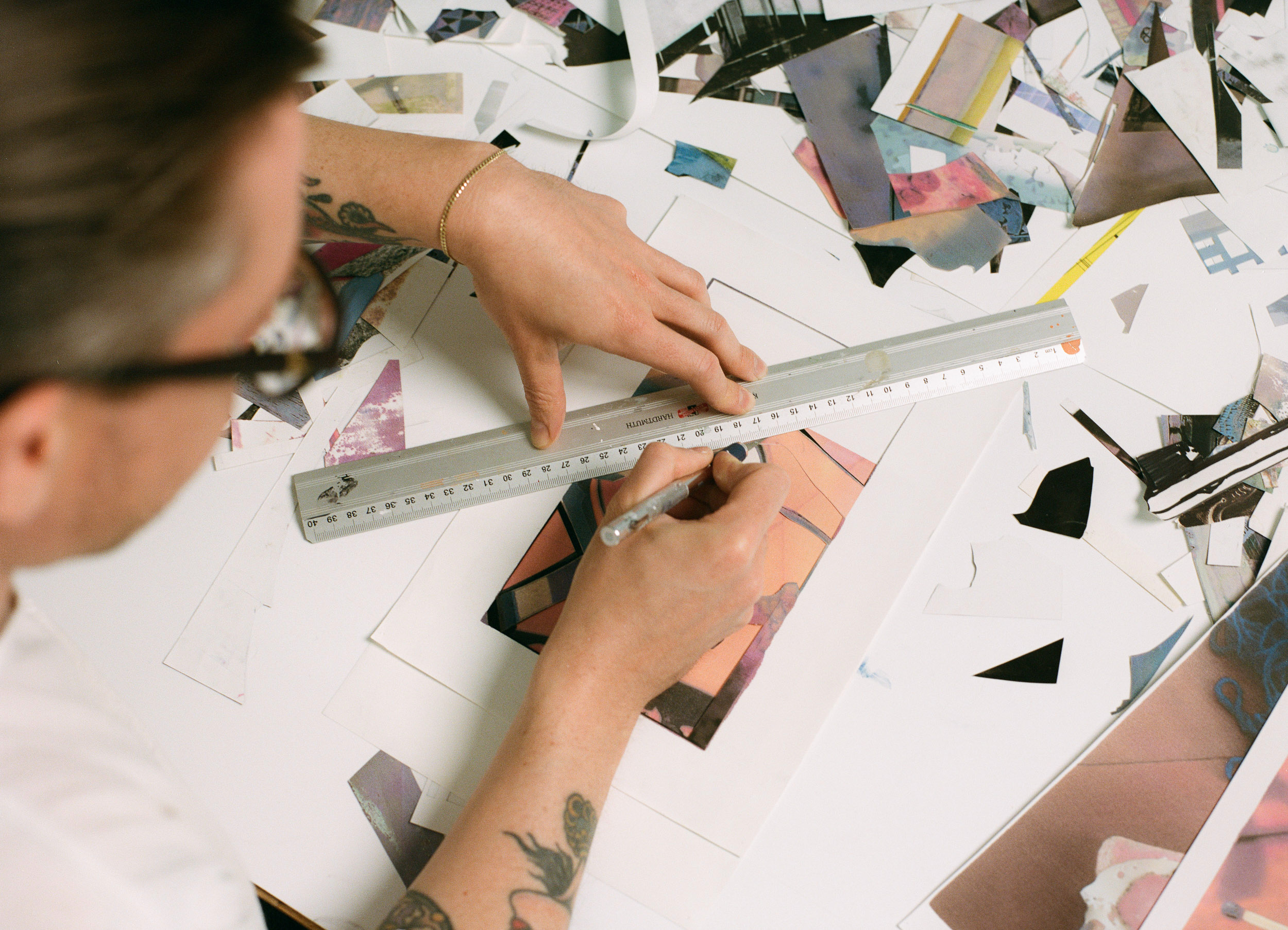
Maximilian Arnold (b. 1987) is a Berlin-based artist working primarily with collage and painting. His practice explores how the meaning of images shifts as they move across different media. Drawing on a personal archive of his own photography and found pictures, he transforms familiar forms until they create an altered visual experience and proposes an image detached from its prior context or intent.

It all starts in the forgotten corners of the artist’s smartphone. His personal archive of newspaper clippings, digital debris, and photographs is a living, raw material that feeds the first layer of the transformation process. Collage becomes a primary tool used to dislocate fragments from their original contexts — he cuts, rearranges, and recombines until anything recognizable morphs into an unfamiliar visual terrain. While Arnold’s work draws on the experimental traditions of painting, he brings this interest into the present, proposing a contemporary approach to reclaiming images.

Collage becomes a primary tool used to dislocate fragments from their original contexts — he cuts, rearranges, and recombines until anything recognizable morphs into an unfamiliar visual terrain.
Layers of Transformation
Printed onto stone paper using an almost obsolete inkjet printer, fragments of photographs, digital debris and Instagram stories acquire a new physical presence. Once cut apart and composed into collages, they are transferred onto canvas, forming the base for the next stage of the rebuilding. Paint is repeatedly applied, removed, wiped away, sanded and scratched across the surface. Beyond paintbrushes, Arnold opts for whatever tool gets the job done — cutters, sandpaper, spatulas, rags, sponges, plastic lids, and paint tubes. The process creates successive layers with traces of earlier stages remaining visible beneath the paint.

In Untitled (2024), this multi-step process makes the picture unfold coat by coat. A blue gradient draws the eye deeper into it, where further layers appear simultaneously beneath and alongside the image. The fragmented scenery becomes more pronounced through varied textures — rough, smooth, matte, and glossy areas sit side by side, lending the surface a stronger presence and making it an important part of how the piece is perceived.
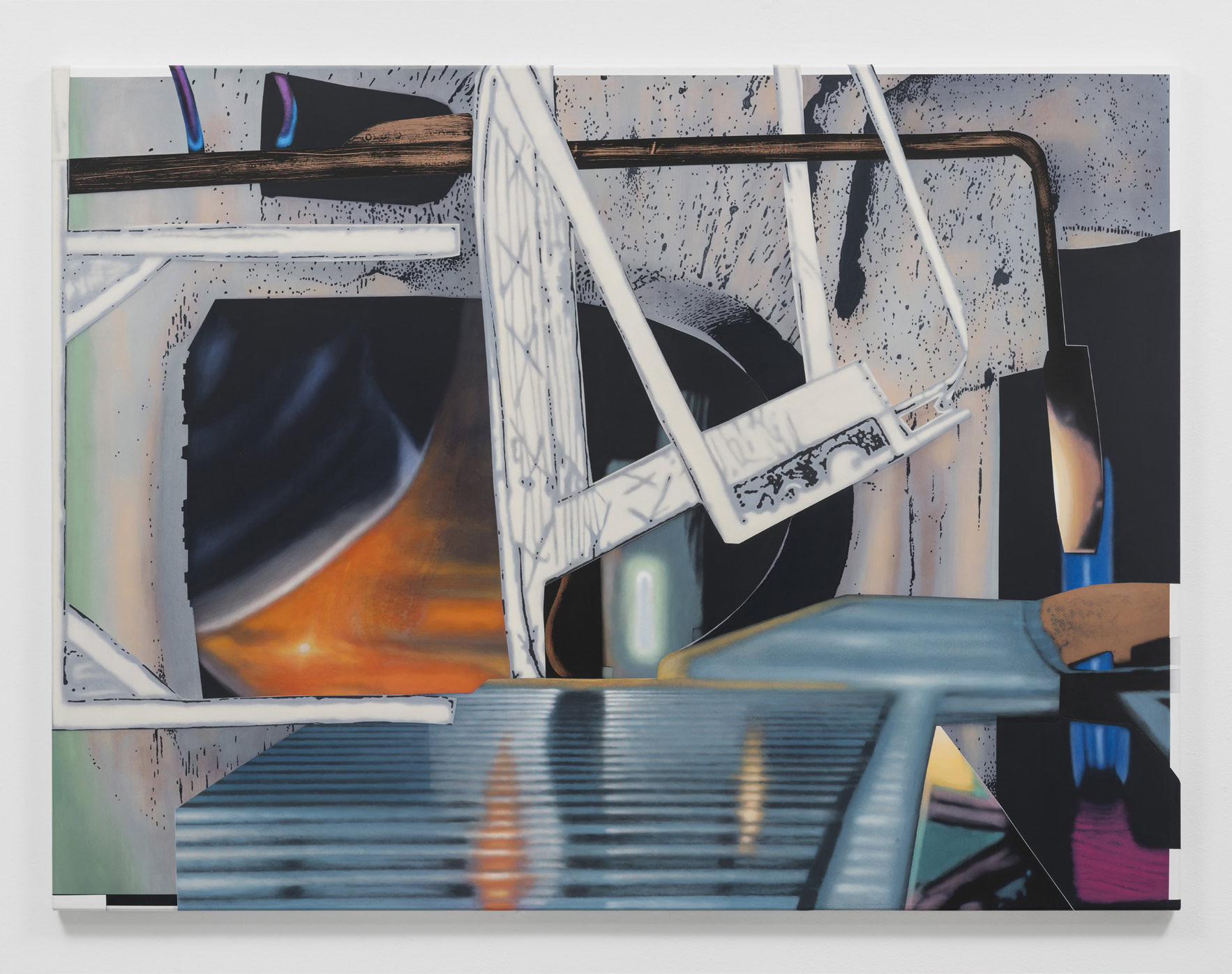
His collages bring together fragments that would normally have little connection, depicting a landscape of the digital era of over-saturation in which images, objects and references merge into one dense visual mass.
The imagery in Arnold’s paintings recalls the visual language of Surrealism, particularly its use of collage and the unexpected combination of unrelated images. However, instead of dreams and fantasies, traditionally associated with the movement, his source material is the overwhelming flow of information that surrounds us every day. His collages bring together fragments that would normally have little connection, depicting a landscape of the digital era of over-saturation in which images, objects and references merge into one dense visual mass.

Between Recognition and Uncertainty
While Arnold’s exhibitions and installations are often grouped under an overarching title, his individual paintings are often left untitled — the exhibition framing offers a sense of guidance, yet the moment you approach a single canvas, the safety net vanishes, leaving you to your own interpretation. Where the physical painting ends and the image begins also remains unclear.

In Untitled (2023), ghosts of the real world linger just beneath the surface — the sharp edge of what appears to be the piece of furniture or the vague outline of a leg. For a moment, the form seems recognizable, before dissolving in front of our eyes. It’s an irritating, fascinating game — the closer one looks, the more the image moves between something familiar and something that can’t quite be named.

Untitled from 2022 also sits in the space where recognition fails. We catch glimpses of familiar objects — rounded forms, a grid-like pattern at the bottom — but as soon as the mind tries to identify them, they slip back into the paint. Our perception is further unsettled by the composition: the rounded form in the centre draws the eye inward, while the geometric scenery above adds another sense of depth. Together, these elements cause the image to change constantly, shifting the way we read it with every look.

An Archive of Present
Arnold’s interest in discarded images responds to the overwhelming circulation of visual material in contemporary life, often flattened and accelerated. Photographs, advertisements, screenshots, newspapers, maps, flyers, and fragments encountered online accumulate so quickly that individual images become largely disposable.

The exhibition Freed from Desire (2025) presented in Matta, Milan slows this process down, inviting us to pause and actually look. Yet Arnold makes no attempt to retain presented snapshots in pristine condition. Instead, colorful, playful forms unfold before our eyes, with every close look revealing the layers and smooth color gradients.

In Arnold’s practice, an image moves from phone screen to collage, from collage to paint, and finally into a whole new kind of archive through social media again — one that carries the marks of every step before it. Misaligned, worn-out objects retain traces of the realities once attached to them. A tiny fragment that would otherwise vanish in the endless scroll is printed and given a physical form.
In Arnold’s practice, an image moves from phone screen to collage, from collage to paint, and finally into a whole new kind of archive through social media again — one that carries the marks of every step before it.
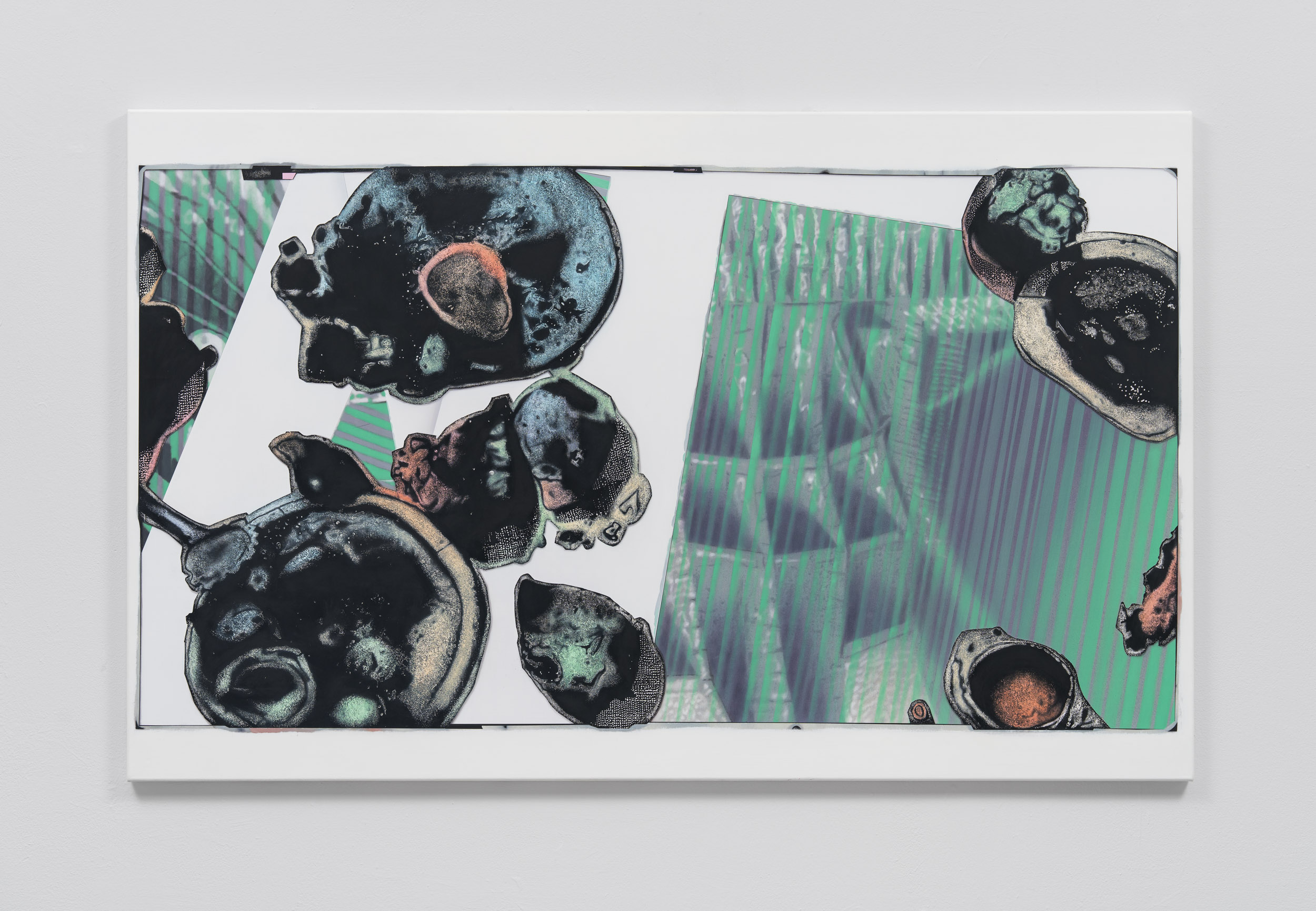
The time and effort put into Arnold’s practice stands in opposition to our culture’s obsession with speed and efficiency. His process is slow. Printing, cutting, sanding, assembling, and reassembling require a physical commitment that digital feeds lack. The surface acts as a record of what disappeared, and its physical presence allows us to stop, look and linger. This way, Arnold’s work becomes a quiet form of resistance to the constant flow of visual information.
BIO
Maximilian Arnold was born in Heidelberg and currently lives and works in Berlin. He studied at AdBK Karlsruhe and Städelschule Frankfurt am Main. His work has been featured in solo and group exhibitions internationally, with recent projects in Milan, New York and Paris, as well as art fairs including LISTE Basel and MiArt Milano. Alongside his studio practice, he will serve as an Interim Professor at AdBK Karlsruhe.