



Olivier Coisne, a French sculptor and visual artist, began his artistic journey as a designer working in metal, creating unique decorative elements for hotels and restaurants in France and abroad. His collaboration with renowned French artists Claude and François-Xavier Lalanne proved to be a turning point, reinforcing his commitment to art and sculpture. Since then, he has developed a practice that combines technical mastery with an exploration of nature, the environment and humanity’s impact on the world.
Today, his sculptures can be found in numerous private and public collections and are regularly presented at international art fairs in Paris. In 2025, his CUBE installation received recognition from the Société des Artistes Français and in 2026, his sculpture ImpAct received two awards at the Art Capital art fair at the Grand Palais, including the Prix Michel Dimon.
On the occasion of the opening of his exhibition ATONE LA LIBERTÉ, on view between 26 September and 31 October at DAgArt Galerie in Poznań, we sat down with Olivier to talk about his artistic process, the development of his relationship with materials, his inspirations that span the natural and the human-made environment, and how jellyfish can be a representation of the state of the world today.

Aleksandra Mainka-Pawłowska: You describe yourself as being “in the service of matter.” What does this mean to you in practice, and how has your relationship with metal evolved over the years?
Olivier Coisne: For me, working with the material means accepting that I cannot always impose a form on it. I start with an intention, a direction, but the metal has its own reactions, its own resistance, its own unexpected twists and turns. Over the years, I have learned to listen to them more closely.
At first, I was much more focused on mastering the material, particularly through metalwork and the object’s function. Today, my relationship with it has become freer. I heat, I melt, I pierce, I twist, I hammer, and I observe what happens. Heat can tear a sheet of bronze, create a void and fragility: almost something plant-like or living that I could never have drawn exactly in advance.
This way of working also aligns with my view of our relationship with nature: I believe we must learn to act with nature rather than against it, to respect its balances, and to ensure that our actions remain consistent with what it imposes on us. In my work, I try precisely to adopt this attitude towards the material.
My role, then, lies in what I decide to retain, transform or assemble. There is an element of control, but also an element of acceptance. It is in this sense that I say I am at the service of the material: I no longer seek merely to dominate it; I work with what it gives me. Over the years, this dialogue has become the heart of my work.
I believe we must learn to act with nature rather than against it, to respect its balances, and to ensure that our actions remain consistent with what it imposes on us. In my work, I try precisely to adopt this attitude towards the material.
AMP: In your early work, you combined functionality with artistic expression, while your practice today is primarily focused on sculpture. What prompted this transition, and do you still see a connection between your work as a designer and as an artist?
OC: My career path has primarily been in the craft trades and is highly technical. For many years, I was accustomed to designing everyday, mechanical or technical objects for companies, architects and large corporations. In my early designs, I therefore naturally combined function, technical expertise and aesthetics, particularly through décor and interior design projects for hotels and restaurants, including work for the Accor Group. I have also collaborated with natural history museums, creating reconstructions of animals and plants. That experience taught me a great deal about observing forms, materials and living organisms.
Over time, collaborations with gallery owners and my participation in art fairs led me to refocus my work towards a more fully artistic practice. But this evolution is not merely a response to market demand: above all, it reflects a personal and ethical progression in my creative process. Today, aesthetics remain the essential starting point. Then comes the meaning, the story and the reflection that I wish to imbue in each piece.
However, from my experience as a designer, I retain this commitment to construction, precision and technical mastery, which continues to inform my work as a sculptor.

AMP: In 1999, you collaborated with the Lalannes, a renowned French artist duo, who explored themes of nature and vegetation. What was that experience like and how did it affect your later artistic practice?
OC: I met Claude Lalanne and François-Xavier Lalanne when I was 24. My partner at the time – who went on to become the mother of my children – was studying for a postgraduate diploma in art history, focusing on Claude Lalanne. We were therefore fortunate enough to meet them and go on to develop quite a close relationship with them.
At that time, I was already working with metal, creating pieces that were both technical and aesthetic; I had started making sculptures and had already exhibited in Paris. But meeting them proved to be a turning point. Their career paths, their freedom, and the way they brought sculpture, nature, craftsmanship and major collaborations into dialogue showed me that it was possible to build an entire life around creativity.
We met up several times, and I even had the chance to work in their studio in Ury, near Fontainebleau, on an occasional basis, getting my hands on the tools, brass and bronze. For me, it was almost surreal. After that experience, I felt I no longer really had a choice: this was the path I wanted to follow. Sculpture offered immense freedom, a way of exploring all the subjects that interested me without being confined to a specific role or framework.
Even though I was only a tiny part of their world, that encounter deeply reinforced my commitment as an artist.

AMP: You transform metal through melting, twisting and bending. How much of your work is planned, and how much develops through a dialogue with the material itself?
OC: My process involves both a great deal of control and a great deal of letting go. It depends very much on the piece. Some works demand absolute precision, whilst others require leaving real scope for the material and the unexpected.
With ImpAct, for example, there is virtually no room for chance. The concept is highly technical, both in terms of cabinetmaking and joinery and in the aesthetic construction of the piece. Everything is calculated, measured to the millimetre and adjusted. The finish must be extremely precise, almost perfect. Even though wood remains a natural material, here it is completely under control.
An unexpected movement, a distortion, a break can become the starting point for something more authentic. Very often, the material itself transforms what seemed like a mistake into an integral part of the work.
Conversely, with Orienza, I work in a much more organic way. The sheets of metal are heated, shaped, melted and assembled, and I allow the material to find its own direction to a greater extent. I guide it, sometimes pushing it to its limits, but it can decide for itself to go beyond them. It is a way of working that is closer to nature, where not everything is perfectly controlled.
I have also learnt not to regard an accident as a mistake immediately. An unexpected movement, a distortion, a break can become the starting point for something more authentic. Very often, the material itself transforms what seemed like a mistake into an integral part of the work.
It is this tension between absolute control and letting go that fuels my work.

AMP: You have said that you have a tendency to “transcribe our natural and astral environment as it is today, in its transformation imposed by humans.” Where does this interest in nature, the environment and humanity’s impact on it come from?
OC: It’s not really a choice; it’s something that common sense dictates. If we listen to that common sense even a little, our actions should naturally be more in harmony with nature. I’m certainly not claiming to be perfect: I use materials that inevitably have an impact on the environment. I simply try to work in a way that minimises that impact as much as possible.
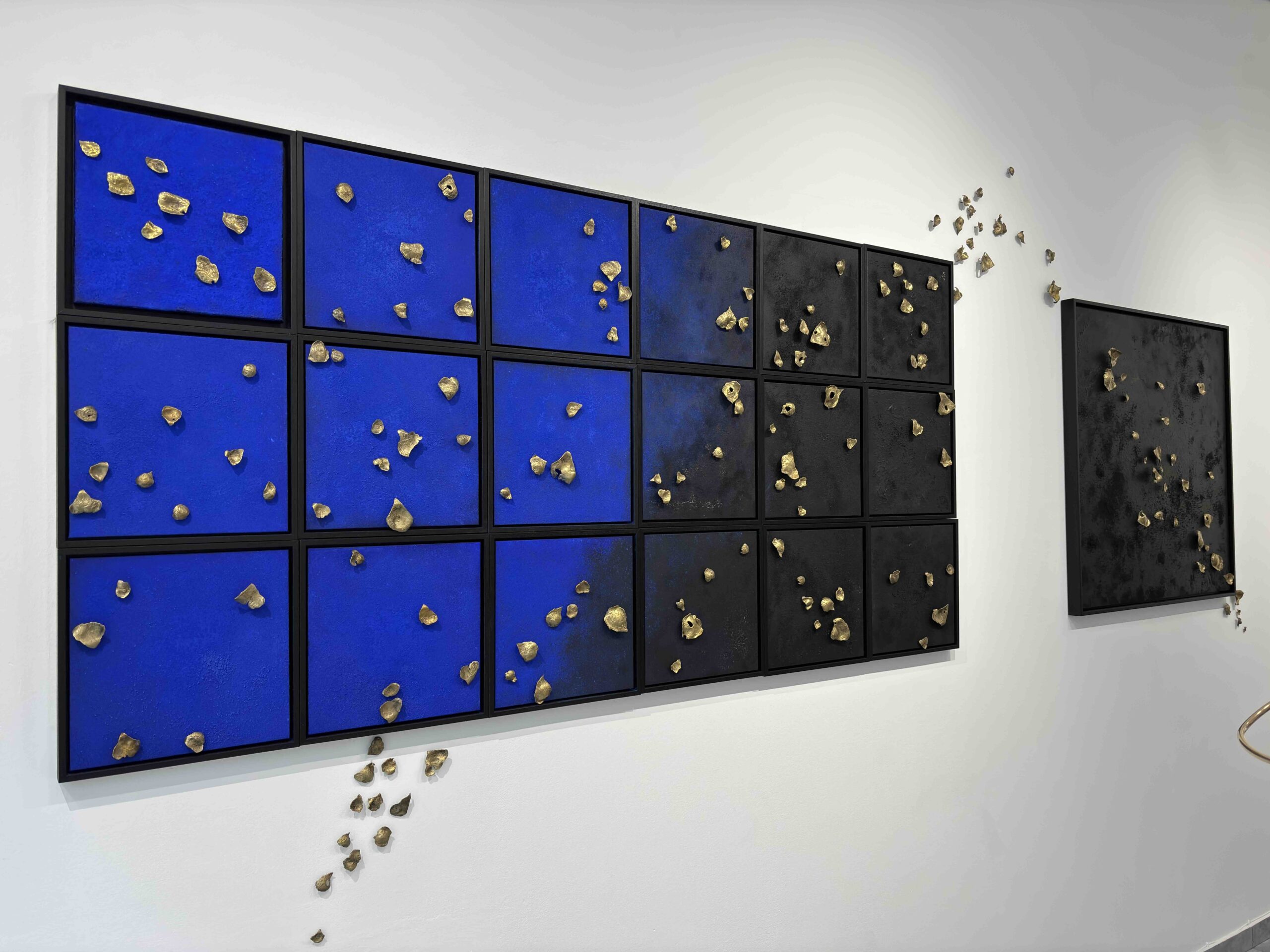
This way of thinking is directly reflected in my creations. With the jellyfish installations, for example – whether they’re displayed in cubes or as larger installations – I aim to highlight the fragility of the seas and oceans and the importance of protecting all the living things that inhabit them. The jellyfish thus becomes a symbol of this balance.
Plants also feature heavily in my work, as do natural cycles, particularly the lunar cycle, which profoundly influences our environment, the tides, rhythms and our perception of time.
What interests me is bringing back into focus things that are right in front of us every day but which we eventually cease to see, absorbed as we are by our routines and daily tasks. I try to make them visible again through highly aesthetic forms, because for me, nature remains the greatest source of beauty. And whatever I do, I know that my work will always fall short of what nature itself is capable of creating.

AMP: Your installation CUBE, with its blue metal jellyfish, uses the underwater world as a metaphor for overconsumption and the exploitation of nature. Why did the jellyfish become the central image for this work?
The jellyfish first appealed to me for aesthetic reasons and for its ability to create movement. Suspended from a thread, my jellyfish almost became mobile. There is this essential idea that sculpture can leave behind stillness and allow air, balance and an element of chance to constantly transform the perception of the work. This is something that speaks to me a great deal, because the seas and oceans themselves are in constant movement.
This allowed me to work around a single species while creating very different forms, sizes and movements. As soon as an object moves, it naturally attracts the eye, and this mobility makes the installation almost hypnotic.
But the jellyfish is also connected to something much more personal. As a child, I was lucky enough to regularly visit the South and stay with an elderly aunt who was very much an epicurean, and who introduced me to life in a completely different way from the one I knew in the north of France. It was there that I discovered the Oceanographic Museum of Monaco, the world of Cousteau and, above all, an aquarium of jellyfish in front of which I could spend hours. Their movement, their transparency, their strangeness fascinated me.
When I was in the North, I never missed a single one of Cousteau’s programmes. And as soon as I returned to the South, I would get into the water, put on a mask, and go and observe the underwater species. Jellyfish were much rarer than they are today, but whenever I spotted one, they had the same power to fascinate me. This childhood memory has remained very present in my work.
For me, the jellyfish is an almost magical creature. It belongs to an extremely ancient lineage and lives without a heart, lungs or a centralised brain. Despite this apparent fragility, it possesses an extraordinarily effective defence system. This contradiction between fragility, power and the capacity to adapt interests me enormously.
The blue of CUBE is not a blue chosen at random. It is a mixture of ultramarine blue and electric blue, intended to evoke the pelagic depths, but also the energy and power of this living creature.
Finally, the jellyfish has become for me a symbol of our impact on the oceans. Certain disturbances linked to global warming, overfishing or changes to ecosystems can encourage their proliferation. What interests me is that a creature that fascinated me as a child can today also serve as an indicator of our own imbalances.

AMP: In CUBE, each jellyfish disappears once it is sold, gradually emptying the installation in a way that mirrors the depletion of the oceans. How important is this interaction between artwork and collector to the piece’s meaning?
OC: When I created CUBE, my intention was to raise awareness of the state of the seas and oceans, but above all to highlight the link between their fragility and our own patterns of consumption and overconsumption. Here, the cube represents a closed, structured space, controlled by humankind, within which I symbolically place a part of the living world.
The collector then truly becomes an active participant in the artwork. When they acquire a jellyfish, it leaves the cube. The installation gradually becomes depleted, and the act of acquisition – which is normally something positive – also becomes a symbol of extraction.
This is exactly what I want to highlight: every action we take has a consequence. When we consume without thinking about what lies behind our actions, we sometimes contribute to the disappearance of living things ourselves.
The public therefore no longer merely views the artwork: they participate in its evolution and, in a sense, become responsible for what it conveys. The more jellyfish disappear, the more visible the message becomes.
And if we take this line of thought to its logical conclusion, if all the jellyfish eventually disappear, there will be nothing left to see. This is precisely where the message becomes most radical: when living things disappear, all that remains is an empty space.
Conversely, I also propose to recreate fragments of this world within everyday spaces: stairwells, walls, glass roofs or other architectural features. Each installation then becomes a part of this symbolic aquarium, a presence of marine life from the seas and oceans that we reintroduce into human spaces.
When we consume without thinking about what lies behind our actions, we sometimes contribute to the disappearance of living things ourselves.

AMP: You have received significant recognition at the Grand Palais in Paris, including awards for CUBE in 2025 and ImpAct in 2026. How have these recognitions affected you and your practice, and what are you focusing on now?
OC: Taking part in these major, long-established art fairs is very important to me. They are places where artists of all generations and working in all media can meet and exchange ideas. We share our thoughts there, but we also submit our work to the judgement of a jury and our peers. This aspect is essential, because these exhibitions are not built solely on a commercial basis: they are part of a long history of recognising artistic careers and creative output.
The Salon des Artistes Français, Comparaisons, the Salon d’Automne and the other major historic Parisian exhibitions have, each in their own way, supported generations of very different artists and movements. I believe this comparison is important because it also forces one to situate one’s own work within a history that extends beyond oneself.
Receiving awards for CUBE in 2025 and then for ImpAct in 2026 was therefore a source of real pride for me. Being recognised by my peers means that the aesthetic of my pieces, as well as their meaning and their commitment, resonated beyond my own perspective. This recognition gives me confidence, but it also compels me to go further.
I also attach great importance to longevity. I work with materials that can stand the test of time, and I would like some of my works to still be viewed by people several generations from now. A work speaks of its time, but if it endures, its meaning can evolve. What we view today through the lens of environmental issues, for example, may be perceived quite differently in a hundred or two hundred years’ time. I am deeply interested in the possibility that a work might continue to provoke reflection long after we are gone.
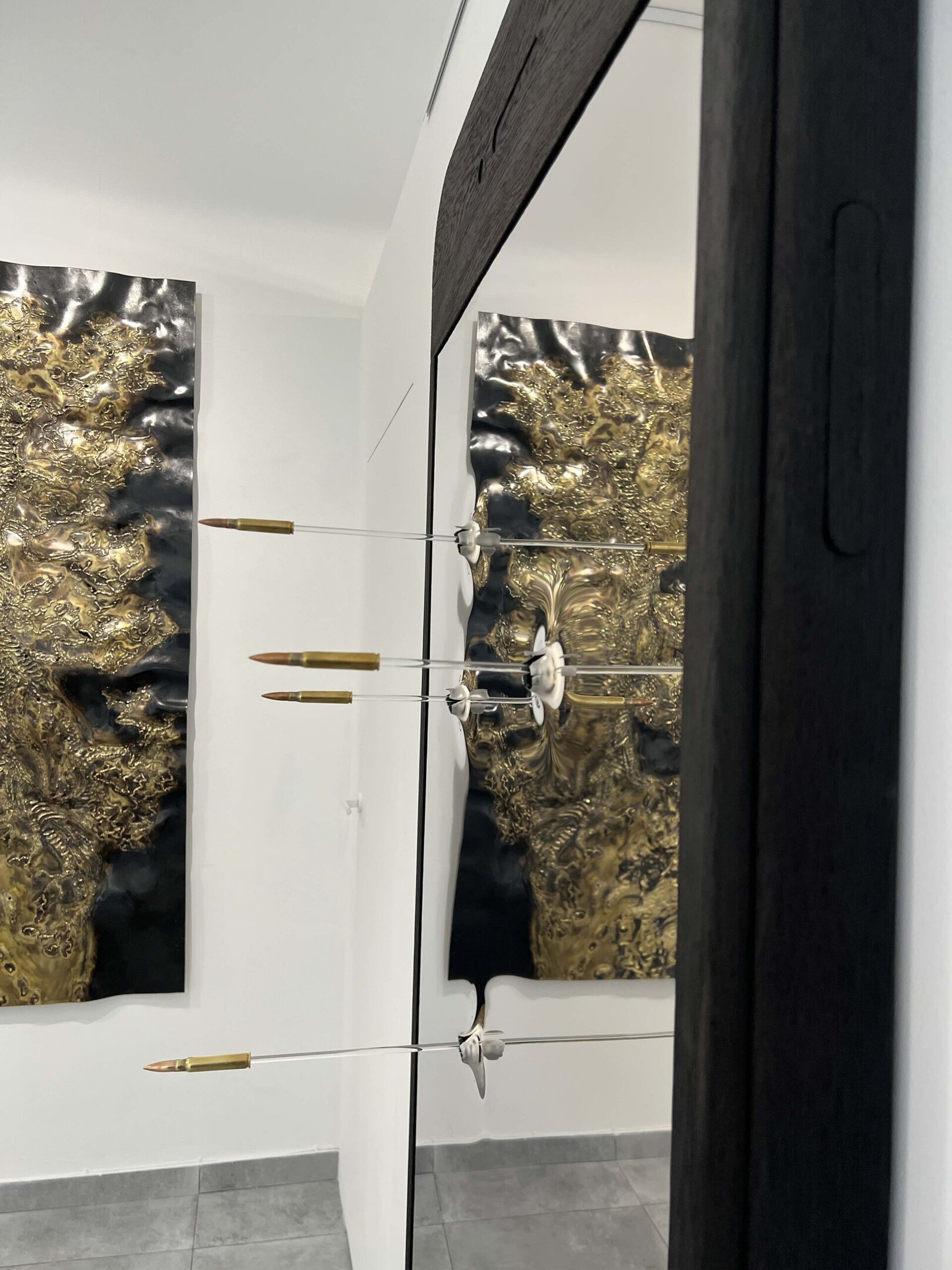
In this respect, ImpAct represents a real turning point in my work. I chose the silhouette of the iPhone 8, an object that has become almost mundane, given how ubiquitous the smartphone has become across all generations and practically everywhere in the world. Yet behind this mundanity lies a profound transformation in our relationship with time, with images, with one another and with ourselves. The smartphone offers us extraordinary possibilities, but it can also capture our attention, alter our perception of ourselves and create forms of dependency.
In ImpAct, the screen becomes a mirror. It directly reflects the viewer’s own image back to them. The balls, frozen just before they strike, embody this idea of impact and potential violence, but above all they pose a question: Who controls whom? The object, or the person looking at it?
To make the impact fully real, I fire live ammunition into the artwork: this deliberately violent act is essential to the concept. When acquiring the piece, the collector is invited to fire into their own artwork, becoming an active participant in its creation.
The title ImpAct, with the ‘I’ and ‘A’ highlighted, also introduces this new line of inquiry into artificial intelligence and the even more profound transformation of our relationship with screens. In a way, ImpAct captures a moment in our civilisation: the moment when the screen became an extension of ourselves. There will inevitably be an ‘after’, and it is precisely this space-time that I sought to capture in the work.
ImpAct is, in fact, not a static work: it was conceived as the beginning of a narrative. I first came up with the idea back in 2019, at the same time as CUBE, and then it took me nearly five years to find the right form – one that was powerful enough to convey the message without the visual intensity overshadowing the reflection.
Today, I wish to continue in this direction: creating works that are, first and foremost, aesthetically powerful, but which can also bear the mark of our era and convey a reflection to those who will view them after us.
So there will be a ‘post-ImpAct’ phase. Further pieces will explore the evolution of our relationship with screens, the moment when we are no longer merely facing the object but are actually bearing the consequences of it. The series is conceived as an evolving work that accompanies the transformation of our perception, our behaviour, and our relationship with this technology.
In ImpAct, the screen becomes a mirror. It directly reflects the viewer’s own image back to them. The balls, frozen just before they strike, embody this idea of impact and potential violence, but above all they pose a question: Who controls whom? The object, or the person looking at it?