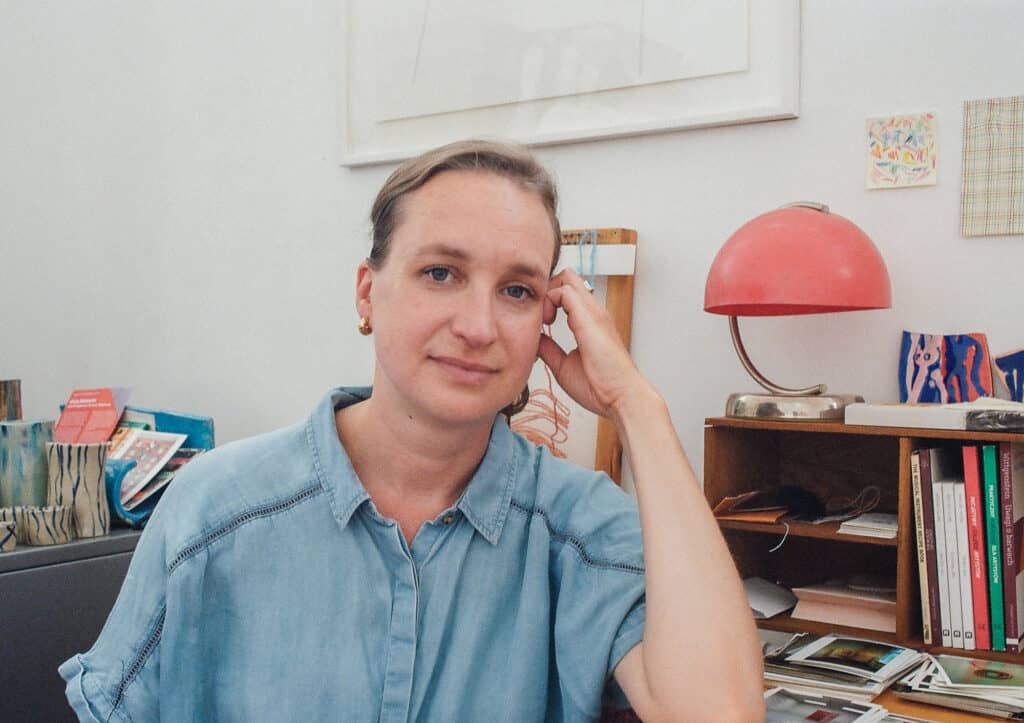
Šejla Kamerić (b. 1976), an artist living between Sarajevo (Bosnia and Herzegovina), Istria (Croatia), and Berlin (Germany), is profoundly attuned to the ambiguity of Eastern European art, having existed in a somewhat state of suspension – a buffer zone, simultaneously engaging with the discourse of the “global centre” while maintaining a sceptical distance, speaking from its outer margins. As such, she transforms it into the very foundation of her artistic inquiry. Navigating between the visual language of the West and her lived experience on the European “periphery”, Kamerić’s work critically engages familiar aesthetics with political urgency and emotional depth, firmly rooted in the specific time and place of its creation.

Kamerić employs media drawn from the public sphere: neon signs, mirrors, posters moved to the sterile spaces of art institutions. In the gallery, these well-known forms are stripped of their usual context and reinterpreted, entering into dialogue with the images that shape our everyday perceptions and imaginaries. A particularly telling example is her installation EU/Others (2000), initially conceived as a public intervention for Manifesta 3. At first glance, the sign evokes familiar associations: perhaps something glimpsed in passing, amid airport noise, or a border zone indicator. In a public or exhibition context, however, it provokes discomfort. Here, removed from its original environment and placed under closer scrutiny, the same sign reveals its full weight—not everyone has had the privilege to ignore such a marker. As often in Kamerić’s work, the symbol becomes a mirror in which viewers are invited to consider their own position.

The artist persistently plays with the visual memory of her audience. The neon piece Refugees Welcome (2022-2023) references a slogan once meant as a counter-narrative to populist, right-wing rhetoric – but in her hands, it becomes a site of tension. On second glance, one’s gaze recalibrates the intuitive reading: the neon flickers – letters spelling “ill” appear and disappear, reminding us that “welcome” may carry systemic sickness. The phrase shifts from speculative to assertive – refugees will come. Kamerić thereby critiques not only legal restrictions placed on migrants but also interrogates the limits of solidarity and the dehumanised discourse of rights, procedures, and permits that so often erases the visceral fact of wartime suffering.

Šejla Kamerić confronts the viewer with the emptiness of symbols, which, in the neoliberal Western discourse, serve as aesthetic gestures devoid of substance. In her installation Liberty Cursive (2015-2023), the sign glows with the sterile brightness of white light. From a distance, the word-promise of “liberty” draws us in, just as freedom itself is dangled before those who remain in darkness. Yet as the viewer approaches, once the eyes adjust to the glare, we see that each letter is studded with spikes, the kind used to deter pigeons in urban infrastructure. Above words lie actions. These expose the merely figurative nature of political slogans: the liberty offered may be an illusion – conditional and inaccessible to those who fail to meet the criteria.

As she herself notes, wryly: “Obviously, those letters need to be protected!… Protected even from the white pigeon – a symbol that stands for the word itself”. This symbolic hollowing-out recurs in Kamerić’s notable and widely discussed recent work, Cease (2024), a public installation in Venice’s Campo Santo Stefano, where a frayed white flag hangs at half-mast, mourning the paradoxical violence carried by the very idea of peace. It’s a “gesture of reprimand beyond truce, parley, or surrender”, as the artist states. The bold, eerily motionless, and monumental sculpture demands an unwavering commitment to vibrant life – a recurring theme in her work, shaped by experiences as a survivor of the Siege of Sarajevo. “A political message of peace”, highlighting the importance of such voices.

The artist also pays attention to the notion that to be a woman is to attend a masquerade. Kamerić views the world through the prism of her own body – an embodied experience of contemporary life. Conscious of her position as a woman-artist, she deconstructs mechanisms of the gaze, of dominance, of self-representation. As John Berger famously wrote: “Men act and women appear. Men look at women. Women watch themselves being looked at”. This burden of being seen has weighed upon Kamerić’s work since the early years of her practice.

Perhaps her most well-known piece is Bosnian Girl (2003), a self-portrait in response to a message left by a Dutch peacekeeping soldier on a wall in Sarajevo: “No teeth? A moustache? Smell like shit? Bosnian girl”. Kamerić rejects this gaze by confronting it directly. Her image stares back. Conscious and unflinching. Who writes the narrative of the “Bosnian girl”? The piece layers two stories: one of being represented, and that of self-representation. In doing so, it asks not just how women from the Balkans have been imagined, but how art might resist such projections through acts of self-definition and image reclamation.

In Kamerić’s practice, both gaze and symbol are never neutral. They construct, discipline, and inscribe themselves directly onto the body. The female figure becomes a site of accumulated anxiety – pregnancy, domesticity, desire, danger – narratives that the artist takes onto her own body, where imposed gazes and symbols accumulate. Like in We Come With a Bow (2019), the recurring symbol of the bow serves as a visual shorthand for femininity, simultaneously ornamental and oppressive – a double sign: charming on the surface, yet a commodified identity; a symbol whose excessive sweetness begins to taste bitter.

Kamerić works with the language of contemporary symbols to put them to the test, stripping away their superficial appeal and confronting their hidden weight. Her art challenges the slogans and aesthetic simplifications that dominate today’s visual landscape. In a world oversaturated with signs and images, the artist proposes an act of renewed looking, more attentive, no longer automatic, perhaps even with a dose of suspicion, to reclaim one’s own perspective and to consciously position oneself in relation to what is external.