






What does it mean to belong to a place when that place is constantly moving? And what happens when a life disappears from view before it can be remembered? These questions sit beneath Xianzhuyue Li’s photography, where belonging is never entirely secure, and visibility is never guaranteed. Her photographs move between communities, waterways and landscapes, attending to the lives, histories and forms of labour that exist beyond the centre of attention.
Li’s practice is grounded in prolonged encounters. She spends time within communities, listens to personal stories and builds relationships before making photographs, allowing the circumstances surrounding her subjects to become part of the work. This process gives her images a particular attentiveness to what accumulates slowly: the objects through which a home is maintained, the memories attached to a landscape, the routines that hold a community together, or the traces of life that might otherwise go unrecorded.
This approach gives Li’s work a particular sensitivity to lives encountered at the edges of larger social narratives. Her photographs move between portraiture, landscape and observational photography, examining mobility, migration, collective memory and the environments people inhabit. Across her practice, home is not treated as a fixed geographical condition — it can be carried, rebuilt, remembered and reimagined through relationships, labour, objects and everyday rituals.

Two recent exhibitions, BE SEEN (2025), presented at Coningsby Gallery, and Off Land (2026), presented at Four Corners Gallery, demonstrate the breadth of this inquiry. Although their subjects are markedly different, the dead birds of Skomer Island in BE SEEN and communities living along Britain’s inland waterways in Off Land both consider visibility, vulnerability and the conditions under which lives are acknowledged or overlooked.
Off Land: A Home in Motion
Floating Homes, Moving Lives, presented as part of Off Land at Four Corners Gallery, follows Britain’s canal network from London to the North of England. The canal boat becomes the central site through which Li considers the relationship between mobility and domestic life. Here, movement changes the conditions through which stability associated with home is produced.

Without a fixed address, home is established through the daily acts that sustain it. Labour, care and memory become embedded within the boats themselves, which are continually maintained and transformed by the people who inhabit them. Objects, bodies and domestic spaces accumulate as records of lived experience, turning the boats into mobile archives shaped by the histories carried within them.
Women’s labour forms an important thread within the project, connecting the working histories of Britain’s waterways with the communities that sustain them today. Li connects the history of the ‘Idle Women’, who worked on the canals during the Second World War, with women today who preserve waterway histories, maintain boats, continue decorative and craft traditions and support their communities. The waterways consequently carry histories of work and collective life that remain active in the present.

This makes the boat more than a setting for the photographs. It becomes a structure through which Li examines how belonging can be maintained without geographical permanence. The reference to Michel Foucault’s description of the boat as a space that exists within social order while also exceeding its fixed boundaries further complicates this relationship between movement and belonging. In Off Land, mobility becomes a condition through which home is continually made and sustained.
BE SEEN: Death at the Margins
BE SEEN, presented at Coningsby Gallery in October 2025, considers the vulnerability of wildlife through a series of photographs made on Skomer Island. The project centres on dead birds encountered on the island, where the physical delicacy of the birds is set against the raw, graphic textures of the moorland. The resulting images establish a visual dialogue between beauty, death and the natural environment.

The position from which Li photographs these bodies is central to how the work unfolds. Viewed from above, the birds might initially appear as objects within the landscape, subject to the detached gaze of the camera. Yet Li describes making the photographs while bent low, close to the ground. This proximity alters the relationship between the photographer and the subject: the viewpoint is not one of distant observation, but of physical closeness to the remains. Li describes this posture as resembling a brief salute or act of mourning, giving the images an elegiac quality.
Death is the first register of the series, but Li uses these encounters to consider how loss is seen and recorded. The distribution of dead birds across Skomer Island becomes significant: those found at the centre are more likely to be noticed and documented, while those at the edges can disappear without trace. Li connects this uneven visibility to the experience of lives at society’s margins, where absence from the record can become a form of erasure.

The photographs also recall a longer visual tradition in which the bodies of dead birds were used to contemplate mortality. Victorian artists frequently incorporated dead game and birds into elaborate still-life compositions, transforming the remains of animals into carefully arranged images of beauty, fragility and death. Li’s photographs engage with this history through a contemporary ecological context. The birds remain physically present within the landscape, yet their vulnerability is inseparable from the environmental conditions shaping their deaths. In this sense, the work brings an established aesthetic language of mortality into contact with the realities of ecological decline.
Li’s treatment of the birds therefore complicates the conventional still-life encounter with death. The bodies remain within the landscape, photographed from a position that brings the viewer into proximity with their remains. The image consequently becomes concerned not only with mortality, but with the act of looking itself: what enters the frame, what is recorded, and what remains beyond it.

Between Place and Disappearance
Seen alongside her earlier projects, Off Land and BE SEEN reveal the range of Li’s photographic practice. Waiting Under Blue (2024) examines temporary communities formed through waiting, where relationships emerge briefly before quietly disappearing; Common Ground (2023) considers strangers sharing urban spaces despite difference and anonymity; Tuan Yuan (Reunion) (2022) turns to food and everyday rituals of care as a means of reconnecting families; while City Surfer (2021) follows urban surfers negotiating a relationship between the city and the sea.

Across these works, Li gives sustained attention to the particularities of where people live, gather, move and remember. A canal boat, an island, a city street, a shoreline or a family table becomes a site through which the character of a place can be understood. Her photographs remain close to these environments and the details within them, allowing histories and relationships to emerge without being separated from the circumstances in which they are formed.
This attentiveness is central to the strength of Li’s practice. She gives significance to what can easily become peripheral and asks the viewer to look closely and for long enough for these details to acquire weight. The result is a body of work attentive to what remains, what is carried forward and what can disappear from view — photographs that insist that the seemingly ordinary is often where a place reveals its deepest histories.

BIO:
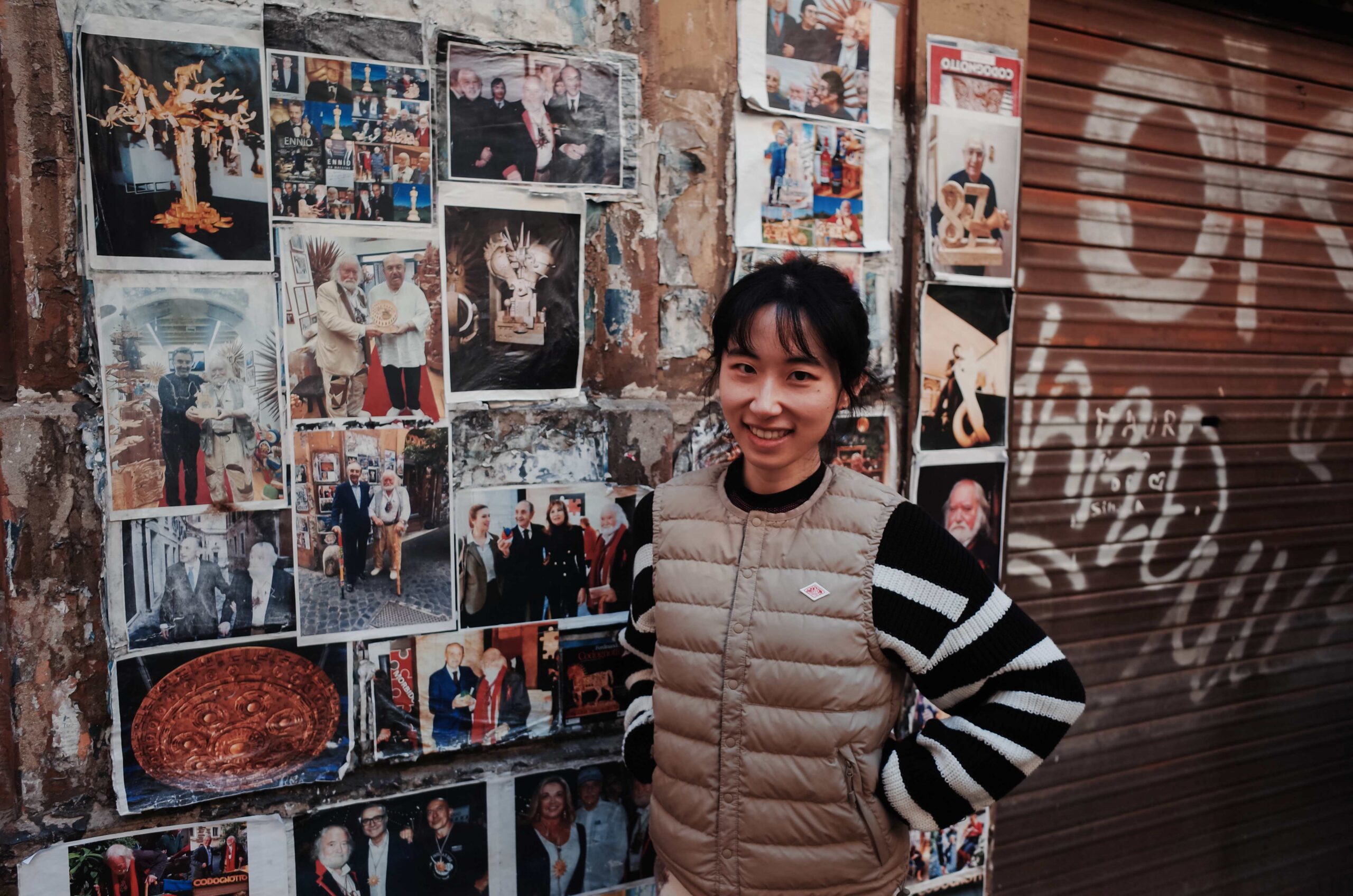
Xianzhuyue Li is a London-based photographer and visual artist. She holds an MA in Design Futures from the Royal College of Art in London and a BA in Fashion Design from the Beijing Institute of Fashion Technology. Her work has been exhibited across the UK and internationally, including solo exhibitions at Four Corners Gallery and Coningsby Gallery in London. Li was a finalist in the 2026 ProgresFestival – The Visual Memory of Protest and received an Honourable Mention at the 2025 Paris International Street Photography Awards and Runner-up at the 2025 Harrow Photographer of the Year Awards. Her work has also been featured in F-Stop Magazine and Visual Poetry Journal.