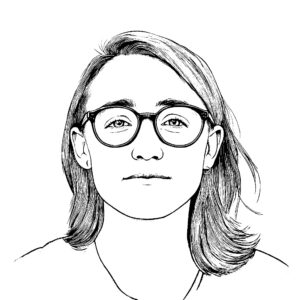
Vero Córdoba’s experimental artistic practice is grounded in explorations of landscape and interactions between body and mind. Her research into the sourcing and use of wild clay in traditional ceramic practices across Latin America leads her to work directly with earth, rocks, and found materials, treating them as carriers of histories that extend beyond human time scales. Through collecting, preserving, and transforming these elements, she explores the relationship between embodied experience and deep geological time. Her visual language is grounded in care, respect, and autonomy of the materials and traditions she works with.

The artist has incorporated these practices and values in Rocas Raras, a research-driven ceramic studio based in Traslasierra, Argentina. The studio operates at the intersection of art, craft, and research, and is dedicated to small-scale work with locally sourced clays and materials. Through training programs, residencies, publications, and a small exhibition space, it fosters embodied forms of knowledge-making and the idea of free sharing of ceramic practice as a living and evolving craft. Its aim is to create conditions for matter and human creativity to meet through artistic expression.
Her work, Paisajes Ígneos, was recently shown at the 112th edition of the Salón Nacional de Artes Visuales in Buenos Aires — the oldest and most prestigious national cultural competition in Argentina. Organized by the Palais de Glace together with the National Secretariat of Culture, it showcases the works of visual artists across multiple disciplines. Following the exhibition, we sat down with Vero Córdoba to discuss her artistic practice, the relationship with natural materials, and the role of clay in her work.

AG: In your approach to ceramics, you stress the importance of learning by doing. Your body, with all its senses and memories, becomes a tool for engaging with the soil. As you study the landscape, your material imagination becomes enriched, widened, and amplified. In consequence, we can perceive your creative process as a translation — or a generation of knowledge — thanks to the interplay between the material and your creative agency. Is that the foundation on which you build your works?
VC: That is what I feel in that practice — there is a physical, bodily, emotional sensation of simply being there. Then, from the construction of meaning, I can identify the information that comes into play at that moment: a link to something ancient, archaic, ancestral in humanity that, in our contemporary condition, we rarely find ourselves aligned with.

AG: I find it very special — this idea that making is questioning, making is learning. In this practice of beginning, activating things, and doing things with the material and the body, questions start to open up, and answers start to emerge. How do you know what to ask? How do you know that you already know?
VC: I’m not sure I actually know, to be honest. It’s more of an orientation for practice and perhaps a way of thinking that, through making, one can also construct knowledge. That knowing and doing go hand in hand, even if we don’t always arrive at a full conceptualization of that making.
I first encountered these perspectives through social interaction, community-oriented work, and popular education, which was based on a line of thought in contemporary democratic pedagogy. This way of thinking has very strong roots and present-day relevance in the Latin American context. Following the premises of radical pedagogy proposed by Brazilian educator and philosopher Paulo Freire, I sought to connect with the environment and with others in order to experience change, and from there I wanted to build knowledge oriented toward social action and practice, in the hope of transforming communities and reality.
I had the sense that working from a place of questioning as it is done within popular pedagogy, one could gain autonomy in one’s own process and construct a know-how that stems from the experience. So I began being more attentive to this back-and-forth between making and body, clay matter and body, time and body.
When I turned to ceramics, the teaching style was quite technical and dogmatic: “This is how it’s done. It’s in the book. You should follow the process and apply rigidly each step prescribed by the technology in order to succeed”. It was very common to transmit traditional methods either in ceramics schools or at workshops in this way by passing a consolidated body of knowledge in a largely vertical manner from masters to apprentices.
I wanted to modify it. I had the sense that working from a place of questioning as it is done within popular pedagogy, one could gain autonomy in one’s own process and construct a know-how that stems from the experience. So I began being more attentive to this back-and-forth between making and body, clay matter and body, time and body. As a result, small cracks started to appear in that consolidated knowledge of traditional ceramics that I had to acquire before. More experiential and experimental methods have been developed.

AG: How has your own body guided you in this process? What has happened in the interaction with the material that has made you more aware both of your embodied power and of the counterpower, placed within the clay?
VC: It is something I’ve been reflecting on a lot in recent years — an idea of contact, the sense that the work one does with the earth, with the material, is in some way a bodily work. It is an interaction between the human body and the body of the earth. A question I’d been mulling over in my mind is: how do you teach someone to caress a child, or to hug their mother? How can we really determine how to touch the earth?
Traditional teachings with their focus on technique often predetermine how that body-to-body contact should be modeled and practiced. But not all mothers hug their children the same way; physical affection with a partner is expressed differently by humans— these exchanges are experiential, singular, and subjective. And from there, a zone of indetermination opens up, where each person finds their own way of contacting the earthly material. If we become more receptive to that uncertainty, a wide range of responses can emerge.
We can apply this intimate, physical approach to our interactions with the body of the earth. We begin by building knowledge through lived experience and only later supplement it with technique.

AG: How do we build that know-how by questioning ourselves in embodied experience?
VC: These are things I sometimes find hard to translate clearly into words, but it’s helpful to ask some very simple questions: what happens when my body imprints a form, when I pay attention to the interaction between my hand and the material while shaping? Such questions allow us to go deeper into things we sometimes automate — a pinch is made this way, a coil technique is done this way. I trust that by inviting these observations, a construction of knowledge and know-how will take place, followed by technical information, such as: if you use too much water, the material loses consistency and stability. That information is coming a priori. What is added within the creative process is the awareness and attention to bodily reaction as we introduce and apply traditional methods.

AG: This autonomy to create develops and expands — this zone of what you can do, of what you can understand about your surroundings — because you start to trust that your body receives certain sensations from the material, and you can trust what your hands are feeling. Is that right?
VC: Yes — trusting that the body knows. We could call it intuition, though that word gets used in many ways and sometimes sounds a bit mystical. I’m interested in thinking of it perhaps as a knowledge of the body, a know-how. There is information that hasn’t been fully rationalized yet, hasn’t been elaborated in more complex terms of thought or conceptualization — but the body knows. The body understands.
This happens in more extreme situations, too. I’ve experienced it in childbirth — my mind had information, but in that moment I felt my body knew what was happening in a way I couldn’t later rationalize. Or on a hike in the hills in a thorny area, where suddenly my whole body is disposed to movements that afterward I might wonder how I managed. My body adjusted to get out of that situation with a kind of information that, in my interpretation, is at a genetic, evolutionary level.

AG: How does your proximity to ancestral cultures and ceramic traditions impact the way you work?
VC: For me, as an urban, mestiza Argentine woman, it was like a rediscovery of a whole range of artisanal and indigenous practices that persevere and resist erasure. I have never sought cultural appropriation — I would not say “I make Mapuche ceramics” or “I make Diaguita ceramics” — because I understand that my identity is not built within the framework of an indigenous community. I have great respect for that, but I understand my task, in my mixed mestiza condition, as being able to recognize this web of practices, knowledges, patterns that has been sustained by indigenous people and traditional artisanal communities — a web that colonization tried to destroy through silencing, invisibilization, and denigration of their work and worldview. That thread is still there, latent.
When I look, study, connect, and share with traditional artisanal communities, it’s always from this place of respect and curiosity about what they are doing with the earth today and how it is sustained — rather than how I can replicate old patterns or reproduce traditional forms.
So I want to be conscious of the ways I can connect with these practices while recognizing myself in my own mestiza identity, so that this web continues to live. I can in no way call myself someone who makes ancestral ceramics, but as a member of a diverse artisanal community, I think I can contribute to sustaining this framework by being carefully grounded in my own practice and the meaning it gives me. When I look, study, connect, and share with traditional artisanal communities, it’s always from this place of respect and curiosity about what they are doing with the earth today and how it is sustained — rather than how I can replicate old patterns or reproduce traditional forms.

AG: The other important reference in your practice is the territory. You are based in Córdoba, Argentina. How important is the context within which you are situated to you?
VC: I live in Traslasierra — it’s my space of daily life, affections, sensory connection, and experience. What drives my practice are concrete actions in the territory, with what it offers, what its limits are — often also as coordinates within which a practice can unfold.

AG: This respect for boundaries — between you and the territory, and between you and the ancestral practices — has in fact allowed you to reach greater autonomy in the field of ceramics, and forced you to take a path that is not conventional. How do you define this respect? How do you translate it into approach, action, attitude?
VC: I’m not sure there’s a certainty about respect, in the sense of being able to say “I am respecting” as a strong discursive affirmation. But yes, for me, acts of care have to do with practicing and taking responsibility for how I obtain materials. So unless I were going with someone who invited me to those spaces, I wouldn’t go on my own to take clay from there. Similarly, there is something in me that leads me to share those spaces in a real, effective way. It has happened many times that someone says, “I’m in Traslasierra; send me the coordinates of the deposit.” My response is: “But that’s not how I work — come over one day, we’ll go to the deposit together, share that moment, talk, and reflect on the making.” For me, that’s where it gains meaning and limits extractivism.
I’m interested in having a map of where the clays are so that everyone can freely go get them when they are sure they will use them — not out of selfishness, but out of recognizing the importance those spaces hold for the people who inhabit them. I am interested in contributing by revealing threats to traditional ceramic practice, rather than saying: “Black ceramics from Traslasierra are at risk, so I’ll start making all black ceramics to keep this alive.” From my previous experience with community work, there’s something similar in that gesture to men trying to rescue women — one can contribute to the struggles for social justice, freedom from violence, but it’s not one’s banner to carry, because one is not in that position. I believe the respect lies in the attitude of listening and dialogue, and in asking: how much do I really need to take? I feel a responsibility at the social, cultural, and community levels — one that is rooted not in appropriation and replication, but in listening and sharing in those struggles.
I feel a responsibility at the social, cultural, and community levels — one that is rooted not in appropriation and replication, but in listening and sharing in those struggles.