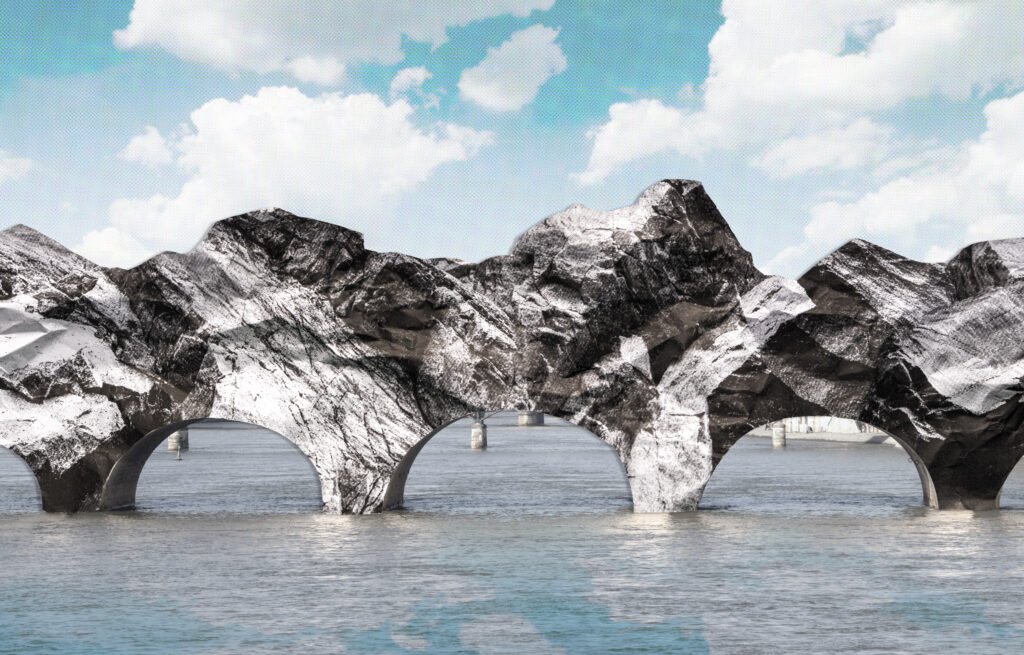
Iza Tarasewicz’s installations and sculptural environments are shaped by processes of constant transformation of the natural world: growth, decay, circulation. They challenge categories used to organise reality and inspire us to experience the world as a network of constantly shifting relationships. Rooted in material experimentation and informed by ideas drawn from science, philosophy, sociology or ecology, her work reveals the often invisible connections between the individual and the collective, the human and the non-human, or the body and the environment.

On view at 66P Subjective Institution of Culture in Wrocław and curated by Piotr Lisowski, Boom raises questions of how to redefine these relationships in a reality marked by environmental crisis. The exhibition examines the systems we create in an attempt to organise the world around us, while questioning how stable these structures really are. Can chaos ever be mastered, or is uncertainty an inevitable condition of existence? Are we able to think beyond established frameworks? We sat down with Iza Tarasewicz to reflect on these issues and the importance of interdependence and community in navigating the uncertainty of the present historic moment.

Kuba Żary: In terms of its structure — not just its scenography — Boom seems to me to be built on a tension between the installation Arena, which surrounds the whole space, and what lies within it. Arena is clearly distinct, both materially and conceptually: it speaks of an attempt at social negotiation, of bringing order to chaos. It concerns what we already know, or aim to name together. Everything inside, by contrast, leads us towards what we try to discover — towards what may lie beyond the limits of our understanding, yet still affects us.
Iza Tarasewicz: The exhibition at 66P brings together works created at different moments. The introduction leads through the installation Arena, which has a long history and has already appeared in various iterations. I created its first version in 2014; in 2018, the largest, industrially produced version was made — eight hundred metres of black silicone rope, which I wrapped around the façade of Warsaw’s Zachęta. This was at the beginning of Piotr Gliński’s tenure as Minister of Culture — a conservative politician whose appointment marked a clear political shift in the cultural field — so the gesture carried a provocative question: what’s next for culture? Later, I moved Arena to various public and private institutions, still asking the same question: what is the role of culture? Is culture still an arena?

Arena is, in fact, a work about the essence of democracy. When I was thinking about how to outline this idea, the starting point was a closed loop — a kind of Greek agora where ideas circulated and the first democracy began to take shape. However, in my version, the loop is tangled. In an abstract way, I address the subject of our freedom: the fact that it remains unsettled, challenging and prone to tension. This loop is intended to provoke disorientation. I feel that we are currently experiencing a collision of accumulated geopolitical crises, but also personal ones, because global processes have a very strong impact on our lives. I introduce viewers to the exhibition precisely through this entanglement — through a chaos that needs to be unravelled, but at the same time offers tools for thinking about it.
I feel that we are currently experiencing a collision of accumulated geopolitical crises, but also personal ones, because global processes have a very strong impact on our lives. I introduce viewers to the exhibition precisely through this entanglement — through a chaos that needs to be unravelled, but at the same time offers tools for thinking about it.
It has always functioned as a frame for the exhibitions, but also as a kind of decoration or set design. Each time, however, it wound its way through the space differently. I am intrigued by the idea of showing it in a different place and seeing how people interpret it. At 66P, I wanted to balance it: to bring the chaos down from above our heads to the ground, to literally ground it. This is important to me because in previous presentations, Arena was monumental, suspended high above the ground; it never touched it. Now I wanted to load this heavy, industrial rope even further, to give it more weight.

KŻ: When you were showing me around the exhibition, you kept returning to the idea of ‘grounding’. Given that with each successive presentation the works unfold, or wind, quite differently and become imbued with additional meanings, I can’t help but ask: why do they seem to be drawn towards the ground this time?
IT: This definitely corresponds to widespread overstimulation, overload and exhaustion. In this exhibition, Arena is also a visualisation of the weight resting on our shoulders: all the conflicts and wars raging around us. Even if we are lucky enough not to be directly affected by them at this moment, they still make our souls rot. I feel this weight; we all feel it. That is why I wanted to overload Arena and place it on the same level as the installation, On the Construction of the Heavens — a work based on the concept of reading the heavens, which here also descends from on high.

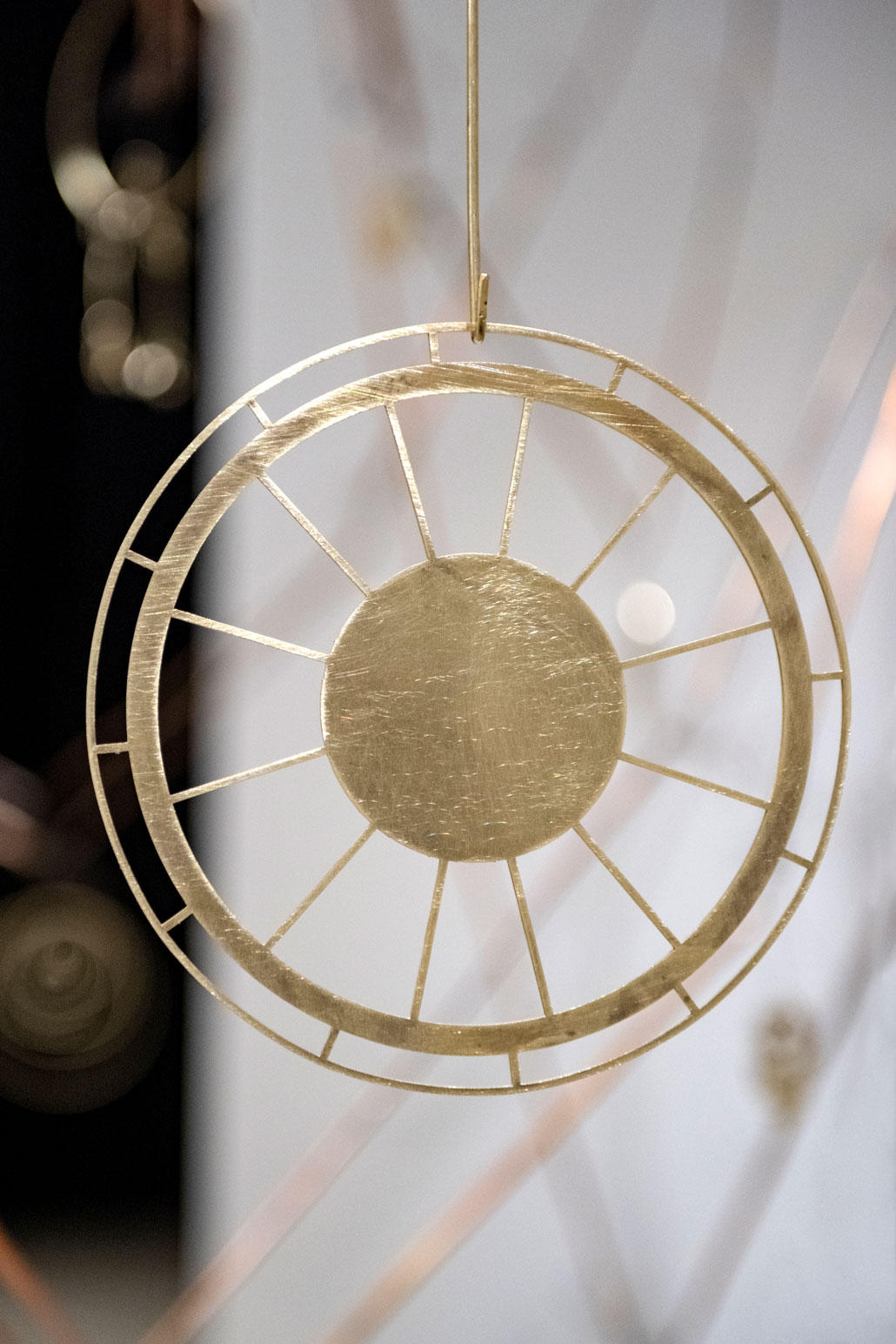
This installation stems from the fusion of astronomy and astrology, which for centuries was one of the ways of seeking answers to questions about the world around us. During the Renaissance, astronomy and astrology began to diverge. On the Construction of the Heavens is, accordingly, multifaceted in nature: the cloud of metal symbols features allegories drawn from various notations and systems. There are signs straight from horoscopes, the Chinese Lo Shu Tortoise, mathematical patterns linked to the occult, but also attempts at a mathematical explanation of planetary configurations. It is a search for solutions, an attempt to find answers to what troubles us. I have always been intrigued by this human interpretation of the unknown. So I wanted the reflection on the heavens and on our own ignorance to descend to a more human level.
I created several works shown here while I was ill. For me, it was a time of exploration into who we are in the face of various personal crises. My loved ones helped me through my crisis. The work Human Chord, presented in the exhibition, is a kind of tribute to them.
At this point, the cosmic scale begins to meet the individual one. I place the individual here — myself, a reflection on my own existence and on my relationship with chaos. Usually, I do not deal with autobiographical themes in my work, but they do appear in this exhibition. I have never made self-portraits, and yet that is how I view at least two of the works on display at 66P. I created several works shown here while I was ill. For me, it was a time of exploration into who we are in the face of various personal crises. My loved ones helped me through my crisis. The work Human Chord, presented in the exhibition, is a kind of tribute to them. It is a very simple work, essentially a copy of a diagram of hand movements for treatment using the Japanese energy technique of Reiki. I love simple scientific diagrams, social choreographies, and sketches for notating dance or music. Here we have a social notation of healing.

It is a work about the support that comes into motion when a member of the community is in crisis. I am talking here about social structures, about the people closest to you who lift you up, who help you rise out of crisis. In this sense, Human Chord is not, for me, a work about the esoteric, but about interdependence: about the fact that the individual body is sustained by a network of relationships. The idea of networking is extremely important because networking manifests itself everywhere: from the vibration of energy, through a single cell, to the vibration of the cosmos or chaos. Everything dances together. We are not separate.
The idea of networking is extremely important because networking manifests itself everywhere: from the vibration of energy, through a single cell, to the vibration of the cosmos or chaos. Everything dances together. We are not separate.
KŻ: Is the work Boom, which neighbours it in 66P and gave its title to the entire exhibition, also personal to you?
IT: It is based on a fifteenth-century Persian miniature I found in the Miraj Nameh manuscript. The image features an angel surrounded by a cloud-like formation of repeating heads. I have absolutely no recollection of how I came across this beautiful book.
During my health crisis, I saw this image and immediately saw my family — the whole circle standing behind me, an echo of strength. This is where my fascination with social resonance and social choreography emerged. I redrew it as a simple arrangement of tiny heads or balloons that explode. This explosion is, in a way, a belief in human relationships.
This work was created long before the current terrifying turmoil in the Middle East, so I wouldn’t say it is political. In the current context, however, it evokes additional meanings, and I am glad that it resonates with suggestions of Persian culture — a culture that is incredibly rich and extraordinary.

KŻ: You said that you don’t usually work with autobiographical narratives, and yet there are quite a few personal threads in the exhibition.
IT: And yet here, too, there are no stories told directly. But of course, the idea that private experiences do not shape individual art is an illusion. It is always the case. I am a filter that filters. My works stem from my experiences.
But even when the works are at their most personal, I wanted to achieve a certain universality. Even during my studies, I became very consciously aware that I wanted to create things for different people, not just in Poland. To do that, I have to reach a more universal level of experience. In the work On the Construction of the Heavens, I use various cultural frameworks for interpreting phenomena in the cosmos. I can explain exactly what each symbol means, but the viewer doesn’t need to know that. They experience it on a different level. My interpretation is important, but it is not the most important one.

I have always wanted to work in a way that makes projects reasonably understandable through their physicality, for people from different parts of the world. I am intrigued by taking them to another country and seeing how people interpret them. I come from Poland, but I don’t consider myself to be making Polish art. I am local, definitely a local patriot, but that is different from making art specifically dedicated to Poland or this region. I think I succeed in this because my work does not feel hermetic. Of course, not everyone will read the abstraction of Arena, but because it is looped, different countries and different settings have yielded different interpretations — and that has always been interesting.
I have always wanted to work in a way that makes projects reasonably understandable through their physicality, for people from different parts of the world. I am intrigued by taking them to another country and seeing how people interpret them.
KŻ: As we move through the exhibition, we shift between different orders: social systems, belief systems, science, speculation and emotion. They do not always fit together; sometimes an answer found in one of them would undermine another. Are you looking for answers within these orders, or are you more interested in being in a place where answers are still being sought?
IT: The process is very intriguing, but in my view, I have found the answer to the chaos of the world. That answer is society, which, on a micro-scale, determines your well-being. From the grand global or cosmic narrative, I move to the single cell. Ultimately, the small, local sphere is what makes you happy on some scale. That is my hope: that building social relationships at the micro-level provides the answer. The crisis of democracy will continue, and life will change. We know from history that our lives are buffeted by geopolitical situations. But ultimately, a single person in your life or a group of people determines your well-being and sense of happiness. Faced with vast systems that we are unable to control, what remains is this smallest scale: relationships, closeness, community — which truly sustain life.

Iza Tarasewicz. Boom
16.05–4.07.2026
66P Subjective Institution of Culture
ul. Księcia Witolda 66, Wrocław
-

Iza Tarasewicz, Boom. Exhibition view at the 66P Subjective Institution of Culture. Courtesy of 66P. Photo by Małgorzata Kujda -

Iza Tarasewicz, Boom. Exhibition view at the 66P Subjective Institution of Culture. Courtesy of 66P. Photo by Małgorzata Kujda -

Iza Tarasewicz, Boom. Exhibition view at the 66P Subjective Institution of Culture. Courtesy of 66P. Photo by Małgorzata Kujda -

Iza Tarasewicz, Boom. Exhibition view at the 66P Subjective Institution of Culture. Courtesy of 66P. Photo by Małgorzata Kujda -

Iza Tarasewicz, Boom. Exhibition view at the 66P Subjective Institution of Culture. Courtesy of 66P. Photo by Małgorzata Kujda -

Iza Tarasewicz, Boom. Exhibition view at the 66P Subjective Institution of Culture. Courtesy of 66P. Photo by Małgorzata Kujda